
Flipping houses with hard money is a powerful strategy for investors who need speed and leverage. If you want to acquire and renovate properties that traditional banks won't finance, this guide will show you how. We'll break down the step-by-step process of using short-term, asset-based loans to fund deals, manage renovations, and secure your profit.
Hard money loans let you close deals in days, not months, often funding both the purchase and the rehab. This allows you to scale your business without tying up all your personal capital in a single project.
The Hard Money Blueprint For House Flippers
Professional flippers know that success is about running a repeatable system, not just finding a fixer-upper. A hard money loan is the engine that drives this system, providing the speed to beat competitors and the leverage to grow your portfolio.
A conventional mortgage can take 30-60 days to close. In contrast, you can get funded with a hard money loan in as little as 7-10 days. That speed is a critical advantage when pursuing distressed properties, foreclosures, or auction deals where you need to act like a cash buyer to win.
Understanding Key Hard Money Terms
Before diving in, you need to understand the language of hard money. These are the core metrics that lenders use to evaluate your deal and determine how much they will fund.
- After-Repair Value (ARV): This is the most important number. It’s the estimated market value of the property after all renovations are complete. Lenders base their loan amount on this future value, not the current purchase price.
- Loan-to-Value (LTV): This ratio compares the loan amount to the property’s ARV. For example, a lender offering 75% LTV on a property with a $400,000 ARV would lend a maximum of $300,000.
- Loan-to-Cost (LTC): This compares the loan amount to your total project cost (purchase price + rehab budget). Lenders often cap this at 90% LTC, meaning you must contribute the remaining 10% as your down payment, often called "skin in the game."
The process is simple in concept: find an undervalued property, secure the loan to purchase and renovate it, and execute your plan.
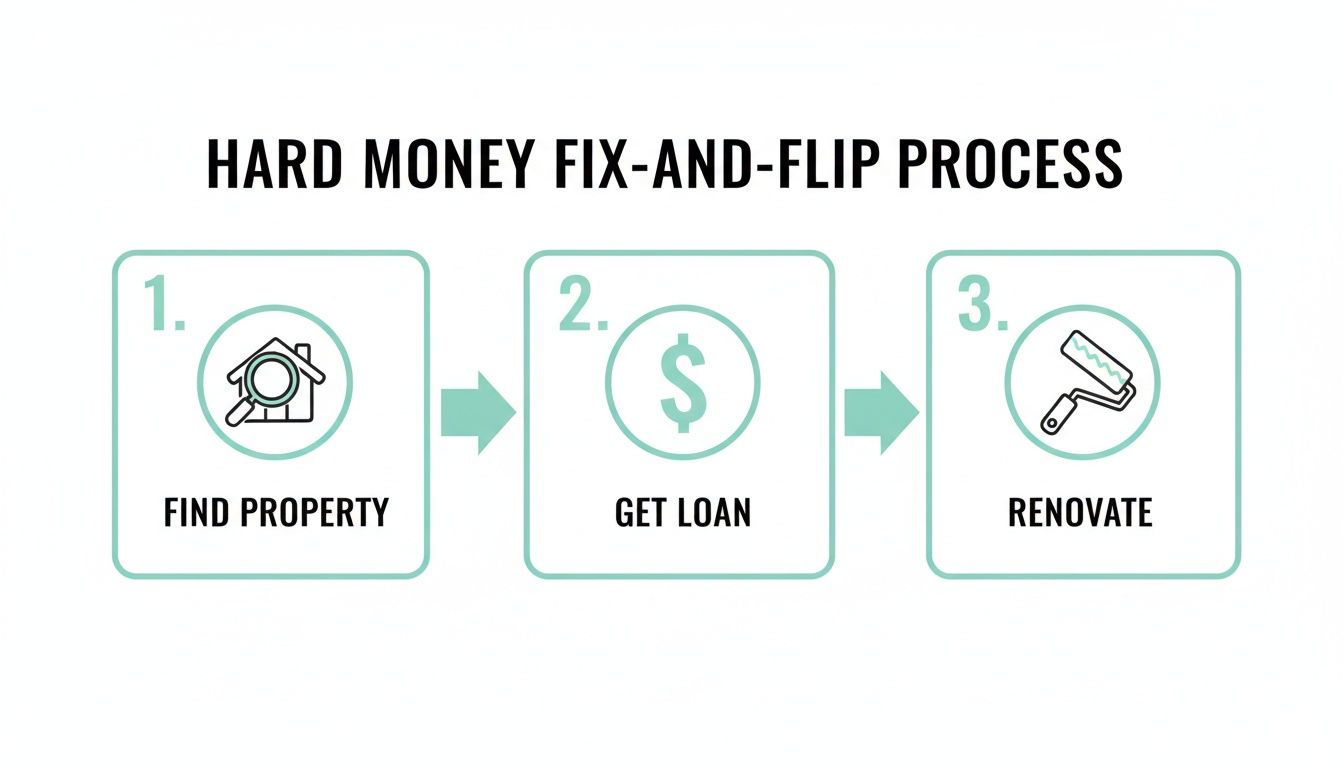
This loan acts as the critical bridge that connects an undervalued asset to its full market potential. For serious investors, the goal is to build an efficient, repeatable system that moves from one project to the next.
Hard Money Loans vs. Conventional Mortgages For Flips
Your choice of financing can make or break a fix-and-flip project. While conventional loans are ideal for buying a primary residence, they are poorly suited for the fast-paced world of real estate investing.
The key difference is underwriting. Conventional lenders focus on your personal finances—income, debt-to-income ratio, and credit score. Hard money lenders focus on the quality of the asset and its potential profit.
This table highlights why experienced flippers overwhelmingly choose hard money.
| Feature | Hard Money Loan | Conventional Mortgage |
|---|---|---|
| Approval Speed | Typically 7–14 days | Typically 30–60+ days |
| Funding Basis | After-Repair Value (ARV) | Current appraised value & buyer's credit |
| Rehab Funding | Often included in the loan | Rarely covers renovation costs |
| Loan Term | Short-term (6–18 months) | Long-term (15–30 years) |
| Interest Rates | Higher (e.g., 9–15%) | Lower (e.g., 6–8%) |
| Property Condition | Can fund distressed properties | Requires property to be habitable |
The comparison is clear: hard money is built for speed and opportunity, while conventional loans are designed for stability and long-term ownership. For an investor flipping houses, the ability to close fast and fund the renovation is essential.
How To Find And Analyze Profitable Flip Deals
The real money in a house flip is made on the purchase, not just during the renovation. A great deal can absorb minor mistakes, but you cannot renovate your way out of overpaying for a property.
This is especially true when using hard money. Since the property itself is the collateral, lenders are laser-focused on its profit potential. Your job is to find a property with such a clear value-add opportunity that a lender is eager to fund it.

That means looking where others don't. While the Multiple Listing Service (MLS) is a starting point, the best deals are often found off-market. Pros build robust networks with wholesalers and actively search for properties that aren't publicly listed.
Strategies For Sourcing Deals
To maintain a consistent deal pipeline, you need to use multiple sourcing strategies.
- Wholesalers: These investors specialize in finding undervalued properties, putting them under contract, and then assigning that contract to a flipper for a fee. A network of reliable wholesalers is invaluable.
- Investor Marketplaces: Modern investors use online platforms to find deals efficiently. On our marketplace, you can create a detailed investor profile and set up a "buy box" to get automatically alerted when a property matching your exact criteria is posted. This is a powerful way to connect with wholesalers and other investors.
- Auctions: Foreclosure and bank-owned (REO) auctions can offer great opportunities, but they require you to act fast, often with limited information. The speed of a hard money loan is a major advantage here.
- Direct Mail & Driving for Dollars: These classic methods still work. Sending targeted letters to owners of distressed properties or driving through neighborhoods to spot neglected homes can lead you to motivated sellers before their property hits the market. Learn more in our guide to finding off-market properties.
Underwriting Your Flip Like A Pro
Finding a potential deal is only the first step. You must then underwrite it—a disciplined process of running the numbers to verify its profitability. This is a non-negotiable skill for any serious investor.
Your analysis boils down to three key numbers:
- After-Repair Value (ARV): What will the house be worth after the renovation? You determine this by analyzing "comps"—comparable, recently sold homes in the immediate area.
- Rehab Costs: This is your detailed, itemized budget for all repairs and upgrades. Always get contractor quotes and add a 15-20% contingency fund for unexpected issues.
- Maximum Allowable Offer (MAO): This is the absolute highest price you can pay for the property while still meeting your profit target.
A common mistake for new investors is getting emotionally attached to a property and overpaying. Your MAO is your firm limit. If the seller's price doesn't work with your numbers, you must be willing to walk away.
Putting It All Together: A Real-World Analysis
Let's calculate the MAO by working backward from the ARV using a common formula for flippers.
The 70% Rule: This guideline suggests you should pay no more than 70% of the ARV, minus your estimated repair costs.
Let's assume your research and contractor bids give you the following numbers:
- ARV: $400,000
- Estimated Rehab Costs: $60,000
Now, apply the formula:
($400,000 ARV * 0.70) - $60,000 Rehab = $220,000 MAO
Based on this, your Maximum Allowable Offer is $220,000.
The remaining 30% (or $120,000 in this example) is not pure profit. It's a buffer that must cover all your other expenses: financing costs, holding costs (taxes, insurance, utilities), and selling costs (realtor commissions, closing fees). What's left after all those deductions is your actual net profit.
Securing The Right Hard Money Loan For Your Project
You've found a deal and run the numbers. Now it's time to secure the hard money loan that brings your project to life.
Choosing a lending partner is as important as choosing the right property. You're not just looking for a check; you're looking for a partner who understands your strategy and can close on your timeline.

It’s easy to focus only on the interest rate, but that’s a rookie mistake. A low-rate lender might have high origination fees, a slow construction draw process, or a prepayment penalty that erodes your profit. The goal is to find a lender who acts as a true partner.
Vetting Your Lending Partner
A good hard money lender will want to see that you've done your homework and have a clear, realistic path to profit. To find the right fit, you need to evaluate them on several key factors:
- Loan Terms: What are the all-in costs? Ask about origination points (upfront fees, typically 1-3% of the loan), the interest rate, and the loan term. Crucially, ask if there are prepayment penalties for selling the house ahead of schedule.
- Draw Schedule: How are rehab funds disbursed? Do they release funds upfront, or only as reimbursement after work is completed? A slow draw process can halt your project.
- Experience & Reputation: Does the lender know your local market? Ask for references from other investors and check their reviews. On a networking platform, you can often see which lenders are active and reviewed by other members.
- Speed and Flexibility: Can they meet your closing deadline? How do they handle unexpected changes to the renovation plan? A rigid lender can turn a minor issue into a major problem.
Building Your Compelling Loan Package
To get approved, you need to present a professional, organized loan application. You're not just asking for money; you're selling the lender on an investment opportunity.
Lenders don't fund investors; they fund deals. While your experience matters, a solid deal with a clear path to profitability is what gets their attention.
A strong loan package should always include these essentials:
- Signed Purchase Agreement: Proof that you have the property under contract.
- Scope of Work (SOW): A detailed, line-item budget for the entire renovation.
- After-Repair Value (ARV) Analysis: Solid comps and data to justify your projected sale price.
- Investor Experience: A simple summary of past projects. If you're new, highlight any relevant construction or project management experience.
- Personal Financials: Basic information showing you have the cash for the down payment and reserves.
Advanced Tactics for Different Experience Levels
- For New Investors: Your primary goal is to complete your first deal successfully and build a track record. Prioritize a reliable, communicative lender over the absolute lowest rate. A good partner on your first flip is invaluable.
- For Experienced Investors: Use your successful track record as leverage. Negotiate for higher LTC to reduce your out-of-pocket cash, lower origination points, or even a line of credit for multiple flips. For more complex projects, you may want to explore specialized products like hard money construction loans.
Managing Your Rehab and Loan Draws Effectively
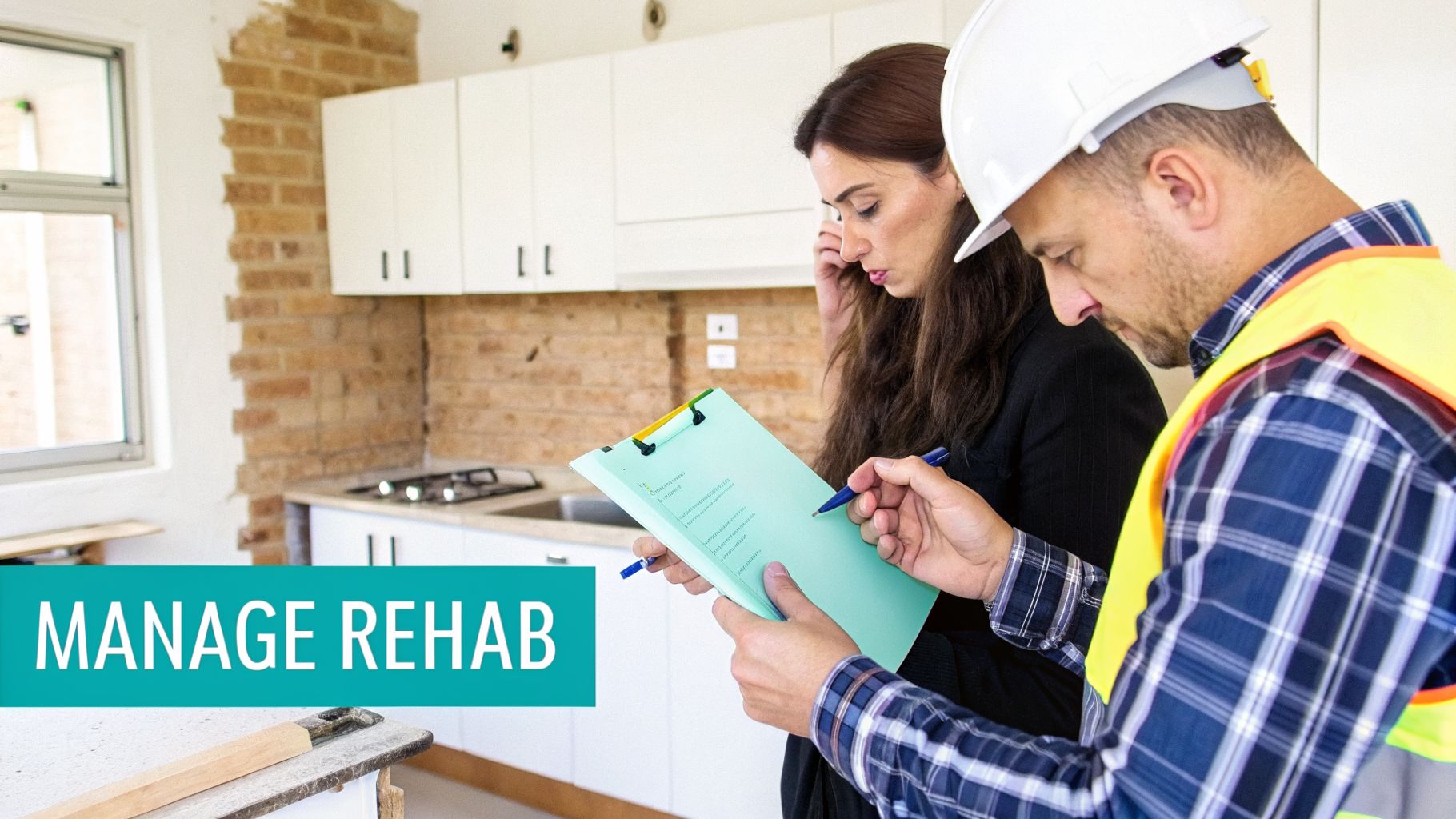
With financing secured, the real work begins. This is where your financial model meets the messy reality of construction. Managing this phase effectively separates profitable flips from money-losing ones.
Every day you own the property, you are paying interest, taxes, and insurance. These holding costs are a constant drain on your profit margin. Staying on schedule and on budget is critical when flipping houses with hard money.
Building Your A-Team of Contractors
You cannot do this alone. The quality of your contractors will make or break your project. A great general contractor (GC) simplifies the process, while a bad one can sink your budget and timeline.
- Vetting Is Non-Negotiable: Always verify licenses and insurance. Ask for at least three recent client references and call them. An investor networking platform can be a great place to find vetted contractors with reviews from other flippers.
- Get Multiple Bids: For any significant job, get at least three detailed bids. This helps you ensure a fair price and spot any outliers.
- Clarity Is Your Best Friend: Your Scope of Work (SOW) must be extremely detailed. If a task isn't in writing, it can lead to disputes and cost overruns.
Understanding the Loan Draw Process
A common rookie mistake is not understanding how rehab funds are disbursed. Lenders don't give you the entire renovation budget at once. It's paid out in stages, or "draws," as you complete specific milestones.
Here’s the typical process:
- You Fund the Work: You pay your contractors to complete a phase of the project (e.g., framing and drywall) using your own capital.
- You Request a Draw: You notify the lender that the work is done and request an inspection.
- The Lender Verifies: An inspector visits the site to confirm the work has been completed according to the SOW.
- You Get Reimbursed: Once the inspection passes, the lender releases the funds for that stage, replenishing your capital.
This cycle repeats until the renovation is complete.
The most important rule to remember is that you must have enough cash on hand to pay for each stage of work before the lender reimburses you. Running out of operating capital between draws is a primary cause of project failure.
A Kitchen Remodel Draw Scenario
Let's walk through a real-world example. Your SOW includes a $20,000 kitchen renovation, broken into two draws.
Draw 1: Demo & Rough-ins ($8,000)
- You pay contractors to demolish the old kitchen and complete the new plumbing and electrical rough-ins.
- You then request your first draw. The inspector verifies the work, and a few days later, the lender wires $8,000 to your account.
Draw 2: Finishes & Appliances ($12,000)
- You use that capital to purchase and install cabinets, countertops, flooring, and appliances.
- With the kitchen finished, you request the final draw. The inspector confirms completion, and the lender releases the final $12,000.
Proactive communication with your lender and GC is key to preventing delays. Failed inspections cost time and money, so ensure everyone is aligned on expectations.
Executing A Profitable Exit And Scaling Your Business
You've managed the renovation and turned a distressed property into a desirable home. Now comes the most important part: the exit. This is where your hard work converts back into cash.
A profitable sale does more than pay off your hard money loan; it's the proof of concept that builds your track record. This credibility is essential for securing future loans and scaling your operations.
Staging And Marketing Your Flip
To achieve a top-dollar sale price, your property must be presented perfectly. Professional staging and high-quality photography are essential marketing tools that directly impact your final profit.
- Professional Photography: Most buyers begin their search online. Dark, blurry phone pictures can kill a listing's potential. Invest in a real estate photographer who can make the home feel bright, spacious, and inviting.
- Strategic Staging: An empty house often feels cold and smaller than it is. Staging helps buyers emotionally connect with the space and visualize themselves living there. Focus on key areas like the living room, kitchen, and primary bedroom.
- A Compelling Listing: Work with your real estate agent to craft a description that tells a story. Highlight the benefits of the upgrades, such as the new quartz countertops, energy-efficient windows, or the spa-like primary bathroom.
Pricing Strategy And Final Profit Calculation
Pricing is a strategic decision. Your agent will analyze fresh comps to recommend a list price. You must then decide whether to price aggressively for a quick sale (to reduce holding costs) or aim for the top of the market and wait for the right offer.
Once you accept an offer, it’s time to calculate your true net profit. This requires accounting for every single dollar spent.
A common mistake is only subtracting the purchase price and rehab budget from the sale price. Your true net profit is what remains after all costs—including financing, holding, and selling expenses—have been deducted.
Here is what a detailed profit calculation looks like:
| Item | Amount |
|---|---|
| Sale Price | $450,000 |
| Less: Selling Costs | |
| Real Estate Commissions (6%) | -$27,000 |
| Seller Concessions | -$5,000 |
| Closing Costs (title, etc.) | -$4,000 |
| Less: Project Costs | |
| Original Purchase Price | -$280,000 |
| Rehab & Materials | -$65,000 |
| Less: Financing & Holding Costs | |
| Hard Money Loan Interest | -$12,000 |
| Loan Points & Fees | -$6,000 |
| Insurance & Utilities (6 mos) | -$3,000 |
| Property Taxes (6 mos) | -$2,500 |
| Net Profit (Before Taxes) | $45,500 |
This level of detail is crucial for understanding your true return on investment and for demonstrating your expertise to future lenders and partners.
Scaling From A Single Flip To A Business
A successful exit is a building block. Each profitable flip strengthens your reputation and makes you a more attractive borrower, which is your ticket to scaling. You can check out more about lending trends on gbfsinternational.com.
Once you have a few wins, you can think bigger. Some investors start tackling multiple projects simultaneously. Others choose to keep a renovated property as a rental, using the BRRRR (Buy, Rehab, Rent, Refinance, Repeat) method to pull their capital out for the next deal. If that's your goal, our guide on how to refinance a rental property can help you plan your next steps.
Building a repeatable system for finding, funding, rehabbing, and exiting deals is what transforms house flipping from a hobby into a scalable business.
Common Questions About Hard Money Flipping
Even with a solid plan, questions are inevitable in the fast-paced world of house flipping. Here are direct answers to the most common questions from investors.
Can I Get A Hard Money Loan With Bad Credit?
Yes, in many cases. Hard money lenders are primarily "asset-based," meaning the quality of the deal is more important than your personal credit score.
They are underwriting the property's After-Repair Value (ARV), not just you. If you bring them a great deal with strong profit potential, a lower credit score is often not a deal-breaker. However, it might result in a slightly higher interest rate or a larger down payment requirement.
How Much Money Do I Need to Flip With A Hard Money Loan?
You cannot flip a house with zero money down using this strategy. You will need your own capital, or "skin in the game," to cover several key costs.
Plan to pay for the following out of pocket:
- Down Payment: Typically 10-20% of the total project cost (purchase price plus rehab budget).
- Origination Points: Upfront lender fees, usually 1-3% of the total loan amount.
- Closing Costs: Standard fees for title, escrow, and legal paperwork.
- Reserves: A crucial cash safety net for holding costs (taxes, insurance) and unexpected renovation overages.
The number one reason new flippers fail is undercapitalization. Having enough cash to cover your down payment, fees, and at least six months of holding costs is the safety net that separates amateurs from professionals.
What Are The Biggest Risks of Using Hard Money?
The primary risks are tied to cost and time. Hard money is an expensive tool designed for short-term use. If your project faces significant delays, these costs can quickly erode your profits.
The two biggest risks to manage are:
- Holding Costs: The clock is always ticking. You are paying high interest on the loan, plus taxes, insurance, and utilities every single day. A rehab that takes a month longer than planned or a house that sits on the market can turn a profitable deal into a loss.
- Loan Maturity: These loans have short terms, typically 6 to 18 months. If you don't sell the property before the loan is due, you could face expensive extension fees or even foreclosure. A realistic timeline and a solid exit plan are non-negotiable.
How Does An Investor Platform Help Me Find Hard Money Deals?
An investor-focused marketplace acts as a powerful shortcut for finding and analyzing deals that are a good fit for flipping houses with hard money.
On our platform, you can set up a “Smart Buy Box” that automatically filters properties based on your exact investment criteria, such as purchase price, required value-add potential, or target neighborhoods. This means the platform does the tedious work for you. Integrated tools also let you model a hard money loan on the spot, plugging in your terms and budget to see a deal's potential ROI in seconds, allowing you to vet opportunities with incredible speed and credibility.
Create your free investor profile to get matched with deals that fit your criteria.