If you're watching your property values climb, you're looking at an opportunity to turn that paper equity into real, usable capital for your next deal. A smart refinance can unlock that value or give your monthly cash flow a serious boost, making it a fundamental tool for scaling your real estate portfolio.
To refinance a rental property is to swap your current mortgage for a new one. The goal is almost always to get better terms, such as a lower interest rate, or a bigger loan that lets you pull out some of that hard-earned equity. Understanding how to use this tool effectively is key for both new and experienced investors.
When and Why You Should Refinance Your Rental Property

Deciding to refinance an investment property should be a calculated, strategic move—not just a reaction to a headline about interest rates. For both new and seasoned investors, the "why" behind this decision will shape the entire process. Getting the timing right and having a clear goal is what separates a profitable refinance from a costly headache.
Key Triggers for a Refinance
Several common scenarios should put the idea of refinancing on your radar. Recognizing these triggers in your own portfolio is the first step.
- A Major Drop in Interest Rates: This is the most obvious trigger. If market rates have dropped since you got your original loan, a simple rate-and-term refinance can lower your monthly mortgage payment and instantly improve your net cash flow.
- Significant Property Value Appreciation: A hot market can increase your property's value, creating a deep well of untapped equity. This is the perfect setup for a cash-out refinance to fund your next acquisition.
- Executing the BRRRR Strategy: The final, crucial "R" in the BRRRR (Buy, Rehab, Rent, Refinance, Repeat) method hinges on a successful refinance. Once you've fixed up a property and stabilized it with a tenant, you refinance to pull your initial investment back out, ready for the next project.
- Adjusting Your Loan Term: Your goals may shift over time. Refinancing from a 30-year to a 15-year mortgage builds equity much faster, though it usually means a higher monthly payment. Conversely, switching from a 15-year to a 30-year can lower your payment and increase cash flow.
Aligning Refinancing with Your Investment Goals
Any decision to refinance must tie back directly to your bigger-picture strategy. Are you in an aggressive growth phase, or are you focused on maximizing the cash flow from the assets you already own?
For investors in growth mode, a cash-out refinance is a powerhouse. It lets you leverage the equity from one stabilized property to fund the down payment on another. You're literally using one property to buy the next one.
For experienced investors, it might be time for a portfolio-level review to consolidate loans or eliminate older mortgages with uncompetitive terms. The end goal is always the same: make sure every single asset in your portfolio is working as hard and efficiently as possible.
Ultimately, a successful refinance is about making your capital work harder for you. It can unlock growth, improve profitability, and give you the financial flexibility needed to navigate the real estate market.
First Things First: Figure Out Your Refinance Goals
Before you call a lender, you need to get crystal clear on why you're doing this. A refinance without a specific goal is like driving with no destination—you’ll burn through time and cash and might end up in a worse position.
When you refinance a rental property, your strategy will fall into one of three main buckets. Each is designed to solve a different problem or unlock a specific opportunity. Your "why" is the foundation for everything that comes next, from the loan you pick to the lender you work with.
The Rate-and-Term Refi: A Play for Better Cash Flow
This is the most straightforward move. A rate-and-term refinance is exactly what it sounds like: you replace your current loan with a new one to get a lower interest rate, a different loan term, or both. The goal is simple: lower your monthly mortgage payment.
This is the perfect strategy for investors focused on stability and boosting the monthly income from a property they already own. If interest rates have dropped or your credit score has improved, you're likely a great candidate. You’re not trying to pull cash out; you’re just making your asset work harder for you.
- Real-world example: Let's say you have a $200,000 loan with a 6.5% interest rate. Your principal and interest payment is $1,264 a month. If you can refi into a new loan at 5.5%, your payment drops to $1,136. Just like that, you’ve added an extra $128 per month—or $1,536 per year—to your cash flow.
The Cash-Out Refi: Fuel for Your Growth Engine
For investors ready to expand, the cash-out refinance is an absolute game-changer. With this strategy, you take out a new, larger loan and pocket the difference between the new loan amount and what you still owe. You're tapping into the equity you've built up and turning it into capital for your next move.
This is the engine that powers scaling strategies like the popular BRRRR method. Smart investors use this cash for a down payment on another property, to fund a major renovation, or to pay off high-interest debt. Keep in mind that on an investment property, lenders will usually cap a cash-out refi at a 70-75% loan-to-value (LTV) ratio.
- Quick example: Your rental is now worth $400,000, and your mortgage balance is $180,000. A lender agrees to a cash-out refi at 75% LTV, giving you a new loan for $300,000. After paying off the original $180,000 loan, you walk away with $120,000 in cash, ready to deploy.
A word of caution: A cash-out refi will increase your loan balance and your monthly payment. The math only works if the return you generate with that new cash is much higher than the increased cost of your debt.
Portfolio Optimization: The Pro-Level Move
For seasoned investors with multiple properties, refinancing becomes a tool for portfolio optimization. You stop looking at each property as an island and start thinking about your entire collection of assets as a single system. This advanced strategy can simplify operations and strengthen your overall financial footing.
Here’s what you might be trying to achieve:
- Consolidating multiple loans: Juggling several properties with different lenders and payment dates can be a headache. A portfolio lender might offer a single "blanket loan" that covers all of them, giving you one payment and one point of contact.
- Unlocking trapped equity: You might have one property with a ton of equity sitting idle while another is highly leveraged. A strategic refinance can help you rebalance by pulling cash from one property to pay down debt on another.
- Getting better terms: Approaching a lender with a whole portfolio of performing assets gives you more leverage than with a single property. This can open the door to better rates, lower fees, and more flexible loan terms.
This approach requires a big-picture view and a good relationship with a lender who understands real estate investing. On our platform, you can connect with specialized lenders who are actively looking to partner with investors who are scaling up.
Getting Lenders On Board and Picking the Right Loan
When you decide to refinance a rental property, you’re playing a different game than when you bought your own home. Lenders see investment properties as a business deal, and their underwriting process is more intense and focused squarely on the numbers.
Getting a handle on what lenders want is the secret to a smooth approval. It lets you build a rock-solid application and pitch your deal in the best possible light. Nail this part, and you’ll get the kind of favorable terms that actually improve your portfolio.
What Underwriters Really Look For
Lenders care about two things: your ability to pay them back and the property's ability to generate enough cash to cover its own bills. They measure this risk with a mix of personal and property-level metrics.
Your Personal Financial Health: Even if your property is in an LLC, expect the lender to require a personal guarantee.
- Credit Score: Most lenders want to see a credit score of 680 or higher for investment properties. A score above 740 will usually unlock the best interest rates.
- Cash Reserves: Lenders need to know you can handle a vacancy. Be ready to show liquid assets to cover 6-12 months of PITI (Principal, Interest, Taxes, and Insurance) payments.
- Debt-to-Income (DTI) Ratio: This is your total monthly debt payments divided by your gross monthly income. A DTI below 43% is a common target for conventional loans.
The Property's Financial Performance: This is where investor financing differs most from residential lending.
- Debt Service Coverage Ratio (DSCR): For many investor loans, this is the single most important number. DSCR is calculated by dividing the property's Net Operating Income (NOI) by its total annual debt payments. A DSCR of 1.0 means the income exactly covers the debt. Lenders want a cushion, typically requiring a DSCR of 1.20 or higher.
Quick example: If your property's annual NOI is $12,000 and the new annual mortgage payment would be $9,600, your DSCR is 1.25 ($12,000 / $9,600). This tells the lender the property generates 25% more income than needed to cover the debt—a healthy margin they love to see.
Choosing the Right Loan Product for Your Strategy
Not all loans are built the same, especially in the investor space. The best choice hinges on your experience, the property type, and your goals. Picking the wrong loan can lead to a denial or, worse, bad terms that kill your cash flow.
The lending environment is always in flux. For example, recent refinancing trends and their impact on CorecastRE.com show how changing interest rates and property type performance can swing your financing options.
With that in mind, let's look at the most common loan options you'll encounter.
Comparing Common Investor Loan Types
Choosing the right loan is about matching the product to your specific deal and financial situation. A conventional loan might be perfect for one property, while a portfolio loan is the only thing that makes sense for another. This table breaks down the key differences.
| Loan Type | Best For | Typical LTV | Key Underwriting Focus |
|---|---|---|---|
| Conventional | Investors with 1-10 financed properties and strong personal financials. | Up to 75% | Borrower's Credit, DTI, and Personal Income. |
| Portfolio Loan | Experienced investors with 10+ properties or complex financial situations. | 70-80% | Property's DSCR and the borrower's overall portfolio health. |
| Commercial Loan | Properties with 5+ units (multifamily) or commercial-use buildings. | 65-75% | Almost entirely on the property's Net Operating Income (NOI). |
Each of these loan types serves a different purpose in an investor's toolkit.
Conventional Loans: These are standard Fannie Mae and Freddie Mac loans. They’re often the best deal for investors holding one to ten financed properties, offering great rates and terms. The trade-off is their strict DTI and credit score requirements.
Portfolio Loans: Offered by local banks and credit unions, these loans are kept "in-house." This gives them more flexibility, making them a great fit for seasoned investors or those who've maxed out their conventional loan limit. The underwriting here leans heavily on the property's DSCR.
Commercial Loans: Once you get into properties with five or more units, you're in the commercial lending world. These loans are underwritten almost entirely based on the property's financial performance. Terms are often shorter (e.g., 5-10 year balloons) with interest rates tied to commercial indexes.
For a deeper look, check out our guide on the complete spectrum of real estate financing options for investors. Remember, matching the right loan to your deal is just as crucial as finding the deal itself.
Navigating the Investor Refinance Process From Application to Closing
Once you’ve settled on your goals and picked the right loan, it’s time to get it done. The process to refinance a rental property is different than a typical homeowner's loan application. Lenders will put your documentation under a microscope, so being organized from day one is critical.
Think of this less like a chore and more like presenting a business case for your property. A clean, well-documented application tells an underwriter you’re a serious, organized investor—exactly the kind they want to lend to.
Assembling Your Application Package
Lenders will ask for a ton of documents covering your personal finances and the property's performance. Having these ready to go before you apply will speed things up dramatically.
Here’s a checklist of what you'll likely need:
- Personal Financials: W-2s, recent pay stubs, and at least two years of personal tax returns. They’ll also want to see bank statements and records for brokerage or retirement accounts to verify cash reserves.
- Property-Specific Documents: This is where investor loans differ. You'll need a copy of the current lease agreement to prove rental income, a detailed rent roll (if it's a multi-unit), and proof of property insurance.
- Entity Documents (if applicable): If you hold the property in an LLC, you'll need to submit your operating agreement, articles of organization, and any relevant business tax returns.
On our marketplace, investors can keep these core documents organized within their profiles. When it's time to apply, they can share a professional package with a lender, saving time and avoiding that last-minute scramble.
The Appraisal: A Critical Hurdle
For an investment property refinance, the appraisal is arguably the most critical step. Unlike a primary residence appraisal that focuses mostly on comparable sales, a rental property appraisal weighs the property's income-generating potential very heavily.
The appraiser will analyze your current lease and compare your rent to market rates in the area. A long-term tenant paying at or above market rent is a huge asset.
Pro Tip: Don't just tidy up the property before the appraiser arrives. Give them a detailed list of every capital improvement you've made, including dates, costs, and permits. This documentation can directly boost the final appraised value and unlock more equity for your refinance.
A lower-than-expected appraisal can derail your refinance, especially a cash-out, by slashing the maximum loan amount you're eligible for.
This visual shows a simplified flow of what lenders are really looking at: your personal financial strength, the property's health, and the loan's structure.
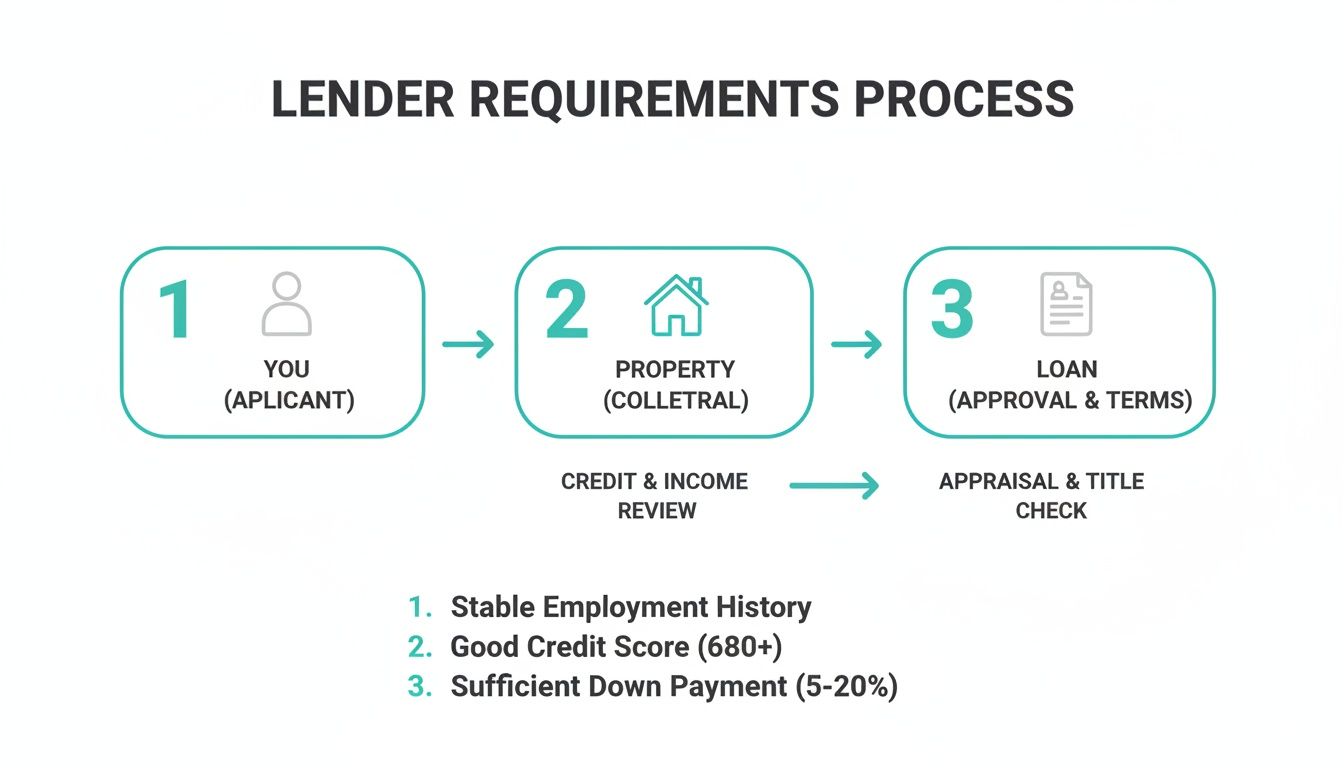
Each piece of the puzzle must be solid for the deal to move forward smoothly, which shows how important thorough preparation is before you ever hit "submit."
From Underwriting to the Closing Table
Once your application and appraisal are in, your file heads to underwriting. An underwriter is the final decision-maker who verifies every piece of information. They will re-check your credit, confirm your income and assets, and ensure the property's numbers meet their lending guidelines.
During this stage, be ready for follow-up questions. Responding quickly and thoroughly is key to keeping the process moving. Market conditions also play a huge role here, as seen in recent mortgage market trends from Milliman's research.
After the underwriter gives final approval, you’ll get a "clear to close." You will be sent a Closing Disclosure at least three business days before your scheduled closing. Review this document carefully to ensure the final loan terms, interest rate, and closing costs match what you were quoted. The last step is signing the loan documents, after which your new loan is funded and your old one is paid off.
Running the Numbers on Your Refinance Deal

A refinance might look fantastic on paper, but a good deal is proven by the numbers. Before you sign on the dotted line, you need to run a detailed analysis to confirm the new loan actually improves your financial position.
This isn't just about snagging a lower interest rate. It’s about digging into the total cost and the real, long-term impact on your investment's bottom line. The first—and most critical—calculation is your break-even point. Refinancing isn't free; you're going to pay closing costs, typically between 2% to 5% of the new loan amount. The break-even point tells you exactly how many months it will take for your monthly savings to pay back those upfront costs.
Calculating Your Break-Even Point
To find this number, you divide your total closing costs by the monthly savings from the new loan. It’s a simple formula that tells you how long it’ll take to recoup your investment.
Here’s a simple, real-world example:
- Total Closing Costs: $4,000
- Old Monthly P&I Payment: $1,400
- New Monthly P&I Payment: $1,200
- Monthly Savings: $200
Calculation: $4,000 (Closing Costs) / $200 (Monthly Savings) = 20 months
In this scenario, it would take 20 months to break even. If you plan to sell the property within a year, this refinance would cost you money. But if you're a long-term buy-and-hold investor, everything after that 20-month mark is pure profit. You can find some great tools to help with these calculations in our dedicated section of real estate investment calculators.
Analyzing the Impact on Key Investor Metrics
Beyond breaking even, a refinance shakes up the core metrics that define your property's performance. Smart investors always model how a new loan will ripple through their cash flow and returns.
Impact on Monthly Cash Flow This is the most immediate change. With a rate-and-term refinance, the goal is a straightforward increase in your monthly cash flow. For a cash-out refinance, your payment will almost certainly go up, shrinking your monthly cash flow. The key is making sure the return you get from deploying that pulled-out cash far outweighs the hit to your monthly income.
Impact on Cash-on-Cash Return Your Cash-on-Cash (CoC) return measures the annual cash flow you get back relative to the total cash you have invested in the deal. A refinance affects both sides of this equation.
A great rate-and-term refi boosts your numerator (cash flow), which juices your CoC return on the same amount of invested cash. A cash-out refi, on the other hand, can actually reduce your total cash invested to zero—or even make it negative—giving you an infinite return. This is the goal of the BRRRR strategy.
Running these numbers is non-negotiable. It’s what turns a hopeful idea into a data-backed business decision, ensuring your move to refinance a rental property is a genuine step toward greater profitability.
Finding Your Next Refinance-Ready Investment
A smart plan to refinance a rental property doesn’t start when you call a lender; it starts the day you buy the asset. The best refinance opportunities are built on a foundation of smart deal sourcing.
When you buy a property with strong fundamentals—good cash flow, solid rental demand, and obvious value-add potential—it's more attractive to an underwriter and gives you strategic flexibility down the road. This shifts your mindset from finding a deal to finding a refinance-ready deal.
Define Your Smart Buy Box
To find these kinds of properties, you need a precise acquisition strategy. On an investor marketplace, you can set up a "buy box" to filter out the noise and surface only the deals that fit your long-term plan. This goes beyond just setting a price and location.
- Targeted ROI Metrics: Filter for properties that already meet or beat your target Cash-on-Cash Return or Cap Rate goals.
- Value-Add Indicators: Look for listings that mention below-market rents or the need for cosmetic updates. These are clear signals of an opportunity to force appreciation.
- Zoning and Development Potential: For experienced investors, filtering by zoning can uncover properties primed for expansion or an ADU, creating a massive equity pop.
By setting these parameters upfront, the platform does the heavy lifting, automatically bringing you deals that are not just profitable today but are practically engineered for a strategic refinance tomorrow. This transforms your deal flow from a random stream of opportunities into a curated pipeline.
This disciplined approach to buying is a core principle among successful investors. To learn more about building these crucial connections, check out our insights on the power of a dedicated real estate investor network.
Ready to get started? Create your free investor profile on our platform to begin defining your criteria and find your next refinance-ready investment today.
Your Top Refinancing Questions, Answered
When you're thinking about refinancing a rental, a handful of questions always come up. Here are some straight answers based on what lenders and seasoned investors see every day.
How Long Do I Have to Own a Rental Before I Can Refinance?
Most conventional lenders have a “seasoning period,” which is typically six months. They want to see that you’ve held the property long enough for its value to stabilize.
If you’re aiming for a cash-out refinance, that waiting period often stretches to 12 months. However, portfolio lenders or local banks you have a relationship with can be more flexible, especially if you have a solid track record.
What’s a Good Debt Service Coverage Ratio for a Refinance?
Lenders rely heavily on the Debt Service Coverage Ratio (DSCR). It’s their quick check to see if your property’s income can handle its debt payments. A DSCR of 1.0 is the break-even point.
Break-even isn't good enough for a bank. Most lenders want to see a DSCR of at least 1.20 to 1.25. This shows them the property is bringing in 20-25% more cash than it needs to cover its debts. A stronger DSCR doesn't just get you approved; it often unlocks better loan terms.
Can I Refinance a Rental Property Titled to my LLC?
Absolutely. Refinancing a property held in an LLC is a standard practice for investors seeking liability protection. The process just looks a little different.
You'll almost certainly be getting a commercial or portfolio loan, not a conventional residential one. Lenders will also require a personal guarantee from the LLC members, which means you’re personally on the hook for the debt if the LLC can't pay. Be ready to provide both your LLC's operating agreement and your personal financial statements.
A smart decision to refinance a rental property can accelerate your portfolio's growth and boost your profitability. By understanding your goals, preparing your financials, and choosing the right loan, you can make your assets work harder for you. Create your free investor profile to get matched with deals that fit your criteria.