
Hard money construction loans are a specialized financing tool for real estate investors who need to move faster than traditional banks allow. They are short-term, asset-based loans designed for projects where speed is your biggest advantage. Unlike a conventional lender focused on your personal credit, a hard money lender cares most about the property's potential value after you’re done with it, often called the After-Repair Value (ARV).
This guide breaks down exactly how these loans work, when to use them, and how to secure one for your next deal.
What Are Hard Money Construction Loans?
Think of a traditional mortgage as a marathon runner—it's slow, steady, and digs deep into your long-term financial endurance. A hard money construction loan, on the other hand, is a sprinter. It’s built for one thing: getting you the cash to acquire and build a project quickly.
That speed comes from a different approach to risk. Private money lenders don't spend weeks analyzing your tax returns and pay stubs. Instead, they focus on the asset itself, underwriting the loan based on the project's viability and what it will be worth when completed.
Understanding the Core Concepts
Whether you're new to real estate or have dozens of deals under your belt, there are a few key terms you must know to speak the same language as lenders.
- After-Repair Value (ARV): This is the estimated value of your property after all renovations or construction are finished. Lenders see the ARV as their main security because it represents the asset's future potential.
- Loan-to-Value (LTV): This metric compares the loan amount to the property's current value, as-is. For an acquisition, a lender might offer 65-75% LTV, meaning you'll need to bring cash for the remaining purchase price.
- Loan-to-Cost (LTC): For construction deals, LTC is often more important. It measures the loan amount against the total project cost (purchase price plus renovation budget). Lenders fund a percentage of this, requiring you to have "skin in the game."
When to Use This Type of Financing
Hard money construction loans are not a one-size-fits-all solution. They are specialized tools for specific jobs where their advantages—speed and flexibility—outweigh their higher cost.
Pro Tip: A hard money loan makes sense when the opportunity cost of waiting for a bank is higher than the borrowing cost. If a two-month delay means losing a great deal, the extra points you pay for speed are a smart business decision.
Investors typically use this tool for situations like:
- Fix-and-Flips: Buying a distressed property, renovating it quickly, and reselling it for a profit, usually within a 6-12 month window.
- Ground-Up Construction: Building from scratch on vacant land and needing capital for both the lot and the build-out.
- Major Renovations: The project is too large or complex for a conventional renovation loan.
Hard money bridges the gap when traditional lenders can't move at the speed of the deal. By focusing on the asset's potential, these lenders empower investors to seize opportunities. Using a platform like Investor Deal Exchange can accelerate this by connecting you with both pre-vetted deals and a network of lenders ready to fund them.
How You Get Your Money: The Draw Process
If you're used to traditional loans where cash lands in your bank account all at once, you're in for a surprise. A hard money construction loan works differently, more like a reimbursement system tied directly to your project’s progress.
The lender doesn't release all the funds upfront. Instead, the money comes in stages based on a pre-approved plan called a draw schedule. This structure protects the lender by ensuring their capital is only used as tangible value is added to the property. It also keeps you, the investor, on track.
This means you’ll need enough cash on hand to start the first phase of work. Once you hit an agreed-upon milestone—like pouring the foundation—an inspector verifies the work. After approval, the lender releases the next "draw" of funds to pay for that completed stage and start the next.
The Draw Schedule in Action
Let’s say you're doing a gut renovation with a total rehab budget of $80,000. The lender won't just write you a check. Instead, you'll agree to a draw schedule that might look like this:
- Draw 1: Demolition and Rough-ins ($20,000)
You pay your contractor to tear out the old space, move plumbing, and run new electrical. After an inspector signs off, the lender releases the first $20,000. - Draw 2: Drywall and Flooring ($20,000)
Your crew hangs drywall, lays flooring, and applies the first coat of paint. Once this milestone is inspected, you get your second draw. - Draw 3: Cabinetry and Countertops ($25,000)
The cabinets and countertops are installed. The lender verifies the progress and releases the third draw. - Draw 4: Appliances and Final Finishes ($15,000)
Appliances are installed and final touches are complete. After a final inspection confirms the project is 100% finished, you receive the last of your construction funds.
This milestone-based system keeps everyone accountable. The lender isn't on the hook for a half-finished project, and you're motivated to keep the job moving.
Understanding Interest and Key Metrics
Here’s a critical detail: many hard money loans charge interest on the entire committed loan amount from day one, not just on the funds you’ve drawn. This can significantly impact your holding costs, so you must build it into your budget.
Beyond the draw schedule, lenders use two key metrics to structure your deal:
- Loan-to-Cost (LTC): The total loan amount divided by the total project cost. A lender might offer up to 85% LTC, meaning you must bring the other 15%. This is your "skin in the game."
- Loan-to-Value (LTV): This compares the loan amount to the property’s ARV. Lenders typically cap this at 70-75% to ensure there's a comfortable equity cushion in the finished project.
A lender will almost always approve a loan amount that fits within both their max LTC and LTV requirements, giving you whichever number is lower. To understand how these and other financing methods compare, explore our complete guide to real estate financing options.
Hard Money vs. Conventional Bank Loans
It helps to put hard money and conventional bank loans side-by-side to see their different purposes.
| Feature | Hard Money Construction Loan | Conventional Bank Loan |
|---|---|---|
| Approval Basis | Asset-based (focused on the ARV of the property) | Borrower-based (focused on your credit, income, and DTI) |
| Funding Speed | Extremely fast (often 7-14 days) | Slow (45-90+ days) |
| Loan Term | Short-term (6-24 months) | Long-term (15-30 years) |
| Interest Rates | Higher (10-15% is common) | Lower (tied to market-driven prime rates) |
| Down Payment | Requires significant skin in the game (15-25% of total cost) | Lower down payment options often available |
| Flexibility | High; structured around the specific project | Low; rigid underwriting criteria |
A hard money loan is a specialized tool for investors who need speed and flexibility to seize an opportunity. A conventional loan is built for stability and long-term ownership.
The Step-by-Step Path to Securing Your Loan
Getting a hard money construction loan is a straightforward process focused on the strength of the deal itself. Your job is to present a project plan that’s clear, professional, and profitable. A well-prepared loan application isn't just paperwork—it’s your business plan.
Preparing a Compelling Deal Package
Your first step is to build a loan package that answers every question a lender might have. A sloppy submission is a massive red flag. A professional package builds instant credibility.
Your deal package needs these key components:
- Detailed Scope of Work (SOW): Your project bible, outlining every task from demolition to final paint.
- Comprehensive Budget: A line-item budget that mirrors your SOW, including materials, labor, permits, and a contingency fund of 10-15% for surprises.
- Contractor Bids: Provide bids from licensed and insured contractors to back up your budget numbers.
- Project Timeline: A realistic schedule with key milestones that helps structure the draw schedule.
Navigating the Underwriting and Approval Phase
Once your package is submitted, the lender starts underwriting. Their main goal is to verify the After-Repair Value (ARV), which is the cornerstone of their risk assessment.
The lender will order an independent, third-party appraisal to confirm your projected ARV. They’ll also scrutinize your budget and SOW for feasibility. An experienced lender can spot an unrealistic budget, so accuracy is critical.
For Beginners: Using online tools to run preliminary numbers shows you're a serious operator who understands the metrics that matter.
For Experienced Investors: Presenting a deal package with a pre-vetted pro-forma generated on an investor marketplace demonstrates efficiency and respect for the lender's time.
On our platform, this stage is easier. You can use a suite of real estate investment calculators to ensure your numbers are rock-solid before a lender ever sees them.
Closing the Loan and Managing Draws
After approval, it’s time to close. This is similar to a traditional closing where you sign loan documents and the lender funds the property purchase. The construction money, however, is held in an escrow account.
From here, you’ll manage the project based on the agreed-upon draw schedule.
This infographic breaks down a typical three-stage draw process.
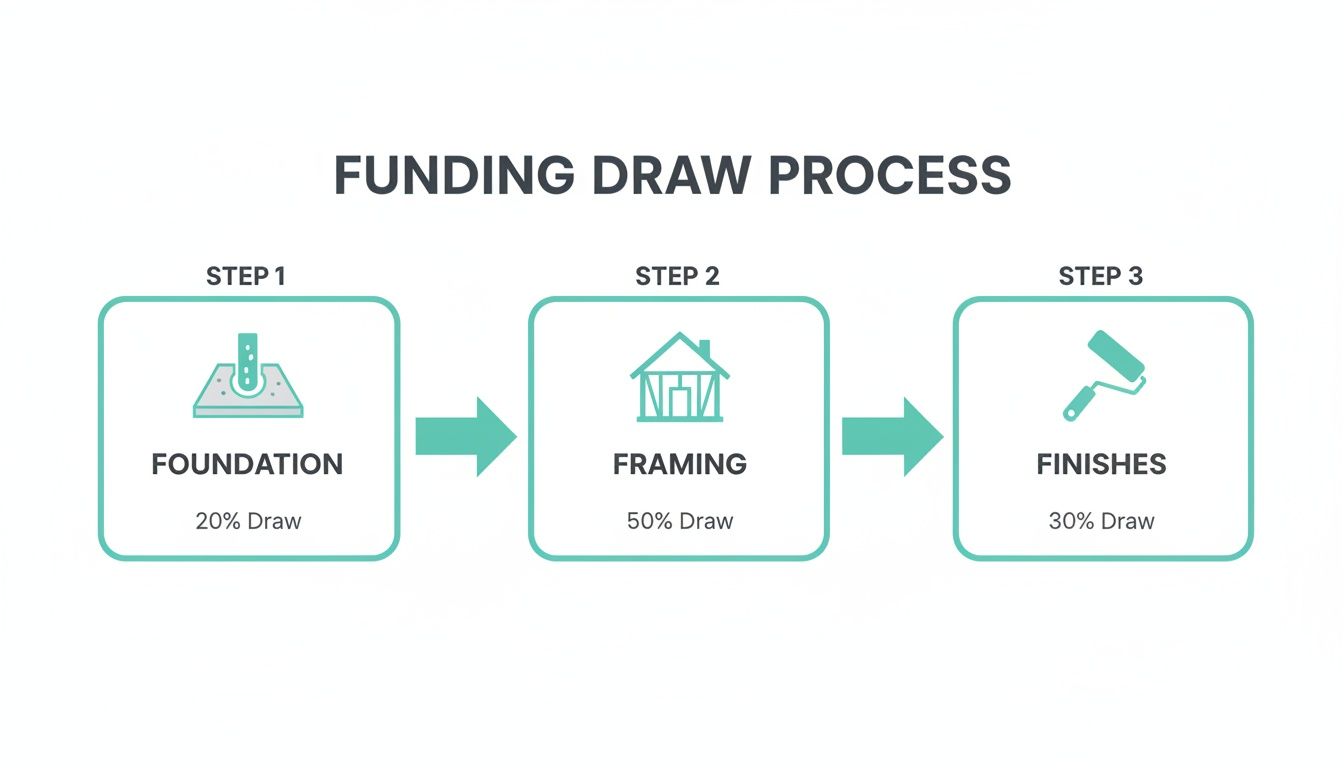
This system manages risk for the lender by releasing funds only after work is complete. Clear communication and diligent project management are essential to ensure each draw is released smoothly without costly delays.
Weighing the Rewards Against the Risks

Smart investing comes down to understanding trade-offs. Hard money construction loans offer incredible advantages but operate with a smaller safety net than conventional financing.
The main reward is opportunity. The ability to close in days, not months, is a massive competitive advantage, allowing you to lock down deals that slower investors miss. Flexible underwriting also opens doors to distressed properties or unique projects that traditional lenders would reject. But these benefits come with significant risks.
Understanding the Key Risks
The most obvious risk is the cost. With interest rates often in the 10-15% range plus origination points, holding costs can quickly eat into profits. Every day of delay means more expensive interest payments.
This is magnified by short repayment terms, typically 6-24 months. This creates a hard deadline to complete construction and execute your exit strategy, whether selling or refinancing.
Perhaps the biggest risk is construction itself. Unforeseen issues like foundation problems, permit delays, or a bad contractor can derail your timeline and budget. The high-risk nature of these loans became clear during the Great Recession when noncurrent rates on construction loans soared. You can see the historical data and risks of ADC loans from the FDIC.
Actionable Risk Mitigation Strategies
Successful investors don't avoid risk—they manage it. By building in safeguards, you can protect your project and capital.
The goal isn't to eliminate every problem but to have a plan for when problems arise. Proactive planning is what separates professional investors from gamblers.
Here are a few non-negotiable strategies:
- Build a Robust Contingency Fund: Always start with a reserve of at least 10-15% of your total construction budget. This is a required buffer for unexpected costs.
- Rigorously Vet Your General Contractor (GC): Your contractor can make or break your project. Check references, review their portfolio, and confirm they are licensed and insured.
- Solidify Your Exit Strategy First: Before you close, have your exit plan locked in. If selling, know your target ARV. If refinancing, speak with a long-term lender to confirm you'll meet their criteria once the project is stabilized.
By weighing the rewards against the risks, you can use hard money construction loans as a powerful tool to build your real estate portfolio.
The Market Context for Hard Money Construction Loans
To understand why hard money construction loans are so powerful today, you have to look at how this corner of finance evolved. What was once a niche option has become a massive, professionalized market, largely shaped by the 2008 financial crisis.
When the crisis hit, traditional banks slammed the brakes on anything considered high-risk, especially construction loans. This created a huge funding vacuum, leaving countless solid real estate projects without financing.
The Rise of Private Capital
Private capital rushed in to fill the void. Hard money lenders, who had mostly operated on the fringes, began to organize and scale. This flood of new money sparked competition, leading to better terms, lower rates, and more professional service for borrowers. Private lending is no longer a "lender of last resort"—it's a strategic financing choice.
The scale of this shift is staggering. The private lending market, which includes hard money construction loans, has ballooned. The U.S. private debt market surged to over $700 billion by the 2020s, more than doubling in the previous decade. You can learn more about the history of private lending on thinkrealty.com.
How This History Shapes Your Strategy Today
This backstory is critical for your investment strategy. The availability and cost of capital are always shifting. When the Federal Reserve hikes interest rates, the cost of hard money loans usually follows.
The chart below shows the delinquency rate on commercial real estate loans for construction and land development, a stark reminder of how quickly market stress can hit this sector.
This data highlights the cyclical nature of construction lending and why private lenders are so focused on asset quality and borrower experience.
An experienced investor doesn't just analyze the deal in front of them; they analyze it within the context of the current capital market. Knowing whether money is "tight" or "loose" informs your negotiation strategy.
Capital isn't spread evenly. Hot real estate markets like Texas and Florida often attract more private lenders, leading to more competitive loan terms. Knowing these regional dynamics can help you find the best financing for your next hard money construction loan.
Finding and Funding Deals Through an Investor Marketplace
Knowing the theory behind hard money construction loans is one thing; putting that knowledge to work is another. The real challenge is finding good projects and packaging them in a way that makes lenders say "yes."
This is where a modern real estate investor marketplace becomes a powerful tool. It helps you cut through the noise and connect with the right deals, lenders, and partners efficiently.
Pinpoint Opportunities with a Smart Buy Box
On our marketplace, you can set up a “Smart Buy Box” to define what a great deal looks like to you. It's like a personal deal-finding assistant. You can specify criteria such as:
- Property Type: Ground-up construction, heavy gut rehab, or fix-and-flip.
- Geographic Area: Specific neighborhoods, cities, or zip codes.
- Financial Metrics: Required ARV, target profit margin, or maximum LTC.
Once set, the platform surfaces deals that match your strategy, saving you time by filtering out projects that aren't a fit for a hard money loan.
Prepare for Financing with Built-In Analytics
Once you find a promising deal, the next step is building a loan package. Lenders need a clear, data-driven pro-forma, and a good marketplace provides the tools to build one.
With integrated calculators for metrics like ROI and cash-on-cash return, you can run preliminary numbers in clicks.
When you approach a lender with a deal analyzed on a platform, you immediately look more professional. It shows your projections are grounded in solid data, not just a gut feeling.
This pre-vetted analysis becomes the backbone of your pitch for a hard money construction loan. The demand for this financing is strong; bridge loans, a core component of hard money, saw a 59% volume surge in 2023. You can see more private lending industry trends on aaplonline.com.
A marketplace does more than show you deals. It gives you the tools to analyze them, prepare your financing pitch, and connect with the right people. Learn more about building these relationships in our guide to creating a powerful real estate investor network.
Common Questions About Hard Money Construction Loans
Even after you get the hang of hard money construction loans, a few questions always pop up. Let's clear up the most common ones.
Can I Get a Hard Money Loan with Bad Credit?
Yes, in many cases. Hard money lenders are focused on the deal itself, not your FICO score. Their security is the property’s ARV. A recent bankruptcy might give them pause, but a strong project with a clear path to profit speaks volumes. The deal's strength is what truly matters.
What's the Difference Between a Hard Money Loan and a Bridge Loan?
People often use these terms interchangeably. "Hard money loan" is the broad category for any short-term, asset-backed loan from a private lender. A "bridge loan" is a specific type of hard money loan designed to "bridge" a temporary financing gap, like buying a new property before selling your old one. Most hard money construction loans are a form of bridge loan—they provide capital until you can sell the project or refinance into a long-term loan.
What Happens If My Project Goes Over Budget or Past Its Deadline?
This is where things can get difficult. If your project runs over budget, that extra cash will likely come out of your own pocket, as lenders rarely increase a loan amount mid-project. If you go past the loan's maturity date, you could face hefty extension fees, penalties, or even default. This is precisely why a contingency fund of 10-20% and a realistic timeline are non-negotiable. Having a solid plan B is a survival tactic.
An investor marketplace helps you find, analyze, and fund your next project with confidence. By setting up your profile, you can connect with deals and partners that perfectly match your strategy for hard money construction loans.
Create your free investor profile to get matched with deals that fit your criteria.