In a competitive real estate market, the best deals are often the ones you never see on public websites. These are off-market properties, assets sold directly between a buyer and seller without ever being listed on the Multiple Listing Service (MLS). This guide provides a step-by-step framework for finding, analyzing, and closing these exclusive deals, giving you an edge over other investors.
Understanding the Value of Off-Market Properties

When a property is listed "on-market," it’s advertised publicly on platforms like Zillow and Realtor.com. This exposure often creates bidding wars, inflated prices, and tight deadlines. Off-market properties operate in a private arena. They are for sale but not publicly advertised, creating an exclusive marketplace for investors who know where to look.
Sellers choose this path for many reasons, including privacy, avoiding the hassle of showings, or dealing with a difficult situation like foreclosure or an inherited property they need to sell quickly. For an investor, this scenario is ideal. It shifts the dynamic from a competitive auction to a one-on-one negotiation focused on solving the seller's problem.
The Core Advantages for Investors
Sourcing deals outside the public market is a strategic way to build a more profitable portfolio. The benefits directly address the biggest challenges investors face in crowded markets.
- Reduced Competition: Since few people know the property is for sale, you aren't competing against dozens of other offers. This is your single biggest advantage and often leads to better purchase prices and terms.
- Direct Negotiation: You're often communicating directly with the property owner. This allows you to understand their true motivation and craft a deal that solves their specific problem—which isn't always about the highest price.
- Access to Exclusive Inventory: Many of the best investment opportunities, especially distressed or value-add properties, are sold before they ever touch the MLS. Building an off-market pipeline gives you first access to this exclusive deal flow.
These advantages are more critical than ever. In times of tight inventory, supply shortages have pushed more transactions off-market. For instance, data shows that U.S. multifamily construction starts fell sharply in the post-pandemic recovery, creating intense scarcity in high-demand areas. This shortage pushes motivated sellers toward private networks for quicker, more discreet sales, making off-market access a powerful edge for any serious investor. For more on this, check out Hines' research on global living trends.
On-Market vs. Off-Market Properties at a Glance
This side-by-side comparison breaks down the key distinctions that shape an investor's strategy.
| Feature | On-Market Properties (MLS) | Off-Market Properties |
|---|---|---|
| Visibility | High – Publicly advertised to everyone. | Low – Shared privately through networks or direct outreach. |
| Competition | Extremely High – Often results in bidding wars. | Minimal to None – Fewer buyers are aware of the opportunity. |
| Negotiation | Formal and structured, often price-driven. | Flexible and direct, often focused on creative solutions. |
| Information | Standardized – Usually includes disclosures and photos. | Variable – Requires more independent due diligence. |
| Deal Flow | Reactive – You find deals as they are listed. | Proactive – You actively generate your own leads. |
Ultimately, the on-market path is predictable but comes with higher prices and fierce competition. The off-market path requires more proactive effort, but the payoff can be finding the exceptional deals that build real wealth.
Proven Strategies for Sourcing Off Market Deals

Finding off-market properties is about building a system that consistently brings opportunities to you. These deals won't just fall into your lap; you have to create channels that lead sellers directly to you.
The goal is to blend proven, old-school tactics with modern, tech-driven networking. By combining a few of these methods, you can build a pipeline of deals that most investors will never see.
Master Direct Mail Marketing
Direct mail involves sending letters or postcards to homeowners in a target area to let them know you're interested in buying their property. It’s a numbers game, but a well-executed campaign connects you with motivated sellers.
- For Beginners: Start with a specific neighborhood or zip code. Purchase mailing lists filtered by criteria like length of ownership or estimated equity. Consistency is key; a single mailing rarely produces results.
- For Experienced Investors: Use list stacking to combine multiple data points and identify the most motivated sellers. For example, an absentee owner who is also behind on taxes is a much warmer lead than one or the other alone. You can also systematize the process with a virtual assistant to manage lists, mailings, and initial calls.
Hit the Streets Driving for Dollars
Sometimes the best opportunities are hiding in plain sight. "Driving for dollars" means driving through target neighborhoods looking for houses that show signs of neglect or distress.
Visual cues—like overgrown lawns, boarded-up windows, or overflowing mailboxes—often signal that an owner is struggling and might be open to a quick, no-hassle offer.
When you find a potential property, use public records or an app to find the owner’s contact information. This hands-on approach connects you with owners facing a real problem you can solve.
Build a Professional Referral Network
Your next great deal might come from a conversation with a professional who encounters distressed property owners. These relationships can create a powerful stream of inbound leads.
A strong referral network acts as your eyes and ears in the market, uncovering opportunities you would otherwise miss.
Key professionals to connect with include:
- Real estate attorneys (especially those in probate or divorce)
- Property managers who know tired landlords
- Contractors and tradespeople who see neglected properties
- Wholesalers who specialize in finding off-market deals
- Local real estate agents with potential pocket listings
Building these relationships takes time. You can learn more about this in our guide on building a strong real estate investor network. The key is to provide value back to your network. Using an investor marketplace can accelerate this process, connecting you with professionals and helping you build a credible team faster.
Using Technology to Find Deals Faster
While traditional methods like direct mail work, they are time-consuming and difficult to scale. Modern technology transforms the hunt for off-market properties from a manual chore into a smart, automated process.
Specialized platforms are built to solve the two biggest challenges in finding off-market deals: scale and speed. Instead of spending weeks building lists or driving neighborhoods, you can tap into a pre-built network of wholesalers and motivated sellers. This digital approach allows you to screen hundreds of potential deals in the time it would take to research a handful of properties manually.
This is why an investor marketplace has become an essential tool. These platforms are designed to connect motivated sellers and wholesalers with serious, pre-vetted buyers in a single, efficient ecosystem. On our marketplace, for example, you can filter active listings to automate your search and focus only on relevant deal flow.
Automate Your Search with a Smart Buy Box
The core of using this technology effectively is setting up a Smart Buy Box. Think of it as your personal, 24/7 deal-finding assistant. It’s a detailed profile where you specify your exact investment criteria, and the platform uses it to match you with properties that fit your strategy.
This flips the traditional model: instead of you hunting for deals, the right deals find you. A well-defined buy box on the platform should include:
- Location: Specific states, counties, cities, or zip codes.
- Property Type: Single-family, multifamily, land, commercial, etc.
- Financial Metrics: Target price range, minimum Cash-on-Cash Return, and required Capitalization Rate (Cap Rate), which is a property's net operating income divided by its asset value.
- Property Characteristics: Bed/bath counts, square footage, or number of units.
- Deal Strategy: Value-add rehab, turnkey rental, or development project.
By setting up a Smart Buy Box, you eliminate the manual search. The platform acts as your tireless scout, notifying you only when a deal that fits your criteria is posted.
Real-World Scenarios in Action
Let's see how this works for different investors. A marketplace delivers pre-vetted opportunities that match unique strategies, right to your dashboard.
Example 1: The House Flipper
A flipper targets distressed single-family homes in specific zip codes. Her buy box is set for properties under $250,000, built before 1990, and tagged as needing a "heavy rehab." When a wholesaler uploads a fire-damaged property for $180,000 that meets these criteria, she gets an instant notification. She can analyze the deal and run the numbers on the After Repair Value (ARV) before most investors even know the property exists.
Example 2: The Multifamily Investor
An investor wants a value-add complex with 5-15 units. His buy box is set for a minimum 7% cap rate in a specific up-and-coming neighborhood. A seller seeking a discreet sale lists their 8-unit building with below-market rents on the platform. The deal, complete with financials, lands in the investor's inbox. He can underwrite the opportunity and connect with the seller in minutes, bypassing months of cold outreach.
How to Analyze and Vet an Off Market Opportunity
Finding a potential off-market deal is the first step; vetting it is what protects your capital. Unlike MLS listings, off-market properties often come with limited information.
Your due diligence process is critical. You must verify the details to make a confident, data-driven decision. Rushing this stage is the fastest way to turn a promising lead into a costly mistake. A structured approach is your best defense against missing red flags.
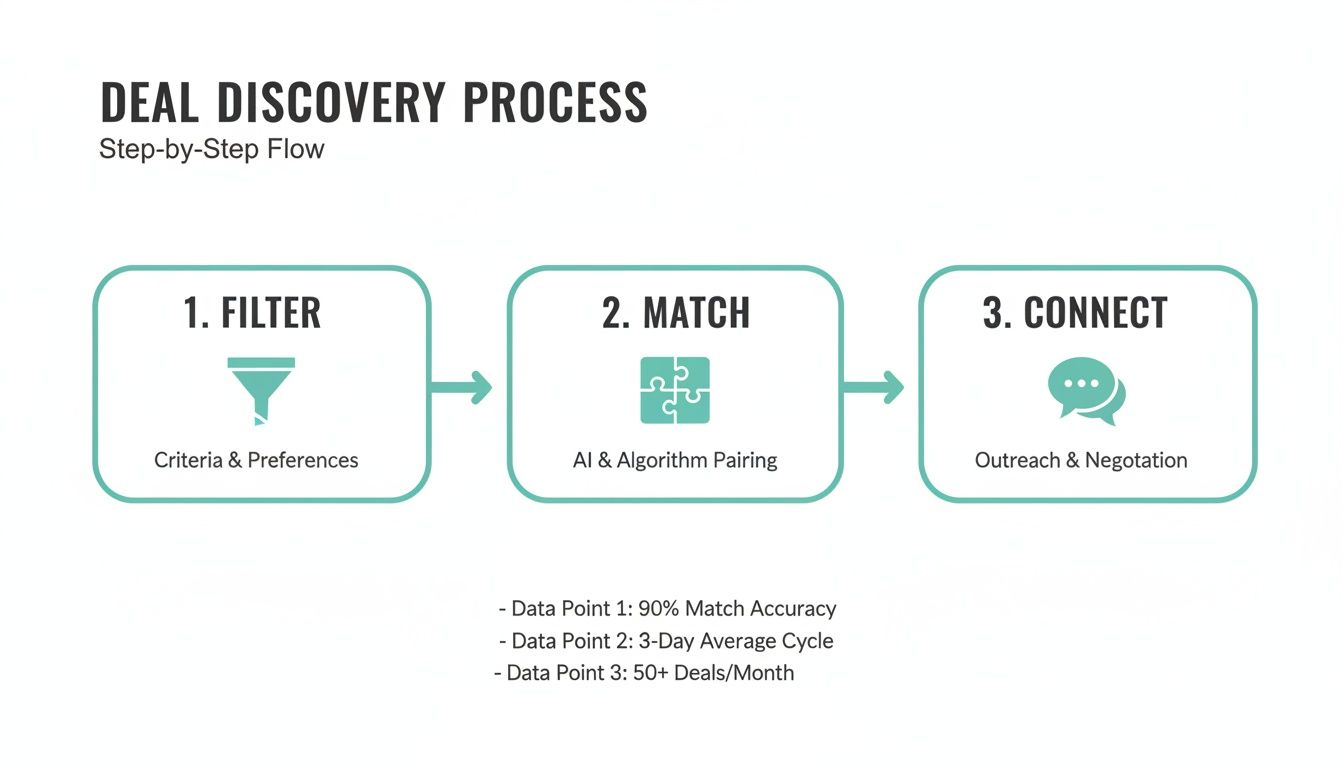
This process shows how a platform can funnel a large pool of properties down to the specific deals that fit your criteria, reducing your initial discovery time.
Your Underwriting Framework
"Underwriting" is the process of running the numbers to confirm a deal makes financial sense. It’s about replacing assumptions with facts.
Your basic checklist must cover these non-negotiables:
- Verify Ownership and Liens: Confirm who owns the property and if there are any claims against it. A preliminary title search is essential to uncover hidden mortgages, tax liens, or judgments that could kill the deal.
- Estimate Repair Costs: This is where many new investors get into trouble. Get a realistic renovation budget. If you’re new, walk the property with a trusted contractor. If experienced, use a detailed scope of work to estimate costs.
- Determine the After Repair Value (ARV): The ARV is what the property will be worth after renovations. Determine this by analyzing recent sales of comparable, updated properties (comps) in the immediate area. This number is the foundation of your profit calculation.
Calculating the Key Performance Metrics
Once you have your core numbers—purchase price, repair costs, and ARV—you can analyze the deal's potential return.
Don't fall in love with a property; fall in love with the numbers. A disciplined analysis protects you from emotional decisions and ensures every deal aligns with your financial goals.
Let's break down the essential calculations:
- Net Operating Income (NOI): For rental properties, this is total income minus operating expenses (taxes, insurance, management, vacancy, etc.), before the mortgage payment. NOI = Income - Operating Expenses.
- Capitalization (Cap) Rate: This metric shows a property's unleveraged return, allowing for apples-to-apples comparisons. Cap Rate = NOI / Purchase Price. A higher cap rate generally signals higher potential return (and often, higher risk).
- Cash-on-Cash Return: This is the annual pre-tax cash flow relative to the total cash invested (down payment, closing costs, rehab). It's a key metric for buy-and-hold investors. Cash-on-Cash Return = Annual Cash Flow / Total Cash Invested.
Analyzing deals is a deep topic. You can dive much deeper into the finer points of real estate due diligence in our detailed guide. Using platform tools like built-in investment calculators can dramatically speed this up, helping you move on good deals faster.
Negotiating and Closing Your Deal with Confidence
Negotiating off-market deals is more about creative problem-solving than winning a bidding war. The goal is to structure an offer that solves the seller's specific problem. Success comes from building trust and offering a solution, not just a number.
First, build rapport by listening more than you talk. Your mission is to understand the why behind their sale. Is it an inherited property that's a burden? Are they a tired landlord? Do they need a fast, guaranteed closing due to financial pressure? Uncovering this motivation is the key to crafting an offer that resonates. A seller facing foreclosure may value a quick, all-cash close more than the highest possible price.
Structuring a Win-Win Offer
Once you understand the seller's situation, you can structure a compelling offer. Price is just one lever. Many of the best off-market deals involve creative terms.
Consider these powerful negotiation strategies:
- Flexible Closing Dates: If the seller needs time, offer a longer closing. If they need cash fast, promising to close in 10-14 days can be more attractive than a higher offer with a 30-day timeline.
- Seller Financing: Proposing that the seller carries a portion of the loan can provide them with a steady income stream and help you secure the deal with less cash upfront.
- Covering Closing Costs: Offering to pay some or all of the seller's closing costs simplifies the math for them and makes your net offer more appealing.
- As-Is Purchase: Most motivated sellers want to avoid repairs. An "as-is" offer removes a major headache and signals you are a serious, professional buyer.
Protecting Yourself Through the Closing Process
A verbal agreement is only a starting point. Protect yourself with clear, legally sound contracts. This is not the place to cut corners.
In off-market transactions, a well-written purchase agreement is your most important tool. It eliminates ambiguity, defines responsibilities, and provides a clear roadmap to closing.
Always work with a qualified real estate attorney and a reputable title company. They handle the critical steps that protect you, including:
- Drafting and Reviewing Contracts: Ensuring the purchase agreement is clear, fair, and enforceable.
- Conducting a Title Search: Verifying the seller’s legal right to sell and uncovering any liens or claims.
- Managing Escrow: Holding all funds securely and ensuring proper disbursement at closing.
Financing these deals can also require specialized solutions. To better understand how investors fund renovations, you can explore options like hard money construction loans. By pairing smart negotiation with professional legal and financial support, you can close off-market deals with confidence.
Building a Scalable Off-Market Deal Pipeline
Finding one great off-market deal is a win. Building a system that produces them consistently is a business. To grow from a single transaction to an investment portfolio, you must create a repeatable, scalable pipeline for sourcing off-market properties. The goal is to move from manual hunting to an automated engine for growth.
An investor marketplace is the heart of this system. It allows you to plug into an existing ecosystem of deal-finders, turning your sourcing process from an active chore into a more passive, efficient operation.
From Manual Effort to an Automated System
The cornerstone of this system is your investor profile and a laser-focused buy box. This isn't just a bio; it’s a magnet for the deals you want. By clearly defining your criteria—from location and property type to your required cap rate and cash-on-cash return—you signal to wholesalers and sellers exactly what to bring you.
A detailed investor profile with a tight buy box acts as a 24/7 filter. It instructs the marketplace to send only relevant deals your way, automating the initial screening process.
Fostering Relationships for Repeat Business
Scalability isn’t just about technology; it’s about people. The best deals often come from trusted relationships. When you find a reliable wholesaler who consistently brings you properties that fit your criteria, that relationship becomes a valuable asset.
An investor platform facilitates these connections.
- Direct Messaging: Build rapport with wholesalers and sellers directly on the platform. Clear communication builds trust and sets the stage for future transactions.
- Repeat Business: When a wholesaler knows your buy box and trusts you to close, they’ll bring you deals first—before sending them to a wider audience.
- Centralized Pipeline: Use a deal pipeline tracker to manage all your opportunities in one place, ensuring nothing falls through the cracks as your deal volume increases.
By combining a powerful buy box with strong professional relationships, you build a true engine for growth. You stop chasing deals and start attracting them. Create your free investor profile today to get matched with off-market properties that fit your criteria and begin building your automated deal pipeline.
Got Questions About Off-Market Deals? We've Got Answers.
Diving into the world of off-market real estate can feel different from the clear-cut rules of the MLS. It's natural to have questions. Let's tackle some of the most common ones.
Are Off-Market Properties Always Cheaper?
Not necessarily. While less competition can lead to a better price, the primary advantage of off-market properties is access to exclusive inventory and the flexibility to negotiate creative terms.
The final price depends on the seller's motivation and the property's condition. A distressed owner needing a quick sale may accept a lower offer. However, a seller who simply wants a private, hassle-free transaction may hold firm on market value.
Is It Legal to Buy Property Without a Real Estate Agent?
Yes, it is completely legal to buy a property directly from a seller without an agent. Many off-market deals happen this way.
However, this doesn't mean you should proceed without professional help. It is highly recommended that you engage a qualified real estate attorney and a reputable title company. They will draft the purchase agreement, conduct a title search for liens, and ensure the closing is handled correctly, protecting you and the seller.
A direct deal doesn't mean cutting corners on legal and financial protections. An attorney and title company are non-negotiable members of your team in an off-market purchase.
How Can I Build a Buyers List for My Wholesale Deals?
For wholesalers, a solid buyers list is crucial. The traditional methods work:
- Networking: Attend local real estate investor meetups and industry events.
- Local Groups: Participate in online forums and social media groups for local investors.
- Marketing: Run digital ads or direct outreach campaigns to find active cash buyers.
However, this manual approach is slow. An investor platform was built to solve this problem. Instead of starting from scratch, you gain instant access to a network of pre-vetted, active investors. On the platform, buyers have already set up their "buy box," specifying the exact deals they are looking for. This allows you to find the ideal buyer for your property in minutes, not months.
Ready to stop hunting for deals and start having them find you? By setting up a Smart Buy Box, you can get matched with off-market properties that fit your exact criteria. Create your free investor profile today and start building a smarter, more efficient deal pipeline.