In a competitive real estate market, a winning offer is about more than just the price. Being able to provide solid proof of funds in real estate is your secret weapon—it tells a seller you’re a serious, credible buyer who can close the deal without delays. This guide provides a step-by-step framework for preparing and presenting your financial readiness to win more deals.
Why Proof of Funds Is Your Golden Ticket
Don't think of a Proof of Funds (POF) document as just another piece of paperwork. It’s a strategic move. When you submit an offer, especially on a desirable property, the seller is looking for the most reliable path to closing. A clean, professional POF instantly makes your offer stand out.
This one document does a few critical things for you:
- It Builds Immediate Trust: A POF removes a seller's biggest fear—the deal collapsing because the buyer couldn't secure their financing or cash.
- It Strengthens Your Offer: Even if your offer isn't the highest, a rock-solid POF can make it more appealing than a slightly higher offer with questionable financial backing. This is especially true when competing for valuable off-market properties where speed and certainty are key.
- It Speeds Up the Whole Process: With the money side of things confirmed from the start, negotiations tend to go smoother, and the closing process can move significantly faster.
In real estate investing, having your POF ready has become non-negotiable. Sellers now routinely ask for these documents—usually bank statements or official letters dated within the last 30 days—to verify a buyer has the liquid cash for a down payment or the full purchase price.
This simple step reduces the risk of deals falling through and can accelerate transaction timelines. Whether you're a seasoned pro or just getting started, having your POF dialed in proves you’re not just browsing; you’re a serious player ready to execute.
What Qualifies as Acceptable Proof of Funds
When you're trying to lock down a real estate deal, not all financial documents are created equal. For a seller, acceptable proof of funds in real estate needs to prove one thing beyond a doubt: you have the liquid cash ready to close, right now. This means the money must be accessible, not tied up in assets that take weeks to sell.
Sellers and their agents are looking for official paperwork that erases any uncertainty about your financial strength. Vague promises or a screenshot of a trading account won't work. The goal is to provide a clean, undeniable snapshot of your readiness to buy.
Having your POF in order is about more than just checking a box; it’s a core part of your offer strategy. It strengthens your position, builds immediate trust with the seller, and can seriously speed up the whole process.
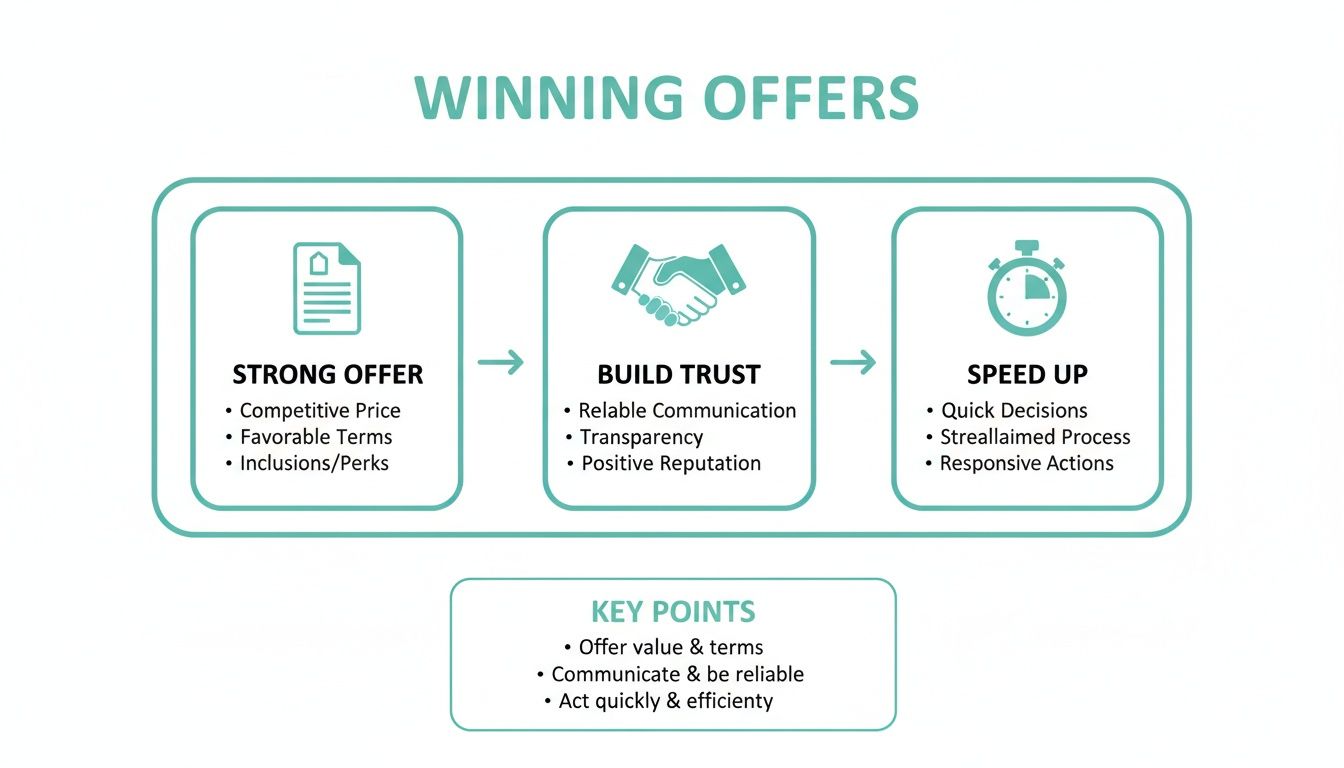
As you can see, these three pieces work together. A strong POF makes your offer more compelling and positions you as a serious, reliable buyer who can get to the closing table without any drama.
Primary Forms of Proof of Funds
For most deals, sellers will recognize a few standard documents. Smart investors have these ready to go before they even think about making an offer.
Official Bank Statements: This is the gold standard of POF. You'll need to provide recent statements—usually from the last 30 to 60 days—from your checking or savings accounts. The statement must clearly show your name, the bank's name, the date, and a balance sufficient to cover the purchase.
A Proof of Funds Letter: Often called a POF letter or a "verification of deposit," this is a formal document from your bank on their letterhead. A bank representative signs it, officially confirming the funds you have on deposit. This is a great option if you want to prove your financial strength without showing the seller your transaction history.
Other Acceptable Documentation
While bank statements and POF letters are the most common, a few other documents can also work, as long as they prove your funds are liquid.
Money Market Account Statements: Just like a regular bank statement, a recent statement from a money market account is solid proof, as the funds are considered cash and readily available.
Brokerage Account Statements: These can work, but with a critical caveat. You must show the cash or cash equivalent balance, not the total value of your stocks and bonds. A seller won't consider your stock portfolio unless you can prove the shares have been sold and the cash has settled in your account.
Certified Financial Statements: A statement prepared and signed by a Certified Public Accountant (CPA) can also be a powerful tool, as it verifies your liquid net worth from a trusted third party.
If you're new, the easiest first step is to call your bank and ask for a "verification of deposit letter for a real estate purchase." They handle these requests daily and can typically provide one in 24-48 hours. It's often the cleanest document to submit with your first few offers.
Acceptable Proof of Funds Documents at a Glance
To make it even clearer, here’s a quick-glance table to help you compare the most common POF documents. This should help you decide which one makes the most sense for your next offer.
| Document Type | Key Requirements | Best For | Pro Tip |
|---|---|---|---|
| Bank Statement | Recent (30-60 days), your name, bank name, account number (redacted), and sufficient balance. | The most common and universally accepted form of POF. | Redact your full account number before sending. You only need to show the last four digits for verification. |
| Proof of Funds Letter | Official bank letterhead, signed by a bank officer, stating the available funds. | Investors who want to show financial strength without revealing transaction history or account details. | Keep an updated letter on file if you're making multiple offers. Some sellers prefer a very recent date. |
| Money Market Statement | Looks just like a bank statement, showing liquid funds. | Demonstrating easily accessible cash reserves held outside of a traditional checking account. | Make sure it's a true money market account, not a money market fund that holds securities. |
| Brokerage Statement | Must clearly show the cash balance (not total portfolio value). | Investors who keep significant cash in their brokerage account. | If you plan to use funds from stock sales, sell them before you make the offer and get a statement showing the settled cash. |
| Certified Financial Statement | Prepared and signed by a CPA, verifying your net worth and liquid assets. | High-net-worth investors or those with complex finances making a large purchase. | This is often overkill for smaller deals but can be a powerful move in a competitive, high-end market. |
Ultimately, your goal is to make the seller feel 100% confident that you can close the deal. Choosing the right document helps you tell that story clearly and professionally.
How to Present Your Proof of Funds Securely
Having the right documents is one thing, but presenting them securely and professionally is what separates serious investors from amateurs. Sharing sensitive financial information is a delicate balance—you need to build trust with the seller while protecting your own data.
The goal is to prove you have the cash without revealing your entire financial history. A seller just needs to verify you have the funds, not every single transaction you’ve ever made.

Protect Your Privacy When Sharing Documents
Before you email your bank statement, take a moment to redact, or black out, any sensitive information. This is standard practice that shows you're both professional and security-conscious.
Here’s what you should always black out:
- Full Account Numbers: Never show the whole number. Leave only the last four digits visible. This is sufficient for verification without exposing your account to risk.
- Unrelated Transaction Details: The seller doesn't need to know about your personal spending habits. While not strictly required, redacting these details helps maintain your financial privacy.
You can do this by printing the document, using a black marker, and scanning it. A better method is to use the editing tools in a PDF viewer like Adobe Acrobat to do it digitally.
Know When to Provide Your Proof of Funds
Timing is everything in a real estate deal. You should have your POF document ready from day one, but you generally present it when it's time to make your move.
A seller or their agent will almost always request proof of funds when you submit an offer. Attaching it directly to your purchase agreement sends a powerful signal: you are a serious, organized buyer. It gives your offer an immediate competitive edge.
If you don't include it with the offer, expect the request to come quickly once the seller begins their review. Waiting for them to ask can create delays and may make you appear less prepared than competing buyers. Being proactive demonstrates you are ready to close.
How to Request a POF Letter from Your Bank
For investors who prefer not to share bank statements, a formal Proof of Funds (POF) letter is the clean, professional alternative. Getting one is simple.
Here’s a quick script you can use when you call or visit your bank:
"Hi, my name is [Your Name]. I am submitting an offer on a real estate property and need a Proof of Funds letter. Can you generate a letter on official bank letterhead that states the current balance in my [checking/savings] account, signed by a bank representative? I do not need my full account number displayed on the letter."
Most banks can provide this within 24-48 hours. It's an official, no-fuss way to satisfy the requirement and keep your deal moving forward.
Common POF Mistakes That Can Kill Your Deal
It’s a painful truth, but simple paperwork mistakes can kill a promising real estate deal. A small error on your proof of funds real estate documents can signal to the seller that you're disorganized or financially unstable, prompting them to move on to the next offer.
Avoiding these common slip-ups is one of the easiest ways to keep your deal on track.
The most frequent mistake is submitting outdated statements. A seller wants to know what your bank account looks like now, not three months ago. Any document older than 30-60 days will likely be rejected, forcing you to scramble and creating unnecessary delays.
The Problem with Unseasoned Funds
Another huge red flag for sellers is "unseasoned" funds. This is industry jargon for large, recent deposits into your account with an unclear origin. If a seller reviews your statement and sees a mysterious $100,000 deposit from last week, their first question will be: where did that come from?
Key Takeaway: Your funds need to be "seasoned," meaning the money has been in your account long enough (usually at least 60 days) to prove it's yours and not a last-minute, undocumented loan. It gives the seller confidence that the money is stable and available.
The solution is to plan ahead. If you're consolidating cash from different accounts or receiving a gift, complete the transfers well before you start making offers. Always be prepared with paperwork to explain any large, recent deposits.
Using Non-Liquid Assets as Proof
This is a classic rookie mistake. It’s easy to assume all assets are viewed equally by a seller, but this isn't the case. Presenting a retirement account or stock portfolio statement is one of the fastest ways to weaken your offer.
Sellers need proof of liquid assets—cash that you can access immediately. Money tied up in investments does not count.
- Retirement Accounts (401k, IRA): Cashing these out incurs penalties and takes time. A seller won’t wait while you navigate that process.
- Stock Portfolios: The value of stocks can change instantly. What's worth $200,000 today might be worth less by closing. Sellers are unwilling to take on that market risk.
- Life Insurance Policies: Accessing the cash value requires a policy loan, which has its own timeline.
If you plan to use funds from these sources, you must liquidate the assets first. That means selling the stocks or finalizing the withdrawal so the cash is sitting in your checking or savings account. Only then can you generate a bank statement that gives the seller the undeniable proof they need.
Understanding Source of Funds Verification
As you scale your real estate portfolio, you will encounter a higher level of financial scrutiny. While a Proof of Funds (POF) shows a seller you have the cash, a Source of Funds (SOF) verification is what title companies and attorneys require. It answers the bigger question: where did that money actually come from?
This isn't about being intrusive. SOF verification is a legal requirement for Anti-Money Laundering (AML) compliance. It’s a safeguard designed to prevent illicit funds from being legitimized through real estate transactions. While a POF proves your ability to buy, an SOF proves the legitimacy of your cash.
POF vs. SOF: The Key Distinction
Let's break it down simply. A POF is a snapshot of your current bank balance—it shows you have the funds for the transaction. An SOF is the story of how you legally obtained that money.
This difference becomes critical on larger or more complex deals where legal and financial oversight is much stricter. A title company is legally responsible for ensuring the funds for a purchase are from a legitimate source.
If you're an experienced investor, expect SOF requests to become routine as you start using more sophisticated funding like private money or capital from partners. Maintaining a clear paper trail for every dollar is the mark of a professional operator.
Why Lenders and Title Companies Demand SOF
The push for SOF verification stems from strict federal regulations aimed at combating financial crime. Research from Global Financial Integrity (GFI) estimates that $2.3 billion was laundered through U.S. real estate in just a five-year window.
This is why the industry now demands a clear paper trail. It’s about preventing illegal money from entering the market. This means you need to be ready to provide documents proving the origin of your closing funds.
Acceptable SOF documents often include:
- Pay Stubs or Employment Verification: Shows funds were accumulated over time from a regular salary.
- Proceeds from a Property Sale: A closing statement (like a HUD-1 or ALTA) from a recent sale is perfect proof that your cash came from another real estate transaction. You can learn more about how this fits into various real estate financing options in our complete guide.
- Inheritance Records: Official legal documents from an estate are needed to show you were the rightful beneficiary.
- Gift Letters: If using funds from a relative, you'll need a formal, signed letter stating the money is a true gift, not a loan that must be repaid.
Understanding why SOF is required allows you to get your paperwork in order long before anyone asks, making the entire closing process smoother.
How to Leverage Your Financial Readiness on Our Platform
In the fast-paced world of real estate investing, being financially ready isn't just a requirement—it's your competitive advantage. On an active marketplace like ours, speed and certainty are what make an offer stand out. Having your proof of funds prepared is a massive signal to sellers that you’re a serious investor.
From the seller's perspective, submitting an offer with your POF already attached immediately elevates you to a top contender. Wholesalers and flippers are always looking for the cleanest, fastest path to closing. Your financial readiness shows them you're organized, capable, and won't be the cause of a deal falling apart.

Putting Our Platform to Work for Faster Closings
Our platform is built to help you turn your financial preparedness into a deal-closing machine. By creating a strong investor profile and setting your "buy-box" criteria, you can attract the right deal-makers and be ready to act instantly when a matching property is posted.
Here’s how you can use the platform to your advantage:
- Build credibility with a complete investor profile that highlights your experience and readiness to close.
- Message sellers directly and confirm right away that you have verified funds, building immediate confidence.
- Act on new deal alerts by submitting a complete offer package, POF included. This simple step puts you ahead of other buyers who are still getting their paperwork together.
This combination of proven financial muscle and the right technology helps you lock down the most desirable opportunities. It's also a game-changer when you're seeking alternative funding. Many private lenders, including those who offer hard money construction loans, will want to see proof of your own liquid capital before they’ll consider funding your project.
Ultimately, being prepared flips the script. You stop being just another bidder and become the high-priority partner every seller wants to work with.
Your Top Proof of Funds Questions, Answered
When you're in the middle of a deal, you don't want to get tripped up by the details. Here are answers to some of the most common questions investors have about proof of funds.
How Old Can My Proof of Funds Document Be?
Sellers are looking for a current, accurate snapshot of your financial position. As a rule, your proof of funds—whether a bank statement or a formal letter—should be no older than 30 days. While some may accept documents up to 60 days old, submitting an outdated POF can make you look unprepared and weaken your offer. The goal is to prove your funds are liquid and ready to go right now.
Do I Need to Show Proof of Funds for a Financed Offer?
Yes, in most cases. Even if you’re getting a mortgage, you are still responsible for the down payment, closing costs, and any potential appraisal gaps. A seller wants to see that you have those funds available. Providing a POF along with your lender's pre-approval letter creates a much stronger offer package, showing you can cover your portion of the deal without issue.
Can I Use Funds from a Partner or a Lender as POF?
Absolutely, provided you have the correct documentation. If you're partnering on a deal, you'll need their bank statements plus a signed joint venture (JV) agreement or a gift letter stating the funds are for that specific purchase. If you're using a hard money or private loan, a commitment letter from the lender serves as your proof. This is the official document confirming they have approved the loan and are ready to fund your deal.
Is a Mortgage Pre-Approval Letter the Same as Proof of Funds?
No, they are two different documents, and sellers typically want to see both.
- A pre-approval letter shows a lender has reviewed your credit and financials and is willing to lend you a certain amount. It proves your ability to borrow.
- A proof of funds document shows you have the actual cash on hand for your down payment and closing costs. It proves your ability to contribute your own capital.
Together, these documents give a seller full confidence that you can successfully close the transaction.
Mastering your proof of funds in real estate is a critical step in becoming a successful investor. On a platform like ours, being prepared allows you to move quickly and decisively on the best deals. Create your free investor profile today to get matched with deals that fit your criteria.