
Securing the right financing is the engine that drives every successful real estate deal. But it's not just about getting any loan; it's about strategically matching the funding to your investment goals to maximize returns and manage risk. A smart financing strategy isn't a luxury—it's the foundation for scaling a profitable portfolio.
This guide provides a practical blueprint for both new and experienced investors, breaking down the best financing for real estate investors based on your strategy, from conventional loans for buy-and-hold rentals to creative funding for your next flip.
Your Blueprint for Investment Property Financing
Whether you’re hunting for your first rental or your fiftieth apartment complex, the way you finance the deal will make or break your success. For new investors, the goal is to master the fundamentals. For seasoned pros, it's about refining your playbook to tap into better, more flexible capital as you scale.
The core concept that makes real estate so powerful is leverage. Think of it as using a small amount of your own cash (the down payment) to control a much larger, more valuable asset. This financial tool amplifies your potential returns, allowing you to build wealth much faster than if you paid all cash.
But not all financing is created equal. You must understand the trade-offs.
- Traditional Banks: Offer stability and the lowest interest rates, but their slow, rigid approval process is a poor fit for time-sensitive deals.
- Private & Hard Money Lenders: Provide incredible speed and flexibility, focusing on the asset rather than your personal income, but at a significantly higher cost.
The goal is to stop thinking about "getting a loan" and start acting like a strategic investor who matches the financing tool to the specific deal. A short-term flip requires a completely different funding source than a long-term rental property.
Matching the Capital to the Strategy
Choosing the right loan always starts with a crystal-clear understanding of your investment plan. This simple decision tree gives you a visual guide for aligning your financing with common real estate strategies.
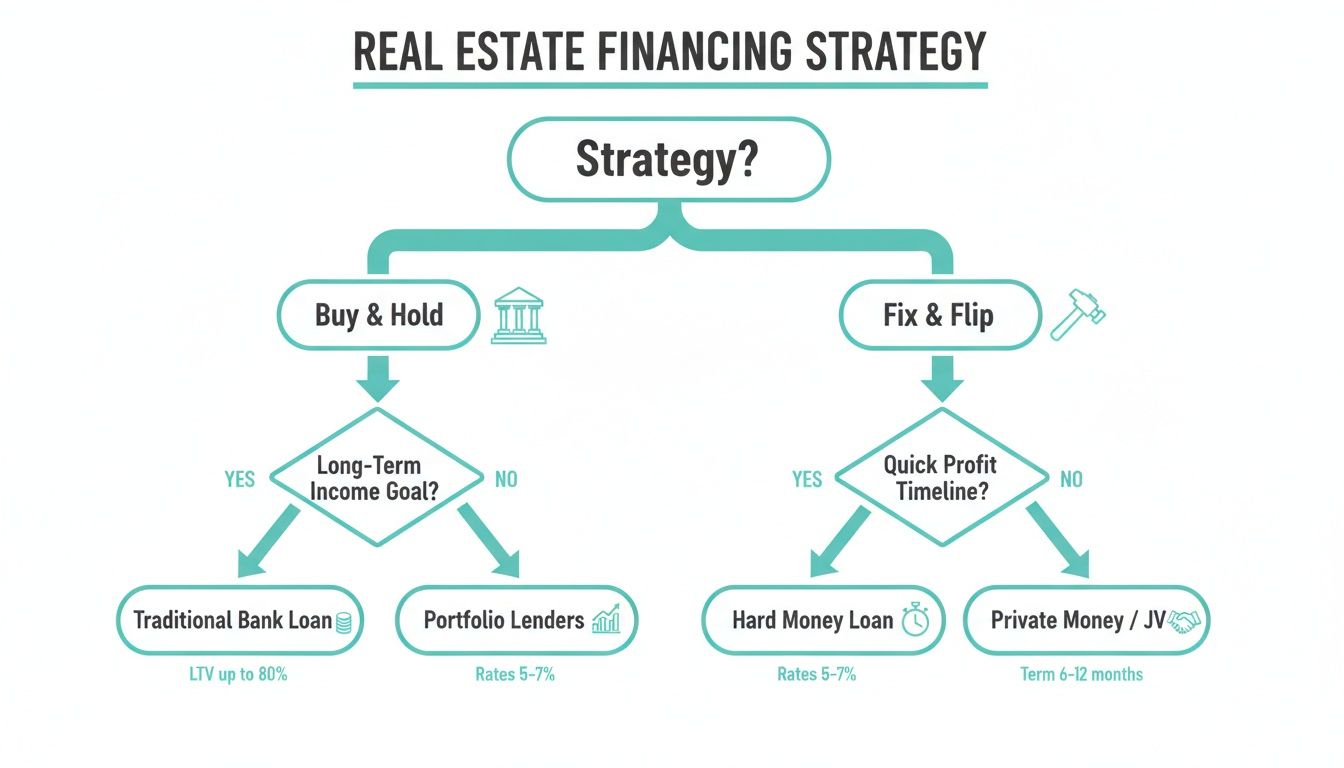
The key takeaway is that your timeline and profit model—whether it's long-term cash flow from a rental or a quick profit from a flip—directly point to the best type of financing for the job.
Comparing Real Estate Investor Financing Options
Here is a quick comparison of the most common financing options for real estate investors. This table breaks down their ideal use cases, typical terms, and key pros and cons.
| Financing Type | Best For | Typical Term | Pros | Cons |
|---|---|---|---|---|
| Conventional | Buy-and-hold rentals; stabilized properties | 15-30 years | Low interest rates; long amortization | Slow closing; strict underwriting |
| Portfolio Loan | Investors with 10+ properties; unique assets | 5-10 years | Flexible criteria; relationship-based | Higher rates than conventional loans |
| Hard Money Loan | Fix-and-flips; BRRRR acquisitions | 6-24 months | Fast closing (7-10 days); asset-focused | High interest rates and fees |
| Seller Financing | Creative acquisitions; properties needing work | Negotiable | Flexible terms; low closing costs | Depends entirely on the seller's terms |
Think of this table as a starting point. Each option has its place, and the smartest investors know how to pick the right tool from the toolbox for each specific project.
Navigating Traditional Bank Financing
When you're building a buy-and-hold portfolio, traditional bank loans are your bread and butter. These come from national banks, smaller community banks, and local credit unions. While they may seem similar, understanding the difference between a conventional loan and a portfolio loan is a game-changer for scaling your real estate business.

Conventional loans are the standardized mortgages designed to meet the strict criteria set by government-sponsored enterprises Fannie Mae and Freddie Mac. Because these entities buy the loans from the original lenders, it creates a massive, stable market. That stability is why conventional loans usually have the best interest rates and long terms, typically 15 or 30 years.
What Conventional Lenders Look For
The trade-off for those great terms is a rigid, non-negotiable qualification process. Lenders put your personal finances under a microscope with very little wiggle room.
They focus on a few key metrics:
- Credit Score: You’ll generally need a 680-720 score for an investment property. The best rates are typically reserved for borrowers with scores above 740.
- Debt-to-Income (DTI) Ratio: A critical metric. Your total monthly debt payments—including the new mortgage—cannot exceed 43-45% of your gross monthly income.
- Down Payment: For a single-family rental, plan on putting down at least 20-25%. Private Mortgage Insurance (PMI) is not available for investment properties.
- Cash Reserves: Lenders need to see a safety net. You’ll have to prove you have enough cash to cover at least six months of mortgage payments for all your properties after closing.
The current economic climate, with fluctuating interest rates, has made debt more expensive and prompted banks to tighten underwriting standards, making it tougher for some investors to qualify.
The Scaling Solution: Portfolio Loans
So what happens when you don't fit perfectly into that tight conventional box? That’s when you need to discover the power of portfolio loans. These are offered by smaller community banks and credit unions that keep the loan "in-house" on their own books—or portfolio—instead of selling it to Fannie or Freddie.
Because the bank holds the loan and the risk, it has the freedom to set its own underwriting rules, which are almost always more flexible. This is the key to building real, long-term banking relationships that can fuel your growth.
Portfolio lenders can get creative. They might finance a unique property a big bank wouldn't touch or work with a self-employed investor with complex tax returns. More importantly, they're the go-to solution for experienced investors who have hit the Fannie Mae 10-loan limit. For a deeper look, check out our guide on how to refinance a rental property, as this often involves a portfolio lender.
Your Strategy for the 10-Loan Limit
How you approach this depends on where you are in your investing journey.
- For Beginners: Your first few properties will likely be financed with conventional loans. They offer the best rates, and your job is simple: maintain excellent personal finances. Protect your credit score and keep your DTI ratio low.
- For Experienced Investors: As you approach the 10-loan limit, it’s time to pivot. Start networking with local bankers who offer portfolio products. This is about building a partnership, not just a transaction. A great portfolio lender wants to understand your business plan and can offer lines of credit or blanket loans to help you scale far beyond ten deals.
When Speed and Flexibility Trump Cost
Ever found a great deal where the seller needs to close immediately? A traditional 45-day mortgage process won't work when you’re competing against cash buyers. This is where alternative financing—the investor’s toolkit for seizing time-sensitive opportunities—shines.
Unlike conventional loans that fixate on your personal income and credit, these lenders focus primarily on the asset itself. They underwrite the deal, analyzing the property's value and income potential. It's the perfect solution for investors whose deals make sense on paper, even if their W-2 doesn't tell the whole story.
Hard Money Loans: The Fix-and-Flip Fuel
For fix-and-flip and BRRRR (Buy, Rehab, Rent, Refinance, Repeat) investors, hard money loans are the lifeblood of the business. These are short-term, asset-based loans from private companies that can get you to the closing table in as little as 7 to 10 days.
The entire model revolves around one key metric: the After Repair Value (ARV), which is what the property will be worth after renovations are complete.
- How It Works: Lenders typically fund up to 70-75% of the future ARV.
- Funding Scope: Many hard money loans also cover 100% of your renovation budget, rolling it into the loan and disbursing it in draws as you hit construction milestones.
This structure lets you acquire a property and fund its transformation with very little of your own cash. Of course, this speed comes at a price: expect interest rates from 10-15% and upfront fees (points) of 2-4% of the loan amount. You can dive deeper into these loans in our guide to hard money construction loans.
Bridge Loans: Minding the Gap
Bridge loans are similar to hard money. They are often used to "bridge" a short-term financing gap, such as when you need to buy a new property before you’ve sold an existing one. They are also fast and asset-based, providing a competitive edge when timing is critical.
DSCR Loans: When Cash Flow Is King
The Debt Service Coverage Ratio (DSCR) loan is one of the most powerful tools for a buy-and-hold investor. It's a lifesaver for anyone who is self-employed, has complicated income, or wants to avoid the extensive paperwork of a conventional loan.
With a DSCR loan, the lender’s decision is based on one question: does the property’s rent cover its mortgage payment? They calculate the DSCR by dividing the monthly gross rent by the total monthly mortgage payment (PITI: principal, interest, taxes, and insurance).
Most lenders look for a DSCR of 1.25x or higher, meaning the rental income must be at least 25% more than the property's total monthly debt service. If the deal hits that number, the lender doesn't need to verify your personal income. This is how smart investors scale their portfolios based on the quality of their deals, not the limitations of their tax returns.
Mastering Creative And Relationship-Based Funding
The most successful investors often figure out how to get deals funded when the banks say no. Once you move beyond traditional lenders, you unlock a world of deals your competition can't touch. This is where creative and relationship-based funding—like seller financing, joint ventures, and private money—becomes your secret weapon.
For new investors, these methods can feel intimidating, but they're often the fastest way to get your first deal done. For experienced investors, mastering these techniques is essential for scaling quickly and seizing unique opportunities.

Seller Financing: The Ultimate Win-Win
What if you could bypass the bank and have the property owner act as your lender? That's the simple idea behind seller financing (or an "owner-carry"). You negotiate the loan terms directly with the seller and make monthly payments straight to them.
This can be a game-changer for properties that need work or for investors who don't meet a bank's rigid criteria. The key is to structure a deal that benefits both parties. The seller gets a reliable income stream, often at a higher interest rate than they could get elsewhere, and you get into a property with more flexible terms and potentially less money down.
Joint Ventures: Partnering For Profit
A Joint Venture (JV) is a strategic partnership where two or more parties pool their resources to complete a deal. This is a powerful tool for filling gaps in your own experience or capital.
For example, a new investor with cash could partner with a seasoned flipper who has the expertise but needs funding for their next project. It's a classic "you bring the capital, I'll bring the experience" scenario.
A rock-solid JV agreement is critical. It must clearly define:
- Roles and Responsibilities: Who finds the deal? Who manages the rehab?
- Capital Contributions: Who is putting in cash and when?
- Profit Splits: How does everyone get paid when the property is sold or refinanced? Is it a straight 50/50 split, or is it weighted based on contribution?
Partnering isn't just about money; it’s about leveraging complementary skills to do more deals, faster.
Private Money: Your Personal Lending Network
Private money comes from individuals—friends, family, colleagues, or other investors in your network who are looking for a better return on their cash. They act as your personal bank, lending you money for deals in exchange for a fixed interest rate, typically secured by a mortgage on the property.
Building this network is a long-term play. It starts with a clear business plan and a track record of success. People invest in operators they know, like, and trust. Our guide on building a powerful real estate investor network breaks down how to make these crucial connections.
The global real estate market is always in motion. According to one global real estate outlook, transaction volumes can fluctuate significantly based on economic conditions. When capital markets tighten, a network of private lenders ready to fund your deals gives you a massive competitive advantage.
How To Prepare A Bulletproof Loan Application
Getting a loan isn't just about your credit score; it's about presenting a convincing, professional story with your numbers. A sloppy application signals amateur, while a well-documented package shows you’re a serious investor who understands risk.
Think of your loan application as the business plan for your investment. A lender’s job is to manage risk. Your job is to make them confident that lending you money is a smart, safe decision. This means anticipating their questions and having the documents ready to go.
Assembling Your Core Financial Documents
Every lender, from a national bank to a local hard money provider, will request the same core documents to assess your financial health. Having this package ready shows you’re organized and professional.
Here's your essential checklist:
- Personal Financial Statement (PFS): A snapshot of your net worth, listing your assets (cash, stocks, properties) and liabilities (mortgages, credit card debt).
- Recent Tax Returns: Typically the last two years of personal and business returns to verify your income history.
- Schedule of Real Estate Owned (SREO): A detailed list of every property you currently own, including its value, mortgage balance, rental income, and expenses.
- Proof of Funds: Recent bank and brokerage statements showing you have the cash for the down payment, closing costs, and required reserves.
This is where an investor platform can save you time and effort. On our marketplace, you can track your entire portfolio and deal pipeline in one place, making it easy to generate an accurate SREO for any lender.
Having this centralized view means you can pull data on your existing properties in minutes, allowing you to provide lenders with a professional overview of your portfolio instantly.
Presenting The Deal With Clarity And Confidence
Once the lender is comfortable with your financial standing, you have to sell them on the deal itself. This is your chance to show you've done your homework by presenting a clear, data-backed analysis of the property's potential.
Be ready to explain the key metrics every underwriter uses:
- Loan-to-Value (LTV): The loan amount divided by the property’s appraised value. Most lenders want this at 80% or lower for investment properties.
- Debt Service Coverage Ratio (DSCR): The property's Net Operating Income (NOI) divided by its total annual mortgage payments. An industry standard is 1.25x or higher.
- Cash-on-Cash Return: Your projected annual pre-tax cash flow divided by the total cash invested. This demonstrates the deal's actual profitability.
Don’t just present numbers; tell the story. For example, you can cite current market supply-and-demand imbalances in multifamily or industrial sectors. When you combine a well-researched market narrative with solid numbers, your application becomes a compelling investment proposal.
Finding and Funding Deals on an Investor Platform
Finding a great deal is only half the battle; securing the right financing is what gets it across the finish line. An investor marketplace is designed to bridge that gap by connecting deal discovery with the tools you need to make smarter, faster funding decisions.
The real advantage is having data and calculators at your fingertips to instantly model different financing scenarios. When you can quickly stress-test a deal with various loan types, you can approach a lender or partner with a clear, data-backed opportunity.

Use a Smart Buy Box to Find Financible Deals
One of the most powerful features on the platform is the Smart Buy Box. It acts as your personal deal-finding assistant, allowing you to set hyper-specific criteria for the deals you want to see. This cuts through the noise so you only focus on relevant opportunities.
You can also dial in your search to match specific funding strategies.
- Hunting for DSCR Loans? Set your buy box to show only properties with a minimum Net Operating Income (NOI) or a target Cap Rate. You're pre-qualifying deals for asset-based loans before you even click.
- Looking for Seller Financing? Target properties owned by the same person for a long time. These long-term holds often signal a seller who may be open to a creative financing discussion.
- Need Hard Money? Filter for distressed properties or those listed well below market value. These are the exact deals that hard money lenders love.
This approach isn't just about finding deals; it's about finding deals that are fundable from the start.
Model Scenarios With Built-In Calculators
Once you’ve found a promising property, the analysis begins. Instead of using a clunky spreadsheet, a good investor platform provides built-in calculators to analyze profitability on the fly. This is where you can dig into different financing options.
With a few clicks, you can see how different loan terms, interest rates, and down payments impact your returns. For example, you can instantly compare a high-leverage hard money loan against a conventional loan with 25% down. This reveals the immediate impact on your Cash-on-Cash Return and overall profitability, turning a gut feeling into a hard number.
Present a Professional Case to Lenders
After analyzing the deal and identifying your ideal funding structure, the platform helps you package it professionally. You can save top opportunities to your deal pipeline, which acts as a central command center for all potential acquisitions.
From there, you can generate a clean summary of the deal, complete with your projected ROI, Cap Rate, and cash flow numbers. This demonstrates to lenders and potential partners that you are a serious operator who has done their homework, dramatically increasing your chances of getting the deal funded.
Your Top Financing Questions, Answered
In real estate investing, the same financing questions come up time and again. Here are straight answers to the most common hurdles investors face.
How Many Investment Properties Can I Finance With Conventional Loans?
This is one of the first major hurdles investors encounter. With conventional loans backed by Fannie Mae and Freddie Mac, you can typically finance up to 10 properties. This is a firm cap that most lenders adhere to.
Once you max out your 10 "Fannie slots," you must pivot to other financing for real estate investors. This is where portfolio loans from community banks, commercial loans, or creative financing strategies become essential. It’s wise to start building relationships with these lenders before you hit the 10-property limit to ensure a smooth transition.
What Is The Difference Between A Hard Money Loan And A Conventional Loan?
The biggest difference is what the lender prioritizes: you or the deal.
A conventional loan is all about you—your personal financial profile. Lenders scrutinize your credit score, income, and DTI ratio. It's a meticulous, slow process that can take 30 to 60 days to close.
A hard money loan is asset-based. The lender underwrites the deal itself, focusing almost entirely on the property's potential, especially its After Repair Value (ARV). Because the property is the primary collateral, approvals are very fast, often funding in just 7 to 10 days. That speed comes at the cost of higher rates and fees, but it's often the perfect tool for a quick fix-and-flip project.
How Does Seller Financing Work For An Investment Property?
Seller financing means cutting out the bank. The property owner acts as the lender. You negotiate all the terms—down payment, interest rate, and loan term—directly with them and send your monthly payments to the seller.
The main benefit of seller financing is its complete flexibility. Every detail is negotiable, making it a game-changer for buying properties that don't fit into a neat conventional box or for structuring deals with terms a traditional bank would never offer.
What Is A DSCR Loan And Who Is It For?
A Debt Service Coverage Ratio (DSCR) loan is a type of non-QM (non-qualified mortgage) loan where the property qualifies for the loan on its own, without requiring verification of the borrower's personal income.
Lenders focus on one metric: can the property's rental income cover the mortgage payment? A common benchmark is a DSCR of 1.25x, which means the gross rent must be at least 25% higher than the total mortgage payment. These loans are perfect for self-employed investors, entrepreneurs, or anyone whose income is complex on paper. If the deal cash flows, you’re likely to be approved.
Ready to find deals that match your financing strategy? On our marketplace, you can set up a buy-box to get matched with properties that fit your criteria, whether you're using conventional, DSCR, or hard money loans.
Create your free investor profile to get matched with deals that fit your criteria.