Finding profitable wholesale real estate deals isn't about getting lucky; it's a discipline built on understanding how the market actually works. The strategy is straightforward: find undervalued properties, get them under contract, and then sell that contract to a cash buyer for a fee—all without ever taking ownership of the property yourself. This guide provides an actionable framework for mastering that process in today's environment.
Thriving In Today's Wholesale Real Estate Market

The market for wholesale real estate deals has changed. The low-interest-rate frenzy of the past is over, creating a more challenging—and professional—environment. This wasn't a slow shift; it was a seismic event that rewarded serious operators and pushed out amateurs.
Success in this new era comes down to having scalable systems for finding motivated sellers, underwriting properties with accuracy, and connecting with reliable cash buyers efficiently. It's a blend of old-school fundamentals and modern technology.
A Market Correction Creates New Opportunities
Recent market volatility, driven by interest rate hikes and inventory swings, created a "survival of the fittest" scenario. Many part-time or undisciplined wholesalers were pushed out because they couldn't adapt to tighter margins and more selective buyers.
One industry study revealed a significant market contraction. Between 2021 and 2025, the number of active wholesalers reportedly dropped from around 90,000 to just 12,000. That's an exodus of over 78,000 operators, highlighting the intense pressure. You can dive deeper into these market shift findings to see the full scope of this industry shake-up.
For beginners: This is an opportunity to learn the business the right way from the start, avoiding the bad habits that washed out so many others. For experienced investors: This is a clear signal to double down on building scalable, repeatable systems for every part of your operation.
This isn’t a crisis; it's a clarification. The wholesalers who remain are more professional, data-driven, and focused on creating real value. For those committed to mastering the craft, this is an ideal time to build a sustainable business.
Leveraging Technology to Gain an Edge
In this competitive environment, technology separates the pros from the pack. The days of relying solely on a spreadsheet and a trunk full of bandit signs are gone. Today's top wholesalers use specialized platforms to manage their entire workflow.
Using an investor marketplace provides a significant advantage. It helps you:
- Source Deals Efficiently: Instead of manual cold outreach, you can connect directly with other investors and access properties that may already fit your criteria.
- Build Your Buyers List: Post your wholesale deal to a network of pre-vetted cash buyers who are actively looking for their next project.
- Establish Credibility: A professional profile showcasing your deal history and reviews helps build trust instantly with both sellers and buyers.
By integrating the right tech, you can automate repetitive tasks, make smarter decisions, and focus your energy on what actually makes money: negotiating and closing profitable wholesale real estate deals.
Finding And Connecting With Motivated Sellers
Every great wholesale deal starts with one non-negotiable ingredient: a motivated seller with an off-market property. Sourcing these opportunities is the engine of your business. Mastering this skill separates wholesalers who consistently close deals from those who struggle to find traction.
This isn't about luck; it's about building a systematic, repeatable process for lead generation.
The most successful investors don't rely on a single method. They blend old-school, time-tested tactics with newer, data-driven approaches. This creates a consistent deal pipeline, protecting your business from the inevitable dry spells that occur when you depend on only one source.
Proven Methods For Sourcing Deals
Let's explore the foundational strategies for uncovering properties you'll never see on the MLS. These methods require effort but are highly effective.
- Driving for Dollars (D4D): This is the purest way to start. Drive through target neighborhoods looking for visual signs of distress, like overgrown lawns, boarded-up windows, or utility shutoff notices. Use an app to log addresses and photos, then begin your outreach.
- Direct Mail: Sending targeted letters or postcards remains a powerful tool. The secret is the quality of your list. Focus mailings on homeowners statistically more likely to need to sell, rather than using a broad "shotgun" approach.
- Public Records: County records are a goldmine for finding homeowners in specific situations that create motivation. Common lists to pull include probate (properties in inheritance), pre-foreclosure filings, and tax-delinquent properties.
If you’re just starting, Driving for Dollars is a low-cost way to learn a market. As you gain experience, you'll likely invest more in refining public records data and optimizing direct mail campaigns for higher conversion rates.
A classic rookie mistake is giving up on direct mail after one or two mailings. The reality is, many sellers won't call until they've seen your mailer 5-7 times. Consistency builds trust and ensures you're top-of-mind when they're ready to sell.
Comparing Lead Generation Methods
Finding the right mix of lead generation strategies is key. Some methods are cheap but time-intensive, while others can be automated at a higher cost. This table breaks down the pros and cons of popular approaches.
| Method | Average Cost | Time Commitment | Best For |
|---|---|---|---|
| Driving for Dollars | Low | High | New investors learning a market; finding visually distressed properties. |
| Direct Mail | Medium to High | Medium | Targeting specific lists (e.g., probate, pre-foreclosure) at scale. |
| Public Records | Low to Medium | High | Pinpointing highly motivated sellers based on legal/financial distress. |
| Networking | Low | Medium | Building long-term relationships for a steady stream of referral deals. |
| Investor Marketplaces | Varies | Low | Quickly accessing deals already vetted by other investors and wholesalers. |
Ultimately, the best strategy is a balanced one. As you grow, having multiple lead "faucets" keeps your pipeline full even if one source slows down.
Building Rapport With Your Outreach
Once you have a lead, the first phone call is crucial. Your goal isn't to immediately make a lowball offer; it's to connect, build rapport, and understand the why behind their situation.
Are they facing foreclosure? Overwhelmed by an inherited property? Tired of being a landlord? Uncovering their motivation is the key to crafting an offer that solves their problem.
Here’s a simple script to start the conversation:
"Hi, [Seller Name], my name is [Your Name]. I'm a local investor, and I was calling about your property at [Property Address]. I know this call is out of the blue, but I was wondering if you might have ever considered an offer on it?"
From there, listen more than you talk. Ask open-ended questions. A truly motivated seller doesn't just want to sell a house; they have a problem that selling the house will solve. Your offer should be the solution.
How To Analyze Deals And Calculate Your MAO
Finding a motivated seller is the first step. The real work—where you make or lose money on wholesale real estate deals—happens during the analysis.
Underwriting a deal quickly and accurately is what separates seasoned investors from rookies. It all comes down to mastering one crucial calculation: the Maximum Allowable Offer (MAO).
This single number is everything. Offer too low, and a competitor gets the deal. Offer too high, and you’re stuck with a contract you can’t sell, wasting time and damaging your reputation with cash buyers.
The visual below shows the basic acquisition funnel. This is the groundwork you lay before you run the numbers.
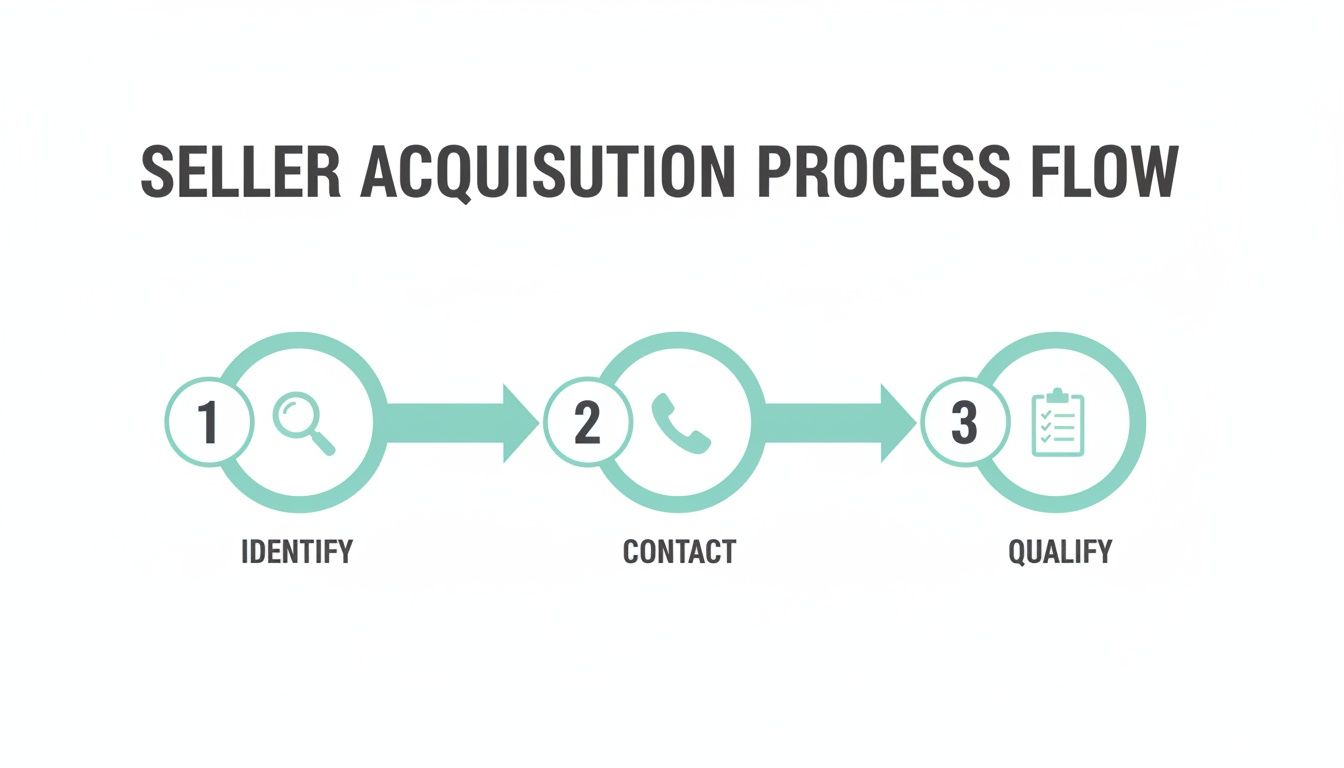
As you can see, you must identify, contact, and qualify the seller before digging into the analysis.
Determine The After Repair Value (ARV)
Before making an offer, you need a solid estimate of what the property will be worth after a flipper renovates it. This is the After Repair Value (ARV), and it's the most important variable in your formula. Get this wrong, and the deal is dead on arrival.
To get a reliable ARV, you must pull comparable sales, or "comps"—recently sold properties that are as similar as possible to your subject property.
Here’s what to look for in solid comps:
- Sold recently: Look for sales within the last 90-180 days.
- Location: Stay within a half-mile radius, ideally in the same subdivision. Don't cross a major road or school district boundary.
- Similar style: Compare a ranch to other ranches, a two-story to other two-stories.
- Comparable specs: Find homes with similar square footage (within 10-15%), bedroom/bathroom count, and lot size.
If you're new, pull at least three to five strong comps to build a confident ARV. Experienced investors adjust for specific features like a finished basement or a two-car garage.
Calculate The Maximum Allowable Offer (MAO)
Once you have a solid ARV, you can use the classic wholesale formula. This calculation works backward from the final sale price to determine what you can offer the seller.
The formula is: (ARV x 70%) - Estimated Repairs - Your Wholesale Fee = MAO
Let’s break that down:
- ARV x 70%: This is the "70% rule," a guideline many flippers use to ensure room for profit, closing costs, and holding costs. While this can flex by market, 70% is a conservative starting point.
- Estimated Repairs: This is your best guess for the rehab cost needed to reach the full ARV, from paint to a new roof.
- Your Wholesale Fee: This is your profit. A typical starting fee is $5,000 to $10,000, but it can be much higher on great deals.
By subtracting repair costs and your desired fee from what a flipper is willing to pay (70% of ARV), you arrive at your MAO. This is the highest price you can offer and still have a deal that works for you and your end buyer. While this formula is geared toward flippers, the same logic applies to rental properties. If you're analyzing a buy-and-hold, check out our guide on how to calculate cap rate for buy-and-hold deals.
Remember, the MAO is your maximum offer, not your starting offer. Always begin negotiations lower to give yourself room to move. A good negotiator knows their walk-away number before the conversation starts.
Many investor platforms have built-in calculators that can run these numbers for you instantly, allowing you to analyze wholesale real estate deals and make informed offers faster than competitors.
Securing The Property With The Right Contract
You’ve run the numbers and agreed on a price. Now it’s time to make it legally binding. Getting the property under contract is the most critical legal step in any wholesale deal.
The purchase agreement is the legal instrument that gives you control of the property—specifically, the right to buy it. This right is what you are actually selling to your cash buyer.
A poorly written contract can kill a great deal or expose you to legal trouble. For wholesalers, a standard real estate contract often isn't enough; you need specific language that provides protection and flexibility.
The Power Of An Assignable Contract
The heart of a wholesale contract is the assignability clause. This is the language that gives you the legal right to transfer your interest in the contract to someone else—your end buyer. Without it, you don't have a wholesale deal; you simply have a contract obligating you to buy a house.
The simplest way to include this is by listing the buyer as "[Your Name] and/or assigns." This phrase signals your intent and establishes that you're selling your equitable interest, not the property itself—a crucial legal distinction.
Even sophisticated players, like family offices managing over $6 trillion in assets, focus heavily on contract language. They scrutinize the difference between assignment contracts and direct purchases because the legal framework changes the deal's risk profile. You can see for yourself how family offices vet wholesale deals to understand why proper structuring is non-negotiable.
Essential Contingency Clauses For Protection
Beyond assignability, you need to build in escape hatches. These are your contingency clauses—conditions that must be met for the deal to proceed. If a contingency isn’t satisfied, you can walk away, usually with your earnest money deposit returned.
Here are the must-haves for any wholesaler:
- Inspection Contingency: This is your most powerful tool. It provides a set time (usually 10-14 days) to inspect the property. For a wholesaler, this "inspection" is your window to find a cash buyer. If you can’t find a buyer or the numbers don't work, you can legally terminate the contract based on an "unsatisfactory inspection."
- Financing Contingency: Even though you plan to use a cash buyer, a financing contingency can be a solid backup, providing another layer of protection.
- Clear Title Contingency: This standard clause ensures the seller is legally required to deliver a "clean" title, free from surprise liens or ownership disputes that could kill the deal.
Think of contingencies as your safety net. They give you the time and legal cover to exit a deal if you can't find a buyer, protecting you from being forced to close on a property you never intended to own.
Assignment Vs. Double Closing: What To Choose
Once you have a buyer ready, you have two main ways to close wholesale real estate deals: an assignment or a double close.
- Assignment of Contract: This is the most direct path. You and your cash buyer sign an "Assignment Agreement," which transfers all your rights and obligations from the original purchase contract to them. Your wholesale fee appears on the final settlement statement. It’s fast, requires no funding from you, and has minimal closing costs.
- Double Closing (or Simultaneous Closing): This involves two separate, back-to-back transactions. First, you buy the property from the seller (A-to-B transaction). Moments later, you sell it to your cash buyer (B-to-C transaction). The main benefit is privacy—neither the seller nor the end buyer sees your profit. The downside is higher costs and the frequent need for transactional funding.
For most wholesalers, especially when starting out, the assignment of contract is the most straightforward and capital-efficient method.
Building Your Buyers List and Closing Deals Faster
An under-contract property is worthless if you have nobody to sell it to. This is where disposition, or "dispo," comes in. Building a robust cash buyers list is just as important as finding motivated sellers.
Many wholesalers get this backward. They find a deal and then scramble to find a buyer. A professional operator builds their buyers list from day one. When they lock up a deal, they already have a pool of ready, willing, and able investors waiting.
Traditional vs. Modern Buyer Generation
Classic methods for finding cash buyers still work. You can network at local Real Estate Investor Association (REIA) meetings, connect with investment-focused agents, and pull public records to see who recently paid cash for homes in your area.
However, these methods require significant manual effort and can be slow. You end up sifting through countless contacts to find the serious players.
The Marketplace Advantage for Dispo
This is where investor marketplaces are a game-changer. Instead of building a list one person at a time, you can tap into a pre-existing network of vetted investors who are actively looking for deals. On a platform, you can post your deal once, and the technology does the heavy lifting.
This approach saves incredible time you’d otherwise spend on calls and emails. It connects your wholesale real estate deals directly with investors whose criteria are already defined. You can dig deeper into how to build a stronger real estate investor network to accelerate your deal flow.
The impact is profound. During the recent market correction that saw the number of active wholesalers plummet, AI-driven platforms became a key survival tool. Systems that match deals to buyers using over 1,500 data points have been shown to slash the number of outreach messages from 14,000 down to just 180 to close a deal, often boosting assignment fees by $3,000–$5,000.
Using a Smart Buy Box for Instant Matching
The secret behind this efficiency is the Smart Buy Box. This is a feature where investors on a platform define their exact purchase criteria in granular detail, specifying:
- Location: Specific cities, zip codes, or neighborhoods.
- Property Type: Single-family, small multifamily, land, etc.
- Financial Metrics: Price range, desired cash-on-cash return, or cap rate.
- Property Condition: From light cosmetic work to full gut jobs.
When you upload your wholesale deal, the marketplace instantly matches it against the Smart Buy Boxes of every investor. Your property is immediately put in front of the most qualified buyers, shrinking your disposition timeline from weeks to days or even hours.
This process eliminates guesswork. You’re no longer blasting a deal to a generic email list. Instead, you're tapping into a targeted, high-intent audience, which increases competition and often drives up your final assignment fee.
Creating an Irresistible Deal Package
To get a buyer to say "yes" quickly, you must provide everything they need to make a confident decision. A professional deal package is non-negotiable.
Your package should always include:
- Property Details: Address, bed/bath count, square footage, year built.
- The Numbers: Your asking price, a well-supported ARV with comps, and a detailed repair estimate.
- Visuals: A comprehensive gallery of high-quality photos and a video walkthrough if possible. Grainy photos are an instant deal-killer.
- Access Information: Clear instructions on how to view the property.
Presenting this information concisely builds trust and separates you from amateurs, helping you close your wholesale real estate deals faster and more reliably.
Frequently Asked Questions About Wholesaling
Jumping into wholesale real estate deals brings up questions. The legal and financial details can feel complex, and even experienced investors revisit the fundamentals to ensure they operate correctly.
Here are answers to some of the most common questions we hear.
Do I need a real estate license to wholesale?
This is a common question, and the answer depends on your state's laws. Generally, you do not need a license if you are simply assigning your equitable interest in a contract. In this case, you are selling the contract, not the property itself.
However, the line blurs quickly when you market the deal. Many states have strict rules against marketing a property you don't own, which can be interpreted as unlicensed brokerage activity. Publicly advertising property details can lead to serious penalties.
Disclaimer: The safest approach is to consult a local real estate attorney who specializes in investor transactions. They can provide guidance on your market's specific laws to ensure you operate legally.
How do I find cash buyers who actually close?
Building a solid list of reliable cash buyers is foundational to a wholesaling business. A great deal is worthless without a buyer.
Traditional methods are a good start:
- Network: Attend local Real Estate Investor Association (REIA) meetings to build relationships with active flippers and landlords.
- Use Public Records: Check county records for recent all-cash sales in your target areas to identify active buyers.
These strategies work but are time-consuming. Today, the fastest path is using an online investor marketplace. When you post a deal on our platform, it is instantly matched with a network of pre-vetted cash buyers whose "Smart Buy Box" criteria—like location and price—are a perfect fit. This eliminates cold outreach and puts your wholesale real estate deals directly in front of qualified buyers.
What’s the biggest mistake new wholesalers make?
Hands down, the most common and costly mistake is inaccurate deal analysis. This typically involves being too optimistic about the After Repair Value (ARV) and underestimating rehab costs.
This single error creates a domino effect:
- You offer the seller too much money.
- This eliminates your wholesale fee and any potential profit for the end buyer.
- The deal becomes unsellable, forcing you to cancel the contract.
This outcome wastes everyone's time and damages your reputation with serious cash buyers. A bad deal is always worse than no deal.
To avoid this, be conservative and ruthless with your numbers:
- Use recent, hyper-local, and truly comparable sales for your ARV.
- Walk the property with a trusted contractor to get a realistic repair estimate.
- Always include a contingency in your repair budget for unexpected issues.
Mastering underwriting is the bedrock of a sustainable wholesaling business, ensuring every contract you sign has a clear path to a profitable closing.
An investor marketplace gives you the tools and network to find, analyze, and close deals with confidence. Create your free investor profile to get matched with deals that fit your criteria.