
A wholesale real estate calculator is the essential tool that stops you from guessing and starts you on the path to making smart, profitable offers. For wholesalers, the difference between a big payday and a deal that falls apart is almost always in the numbers you run before you sign a contract. This guide provides an actionable framework for using these calculations to build a profitable and sustainable business.
Why Nailing Your Numbers Is Everything
In real estate wholesaling, speed and accuracy are the entire game. The line between a successful assignment and a massive headache is drawn by your initial deal analysis. One bad calculation can wipe out your profit margin and damage your reputation with your end buyers.
This is exactly where a wholesale real estate calculator becomes your first line of defense. It replaces gut feelings with data-driven confidence, ensuring every deal is built on a solid financial foundation.

Every wholesaler knows the pressure of analyzing a deal on the fly. It's easy to get caught up in the excitement and let emotion take over. A good calculator forces you to slow down and follow a system, making sure you never skip a critical step.
Stop Guessing and Start Calculating
When you rely on a structured calculator, you take the guesswork out of the equation. Instead of just "feeling" like a property is a good deal, you can prove it with cold, hard numbers. This numbers-first approach lets you:
- Make Offers with Confidence: You can walk into a negotiation knowing your offer is backed by sound logic that works for both you and your network of cash buyers.
- Analyze More Deals, Faster: A standardized process allows you to evaluate potential properties quickly, dramatically increasing your odds of finding a winning deal.
- Protect Your Bottom Line: A calculator forces you to account for all variables—repair costs, closing fees, and your assignment fee—before you're contractually committed.
The global real estate market is massive and still growing, with some estimates projecting it will hit USD 4.58 trillion by 2026. As the market expands, so does the competition. This growth makes precise tools more critical than ever. You can read more about this real estate market research to get a sense of the expanding landscape.
A reliable wholesale calculator allows you to operate with the precision of a seasoned pro, helping you build a business that’s not just profitable, but sustainable.
Decoding The Core Wholesaling Formulas
Behind every good wholesale deal are a few simple, powerful formulas. They are the engine that drives your entire operation. Once you understand them, a wholesale real estate calculator stops being a magic box and becomes a tool that simply runs basic math, fast.
Getting these numbers right is the foundation of every profitable deal.

It all starts with a rule of thumb that fix-and-flip investors have used for decades: the 70% Rule. Think of it less as a strict law and more as a time-tested principle that creates a crucial safety net for your end buyer.
The rule states an investor should pay no more than 70% of a property's After Repair Value (ARV), minus the repair costs. That leftover 30% isn't just pure profit; it’s a buffer that covers the flipper's holding costs, financing expenses, realtor commissions, closing costs, and their desired profit margin.
The Key Ingredients Of Your Offer
Your main job as a wholesaler is to calculate the Maximum Allowable Offer (MAO). This is the absolute ceiling—the highest price you can pay the seller while leaving enough profit potential for your cash buyer. A good wholesale calculator does this for you instantly, but here's what's going on under the hood.
- After Repair Value (ARV): This is your most important number. It's the estimated market value of the property after all renovations are complete. You determine this by running "comps," or analyzing what similar, recently updated homes have sold for in the immediate area.
- Estimated Repair Costs: This is the total cost to get the property from its current "as-is" state to its renovated "after" state. It covers everything—roof, HVAC, kitchen, paint, flooring, and more. Underestimating repairs is the single fastest way to ruin a deal and burn a relationship with a buyer.
- Your Wholesale Fee: This is your paycheck. It’s the assignment fee you build into the deal for finding, negotiating, and locking up the property. This is subtracted from the final number to determine your offer to the seller.
To help you keep these straight, here’s a quick reference table of the core formulas you’ll use every day.
Essential Wholesale Real Estate Formulas At A Glance
| Formula Component | Calculation | Purpose |
|---|---|---|
| After Repair Value (ARV) | Based on comparable sales data | Determines the property's future market value post-renovation. |
| Maximum Allowable Offer (MAO) | (ARV x 70%) - Repair Costs | Calculates the max price a fix-and-flipper will pay. |
| Your Offer To Seller | MAO - Your Wholesale Fee | Calculates your final offer price to the homeowner. |
| Assignment Fee (Your Profit) | The price your cash buyer pays - your contract price with the seller. | Your gross profit for sourcing and structuring the deal. |
This simple math ensures you’re making offers that work for your end buyers, which is the key to building a sustainable wholesaling business.
The MAO formula is the heart of your deal analysis:
Maximum Allowable Offer (MAO) = (ARV x 70%) – Estimated Repairs – Your Wholesale Fee
This single calculation protects everyone involved. It gives your investor a clear path to profit, making your deal attractive. It also gives you a firm, data-driven limit for your negotiation with the seller, preventing you from overpaying.
Just remember, this formula is built for flippers. Buy-and-hold investors analyze deals differently. For rental properties, you'll need to learn how to calculate cap rate for rental properties, because their primary goal is monthly cash flow, not a one-time flip profit.
Figuring Out Your Profit and Wholesale Fee
Once you’ve calculated the Maximum Allowable Offer (MAO), it’s time to determine how you get paid. Your wholesale assignment fee is a strategic number that must balance your own profit with making the deal irresistible to a cash buyer.
Think of your fee as your reward for the hustle. You did the hard work of finding a great off-market deal, building rapport with the seller, and getting the property under contract. Your fee is compensation for handing a profitable opportunity to an investor. Get this right, and you’ll build a reputation as a wholesaler who brings real value.
Flat Fees vs. Percentage-Based Fees
Most wholesalers use one of two simple fee structures. Neither is universally "better"—the right one depends on the deal and your local market norms.
- Flat Fee: This is the most straightforward approach. You decide on a set dollar amount for your work—$5,000, $10,000, or $20,000—and build it into your calculations. This method is predictable and easy for buyers to understand.
- For Beginners: Starting with a modest flat fee like $5,000 is a great way to get a few deals done and build your buyers list.
- Percentage Fee: Some wholesalers prefer a percentage of the deal, often tied to the property’s After Repair Value (ARV), typically 3-5%. On a property with a $300,000 ARV, a 4% fee would be $12,000. This can be a smart strategy on higher-value properties.
- For Experienced Investors: Fee strategy becomes more fluid. You might take a smaller cut on a simple deal to build a relationship with a high-volume buyer, knowing it will lead to repeat business.
Ultimately, your fee must be justified by the quality of the deal. A deeply discounted property with a large potential profit margin for the end investor can support a larger assignment fee. A tighter deal requires a more modest fee to attract a buyer.
The key is to always run the numbers from your buyer’s perspective. If they can analyze your deal, factor in your fee, and still see a clear path to their own profit target, you’ve found the sweet spot.
A Step-By-Step Deal Analysis Walkthrough
Formulas on paper are one thing; seeing them in action is another. Let's walk through a realistic deal from start to finish to see how a wholesale real estate calculator turns abstract numbers into a solid, actionable offer.
Imagine you've found a promising off-market property. It’s a 3-bedroom, 2-bathroom single-family home in a desirable neighborhood, but it's dated and needs a lot of work.
Step 1: Property Details And ARV
First, we need to establish our baseline numbers. You've done your homework and run comps, analyzing recent sales of similar-sized, fully renovated homes within a half-mile radius.
- Subject Property: 123 Main Street
- Condition: Needs a full cosmetic overhaul—kitchen, baths, flooring, and paint.
- After Repair Value (ARV): Based on three solid comps, you’ve confidently estimated an ARV of $300,000.
Step 2: Estimate The Repair Costs
Next, you walk the property and create a repair estimate. You don't need to be a general contractor, but you do need to be thorough and realistic.
- Kitchen Gut & Remodel: $15,000
- Two Bathroom Updates: $8,000
- New LVP Flooring & Carpet: $7,000
- Interior & Exterior Paint: $6,000
- Landscaping & Curb Appeal: $2,000
- Contingency (always add 10-15% for surprises): $3,800
- Total Estimated Repairs: $41,800
With the ARV and repair budget, we can now calculate the Maximum Allowable Offer (MAO).
Step 3: Calculate The Maximum Allowable Offer
Using the industry-standard 70% Rule, the math is straightforward. This number represents the highest price a flipper would be willing to pay for this property.
- MAO = (ARV x 70%) - Repair Costs
- MAO = ($300,000 x 0.70) - $41,800
- MAO = $210,000 - $41,800
- MAO = $168,200
This $168,200 figure is the all-in price for your end buyer, which includes your profit.
Step 4: Factor In Your Wholesale Fee
Now it’s time to decide on your assignment fee. For a deal of this size with solid potential, let's aim for a $15,000 wholesale fee. This amount is subtracted from the MAO to determine what you can offer the homeowner.
- Your Offer = MAO - Your Wholesale Fee
- Your Offer = $168,200 - $15,000
- Your Offer to Seller = $153,200
This is how the pieces fit together. Your MAO sets the ceiling, your fee determines your profit, and the remainder is your offer.
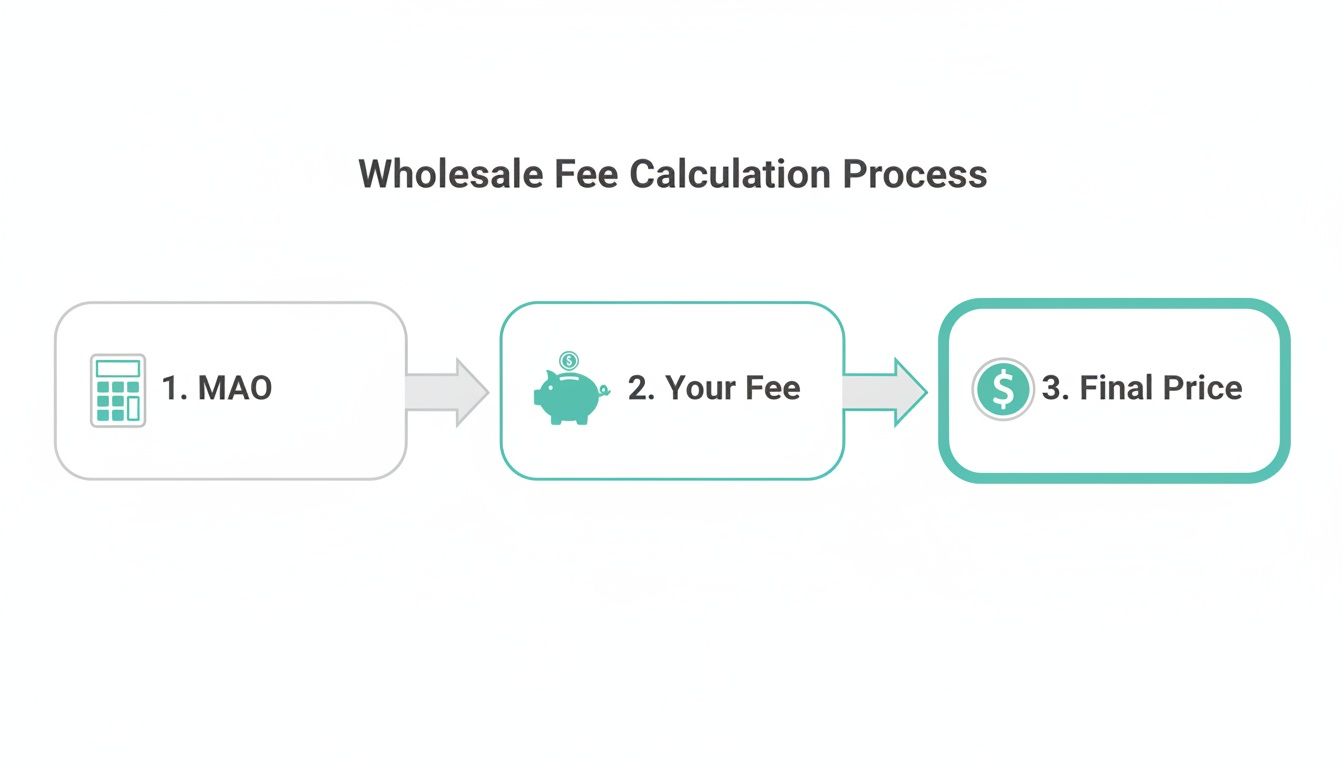
If you get the property under contract for $150,000 after negotiations and assign it to your cash buyer for $168,200, you would earn an $18,200 assignment fee—even more than planned.
This step-by-step process gives you a competitive edge. Being able to quickly and accurately analyze a deal means you can make confident offers while others are still hesitating. For more on finding these opportunities, check out our guide on how to find off-market properties.
Common Pitfalls To Avoid In Your Calculations
Even with the best wholesale real estate calculator, your outputs are only as good as your inputs. A small mistake or an overly optimistic guess can turn a home run into a financial landmine. Learning to spot these common pitfalls is what separates pros from rookies.
Underestimating Repair Costs
This is the single biggest deal-killer in wholesaling. If you get the repair budget wrong, the entire deal falls apart, wiping out the profit for your end buyer. A flipper who gets burned on your numbers once is unlikely to work with you again.
- Walk Every Property: Take detailed photos and videos of big-ticket items—roof, HVAC, electrical, plumbing, and foundation.
- Build a Price List: As you gain experience, create a price list for common jobs in your market (e.g., a new roof costs X, a basic kitchen remodel costs Y). For beginners, bringing a trusted contractor is a smart investment.
- Add a Contingency Buffer: Always add a 10-15% contingency to your final repair estimate. Distressed properties often hide surprises like old water damage or faulty wiring. That buffer is your buyer's safety net.
Relying on Bad Comps for ARV
Your After Repair Value (ARV) is the anchor for your entire deal analysis. If that number is inflated, every other calculation is flawed. Using bad comparable sales ("comps") is the fastest way to overpay and present a deal that makes no financial sense.
A great comp is a recently sold, fully renovated property that is nearly identical to your subject property in size, style, age, and location. Drifting too far on distance or time will give you a dangerously inaccurate ARV.
Look for sold properties from the last 90-180 days, ideally within a half-mile radius. Don't compare a 3-bed/2-bath ranch to a 4-bed/3-bath two-story, even if they're on the same street. Precision is critical.
Forgetting Hidden Holding and Closing Costs
A flipper’s expenses don't stop on closing day. There are numerous ongoing costs that a smart wholesaler must account for. Forgetting these makes a deal look more profitable than it really is.
These "hidden" costs include:
- Loan interest payments
- Property taxes
- Insurance
- Utilities (water, electricity, gas)
- Commissions for the real estate agent who sells the renovated home
While your calculator might not have a line item for each of these, the 70% Rule is designed to account for them. That 30% discount is a buffer to cover these carrying costs and the investor's profit. Sticking to that rule ensures you’re presenting a deal that realistically accounts for a buyer’s total investment.
Ditch The Spreadsheet And Analyze Deals Instantly
Manually crunching numbers for every potential deal is a time-consuming process. A dedicated investor marketplace changes the game, shifting you from clunky spreadsheets to instant, data-backed decisions. Instead of plugging numbers into a separate wholesale real estate calculator, the analysis tools are baked right into every listing.
On a marketplace platform, investors can get an immediate read on potential ROI and cash-on-cash return without leaving the deal page. This allows you to vet dozens of opportunities in the time it used to take to underwrite just one.
How a Marketplace Streamlines Deal Analysis
This integration of tools and deal flow is a massive advantage for both sides of the transaction.
- For Investors: It’s all about speed and confidence. On our marketplace, you can set up a "buy box" to filter for deals that fit your exact criteria, then immediately verify if the numbers work for your financial goals.
- For Wholesalers: This adds transparency and credibility. When buyers can see how you calculated your numbers using industry-standard formulas, it builds trust and shortens their due diligence. It also connects you with pre-qualified investors actively looking for deals like yours.
The goal is to move faster and be more accurate. By removing the friction of manual calculations, the platform frees you up to focus on what actually matters—negotiating great deals and closing more properties. You can learn more about our integrated investment property calculators to see how they work in real-time.
Frequently Asked Questions
Even with the best tools, questions will come up. Here are answers to a few common ones that investors face when running numbers on a wholesale deal.
Is The 70% Rule A Hard And Fast Rule?
No, think of it as a critical guideline, especially for beginners. The 70% Rule provides a conservative baseline that protects you and your buyer.
However, real estate is market-dependent. In a hot seller's market, investors might push their offers to 75% or even 80% of ARV to secure a deal. Conversely, in a cooling market, you might need to drop your offers to 65% of ARV to leave enough profit potential to attract a serious cash buyer.
How Can I Accurately Estimate Repairs?
You don’t need to be a licensed contractor, but you need a system. Start by creating a simple checklist for big-ticket items: roof, HVAC, kitchen, bathrooms, flooring, and paint. Research local cost ranges for each. For your first few deals, walking the property with a trusted contractor is one of the best investments you can make. Over time, you'll become proficient at building a reliable repair budget on your own.
Can I Use A Wholesale Calculator For Multifamily Properties?
While the concepts of ARV and rehab costs apply, a standard single-family wholesale calculator isn't built for multifamily deals. Multifamily properties are valued based on income metrics like Net Operating Income (NOI) and Capitalization (Cap) Rate.
A basic calculator can't handle the variables of a multifamily investment, where factors like local vacancy rates, rent growth, and regional supply forecasts are critical. For a deeper dive into these larger forces, it's worth reviewing the global real estate market outlook to understand how they impact investment calculations.
Ready to stop guessing and start analyzing deals with speed and precision? An investor marketplace provides the tools and network to make data-driven offers with confidence. Define your criteria, find deals that match, and connect with partners to grow your business.
Create your free investor profile today to get matched with deals that fit your criteria.