If you're getting into real estate investing, you need to know the acronyms, and one of the most fundamental is SFR, which stands for Single-Family Rental. An SFR is a detached, standalone house on its own lot, owned by an investor and rented to a tenant. Understanding this asset class is crucial because for many investors, from beginners to seasoned pros, SFRs are the cornerstone of a profitable portfolio.
This guide will break down exactly what an SFR is, why it's such a powerful investment vehicle, and how you can find, analyze, and fund these deals to build long-term wealth.
Understanding the Single-Family Rental
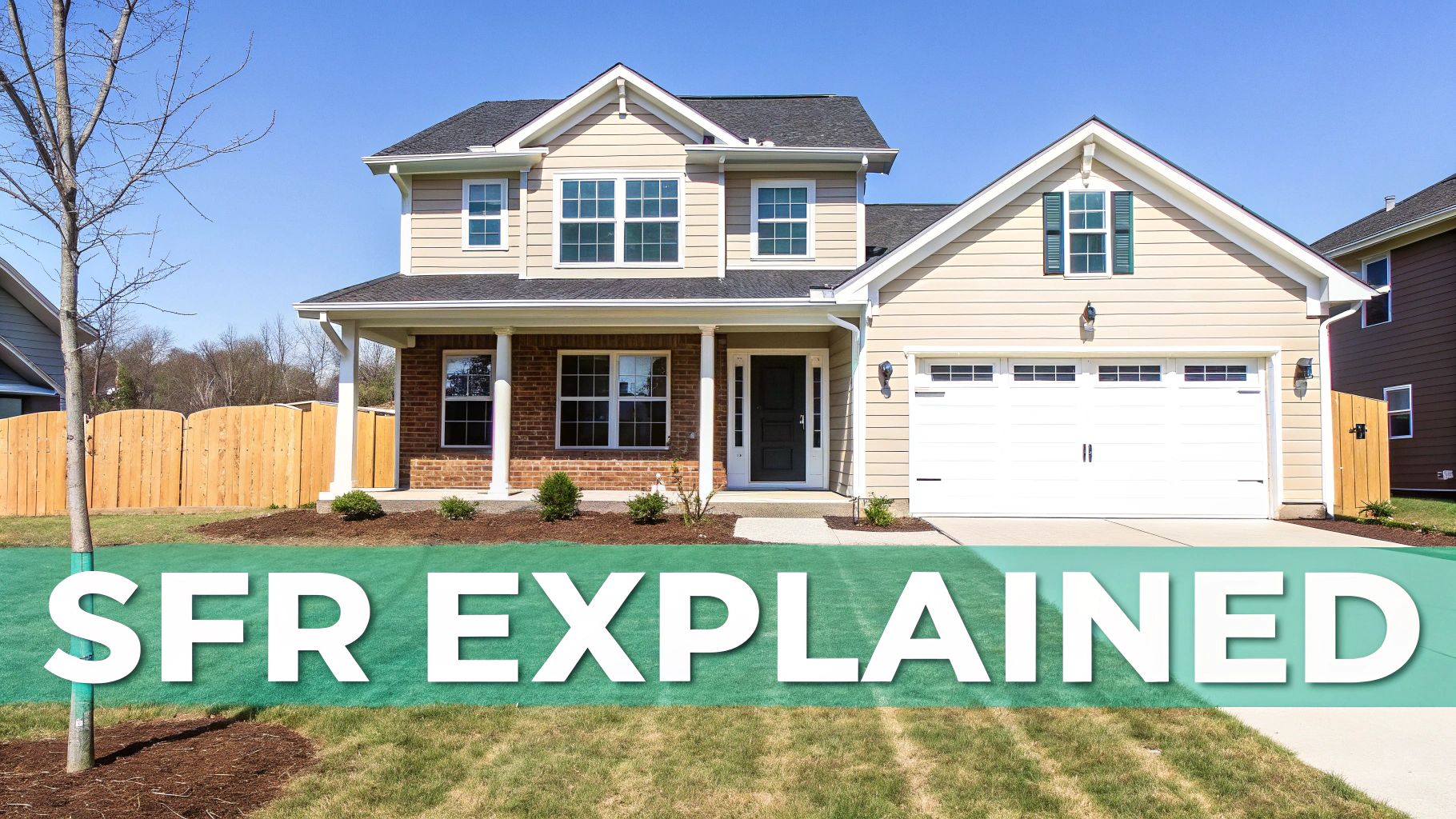
So, what makes an SFR different from any other rental? It's all about the structure. Unlike a condo, apartment, or townhouse, a true SFR is a detached home with no shared walls. This distinction is critical for investors because it gives tenants a sense of privacy and space that drives strong, consistent demand.
The standalone nature of an SFR attracts a specific type of tenant—often families looking for stability. This frequently translates into longer lease terms and less tenant turnover, which is a direct boost to your bottom line. Families are drawn to the lifestyle a single-family home offers: a private yard, more space, and the feeling of being part of a neighborhood, all without the financial commitment of a mortgage.
Core Benefits for Investors
Whether you're just starting out or scaling a large portfolio, SFRs offer a compelling package. They are a tangible asset, making them easier to understand than abstract financial products. The benefits are direct and powerful.
Here’s what makes SFR investing so attractive:
- Steady Cash Flow: This is the primary goal. The rent collected each month should cover all expenses—mortgage, taxes, insurance, and maintenance—with profit left over for you.
- Long-Term Appreciation: While you collect monthly rent, the property itself is typically increasing in value over time, quietly building your net worth through equity growth.
- Significant Tax Advantages: As an investor, you can deduct numerous expenses, including mortgage interest, property taxes, and operating costs. You can also leverage depreciation, a powerful tax strategy that allows you to write off the value of the building over time, which can significantly reduce your taxable income.
- Control and Autonomy: Unlike investing in a REIT (Real Estate Investment Trust) or a fund, owning an SFR gives you direct control over all decisions, from tenant selection to renovation choices.
For beginners: An SFR is an excellent entry point. It's a straightforward way to learn the fundamentals of property management and deal analysis. For experienced investors: SFRs are a stable and scalable asset class for building a diversified, high-performing portfolio.
What's Happening in the SFR Market and Why You Should Care
To understand what a single-family rental is, you have to look beyond the definition and see the market forces driving this asset class. Major economic and social trends are increasing demand for these properties, creating a stable and promising environment for investors.
It starts with a fundamental shift in how people want to live. More households now prioritize space, privacy, and a private yard—all standard features of a single-family home. This isn't a passing trend; it's a significant change in lifestyle preference, making SFRs one of the most sought-after rental products available.
The Unshakeable Demand for Single-Family Living
Another huge driver is the simple fact that buying a home has become incredibly difficult. With high home prices and interest rates, many would-be buyers are renting for much longer than they originally planned. This group often has stable income and a strong desire for the single-family lifestyle, creating a large, reliable pool of tenants for SFR investors. They are searching for long-term homes, not just temporary housing.
This relentless demand is the bedrock of the entire SFR market. Single-Family Rentals are an absolute powerhouse in the U.S., making up 30% of all rental households—that’s about 14 million households nationwide. Investor confidence is soaring, with investors recently purchasing a record 30% of all single-family homes sold. You can explore more data on the SFR market's impressive growth to see how both large and small investors are shaping the market.
Key Takeaway: The combination of a deep-seated desire for single-family living and the high cost of homeownership creates powerful, sustained demand for SFRs. This is a long-term structural shift that makes the market incredibly resilient.
The Rise of Build-to-Rent Communities
Institutional confidence in SFRs has even sparked a new industry: Build-to-Rent (BTR). In this model, developers construct entire neighborhoods of new single-family homes specifically to be rented out.
For an individual investor, this trend is a massive validation signal:
- It Validates the Model: When institutional giants bet billions on the future of single-family rentals, it's a huge vote of confidence in the asset class's long-term strength.
- It Sets a New Standard: BTR communities often include professional management and modern amenities, raising tenant expectations across the board. This is a trend every SFR owner should monitor.
- It Leaves Room for You: While BTR adds new supply, it primarily targets a specific segment of the rental market. This leaves plenty of opportunity for smaller investors to buy, improve, and operate existing homes in established neighborhoods.
Understanding these market forces is critical. It shows that SFR investing isn't just about buying a house; it's about tapping into one of the most fundamental and enduring needs in the American housing market.
Common SFR Investment Strategies
You know what an SFR is, but the real question is how you make money with them. There isn't just one playbook. The right strategy for you depends on your capital, risk tolerance, and long-term financial goals. Let's break down the three most common paths investors take to turn a single-family house into a cash-flowing asset.
The Classic Buy-and-Hold Strategy
This is the cornerstone of real estate wealth-building. The approach is simple and effective: you buy a solid property and hold it for years, letting time and the market do the heavy lifting. The goal is to build steady, long-term wealth in two powerful ways:
- Monthly Cash Flow: After the rent covers the mortgage, taxes, insurance, and repairs, the money left over is your profit—a reliable income stream.
- Long-Term Appreciation: While you collect rent, the property's value generally increases due to market forces, inflation, and paying down your loan, building your equity.
This is the perfect approach for investors who prioritize stability over speed.
The BRRRR Method for Scaling
For investors who want to build a portfolio quickly, the BRRRR method (Buy, Rehab, Rent, Refinance, Repeat) is a powerful accelerator. It’s an active, cyclical strategy designed to use the same capital to acquire multiple properties.
Here’s how the five steps work:
- Buy: Find a distressed or undervalued property that you can purchase below market value.
- Rehab: Renovate the property with smart upgrades to "force appreciation" and significantly increase its value.
- Rent: Place a qualified tenant in the newly renovated property to establish a steady rental income stream.
- Refinance: Go to a lender for a "cash-out" refinance based on the property's new, higher appraised value.
- Repeat: Use the cash pulled out from the refinance as the down payment for your next property, starting the process all over again.
The BRRRR method is a powerhouse for scaling because it leverages the bank's money to grow your portfolio, rather than requiring you to save up for each down payment.
The Simple Buy-to-Rent Approach
If you're just starting, the Buy-to-Rent strategy is the most straightforward path into the rental market. It’s a simplified version of Buy-and-Hold, focused on acquiring a turnkey property—a house that is already in good condition and ready for a tenant on day one.
With this approach, you skip the complexities of managing contractors and renovation budgets. Your goal is to find a solid house in a good location, screen for a reliable tenant, and start collecting rent immediately. It has a lower barrier to entry and is an excellent way to learn the fundamentals of being a landlord.
How to Analyze an SFR Deal Using Key Metrics
Successful real estate investing is about running the numbers, not relying on gut feelings. A profitable Single-Family Rental (SFR) portfolio is built on a foundation of data-driven decisions. Fortunately, you don’t need a finance degree to master the essentials. By focusing on a few key metrics, you can quickly assess a property's financial health and determine if it aligns with your goals.
This flowchart breaks down the three core strategies you can take with an SFR, but no matter which path you choose, the math behind a good deal stays the same.
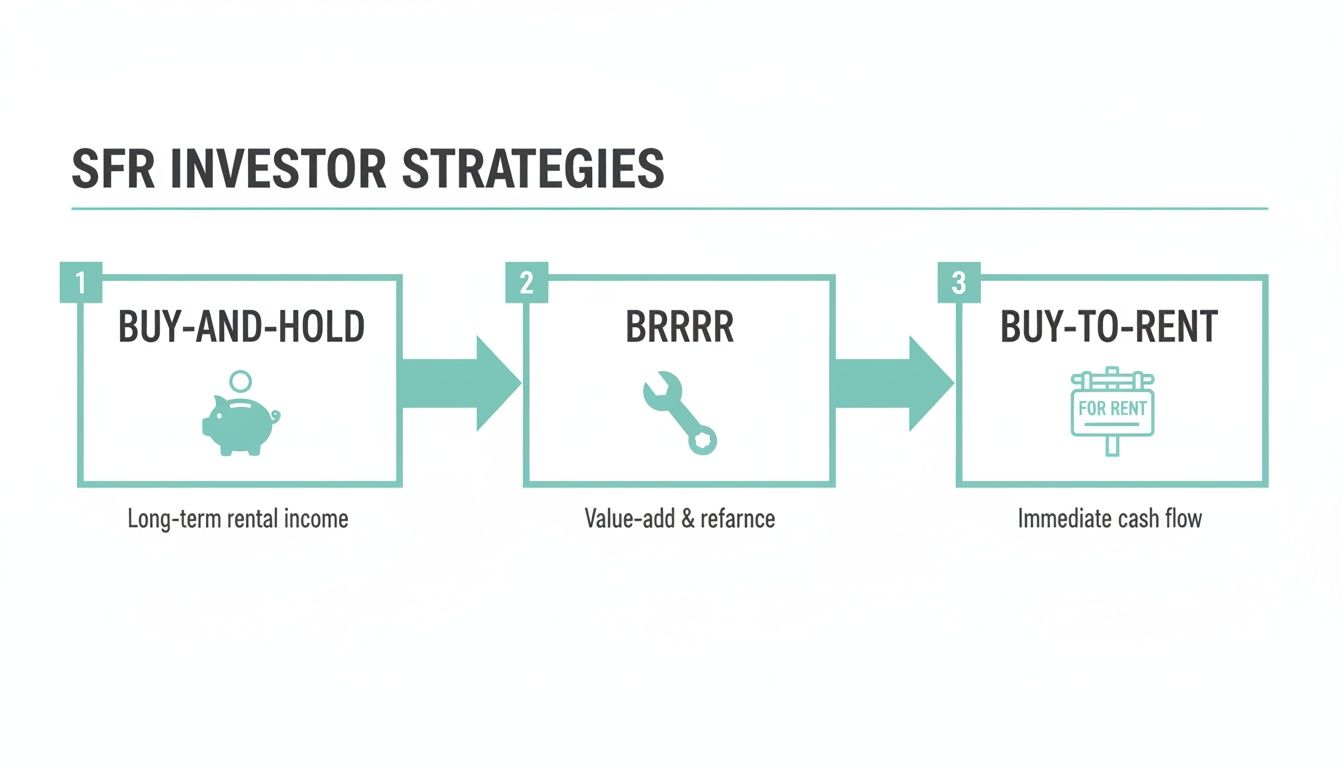
Whether you're aiming for the steady income of a Buy-and-Hold or the dynamic equity-building of the BRRRR method, it all starts with the same fundamental analysis.
Starting with Net Operating Income (NOI)
The first and most important metric is Net Operating Income (NOI). Think of NOI as the property's annual profit before factoring in your mortgage payment or income taxes. It is the purest measure of a property's ability to generate cash on its own.
The formula is simple: Gross Rental Income - Operating Expenses = Net Operating Income (NOI)
Operating expenses include all necessary costs to keep the property running:
- Property Taxes
- Insurance
- Maintenance and Repairs
- Property Management Fees
- Utilities (if paid by the owner)
- Vacancy Loss (always budget for periods when the property is empty)
Starting with NOI gives you a clean look at a property's raw profitability, independent of your financing structure.
Understanding Cap Rate and Cash-on-Cash Return
Once you have the NOI, you can calculate two other crucial metrics: Capitalization Rate (Cap Rate) and Cash-on-Cash Return.
Cap Rate measures the return you would get if you paid all cash for the property. It’s a great way to compare the raw potential of different deals in a market. A higher cap rate often suggests a higher potential return (and sometimes, higher risk).
Cash-on-Cash Return is arguably the most important metric for most investors because it measures the return on the actual cash you invested—your down payment, closing costs, and initial rehab funds. It answers the most critical question: "How hard is my money working for me?"
For Beginners: If you only master one metric, make it Cash-on-Cash Return. It directly connects your initial investment to your annual pre-tax profit, making it the most practical gut check for a deal's real-world performance.
While the rapid rent growth of recent years has stabilized, the long-term trend for SFRs remains strong. U.S. rents saw a modest 1% year-over-year increase in a recent September, but that's on top of a massive 29% cumulative jump since 2020. To put that in perspective, the average renter now pays about $7,300 more per year than five years ago, proving the powerful income potential of this asset class. You can see the latest numbers in the full CoreLogic report on single-family rent trends.
To see how these numbers work in practice, let's walk through a quick example calculation for a hypothetical SFR deal.
Example SFR Deal Calculation
This table breaks down the key metrics for a sample property, showing you exactly how the formulas work with real numbers.
| Metric | Calculation | Example Value |
|---|---|---|
| Purchase Price | - | $250,000 |
| Down Payment (20%) | $250,000 * 0.20 | $50,000 |
| Closing Costs | - | $5,000 |
| Total Cash Invested | $50,000 (Down Payment) + $5,000 (Closing Costs) | $55,000 |
| Gross Annual Rent | $2,000/month * 12 | $24,000 |
| Annual Expenses | Taxes, Insurance, Maint., Mgmt., Vacancy (Est. 40%) | $9,600 |
| NOI | $24,000 (Gross Rent) - $9,600 (Expenses) | $14,400 |
| Cap Rate | $14,400 (NOI) / $250,000 (Price) | 5.76% |
| Annual Mortgage | Principal & Interest on $200,000 Loan | $13,548 (Est. @ 6%) |
| Annual Cash Flow | $14,400 (NOI) - $13,548 (Mortgage) | $852 |
| Cash-on-Cash Return | $852 (Annual Cash Flow) / $55,000 (Total Cash) | 1.55% |
As you can see, each metric builds on the last to give you a complete financial snapshot. Running these simple calculations is the first step to moving from simply finding properties to finding truly profitable investments.
Financing and Scaling Your SFR Portfolio
Analyzing a deal is one skill; funding it and scaling from one house to a full portfolio is another. Getting the right financing is the first hurdle, and it becomes even more critical as you grow. Fortunately, investors have a toolbox of funding options suited for different stages of their journey.
For most beginners, traditional financing like conventional mortgages or FHA loans is the most common path for acquiring the first one or two properties.
Common Financing Options for SFR Investors
As you gain experience, your funding strategy must evolve. Moving beyond your first couple of deals means looking at more specialized financing designed for investors building a business.
Here are a few paths savvy investors take:
- Portfolio Loans: Once you own several properties, some lenders offer a single "blanket" loan that covers them all. This simplifies your finances and can free up capital for your next acquisition.
- Private and Hard Money Lenders: When a deal is time-sensitive or the property is a fixer-upper that won't qualify for a conventional loan, these lenders offer speed and flexibility in exchange for higher interest rates.
- Strategic Refinancing: This is the engine of the BRRRR method. After renovating a property to increase its value, a cash-out refinance allows you to pull your original capital back out to reinvest in the next deal.
Understanding your financing options is a critical skill. The right loan at the right time can be the difference between buying one property and building an entire portfolio. You can explore our complete guide to real estate financing options to see which strategy best fits your goals.
Scaling and Management
Growing from one SFR to ten or more isn't just about buying more houses—it's about building systems. A key decision is whether to continue managing everything yourself or hire a professional property manager. Self-management is a great way to learn the business, but it is a job.
Hiring a professional, which typically costs 8-12% of the monthly rent, frees you up to focus on what actually grows your wealth: finding the next great deal.
Finally, never overlook the powerful tax benefits of owning rental properties. As an SFR owner, you can deduct mortgage interest, property taxes, insurance, and repairs. The biggest advantage is depreciation—a non-cash deduction that allows you to write off the building's value over time. This can dramatically lower your taxable income and supercharge your real returns.
Finding Profitable SFR Deals in a Competitive Market

Knowing how to analyze a single-family rental is essential, but that skill is useless without a consistent flow of deals to evaluate. In today's crowded market, consistent deal flow is what separates professional investors from frustrated amateurs. The competition is fierce, with private funds seeing their SFR portfolio values jump 39% year-over-year to $7.5 billion in a recent quarter. Both institutional and small-time investors drove a record 30% investor share of all single-family home purchases. You can get more insights on the competitive SFR market from Houlihan Lokey.
Traditional vs. Modern Deal Sourcing
For years, investors relied on a handful of old-school methods. While these can still work, they are often slow and inefficient.
- Investor-Friendly Agents: Building a relationship with a real estate agent who understands investment metrics is a classic strategy. They can bring you deals that fit your criteria as soon as they hit the market.
- Driving for Dollars: This involves driving through target neighborhoods to find properties that appear distressed, then tracking down the owners to make an offer.
- Direct Mail: Sending letters to homeowners in a target area can generate leads, but it's a numbers game requiring hundreds of mailers for just a few responses.
These foundational methods require significant time and effort. Seasoned investors know that to gain a real edge, you must find ways to see more deals, faster than the competition. For more advanced tactics, check out our guide on finding off-market properties.
Using Technology to Get an Advantage
This is where an investor marketplace changes the game. Instead of manually searching for deals, technology can bring pre-vetted opportunities directly to you, turning a frustrating hunt into an efficient process. On a platform like ours, you can create a detailed investor profile—your "buy box"—that outlines your exact criteria, including target locations, price points, and desired return on investment.
The platform then automatically notifies you the moment a matching SFR property is posted by a wholesaler or another seller. This direct connection gives you a serious competitive advantage, allowing you to analyze and act on opportunities before they are seen by the broader market. This marketplace model helps wholesalers connect with qualified buyers and helps investors find deals that fit their specific strategy, accelerating the entire transaction process.
Frequently Asked Questions About SFR Investing
As you dive deeper into the world of Single-Family Rentals, a few questions always come up. Here are the answers to some of the most common ones.
Are Townhouses and Condos Considered SFRs?
In real estate investing, the answer is a firm no. While a single family may live in them, the term "SFR" almost exclusively refers to a detached home on its own lot. Townhouses and condos are different asset classes with shared walls, common areas, and Homeowners Associations (HOAs). These factors introduce different management challenges and risk profiles, which is why investors categorize them separately.
What Are the Biggest Risks with SFR Investing?
The biggest risk is vacancy. Since your entire rental income is tied to one door, that property going empty results in a 100% income loss overnight. Other significant risks include:
- Major Capital Expenditures: An unexpected roof replacement or HVAC failure can wipe out a year's worth of profit.
- Problem Tenants: A single difficult tenant can become a massive drain on your time, energy, and finances, potentially costing thousands in legal fees, repairs, and lost rent.
You can mitigate these risks with a thorough tenant screening process, a healthy cash reserve for repairs, and proper insurance coverage.
When Should I Hire a Property Manager?
There's no magic number, but the decision usually comes down to your time, expertise, and proximity to your rentals. Many investors self-manage their first one to three properties to learn the business from the inside out. However, if you want to scale your portfolio, invest in properties out of state, or simply free up your time to focus on finding new deals, hiring a good property manager is a critical step. They are the key to turning a few rentals into a scalable business.
Ready to stop hunting for deals and start analyzing them? An investor marketplace connects you with SFR opportunities that perfectly match your investment criteria.
Create your free investor profile to get matched with deals that fit your strategy.