
If you're exploring real estate investing, you've likely heard about single-family rentals and duplexes. But for investors seeking a powerful blend of cash flow and scalability, the quadplex is a strategic sweet spot. Understanding this unique asset class can accelerate your portfolio growth, whether you're just starting or looking to expand.
A quadplex, also known as a fourplex, is a single residential building that contains four separate apartment units. This property type is a game-changer because it combines the accessible financing of a residential home with the significant income potential of a small apartment building, offering a unique advantage for savvy investors.
What's a Quadplex and Why Should Investors Care?
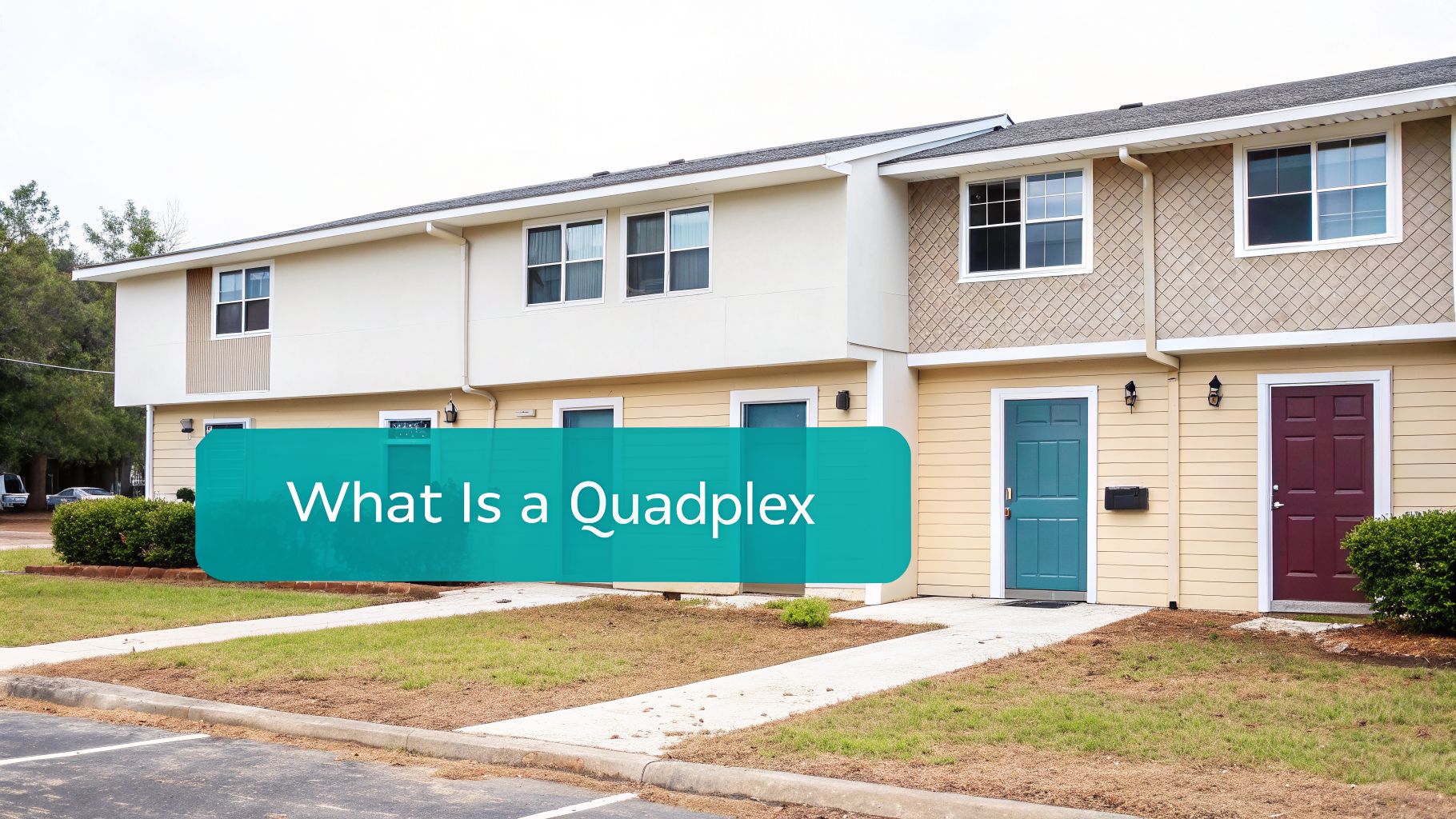
At its core, a quadplex is a multifamily property with four distinct homes under one roof. Each unit typically has its own private entrance, kitchen, bedrooms, and bathrooms, giving tenants the privacy of a single-family home while providing you, the investor, four income streams from one asset.
Herein lies the strategic advantage. A quadplex is more scalable than a duplex (two units) or a triplex (three units), but it’s still considered residential property. This is a crucial distinction. Buildings with five or more units are classified as commercial, which requires more complex and expensive financing. That one-unit difference makes the quadplex accessible to both new and experienced investors looking to grow their portfolios efficiently.
Quadplex At A Glance
| Characteristic | Description |
|---|---|
| Number of Units | Exactly four separate and self-contained living units. |
| Property Type | Multifamily residential. |
| Financing | Qualifies for residential loans (FHA, VA, Conventional). |
| Management | More efficient than managing four separate single-family homes. |
| Income Streams | Provides four distinct sources of rental income from one property. |
| Ideal For | House hacking, entry-level investors, and efficient portfolio scaling. |
This combination of features makes the quadplex a uniquely powerful tool in an investor's toolkit.
The Ultimate House Hacking Machine
For new investors, the quadplex is the ideal vehicle for a strategy called house hacking. The concept is simple: you live in one of the four units and rent out the other three. In many markets, the rent collected from the three tenants can cover your entire mortgage, property taxes, and insurance.
This strategy unlocks two massive advantages:
- Reduced or Eliminated Housing Costs: Your tenants are effectively paying down your mortgage while you build equity in a valuable, income-producing asset.
- Favorable Financing: Because you’re living in one of the units (as your primary residence), you can qualify for owner-occupant loans like an FHA loan or VA loan, which offer incredibly low down payment requirements—sometimes as little as 3.5%.
A Smarter Way to Scale Your Portfolio
Experienced investors appreciate the operational efficiency of a quadplex. Managing four units in one location is far simpler than managing four single-family homes scattered across town. Consider the benefits: one roof to maintain, one lawn to mow, and one trip to handle multiple maintenance requests. This consolidation drives down your operating costs per unit and saves significant time.
The demand for small multifamily rentals is also strong. According to recent market data, the global multifamily housing construction market is projected to grow substantially, from USD 1 trillion in 2026 to USD 1.5 trillion by 2030, showing robust investor confidence in this asset class. You can dig into the full research on multifamily market trends for more details.
The Strategic Advantages Of Investing In Quadplexes
 Seasoned investors often gravitate toward quadplexes for two practical reasons: stronger economics and smarter risk management. These properties offer financial benefits that single-family rentals or even duplexes can’t match, especially when it comes to managing every landlord’s biggest risk—vacancy.
When a tenant moves out of a single-family rental, your income drops to zero. In a duplex, one empty unit means an instant 50% loss of your gross rental income. However, in a quadplex, that same vacancy only represents a 25% loss. This built-in vacancy buffer creates a powerful financial cushion, making your cash flow far more stable and predictable.
This resilience is a cornerstone for building a durable portfolio, particularly in uncertain economic times. The simple math of a 25% income loss versus 50% provides a clear advantage. If you want to dig deeper, you can explore how fourplexes outperform duplexes in volatile markets.
Achieving True Economies Of Scale
Beyond vacancy protection, the quadplex is a masterclass in efficiency. Because all four units are under one roof, you benefit from significant economies of scale. Instead of managing four separate properties, you consolidate your efforts and, more importantly, your expenses.
Consider the major property ownership costs:
- One Roof: You only have one roof to inspect, repair, and eventually replace, not four.
- One Foundation: A single foundation supports all four units, simplifying major structural maintenance.
- One Insurance Policy: Insuring one four-unit building is almost always cheaper than purchasing four separate policies.
- One Set of Vendors: You can hire one landscaper, one snow removal service, and one pest control company for the entire property.
This consolidation slashes your per-unit operating costs. Every dollar saved on expenses drops directly to your bottom line, boosting your Net Operating Income (NOI) and overall return on investment.
For beginners: The simplicity here is key. One property means one trip for maintenance calls, one set of property tax bills, and one mortgage payment. It makes your first multifamily investment far less overwhelming.
The Power Of Concentrated Cash Flow
Ultimately, all these advantages lead to one outcome: more robust and predictable cash flow. With four income streams from a single asset and lower per-unit expenses, a quadplex is a financial workhorse. It’s a true portfolio accelerator.
For an experienced investor, this efficiency is the key to scaling. Adding one quadplex to your portfolio can have the same income impact as acquiring four separate single-family rentals but with significantly less administrative headache. This allows you to grow your holdings faster and more profitably.
How To Finance Your First Quadplex Purchase
Financing a four-unit property is more accessible than many new investors realize. The quadplex's unique advantage is that it's the largest property type that still qualifies for owner-occupant residential loans. This completely changes the financing game.
Instead of the typical 20-25% down payment required for a commercial loan, an investor who plans to live in one of the units can access powerful government-backed programs. This strategy, known as house hacking, opens the door for investors to get started with a much lower upfront cost and more favorable loan terms.
Owner-Occupant Financing: The Smart Start
If you're willing to live on-site for at least one year, a different world of residential loan options becomes available. These loans are designed for primary residences, but regulations for 2-4 unit properties allow you to use them for your first quadplex.
The two most popular programs are:
- FHA Loans: Backed by the Federal Housing Administration, these loans allow you to purchase a property with a down payment as low as 3.5%. This is a major advantage for new investors without large cash reserves.
- VA Loans: Available to eligible veterans, active-duty service members, and surviving spouses, these loans are even more powerful. They often require 0% down, removing the single biggest barrier for qualified buyers.
Key takeaway for new investors: Lenders can often count a portion of the projected rental income from the other three units—usually around 75%—to help you qualify for the mortgage. This makes it much easier to get approved for the loan amount needed to buy the property.
Conventional and Commercial Lending Options
If you're an experienced investor with no plans to live in the property, you'll use a different financing path. While owner-occupant loans are off the table, you still have excellent options.
A conventional investment property loan is the most common route. These typically require a down payment of 20-25%. The approval process is stricter than an FHA loan, as lenders will closely examine your credit score, income, and existing debt.
For investors with a larger portfolio or those buying the property under an LLC, a commercial loan may be the right fit. With these loans, the lender focuses less on your personal income and more on the property's financial performance. They will analyze the deal's Net Operating Income (NOI) and cash flow potential to ensure the property can support the debt. To learn more, check out our guide on the complete spectrum of real estate financing options.
Be aware that commercial loan terms differ from residential ones. They often have shorter terms (e.g., 5-10 year balloons) and may have variable interest rates. The trade-off is greater flexibility, especially for investors looking to scale their operations.
Analyzing A Quadplex Deal Like A Seasoned Pro
Investing without running the numbers is just gambling. To invest like a professional, you must underwrite a quadplex with confidence. This means mastering a few key metrics that reveal whether a deal is truly worth pursuing.
These calculations cut through the sales pitch to reveal the property’s true financial health. The three most important are Net Operating Income (NOI), Capitalization Rate (Cap Rate), and Cash-on-Cash Return. Think of them as the tools you need to build a clear financial picture and determine what the property is genuinely worth to you.
Key Investment Metrics You Have To Know
A proper deal analysis goes beyond just looking at the monthly rent. You must account for every expense that reduces your profit. A solid analysis includes all income, all operating expenses, and—critically—reserves for future vacancies and capital expenditures like a new roof or HVAC system.
- Net Operating Income (NOI): This is the purest measure of a property's profitability. It’s the building's total annual income after you've paid all operating expenses but before accounting for your mortgage payment (debt service) and income taxes.
- Capitalization Rate (Cap Rate): This is your go-to metric for comparing the potential return of different properties. It measures the property’s NOI relative to its market value, giving you a quick snapshot of its performance. If you need a refresher, check out our in-depth guide on how to calculate cap rate.
- Cash-on-Cash Return: This is arguably the most important metric for any investor using financing. It measures the annual pre-tax cash flow relative to the total amount of cash you invested. It answers the simple, crucial question: "How hard is my actual cash working for me?"
For Beginners: Your first priority is getting accurate numbers for income and all operating expenses (taxes, insurance, management, repairs, utilities, etc.). A deal that looks fantastic on paper can fall apart quickly if you underestimate your costs.
This map illustrates how different loan types, from FHA to commercial, fit into your overall deal structure and financial picture.
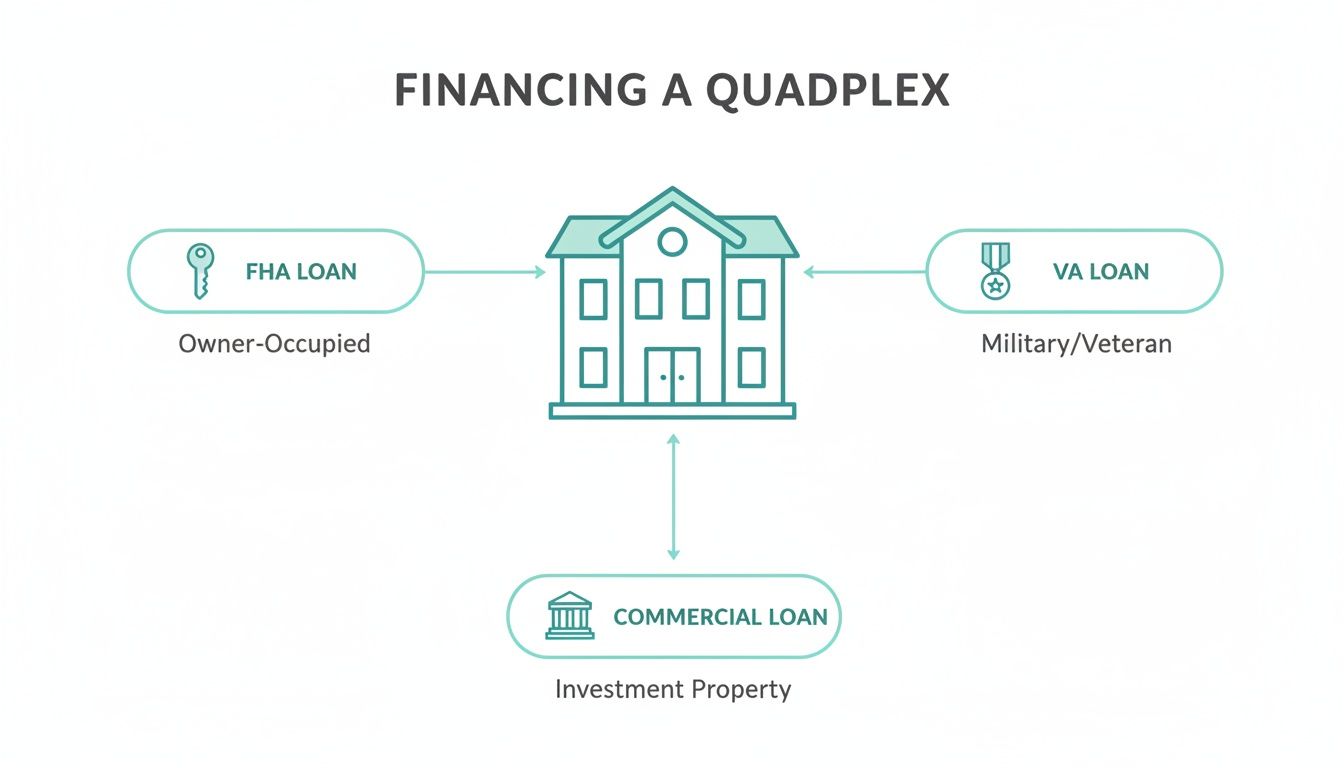
As you can see, your financing choice has a massive impact on your down payment and overall returns, making it a critical piece of your analysis.
Key Investment Metrics For Analyzing A Quadplex
| Metric | Formula | What It Measures |
|---|---|---|
| Net Operating Income (NOI) | (Gross Rental Income + Other Income) - Operating Expenses | The property's raw, unleveraged profitability before debt. |
| Capitalization Rate (Cap Rate) | Net Operating Income / Purchase Price | The potential rate of return, used to compare different properties. |
| Cash-on-Cash Return | Annual Pre-Tax Cash Flow / Total Cash Invested | The return on your actual out-of-pocket investment. |
| Gross Rent Multiplier (GRM) | Purchase Price / Gross Annual Rent | A quick valuation tool based on gross income alone. |
| Debt Service Coverage Ratio (DSCR) | Net Operating Income / Total Annual Debt Service | A lender's key metric; shows if the property can afford the mortgage. |
Getting comfortable with these formulas will give you the confidence to quickly evaluate a deal and decide if it’s worth a deeper look.
Simplify Your Analysis With A Marketplace Platform
Manually building spreadsheets for every potential deal is a time-consuming process prone to errors. This is where an investor marketplace platform becomes an invaluable tool.
Instead of crunching numbers from scratch, you can use built-in investment calculators that instantly analyze the financials of listed properties. On our marketplace, for example, every quadplex listing comes with tools to calculate ROI, Cap Rate, and Cash-on-Cash return on the spot. This allows you to filter out bad deals in seconds and focus your energy on opportunities with real potential, giving you a critical edge in a competitive market.
Managing Your Quadplex For Maximum Profitability
Purchasing a quadplex is just the beginning. Long-term wealth is built through smart, consistent management. Your first major decision is deciding who will run the property. This choice boils down to two paths: self-management or hiring a professional property manager. The right choice for your situation is critical to maximizing your returns.
The DIY Approach: Self-Management
For investors who live nearby—especially house-hackers—self-management can be a great way to maximize cash flow by avoiding management fees. It's also an incredible hands-on education. You'll learn more in your first year of managing a quadplex than from dozens of books.
However, this is a significant commitment. You are the CEO, customer service representative, and head of maintenance. Your responsibilities include:
- Tenant Screening: Thoroughly vetting applicants' income, credit, and references to find reliable tenants.
- Rent Collection: Implementing a system for timely rent collection and enforcing late fees when necessary.
- Maintenance Coordination: Having a reliable network of plumbers, electricians, and other contractors for repairs.
- Lease Enforcement: Addressing lease violations professionally and legally.
For Beginners: Think of self-managing your first quadplex as an immersive real estate bootcamp. It's challenging, but it forces you to learn every aspect of the business, from tenant relations to bookkeeping. That foundation is priceless for scaling your portfolio later.
Calling in the Pros: Hiring a Property Manager
If you are investing from a distance or your goal is to build a passive income stream, hiring a professional property manager is almost always the right move. While their fee—typically 8-12% of the gross monthly rent—is a direct expense, a great manager can often save you more money than they cost.
A good property management company handles all the day-to-day operations, freeing you to focus on finding your next deal. They bring expertise in local landlord-tenant laws, have a network of vetted vendors, and use proven systems for marketing and tenant screening. A solid PM is a strategic partner who turns your quadplex into a well-oiled, income-generating machine.
How To Find And Close Your First Quadplex Deal
So, how do you actually find and acquire a quadplex? Sourcing your first four-unit property requires a deliberate strategy. While traditional methods still work, modern tools provide a significant advantage for cutting through the noise and finding the right deals efficiently.
Sourcing Deals The Smart Way
The classic approach involves networking with real estate agents who specialize in multifamily properties or attending local investor meetups. While great for building relationships, this can be a slow way to find a specific property type like a quadplex. Many investors also spend hours scouring the MLS or hunting for off-market properties.
An investor marketplace platform changes this dynamic. Instead of manually digging through listings, you can set up a "buy box" to automate your search. On the platform, you can set precise criteria for your ideal deal:
- Property Type: Select "Multifamily" and specify 4 units.
- Target Market: Define your preferred cities, counties, or zip codes.
- Financial Criteria: Set minimums for cap rate and cash flow, or a maximum purchase price.
This simple setup creates a pipeline of pre-vetted deals that fit your investment strategy. You can stop wasting time on irrelevant properties and connect directly with wholesalers and sellers who have exactly what you're looking for.
From Analysis To Closing
Once a promising deal appears, you can use the platform's built-in analysis tools to underwrite it in minutes. When you're confident the numbers work, you can message the seller directly to ask questions, submit an offer, and start the closing process. This direct communication streamlines the transaction, helping you get your first quadplex under contract faster. Using technology to find, analyze, and act on good deals gives you a decisive edge.
Create your free investor profile on our platform to get matched with deals that fit your criteria.
Got Questions About Quadplex Investing? We've Got Answers
As you explore quadplex investing, a few common questions often arise. Let's tackle them to clarify key concepts.
Is It Hard to Sell a Quadplex?
The buyer pool for a quadplex is smaller than for a single-family home, which requires a more focused sales strategy. However, there is consistent demand from two key groups: new investors looking to house hack and experienced investors seeking to add another cash-flowing asset to their portfolio.
The key is to work with a real estate agent who specializes in multifamily properties. They know how to market the property to the right audience by highlighting the metrics investors care about: strong rental history, low vacancy rates, and a solid Net Operating Income (NOI).
Can I Use Projected Rent to Qualify for a Loan?
Yes, and this is a major advantage. Most lenders will allow you to use the projected rental income from the other three units to help you qualify for an owner-occupied mortgage. Typically, lenders will count about 70-75% of the estimated fair-market rent from those units in your application.
Lenders hold back the remaining 25-30% as a buffer to account for potential vacancies and maintenance expenses. This rule makes it significantly easier for new investors to get approved for the loan they need.
Are Quadplexes Considered Commercial Real Estate?
No, and this is the most important distinction. A property with four units or fewer is classified as residential real estate. This is what unlocks access to favorable residential financing options like FHA and VA loans.
The moment a property has five or more units, it crosses into commercial real estate. This triggers a different set of rules, including stricter zoning, more complex commercial loans with higher down payments, and a more intensive underwriting process. That one-unit difference is precisely what makes the quadplex such a powerful and accessible entry point into multifamily investing.
Ready to put this knowledge into action? The fastest way to learn is by analyzing real deals.
On Investor Deal Exchange, you can create your free investor profile and set up a buy box to find quadplex opportunities that fit your exact criteria.
Start getting matched with deals today by visiting Investor Deal Exchange.