Trying to grow your real estate portfolio but feeling stuck with trapped equity? Many investors see refinancing as just a way to get a lower interest rate, but for a savvy investor, it's one of the most powerful tools for expansion. This guide will show you how to use refinancing as a strategic weapon to pull out capital for your next deal, improve cash flow, and make your properties work harder for you.
Refinancing isn't just a defensive move to save a few dollars; it's an offensive play to grow your portfolio. Smart investors use it to turn one successful property into the down payment for the next. We’ll walk through the exact strategies and steps you can implement to do the same.
Why Refinance Your Rental Property?
Knowing why you’re refinancing is just as critical as knowing how. The right answer is rarely a single thing; it’s a mix of market timing, your personal goals, and where you want your portfolio to be in five years.
Before diving into the "how," let's quickly map out the main reasons investors refinance. Identifying your primary goal is the first step in shaping your entire strategy and choosing the right loan product.
Key Refinancing Goals for Rental Property Investors
| Refinancing Goal | What It Achieves | Best For Investors Who... |
|---|---|---|
| Lower Your Payment | Reduces monthly mortgage costs by securing a lower interest rate or extending the loan term. | Want to maximize monthly cash flow or create a larger buffer for vacancies and repairs. |
| Pull Cash Out (Cash-Out Refinance) | Converts your property's equity into liquid cash that you can use for anything. | Are looking for a down payment for their next acquisition, especially in a BRRRR strategy. |
| Consolidate Debt | Combines multiple property loans into a single, simpler portfolio loan. | Own several properties and want to simplify their finances and potentially get better overall terms. |
| Pay Off the Loan Faster | Switches to a shorter loan term (e.g., from a 30-year to a 15-year) to build equity quicker. | Are more focused on long-term wealth and debt reduction than immediate cash flow. |
Each of these goals has its own time and place. The key is to match your refinancing strategy to what the market is giving you and where you want to go next.
Capitalizing on Market Dynamics
The real estate market never sits still. After a rollercoaster of interest rate hikes, the market is showing signs of stabilization. When you pair that with stubbornly high rental demand, you get a very compelling environment for a refinance.
For example, when new multifamily construction slows, the supply of rental units tightens. This can lead to higher occupancy rates and more predictable rental income—two things lenders absolutely love to see when you apply for a refinance. Keeping an eye on 2026 rental market predictions can help you time your moves.
Key Takeaway: Refinancing isn’t just about trimming your interest rate. It’s about strategically unlocking and deploying capital when market forces—like tight supply and strong rental demand—are on your side.
Fueling Portfolio Growth
For most serious investors, the number one reason to refinance is simple: growth. A well-timed refinance can be the rocket fuel that gets you into your next property.
Unlock Trapped Equity: Appreciation is great, but equity sitting in a property is "dead money." A cash-out refinance turns that on-paper equity into actual cash you can use for a down payment on another rental. This is the engine behind the famous BRRRR (Buy, Rehab, Rent, Refinance, Repeat) strategy.
Improve Monthly Cash Flow: Lowering your interest rate or extending your loan term drops your monthly payment. That immediately improves your net operating income (NOI)—your property's profit before the mortgage is paid—and gives you a bigger cash cushion for vacancies and repairs.
Consolidate and Simplify: Juggling multiple loans across different properties is an administrative headache. Refinancing can let you roll several loans into a single, streamlined portfolio loan. This not only makes your life easier but can often land you better terms than you had on the individual loans.
When you start seeing refinancing as a strategic tool, you shift from being a passive owner to an active portfolio manager. Once you've unlocked that capital, an investor marketplace on our platform can help you find that next deal and act fast.
Choosing the Right Refinance Option for Your Goals
Alright, you've decided refinancing a rental property is the right move. Now for the important part: picking the right type of refinance. This isn't a one-size-fits-all decision. The best loan for your portfolio depends entirely on what you're trying to accomplish right now.
Knowing the strategic reason behind each refinance type is what separates the pros from the amateurs. Let’s get into the main options you’ll come across.
Rate-and-Term Refinance
This is the most straightforward play in the book. A rate-and-term refinance simply swaps out your old mortgage for a new one, with the goal of securing a lower interest rate or a more favorable term (like switching from a 15-year to a 30-year loan to lower payments). You aren’t pulling any equity out; the new loan is just large enough to pay off your old mortgage and cover closing costs.
- Best For: Investors whose number one goal is improving monthly cash flow on an existing asset.
- Real-World Scenario: Let's say you own a rental with a 6.5% interest rate, and current rates have dropped to 5.5%. A simple rate-and-term refi could lower your monthly payment, increasing your cash flow and cash-on-cash return without adding more debt.
Cash-Out Refinance
This is where things get interesting for investors focused on growth. With a cash-out refinance, you take out a new mortgage that’s larger than what you owe and pocket the difference in cash. It's the most common way to tap into the equity your property has built up from appreciation or paying down your loan.
For active investors, a cash-out refinance is the engine of portfolio expansion. It's how you turn one performing asset into the seed capital for the next, making it a cornerstone of the BRRRR (Buy, Rehab, Rent, Refinance, Repeat) method.
This move can provide the down payment for your next acquisition or fund major renovations on another property. Just remember, you're taking on more debt. The property must still cash flow comfortably with the new, higher mortgage payment.
Cash-In Refinance
This one is less common, but it can be a brilliant strategic tool in certain situations. A cash-in refinance is exactly what it sounds like: you bring your own money to the closing table to pay down the loan balance.
The main reason to do this is to lower your loan-to-value (LTV) ratio—the loan amount divided by the property's value. A lower LTV can help you qualify for a much better interest rate, get rid of private mortgage insurance (PMI), or meet a lender's strict LTV cap for investment properties (often around 75-80%).
- If you’re new, start here: If you're right on the edge of a lender's LTV requirement, bringing a little cash to closing can be the one thing that gets your refinance approved.
- If you’re experienced, focus on this: A cash-in refi can be a smart defensive play to de-risk a property with thin margins. Lowering the payment also lowers your break-even occupancy rate, giving you more breathing room in a downturn.
This flowchart gives you a simple way to visualize the first big question you need to ask yourself when thinking about a refi.
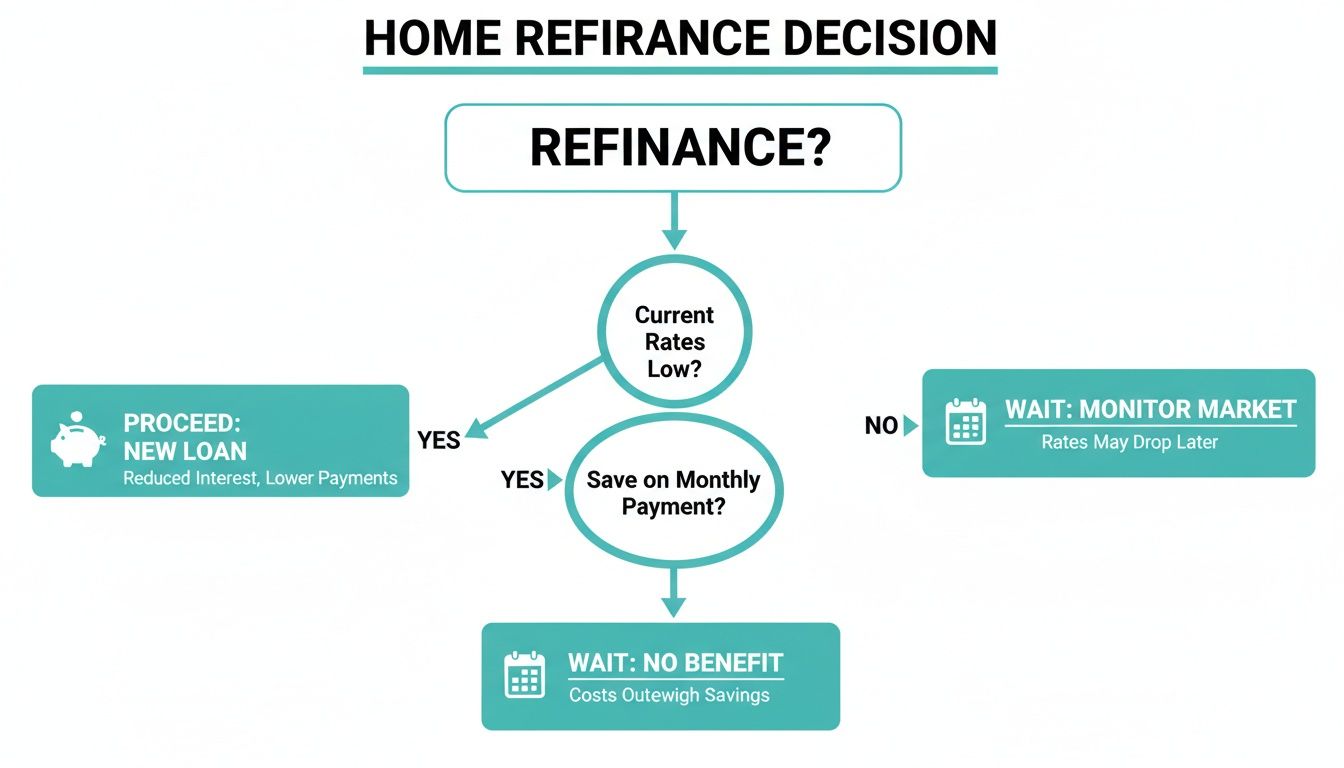
As you can see, the path often leads toward acquiring new deals, which shows just how central refinancing is to growing your portfolio.
Portfolio Loans
Once you've scaled up to managing a handful of properties, all those individual mortgages become a headache. This is where a portfolio loan comes in. It lets you consolidate the debt on several properties into a single loan with one monthly payment. These are commercial loans, typically offered by community banks and specialized lenders who understand the investor world.
The lender underwrites the performance of your entire portfolio, looking at the combined cash flow, occupancy rates, and property values. For a deeper dive into more advanced financing, check out our guide on the different real estate financing options for investors. A portfolio loan can dramatically simplify your financial life and often land you better overall terms.
How to Qualify for an Investment Property Refinance
Forget everything you know about qualifying for a mortgage on your own home. When it comes to refinancing rental property, the lender's focus shifts. They are less concerned with your personal salary and laser-focused on one thing: can the property pay for itself?
Getting approved isn't a secret. It all boils down to a few key metrics that prove your property is a solid, cash-flowing asset. If you can present a deal that makes sense on paper, lenders will be eager to work with you.

DSCR: The Metric That Matters Most
For an investor, the Debt Service Coverage Ratio (DSCR) is everything. This single number tells a lender whether your rental income is sufficient to cover the mortgage payment. For most investor loans, it’s far more important than your personal salary.
The calculation is simple: DSCR = Net Operating Income (NOI) / Total Debt Service
Let's break that down:
- Net Operating Income (NOI): This is your total rental income minus all operating expenses (taxes, insurance, management fees, maintenance). It's your profit before you pay the mortgage.
- Total Debt Service: This is your annual mortgage payments (principal and interest).
Most lenders require a DSCR of at least 1.20x. This means your property’s income is 20% higher than its mortgage payments, giving them a comfortable buffer. A DSCR below 1.0x means you're losing money each month on the loan payment, which is an automatic rejection.
For new investors: Aim for a DSCR of 1.25x or higher. This proves the property has a healthy cash flow cushion and makes you a much lower-risk borrower in the lender's eyes.
For seasoned pros: A high DSCR (think 1.40x+) is your golden ticket. It unlocks the best rates and terms and gives you serious leverage when negotiating on larger deals or portfolio loans.
Loan-to-Value (LTV) and Your Equity Position
Next up is Loan-to-Value (LTV). This ratio shows how much of the property's value is being financed. Lenders are more cautious with investment properties and require you to have more "skin in the game."
While you might get 90% LTV on your primary residence, expect a ceiling of 75-80% for a rate-and-term refinance on a rental. For a cash-out refinance, that maximum almost always drops to a firm 75%. In plain English, you need at least 25% equity to even start the conversation.
Your Personal Financials Still Count
Even with a stellar DSCR, lenders still need to see that you're a responsible borrower.
- Credit Score: You’ll need a score of at least 640 to get in the door. To unlock the most competitive rates, aim for 720 or higher.
- Cash Reserves: Lenders want proof you can handle vacancies or unexpected repairs. Be prepared to show 3-6 months of the new PITI (principal, interest, taxes, and insurance) payment in a liquid account. For a portfolio of properties, they'll want to see even more.
Having your financial house in order is non-negotiable, especially for investors with fluctuating income like wholesalers and flippers. Strong cash reserves are critical. For more on funding your first few deals, check out our guide on hard money construction loans.
Your Step-by-Step Game Plan for a Flawless Refinance
Refinancing an investment property is a business project. Treating it like one from the start is the only way to avoid frustrating delays and keep the deal on track. A clear, organized approach is your best defense against last-minute surprises.
1. Get Your Paperwork in Order Before You Apply
Lenders will ask for a ton of documents. Having everything organized and ready to go before you even submit your application shows you're a professional investor and can shave weeks off the underwriting process.
Create a single digital folder and start gathering these essentials:
- Personal Finances: Last two years of tax returns (personal and business), recent pay stubs, and W-2s.
- Asset Statements: Two to three months of statements for all bank and brokerage accounts to prove you have the required cash reserves.
- Property-Specific Docs: This is where an investor loan gets serious. You’ll need:
- A copy of the current lease agreement for every unit.
- A rent roll that lists each tenant, their monthly rent, and their lease end date.
- A property-level Profit & Loss (P&L) statement.
- Your most recent mortgage statement and homeowners insurance policy declarations page.
Presenting a complete package tells the lender you run your rentals like a business, not a hobby.
2. Understand the Timeline and Key Milestones
Most investment property refinances take about 30 to 60 days. The secret to staying on schedule is proactive communication.
- Application & Initial Review (Days 1-7): You submit your application and document package. The loan officer does a quick check to see if you meet the basic guidelines.
- Underwriting & Appraisal (Days 8-25): An underwriter scrutinizes every document. During this time, they’ll order the property appraisal. This is where most delays happen as the underwriter requests more information or clarification (known as "conditions").
- Appraisal Review & Final Conditions (Days 26-35): The underwriter reviews the appraisal to confirm the property value supports the loan. You’ll likely have a few final conditions to clear.
- Clear to Close & Closing (Days 36-45+): Once all conditions are met, you get the "clear to close." You'll receive your final Closing Disclosure (CD) at least three business days before signing the final loan documents.
Pro Tip: Don’t wait for your lender to call you. A weekly check-in email keeps your file top-of-mind and lets you tackle potential issues before they become major roadblocks.
3. Run Your Break-Even Point
Before you sign anything, be certain the refinance actually makes financial sense. Your break-even point tells you how many months it will take for your monthly savings to pay back your closing costs.
Formula: Total Closing Costs / Monthly Savings = Months to Break Even
Here’s a simple example:
- Total Closing Costs: $5,000
- Current Monthly P&I: $1,800
- New Monthly P&I: $1,600
- Monthly Savings: $200
$5,000 / $200 = 25 months
It will take just over two years to earn back the closing costs. If you plan to hold the property longer than that, the refinance is likely a good move. If you might sell sooner, you could lose money on the deal.
4. What to Do If the Appraisal Comes in Low
A low appraisal can kill a refinance, especially a cash-out. Don't panic. First, get a copy of the report and review it for errors.
Look for:
- Incorrect square footage, bed/bath count, or lot size.
- Poorly chosen "comps" (comparable sales), such as a foreclosure or a home from a different neighborhood.
- Missing major upgrades you've made that add value.
If you find legitimate errors, you can file a Reconsideration of Value (ROV). You must provide evidence: better comps, receipts for upgrades, and a detailed letter explaining why the appraiser's value is off. A well-argued challenge can sometimes get an appraiser to revise the value.
Staying on top of market trends is crucial. With residential mortgage issuance projected to grow, as detailed in the U.S. residential mortgage outlook on spglobal.com, locking in better terms now can significantly improve your margins and unlock new opportunities.
Using Refinancing to Fuel Your Portfolio Growth
Growing a real estate portfolio isn’t just about buying more properties. It's about making your existing assets work harder to fund your next deal. Refinancing a rental property is the engine that drives this smart expansion.
This is the entire point of the BRRRR (Buy, Rehab, Rent, Refinance, Repeat) method. The "Refinance" step is where the magic happens. By pulling cash out of a stabilized asset, you recycle your initial capital and get it back to work.
Deploying Your Cash-Out Proceeds Wisely
A cash-out refinance drops a significant chunk of tax-free capital right into your bank account. Because it's structured as a loan, not income, you don't owe taxes on the proceeds. But what you do next is what separates successful investors from the rest. Treat these funds with discipline.
- Acquisition: The most common move is using the cash for a down payment on another rental, immediately accelerating your portfolio's growth.
- Renovations: You can also reinvest that money into an existing property for value-add renovations, which can boost rents and force appreciation.
- Building Reserves: It's always a good idea to set aside a portion of the funds to beef up your cash reserves for future opportunities or unexpected expenses.
The key is to make sure the new debt is put to productive use. If you pull out $70,000 in a cash-out refi, that new capital needs to generate a return that more than covers its borrowing cost. Simply spending it on personal items erodes your equity without improving your financial position.
An Investor in Action: A Real-World Example
Let's walk through a realistic scenario. An investor bought a duplex five years ago and now has significant equity.
- Original Purchase Price: $400,000
- Current Market Value: $600,000
- Remaining Mortgage: $300,000
She decides on a cash-out refinance, getting a new loan for 75% of the property's current value.
- New Loan Amount: $600,000 x 0.75 = $450,000
- Payoff Old Mortgage: -$300,000
- Cash to Investor (before closing costs): $150,000
With roughly $150,000 in her account, she now has serious buying power. She uses that cash to put 25% down ($120,000) on a $480,000 four-plex, leaving her with extra funds for initial repairs and reserves. She just doubled her unit count and dramatically increased her gross rental income using the equity from one property.
The Tax Implications of Your New Loan
While the cash you receive from a refinance isn't taxed, the new loan has tax consequences you need to understand, specifically regarding your mortgage interest deduction.
Generally, the interest on the portion of the loan used to acquire or improve a rental is deductible. This is why meticulous record-keeping is so important. If you use part of the cash-out for personal expenses, the interest on that slice of the debt is typically not deductible. If you're trying to figure out how a new loan might change your numbers, you can learn more about how to calculate cap rate and other key metrics. Always consult a tax professional who specializes in real estate to structure everything correctly.
Common Questions About Refinancing Rental Property
Even with a perfect strategy on paper, you’re going to have questions. Here are some of the most common ones investors ask, with direct answers to help you move forward.
How Soon Can I Refinance a Rental Property After Buying It?
This depends on your lender and the loan you used to buy the property. Most conventional lenders have a “seasoning” period—the minimum time you must own the property before they’ll consider a refinance.
- For a rate-and-term refinance: This is often a six-month wait.
- For a cash-out refinance: The timeline is usually longer, typically requiring 12 months of ownership.
However, many investor-focused lenders have different rules. If you bought a property with cash or hard money and forced appreciation through a major renovation, some lenders will let you refinance based on the new appraised value (After Repair Value or ARV) as soon as the work is done and a lease is signed. Always confirm this policy with your lender upfront.
Will a Cash-Out Refinance on a Rental Affect My Taxes?
The cash you receive from a cash-out refinance is generally not considered taxable income because it is a loan, not profit. Where it gets tricky is the mortgage interest deduction. The interest paid on debt used to buy or improve a rental is usually deductible. But if you use that cash for personal expenses, the interest on that portion of the loan may not be.
Investor Insight: This is where meticulous bookkeeping becomes your best friend. If you pull out $100,000 and use $80,000 for a down payment on another rental and $20,000 to pay off personal credit cards, you must track where every dollar went. Always consult a tax professional who specializes in real estate.
Why Does DSCR Matter More Than My Personal Income?
When you’re refinancing a rental, lenders care more about the asset's ability to pay its own bills. The Debt Service Coverage Ratio (DSCR) is their primary tool for this. It proves the property’s income can cover the new mortgage payment.
A lender wants to see a DSCR of at least 1.20x, meaning the property brings in 20% more cash than it needs for the debt payment. Your W-2 income takes a backseat because the property is both the collateral and the engine for repayment. A strong DSCR proves the investment is solid on its own.
Can I Refinance a Property Held in an LLC?
Yes, and for asset protection, it's a common practice. The process is slightly different as you'll be getting a commercial loan, not a residential one. The lender will underwrite the property’s performance (DSCR, rent roll) and will almost certainly require a personal guarantee from you as the LLC owner.
This means that even though the loan is in the LLC’s name, you are still personally responsible for paying it back if the business defaults. Be ready to provide your LLC’s operating agreement and articles of organization along with your personal financial documents.
Ready to use refinancing to expand your portfolio? On our marketplace, you can find your next deal faster. Create your free investor profile to get matched with deals that fit your criteria.