A powerful real estate investor buyers list isn't just a random collection of email addresses—it's a curated database of verified, ready-to-act investors. Building one correctly turns a simple spreadsheet into your most valuable asset, helping you close deals faster and more predictably. This guide provides a step-by-step framework for building a high-performance list that drives revenue.
Why Your Bloated Buyers List Is Costing You Deals
It’s a scenario every wholesaler knows: you lock up a great off-market deal, blast it out to a list of hundreds of "buyers," and get nothing but silence. This isn’t a marketing failure; it’s a systems problem. The issue is almost always the quality of your list, not the sheer number of names on it.
A massive, unvetted list is a liability. When you send a prime fix-and-flip opportunity to a buy-and-hold landlord or a commercial property to an investor who only touches single-family homes, you're wasting their time and training them to ignore you. Every irrelevant email teaches your contacts that your name in their inbox means "delete."
This bad habit leads to dismal open rates and worse engagement. Ultimately, it costs you real money when a genuinely interested buyer gets lost in the noise.
The True Cost of a Bad List
The damage from a poorly managed buyers list goes beyond unanswered emails. It creates a frustrating cycle of wasted effort and missed revenue that can stall your business. You spend hours pushing out deals only to realize most of your contacts are tire-kickers, unmotivated, or just the wrong fit.
This is where the real pain points show up.
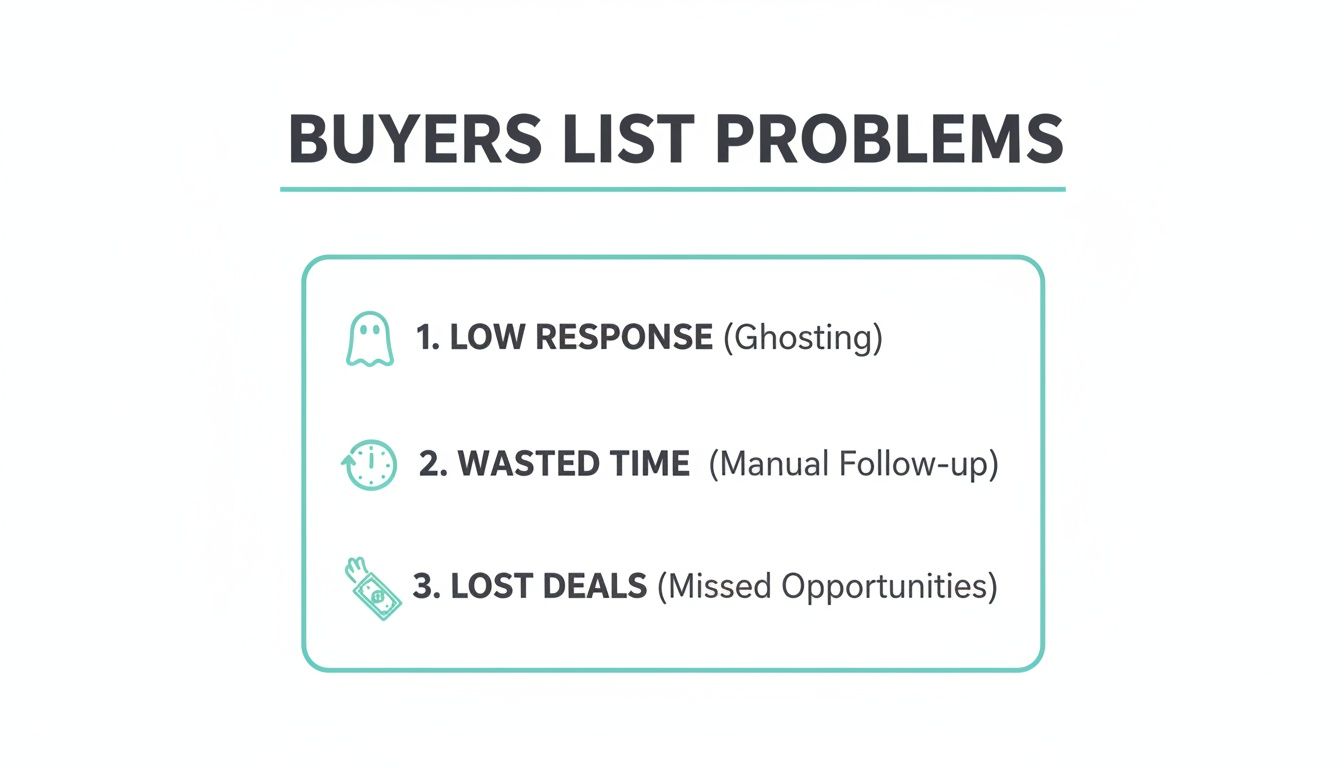
As you can see, the consequences are a direct line from one problem to the next: low response rates eat up your time, which directly leads to lost deals and revenue left on the table.
A high-performance buyers list isn't built on size; it's built on precision. A small, vetted group of 20-30 serious cash buyers who trust your deal flow is infinitely more valuable than a list of 500 unverified contacts.
Shifting from Quantity to Quality
The fix is to stop treating your buyers list like a numbers game and start treating it like a strategic asset. This means shifting your focus from collecting contacts to actively cultivating relationships with proven closers. A quality list is one where you know each investor’s specific criteria inside and out.
The difference between a list that makes you money and one that wastes your time is the difference between a targeted tool and a blunt instrument.
The Strategic Buyers List vs The Generic Contact List
| Attribute | Strategic Buyers List | Generic Contact List |
|---|---|---|
| Focus | Quality over quantity | Quantity over quality |
| Verification | Verified proof of funds & closing history | Unvetted, often sourced from public lists |
| Criteria | Detailed knowledge of each buyer’s needs | Vague or unknown buying criteria |
| Engagement | High open rates, fast responses | Low open rates, minimal engagement |
| Relationship | Built on trust and consistent deal flow | Transactional, low-trust interactions |
| Outcome | Fast dispositions, predictable revenue | Wasted time, lost deals, damaged reputation |
A strategic list feels like having a handful of expert partners on standby. A generic list feels like shouting into the void.
To get there, you need to know:
- Investment Strategy: Are they a flipper, a BRRRR (Buy, Rehab, Rent, Refinance, Repeat) investor, or a long-term rental holder?
- Property Type: Do they focus on single-family, small multifamily, or something else?
- Geographic Focus: Which specific neighborhoods, cities, or zip codes are they targeting?
- Financial Capacity: Can they provide proof of funds and close quickly with cash or hard money?
Modern platforms like Investor Deal Exchange help you skip much of this manual grind. On our marketplace, investors set up a "buy-box" with their exact criteria. When you post a deal, it's automatically matched with people actively looking for that property type, ensuring your deals land in front of the right people.
Finding and Sourcing High-Intent Investor Leads
Building a killer real estate investor buyers list is about knowing where to fish, not casting the widest net. Your time is better spent on channels where serious, high-intent investors are already looking for deals.
The goal is to find warm leads—investors actively hunting for opportunities now. A recent CBRE survey confirmed a huge majority of investors plan to maintain or increase their buying activity. The appetite is there; you just need to connect with them efficiently using a mix of modern and traditional tactics.

Go Where the Buyers Are: Digital Investor Marketplaces
The most efficient way to find motivated buyers is to go where they already congregate. Modern investor platforms are built to connect people with deals to pre-qualified buyers who have specified exactly what they're looking for.
On a platform like ours, an investor creates a "buy-box," which is their precise investment criteria. This includes:
- Property Type (single-family, small multifamily, land, etc.)
- Geographic Focus (down to the zip code)
- Price Range and preferred Deal Size
- Financial Metrics like a target cash-on-cash return or cap rate
This removes the guesswork. Instead of blasting your deal to a cold list, you get instant access to a curated pool of buyers searching for the exact kind of off-market properties you find. When you post a deal, the system automatically matches it with investors whose buy-boxes fit, making sure your opportunity gets seen by the right people immediately.
Dig for Gold in Public Records
Public records are a goldmine for finding proven cash buyers. Every property transaction is documented, including the buyer's name and whether a mortgage was recorded. If there's no mortgage lender listed, it’s a massive sign it was a cash deal.
- For beginners: Pull recent sales in your target zip codes. Look for buyers listed as an LLC or a trust, which are almost always investment vehicles.
- For experienced investors: Use a data service that aggregates and filters this info. Search for individuals or companies that have made multiple cash purchases in the last 6-12 months. This indicates they're active, capitalized, and ready to buy again.
Once you spot a potential cash buyer, you have a highly qualified lead to vet.
Network Smarter, Not Harder, at Industry Events
Going to your local Real Estate Investor Association (REIA) meeting is a great start, but you need a plan. Don't just collect business cards; have real conversations that uncover who the active players are.
Forget trying to talk to everyone. Focus on connecting with three to five serious investors at each event. Ask pointed questions to see if they're a fit:
- "What type of deals are you looking for right now?"
- "What neighborhoods are you most active in?"
- "What was the last deal you closed?"
Listen for specifics. An investor who says, "I'm looking for 2-4 unit value-add properties in the 78704 zip code that need cosmetic work" is a much better lead than someone who just says, "I'm looking for good deals."
Build a Referral Engine with Industry Pros
Other real estate professionals constantly interact with investors. Building solid relationships with them can create a powerful referral network.
- Real Estate Agents: Focus on agents who specialize in investment properties or frequently list REOs and distressed homes.
- Hard Money Lenders: They work exclusively with investors funding flips and rehabs and know exactly who is closing deals in your market.
- Property Managers: They know which owners are looking to grow their portfolios and can be an amazing source for local buy-and-hold investors.
- Real Estate Attorneys and Title Companies: They sit at the closing table for every deal. A good relationship here can lead to direct referrals from investors they know are reliable.
By combining these digital and traditional methods, you'll systematically build a powerful buyers list filled with high-intent, verified players ready for your next deal.
How to Properly Vet Your Potential Buyers
Sourcing a lead is just the start. An impressive contact list means nothing if the people on it can't or won't close.
The real work is the vetting process, where you transform a contact into a qualified asset for your real estate investor buyers list. Think of it as a professional conversation to build a relationship and confirm you're both serious players. The goal is to understand their investment thesis so you only send them perfectly-fit deals, positioning you as a credible source for quality opportunities.
Asking the Right Qualification Questions
Your first conversation should be direct but relational. You're gathering the key data points that define their "buy-box"—the specific set of criteria a buyer uses to evaluate deals.
Here are the essential areas to cover:
- Investment Strategy: Ask point-blank, "What's your primary strategy? Are you looking for fix-and-flips, long-term rentals using the BRRRR method, or something else?" This tells you what numbers will matter most to them.
- Property Type and Size: Get granular. Do they only buy single-family homes, or are they open to duplexes and quads? Knowing their preferred bed/bath count or square footage range helps you filter opportunities.
- Geographic Focus: Drill down past the city. Ask for specific zip codes, neighborhoods, or even school districts. An investor who dominates one side of town likely has zero interest in a deal across the county.
This is especially critical for deals needing renovation. Global trends show serious capital is chasing value-add deals. According to Realfin's State of the Market Report, these funds attracted $24.6 billion in H1 2026, showing a huge appetite for properties that can be repositioned. You can discover more insights about these real estate capital trends on withintelligence.com.
Verifying Financial Capacity
This is the most important part of vetting. A buyer who can't fund the deal is just a contact, not a closer. You must confirm their ability to perform.
A professional way to approach this is to ask, "To make sure I'm only sending you deals you can act on quickly, are you typically closing with cash, hard money, or another type of financing?" Their answer guides your next steps.
- For beginners: Your main goal is to get a clear "yes" on their ability to close with cash or a hard money loan. Ask for a recent proof of funds (POF) letter from a bank or a pre-approval letter from a hard money lender.
- For experienced investors: You can dig deeper. Ask about their last few closings. A serious investor will have no problem discussing their deal history, typical closing timeline, and preferred title company.
Key Takeaway: Asking for proof of funds isn't confrontational; it's about confirming capacity. Frame it as a step to ensure you can bring them deals that require a quick, confident close. For a deeper dive into funding, check out our guide on real estate financing options.
Platforms like ours can shorten this vetting timeline. When you connect with an investor on the platform, you can often see their pre-stated buying criteria and deal history on their profile. This adds credibility and helps you start the conversation with confidence.
Segmenting Your Buyers List for Targeted Dispositions
You’ve vetted your contacts and now have a list of qualified investors. But a flat list is still a clumsy tool.
Blasting a prime land deal to a multifamily investor is a surefire way to get ignored. The next step is to segment your real estate investor buyers list for surgical precision. Think of segmentation as creating specialized "sub-lists" within your master list, grouping buyers by their verified criteria.
This simple organization transforms your disposition process from a shotgun blast into a sniper shot. The right deal always lands in front of the right person, leading to higher response rates, faster closes, and a reputation as a pro who respects everyone's time.

Building Your Segmentation Framework
You don't need a complex system. A simple spreadsheet or a basic CRM (Customer Relationship Manager) is all it takes to track key data for each investor. The information gathered during vetting becomes the foundation for your segments.
Your goal is to create columns for each critical piece of data, allowing you to sort and filter your list with a few clicks.
Here are the key data points to track for each buyer:
- Property Type: Single-Family, Small Multifamily (2-4 units), Large Multifamily (5+ units), Land, or Commercial.
- Investment Strategy: Fix-and-Flip, BRRRR, Wholesale, Buy-and-Hold (Turnkey), or Development.
- Geographic Focus: Counties, cities, zip codes, or specific school districts.
- Deal Size / Price Point: Their typical "all-in" budget (e.g., under $250k, $500k-$1M).
- Funding Type: Cash, Hard Money, Private Money, or Conventional.
- Key Metrics: Target Cap Rate, ARV percentage, or Cash-on-Cash Return.
With this data organized, you can instantly pull the perfect audience for any deal.
Creating Actionable Buyer Tiers and Segments
Once your data is structured, you can build actionable segments. This is where you combine multiple criteria to create hyper-targeted groups.
It's helpful to think in "tiers" to prioritize outreach. Your Tier 1 buyers are the proven closers you call first.
Here’s a real-world example of what segments might look like:
- Segment Name: Tier 1 Cash Buyers - Dallas SFR Flips
- Criteria: Buys Single-Family Residences, focuses on fix-and-flips, targets Dallas county, always closes with cash, and won't touch a deal over 70% of ARV.
- Segment Name: Tier 2 Small Multifamily - Austin BRRRR
- Criteria: Buys 2-4 unit properties, uses the BRRRR strategy, focuses on Travis County, typically uses hard money, and hunts for value-add opportunities.
- Segment Name: Tier 3 Land Investors - Houston Infill Lots
- Criteria: Buys vacant land for new construction, targets infill lots in Harris County, and has specific zoning requirements.
Now, when you get a distressed 3-bedroom house in Dallas, you send it directly to the "Tier 1 Cash Buyers - Dallas SFR Flips" segment first, giving your most reliable partners the first look.
This targeted approach does more than save time. It builds powerful relationships. When buyers know you only send them relevant deals, they open your emails and act quickly because they trust you've already done the filtering for them.
How Technology Simplifies Segmentation
Manually managing segments in a spreadsheet works when you're starting out. But modern platforms provide a massive advantage.
On a marketplace like ours, segmentation is essentially automated. When an investor sets up their "buy-box," they are self-segmenting by inputting their core criteria—location, property type, deal size, and key metrics.
When you upload a deal, our platform instantly matches your property's specs with the buy-boxes of every investor in the network. Instead of manually filtering a spreadsheet, the system delivers your opportunity directly to a pre-qualified, highly-interested audience. This cuts your disposition timeline and ensures you never miss a potential buyer.
Engaging Your List to Close Deals Efficiently
You’ve done the heavy lifting: your real estate investor buyers list is vetted, organized, and segmented. Now it's time to move properties.
How you present a deal is as important as the deal itself. It reflects your professionalism and sets the tone for the transaction. A well-crafted outreach message isn't just a notification—it's a concise business proposal designed to get a quick decision from a serious investor. In wholesaling, speed is everything.
Crafting the Perfect Deal Presentation
When you send a deal to a segment of your list, your message must be ruthlessly efficient. Investors are busy and appreciate wholesalers who get straight to the point with organized, actionable information.
Your outreach should always include these core components:
- The Basics: Full property address, bed/bath count, and square footage.
- The Visuals: A link to a folder with clear, recent photos—interior and exterior. Don't hide the flaws; showing the good, the bad, and the broken builds trust.
- The Numbers: Your asking price, the After Repair Value (ARV) with comps to back it up, and a realistic repair estimate.
- Access Details: Simple instructions on how to see the property (lockbox code, showing times, etc.).
This level of detail signals that you're a pro, filtering out tire-kickers and empowering genuine buyers to run their numbers and give you a real answer, fast. For a deeper look into connecting with other pros, you might find our guide on building your real estate investor network helpful.
Nurturing Relationships Between Deals
A big mistake wholesalers make is going silent when they don’t have a property under contract. Your buyers list is a network of professional relationships that requires consistent nurturing. Staying in touch keeps you top-of-mind and strengthens the partnership.
A simple check-in every month or so can make a huge difference. Ask if their buying criteria have changed or if they're seeing new market trends. This small effort shows you see them as a partner, not just a potential paycheck.
This approach ensures that when you bring them a deal, they're more likely to open your email first. This is especially important as market dynamics shift. Recent data shows North American investment activity is rebounding with an 11.3% yearly increase. Having an engaged, ready-to-act buyers list is the only way to capitalize on the faster pace. You can read the full research on these global real estate market trends on aberdeeninvestments.com.
Streamlining Your Disposition Workflow
Managing the disposition process—from initial outreach to tracking responses and coordinating showings—can get chaotic. An investor marketplace gives you a powerful advantage by centralizing this workflow.
Instead of juggling endless email chains, you post your deal once on the platform. The system automatically notifies investors whose buy-boxes match, putting your opportunity in front of a pre-qualified audience instantly.
From there, the benefits compound:
- Direct Messaging: Conversations with interested buyers happen on the platform, keeping everything organized.
- Progress Tracking: Both you and the buyer can see the deal's status, from initial interest to closing.
- Reduced Friction: This cuts out the frustrating back-and-forth of old-school methods, saving you time.
In a business where speed is key, combining a well-managed buyers list with efficient platform tools is your recipe for faster, more predictable closings.
Frequently Asked Questions About Building a Buyers List
Even with a solid plan, building a high-performing real estate investor buyers list can be confusing. Getting straight answers helps you focus on what really moves the needle: closing more deals.
How Big Should My Buyers List Be?
The answer is always the same: focus on quality over quantity. A bloated list of 500 unvetted contacts is a liability. It creates noise, wastes your time, and teaches people to ignore your emails.
A highly-vetted list of 20 to 30 serious, proven cash buyers is infinitely more valuable.
Your first goal should be to build deep, trusted relationships with a core group of investors. These are the people you can call directly, who know your deal flow is solid and can close without drama. Once you have that foundation, you can scale, but never at the expense of quality.
What's the Fastest Way to Build a Buyers List from Scratch?
When you need a list yesterday, go where the buyers already are. The single fastest way is to plug into an investor marketplace where deals are actively being sought.
- Investor Marketplaces: Joining a platform like ours gives you instant access to investors who have already detailed what they're looking for. This shaves months off the process of cold outreach.
- Targeted Networking: The next fastest route is in-person networking. Show up at your local Real Estate Investor Association (REIA) meetings with a purpose. Introduce yourself as someone who finds great deals and spend your time talking to the most active players in the room.
Both channels provide warm leads who are in the game and hungry for opportunities.
How Often Should I Contact My Buyers?
Your contact frequency should be driven by value. The moment you have a deal that is a perfect fit for an investor's criteria, contact them. That's why they're on your list.
Outside of specific deals, a light touchpoint every 4 to 6 weeks is smart for nurturing the relationship. This isn’t a sales pitch; it’s a simple check-in to see if their buying criteria have shifted or to share a quick market insight. The goal is to stay top-of-mind, so when you do have the perfect deal, they're ready to listen.
Should I Charge Buyers to Get on My List?
No. You should never charge an investor to be on your standard buyers list. It’s not how the industry works and puts up an unnecessary wall between you and the people you need to build relationships with.
As a wholesaler, you get paid from the assignment fee when you bring them a deal they close on. The value you provide is the well-vetted, off-market property—not access to your contact list. Trying to charge a fee cheapens your value proposition and will turn off nearly every serious investor. Focus on what matters: delivering great deals.
Stop the endless grind of building and vetting a list from scratch. On Investor Deal Exchange, you can post your deal and instantly connect with pre-qualified investors whose buy-boxes match your property. Create your free investor profile to get started today.