If you’ve ever found yourself staring at spreadsheets until your eyes cross, you know that going it alone in real estate is a fast track to burnout. A real estate investing community is your most important asset, connecting you with other investors to find deals, analyze opportunities, and build wealth. This guide will show you how to find and leverage a community to scale your business, faster.
Why Investing Is Not a Solo Sport
The romantic image of the lone-wolf investor building an empire from their laptop is a myth. In reality, isolation is a major roadblock. Every deal has dozens of moving parts, from finding and funding it to managing the project. Trying to be a master of all of them by yourself isn't just slow—it's a massive risk. A good real estate investing community turns that lonely struggle into a team sport.
This group becomes your go-to for everything you can't learn in a book. It’s where a wholesaler with a great off-market contract finds a flipper who has the cash and crew ready to start demo tomorrow. It’s where a new landlord gets a second opinion on their rent projections from a local property manager who knows the market down to the block.
Your Unfair Advantage in a Competitive Market
The right community gives you a real competitive edge. While others are scrolling through public listings, you get a curated flow of opportunities and insights. These advantages directly boost your bottom line.
A solid community delivers tangible results:
- Accelerated Deal Flow: You get first dibs on off-market properties and wholesale deals long before they show up on the MLS.
- Collaborative Underwriting: You can stress-test your numbers with seasoned operators who can spot a red flag in your assumptions from a mile away.
- Strategic Partnerships: Need funding? This is where you find private money lenders, equity partners, and joint venture (JV) opportunities to tackle larger deals.
- Battle-Tested Expertise: You learn from other people's expensive mistakes, saving yourself thousands of dollars and years of painful trial and error.
A well-curated community acts as a force multiplier. It lets you tap into the collective experience, capital, and deal flow of dozens of other serious investors, giving you the confidence and resources to take decisive action.
Ultimately, being part of a real estate investing community is about working smarter and minimizing risk. To build a powerful circle, you first have to understand the different kinds of groups out there. You can learn more about how a real estate investor network functions in our detailed guide. This article will show you how to find, vet, and become a valuable member of a community that will help you scale your portfolio.
Finding the Right Community for Your Strategy
Not all investing groups are created equal. The right community for you depends on your strategy, experience level, and goals. Finding your fit means looking past generic options and digging into what each type of community is built to do. After all, a new house flipper needs different support than a seasoned multifamily syndicator.
A strong community connects you to the three pillars of real estate success: deals, funding, and advice. Think of it as an ecosystem.
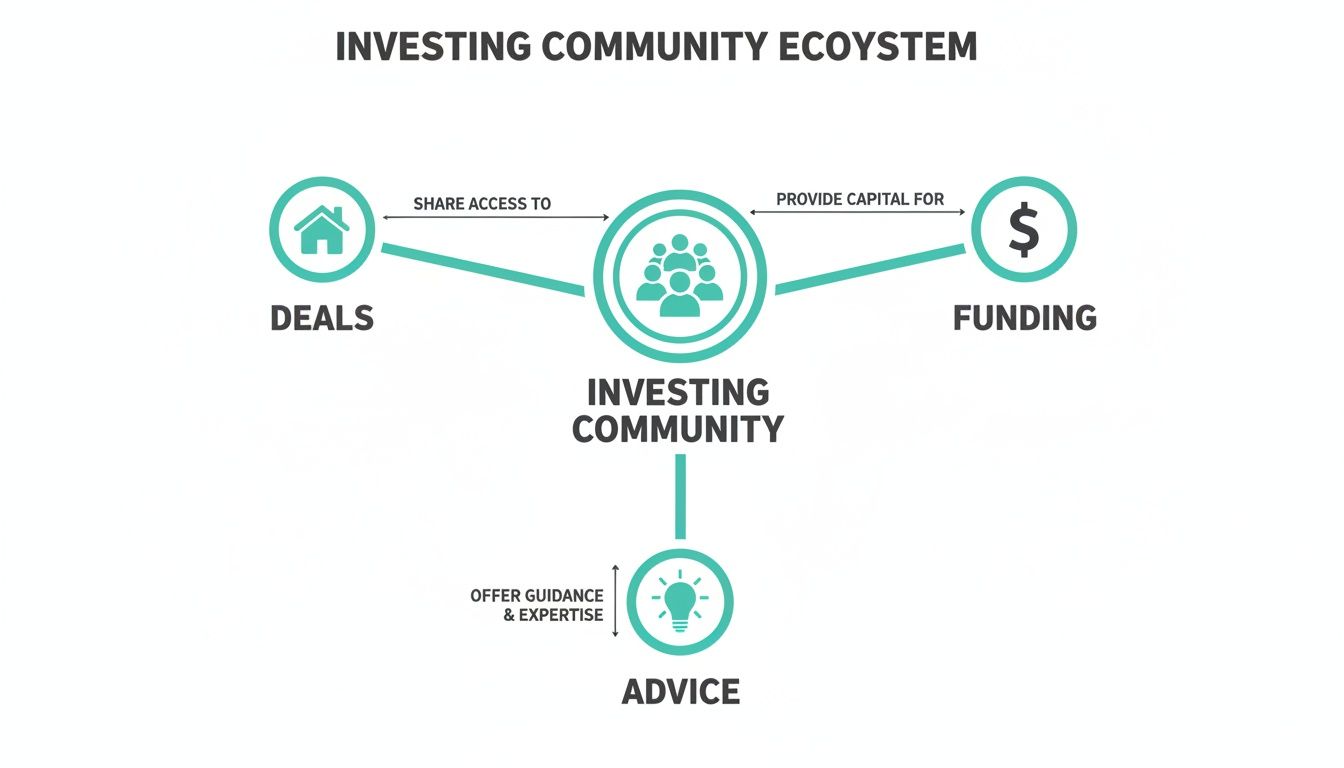
These pieces are all interconnected. A great deal is useless without funding, and both require solid advice to get across the finish line. Let’s break down the main community models.
Online Forums and Social Groups
Large-scale online forums are often the first stop for new investors. They’re like massive public libraries, holding a huge collection of articles and discussions.
If you’re just starting out, this is where you can learn the lingo—like what BRRRR (Buy, Rehab, Rent, Refinance, Repeat) actually means—and get a feel for different strategies. The main problem? The signal-to-noise ratio can be low. You’ll spend time sifting through outdated advice and unvetted opinions to find credible information.
Local REIA Meetups
Real Estate Investor Associations (REIAs) are local, in-person groups that meet regularly. These events are fantastic for building face-to-face relationships with people active in your specific market.
A new flipper could go to a local REIA and find a trustworthy general contractor who has already been vetted by other members. This is where you meet the boots-on-the-ground pros—the agents, lenders, and property managers—who make deals happen. Their value is hyper-local connections and market-specific knowledge.
Comparing Real Estate Investing Community Types
With so many options, it helps to see them side-by-side. This table breaks down the different community models to help you figure out which one is the best fit for your current goals.
| Community Type | Primary Function | Best For | Key Limitation |
|---|---|---|---|
| Online Forums | General education & broad networking | Beginners seeking foundational knowledge | High noise-to-signal ratio; lots of unvetted advice |
| Local REIA Meetups | Hyper-local networking & market intel | Investors needing local contacts (contractors, agents) | Limited to a specific geographic area; deal quality varies |
| Masterminds | Advanced problem-solving & accountability | Experienced investors looking to scale or pivot | High cost; exclusive and often hard to get into |
| Investor Marketplaces | Transaction-focused deal flow & connections | Active investors looking for vetted deals and capital | Less focused on general education or casual networking |
Ultimately, you'll probably engage with several of these over time as your needs change. The key is to be intentional about where you spend your energy.
Mentorships and Masterminds
These are small, curated, and usually paid groups built around a specific mentor or a high-level peer exchange. Masterminds aren’t for beginners. They’re for investors who have moved past the basics and need strategic guidance on scaling their business.
The focus here isn't on general education, but on accountability and advanced problem-solving. Members share their biggest challenges, and the group works together on high-level solutions for things like raising private capital or building automated systems.
For example, an investor scaling from single-family rentals to small multifamily buildings might join a mastermind to learn from others who have already made that exact leap. The cost is often high, but the direct access to proven expertise can provide a massive shortcut. If you're looking for deals, you might also want to learn about finding off-market properties through different channels.
Modern Investor Marketplaces
An investor marketplace is a community built entirely around the transaction. These platforms are designed to connect motivated parties—like wholesalers with deals and investors with capital—as efficiently as possible. They combine the broad reach of an online forum with the sharp, deal-centric focus of a mastermind.
On a platform like ours, for instance, you can set your buy-box criteria to find highly specific properties. This automatically connects a syndicator looking for a 50-unit apartment building in Dallas with wholesalers who have exactly that type of asset under contract. It’s a community built around the deal itself, cutting through the noise to get you straight to the action.
The Real-World Payoff of Active Participation
Joining a real estate investing community is step one. But just lurking in the background won't fill your deal pipeline. The real returns only show up when you shift from being a passive observer to an active contributor. This is where "networking" stops being a buzzword and starts turning into tangible business.
Active engagement delivers concrete advantages. With a high volume of deal-making in the market, you need every edge you can get. A strong community provides it. You can check out the full global real estate market report for more on current trends.

Better, Faster Deal Flow
Let’s be honest: the best deals rarely hit the open market. They’re found and closed within trusted circles. By participating in a community, you get direct access to this off-market inventory. Wholesalers and flippers are always looking for reliable buyers who can close fast.
When you build a reputation as a serious, responsive investor, they’ll bring opportunities straight to you. Instead of wasting time sifting through irrelevant public listings, you get a curated stream of deals from people who already know your buy-box and trust you to perform. It's especially powerful on our platform, where a wholesaler can see your criteria and instantly message you about a matching property.
Your Unofficial Underwriting Team
Every investor has blind spots. Underwriting in a vacuum is a recipe for expensive mistakes. An active community acts as your personal underwriting committee, giving you invaluable second opinions.
It happens all the time. An investor posts a pro-forma for a small apartment building. A local property manager in the group immediately chimes in, pointing out that the projected 5% vacancy rate is unrealistic for that submarket, which historically runs closer to 8%. That single piece of feedback can save the investor tens of thousands of dollars.
This collaborative review helps you stress-test your numbers, question your assumptions, and spot risks you might have missed. It’s like having a team of seasoned analysts on your side for every deal.
Finding Partners to Help You Scale
Nobody scales their real estate business alone. Sooner or later, you'll need partners for capital or expertise. A community is the natural breeding ground for these critical relationships.
Active participation lets you find and vet potential partners in a low-risk environment.
- Capital Partners: Connect with private money lenders or equity partners actively looking to place capital into solid deals.
- Joint Venture (JV) Partners: Find an experienced operator to partner with on a deal outside your comfort zone, like your first commercial building.
- Operational Partners: Link up with other investors to share resources, like a rockstar project manager or a trusted property management company.
These partnerships are built on trust, which is forged through consistent, value-add interactions over time.
Sidestep Expensive Mistakes
One of the most underrated benefits of a real estate community is learning from other people's screw-ups. Every seasoned investor has war stories of deals that went sideways—the contractor who vanished or the hidden structural problem that blew the budget.
By being an active participant, you get a front-row seat to this treasure trove of cautionary tales. Hearing how another member navigated a nightmare tenant situation gives you a playbook for handling similar challenges. This collective wisdom is a powerful risk-mitigation tool that helps you protect your capital.
How to Evaluate a Real estate Investing Community
Wasting time in the wrong group is a costly mistake that can stall your progress. Before you invest your time, you need a framework to vet any potential real estate investing community to ensure it aligns with your goals.
Your job is to look past the sales pitch and figure out what truly matters for an active investor.
Assess the Quality of the Members
The value of any community comes from its members. You're looking for a group of active, serious investors—not a collection of beginners asking basic questions or promoters hawking unrelated services. A high-quality community is filled with people who are actually doing deals.
When you're sizing up a new group, look for:
- Active Participants: Are members regularly sharing deals, asking intelligent questions, and offering valuable feedback? A silent group is a dead group.
- Experience Mix: A healthy community has a blend of experience. You want enough seasoned investors to provide real guidance, but also newer members who bring fresh energy.
- Professionalism: Do members communicate respectfully? A group that tolerates hype or unprofessional behavior is a major red flag.
Analyze Deal Relevance and Flow
A great community for a house flipper in Phoenix is useless to a multifamily syndicator in Miami. The deal flow inside the group must be relevant to your specific strategy and target market. A good community acts as a filter, bringing you closer to the right opportunities.
Check if the deals being discussed match your buy-box—a set of criteria defining your ideal investment. Are they the right property type, in the right location, and within your price range? On our marketplace, this is easy—you can see if the platform surfaces deals that fit your saved criteria. If the group is focused on assets that don't fit your model, it’s not the right place for you.
Review Leadership and Moderation
Every successful community has strong leadership. Whether it’s a forum moderator or the team behind an online platform, effective management holds everything together. Good leaders foster a culture of value and trust while actively shutting down spam and noise.
A well-managed community feels professional and focused. It prioritizes member success over upselling, making sure conversations stay centered on real estate strategy and actual transactions.
Look for clear rules and active moderation. This shows that the leaders are committed to maintaining a high-quality environment. If the group is a free-for-all dominated by aggressive sales pitches, it’s a sign of poor leadership.
Watch for These Community Red Flags
While vetting a group, be on high alert for common warning signs. These red flags often point to a community that will waste your time or lead you toward bad decisions.
- "Get Rich Quick" Hype: Avoid any group that promises guaranteed returns or overnight success. Real estate is a business, not a lottery ticket.
- Aggressive Upselling: If the main focus is pushing expensive coaching programs, it's a seminar, not a community.
- Lack of Verifiable Deals: A real investing community talks about real deals. If there’s no evidence of actual transactions happening, it’s just a social club.
- Echo Chamber Mentality: Be wary of groups where dissenting opinions are shut down. You need honest feedback, not just a chorus of people agreeing with you.
By using this framework, you can cut through the noise. Joining the right real estate investing community is a strategic decision that will impact your access to deals, partners, and the expertise you need to scale.
Your First 90 Days: From New Member to Valued Partner
Joining a community is easy. Actually contributing is what opens doors and builds the relationships that lead to real opportunities. Think of your first three months as a strategic window—your chance to go from silent observer to respected participant who attracts deals and partners.
This 90-day roadmap is designed to help you build a reputation that generates actual investment opportunities.
The goal is to show you're serious, you do your homework, and you're here to add value—not just take it.
The First 30 Days: Listen and Learn
Your first month is all about observation. Resist the urge to jump in with questions or pitches. Instead, focus on soaking up the culture and setting yourself up for success.
- Complete Your Profile Thoroughly: This is your digital business card. On our platform, this means fully completing your investor profile and setting up your buy-box. Nail down your target markets, property types, and ideal deal metrics like cash-on-cash return. A detailed profile instantly tells everyone you're a serious operator.
- Observe the Flow: Pay attention to how members interact. Who are the heavy hitters? What kind of deals get the most attention and why? Understanding the group’s unwritten rules will help you engage effectively.
- Study Past Discussions: Dig into older posts and deal analyses. This is the fastest way to learn the community's etiquette and avoid asking questions that have already been answered.
The Next 30 Days: Add Value First
Now it's time to start participating. The golden rule is simple: give value before you ask for it. This one act immediately separates you from the 90% of members who only show up when they need something.
Your goal is to become a resource. Even if you're new, you can share an insight about your local market, a helpful article, or a positive experience with a vendor. Offering value first builds social capital that you can draw on later.
When you do ask questions, make them smart. Show you've put in the initial legwork. Instead of a lazy question, try a specific approach.
Weak Question: "What do you guys think of this duplex?"
Strong Question: "I'm underwriting this duplex. My numbers show a 7% cap rate based on $2,200 gross monthly rent and a 6% vacancy assumption. For those who know this area, does that vacancy rate seem realistic, or am I being too optimistic?"
The second question shows you’ve done the work and are looking for specific, expert feedback. That makes people want to help you.
The Final 30 Days: Engage and Connect
By month three, you’ve laid the groundwork. Now you can start using the community to actively chase your investment goals.
- Engage Constructively on Deals: When a deal catches your eye, ask the poster clear, direct questions. On a deal-focused platform, you can message the wholesaler or seller directly to get the details you need.
- Make Your "Ask": Now is the time to post what you're looking for, whether it’s a lender referral or a potential partner for a specific deal. Because you’ve spent the last 60 days adding value, your request will land on friendlier ears.
- Take Conversations Offline: Once you've built a rapport with someone online, suggest a quick call. Real relationships—the kind that lead to off-market deals—are almost always built in one-on-one conversations.
- For experienced investors: This 90-day plan is your chance to establish authority. Share your expertise in a specific niche. By becoming the go-to expert on small multifamily or self-storage, you'll attract proprietary deal flow.
This is how a real estate investing community stops being a forum and becomes a powerful engine for growing your business.
How a Marketplace Supercharges Your Connections
Traditional communities can be slow and noisy. A modern investor marketplace is a different beast entirely. It’s a community built for one thing: getting deals done.
It’s an ecosystem designed not just for casual networking, but for closing deals with a level of scale and precision that was impossible before.
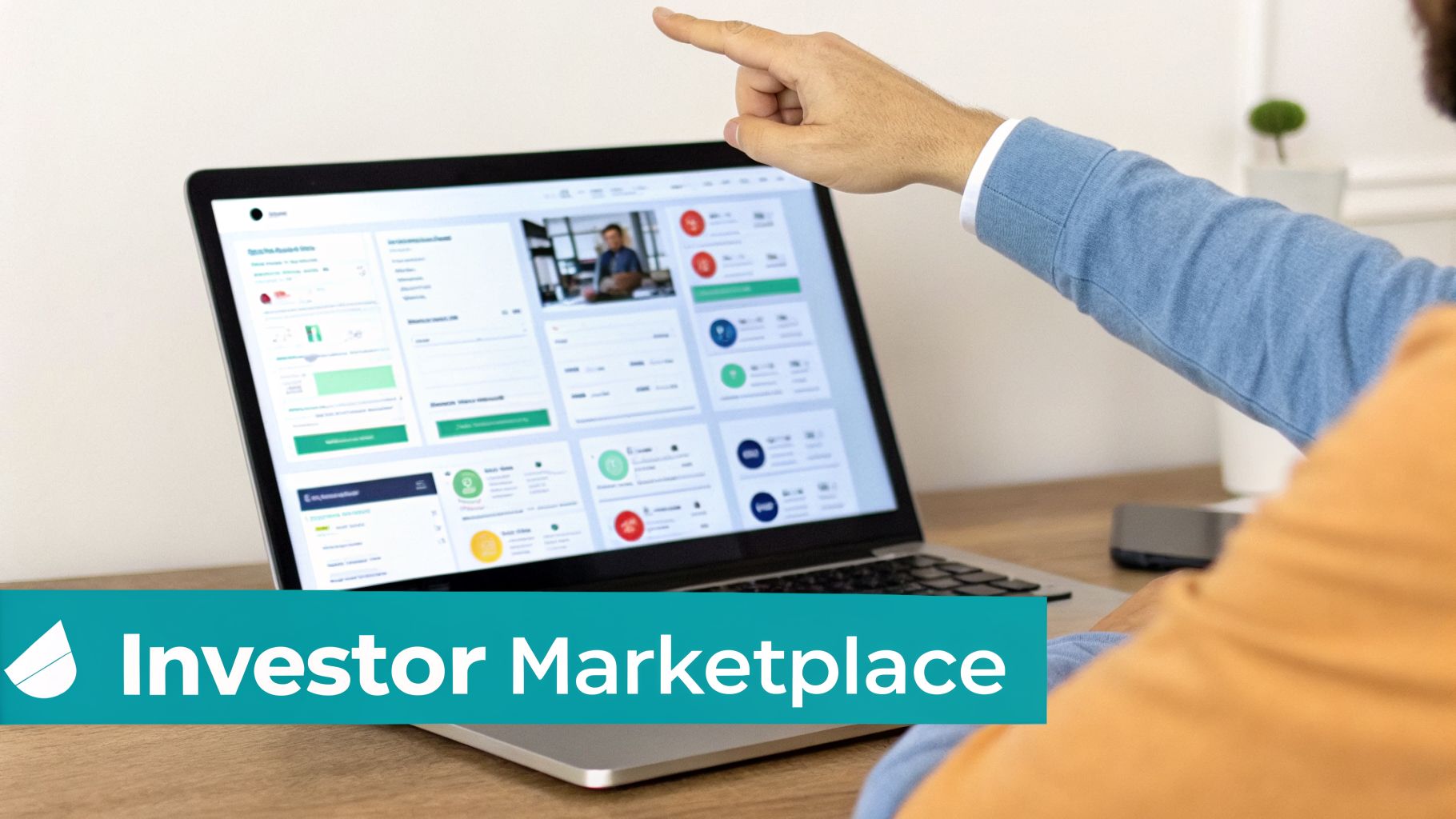
Instead of you manually sifting through hundreds of posts, the platform instantly matches a deal to your specific criteria. It replaces endless searching with automated, laser-targeted deal flow.
Create Your Own Sub-Community on the Fly
The real magic of a marketplace platform is its ability to create instant sub-communities based on shared goals. Forget about shouting your needs into a crowded forum.
Features like a buy-box do the work for you. By defining your exact criteria—location, asset class, desired return metrics—you automatically join a filtered group of buyers and sellers with perfectly aligned interests.
For example, when a wholesaler uploads a 10-unit apartment building in Austin, they don't have to email a list of thousands of people. The platform instantly notifies a pre-vetted group of investors whose buy boxes are set for small multifamily assets in that exact market. A hyper-relevant connection is made in seconds.
A Real-World Marketplace Scenario
Let's walk through how this actually plays out on our platform.
- A Wholesaler Posts a Deal: A wholesaler gets a distressed single-family rental under contract. They log in and upload the property details, photos, and their asking price.
- Instant Matching Occurs: The platform’s algorithm immediately pings every investor whose buy box matches that property's profile—say, flippers looking for 3-bed, 2-bath properties in that specific zip code.
- An Investor Analyzes and Connects: A flipper gets a notification. They can review the deal, run a quick analysis using built-in calculators, and message the wholesaler directly to ask a question or schedule a walkthrough—all within the platform.
This entire sequence, from a deal going live to initial contact with a serious buyer, can happen in under an hour. It takes the trust-building and due diligence that traditional communities foster and puts it on rails.
A tech-enabled marketplace doesn't replace the need for relationships; it accelerates them. By connecting the right people around the right deal at the right time, it provides a structured environment for trust and transactions to happen faster.
As the global real estate market continues to shift, speed and efficiency are your competitive edge. The investors who can find and vet quality deals the fastest are the ones who will win. For instance, who would have thought data centers would become a top prospect for investors? It just shows how quickly opportunities can change. You can discover more insights about 2026 global real estate trends.
By integrating technology, an investor marketplace creates a dynamic and effective real estate investing community that is built for action. It’s the modern way to browse for investment properties that perfectly match your strategy, connecting you with the sellers and partners who are ready to transact.
Got Questions About Investing Communities? We've Got Answers.
Even after you've nailed down your strategy, jumping into a real estate investing community can feel intimidating. Getting straight answers to your questions is the best way to set the right expectations and start contributing from day one.
Let's tackle some of the most common questions investors ask when considering joining a group.
How Much Time Should I Actually Spend in a Community?
There's no magic number. The key is quality over quantity.
Spending one focused hour a week leaving thoughtful feedback on a deal is infinitely more valuable than passively scrolling for five hours. The goal is to use the community to get your own deals done, not let it become a distraction.
- For new investors: Plan on 2-3 hours per week at the start. Use that time to complete your profile, read past discussions, and get a feel for the group's culture.
- For experienced investors: Be surgical with your time. A focused 1-2 hours a week is plenty to answer specific questions in your niche, connect with a potential partner, or dig into deals that fit your buy-box.
Remember, the community is a tool to help you invest—it's not a substitute for taking action. The time you put in should directly lead to finding a deal, funding a deal, or avoiding a major mistake.
Can I Actually Find Funding for My Deals in a Group?
Absolutely. A good community is one of the best places to find capital partners. But you can't just show up with a half-baked deal and your hand out.
Investors with capital are looking for two things: a competent operator and a well-vetted opportunity. To get their attention, you have to bring your A-game.
- Build Your Reputation First: Don't make your first move an ask for money. Establish yourself as a knowledgeable, trustworthy member of the community before you ever bring a deal to the table.
- Present a Professional Deal Package: You need a rock-solid executive summary, a detailed pro-forma with conservative numbers, good photos, and a crystal-clear business plan.
- Know Your Numbers Cold: When potential partners start poking holes in your underwriting—and they will—you need to have immediate, confident answers. It shows you’ve done your homework and respect their capital.
Approach this as a professional partnership, not a plea for a handout.
What Are the Biggest Mistakes I Should Avoid?
Navigating the social dynamics of a new community can be tricky. Most major mistakes come from having a "take first, give later" attitude.
Here are the top three mistakes to steer clear of:
- Asking for Help Without Providing Any Value: This is the cardinal sin of any community. If your first post is a request for someone's time, contacts, or money, you signal that you're only there to take.
- Trusting Advice Blindly: A community offers incredible insights, but you are the one signing the checks. Never take advice at face value. Always do your own independent verification.
- Being a "Tire-Kicker" on Deals: If you consistently engage with wholesalers on deals you have no intention or ability to close, your reputation will get torched. Be upfront about what you're looking for and only chase deals you're serious about pursuing.
A real estate investing community is built on reciprocity and trust. Dodge these common mistakes and focus on being a professional, and you'll build a reputation that attracts the deals and partners you're looking for.
Ready to join a community built for serious investors? On our platform, you can connect with a network of professionals and find deals that perfectly match your criteria.
Create your free investor profile to get matched with deals that fit your criteria.