While most investors are stuck scrolling endlessly through the Multiple Listing Service (MLS), the truly lucrative deals—the ones that build real wealth—are often found behind the scenes. This guide will show you how to find them.
These are off-market real estate deals: properties sold privately, away from the public eye, creating a "hidden inventory" that lets you bypass the bidding wars that crush your margins. For investors who know where to look, this direct path to motivated sellers means better terms and much higher potential profits.
What Are Off-Market Real Estate Deals?
Off-market properties are simply homes, apartment buildings, or land parcels that aren't publicly advertised for sale on platforms like the MLS or Zillow. Instead, they're traded through private networks, direct outreach, or specialized investor marketplaces. For new and seasoned investors alike, understanding this space is the key to building a deal pipeline that actually works.
Sellers choose this route for many reasons. Sometimes it's about privacy. Other times, they want to avoid the hassle of endless showings, or they need a quick, guaranteed sale due to a personal situation. These scenarios create an environment where the seller often cares more about a smooth, fast closing than squeezing every last dollar out of the property.
Key Advantages of Targeting Off-Market Deals
Focusing on off-market deals can fundamentally change your investment strategy. The main advantages boil down to a few key points:
- Reduced Competition: You're often one of only a few investors—or perhaps the only one—who knows the property is for sale. This eliminates the bidding wars that drive prices sky-high on the open market.
- More Favorable Terms: Because you're usually solving a problem for the seller (e.g., speed, certainty), you have more leverage to negotiate terms beyond just the price. This can include creative financing, flexible closing dates, or other conditions that work in your favor.
- Access to Unique Inventory: Many of the best deals never hit the open market. This is where you find distressed properties with massive value-add potential, inherited homes from probate, and portfolios from tired landlords ready to cash out.
For sellers, going off-market provides a private, streamlined process. They avoid endless showings and public scrutiny, a major benefit for those in sensitive situations like probate. As an investor, understanding and catering to this need for privacy is key to building rapport and closing the deal. If you're interested in this niche, you can learn more about finding and purchasing properties in probate to expand your sourcing channels.
Ultimately, focusing on off-market real estate deals shifts you from being a reactive buyer who competes for listed properties to a proactive investor who creates their own opportunities. It takes more upfront effort, but the payoff is a consistent flow of high-potential properties that the rest of the market never sees.
How to Find Off Market Real Estate Deals
Finding off-market deals isn't about luck; it's about building a repeatable system. Successful investors build a multi-channel sourcing engine so that when one channel is quiet, another is delivering opportunities. A proactive strategy combines direct outreach, strategic networking, and modern technology to build a steady pipeline.
Mastering Direct Outreach Methods
Direct outreach is the classic, roll-up-your-sleeves approach to finding motivated sellers before they contact an agent. It gives you complete control over your target audience.
- Direct Mail Campaigns: An effective campaign starts with a targeted list. You can acquire lists focusing on specific situations, like absentee owners, owners facing pre-foreclosure, or those who have owned a property for 20+ years. The key is to write a message that is empathetic and focuses on solving their problem.
- Driving for Dollars: This is a powerful hyper-local strategy. Simply drive through your target neighborhoods and look for properties showing signs of neglect, such as overgrown lawns, boarded-up windows, or overflowing mailboxes. Note the addresses, then use public records to find the owner's contact information.
- Cold Outreach: While not for everyone, cold calling or texting can be effective with the right approach. Start with a targeted list and a script that quickly establishes your credibility and presents a clear, no-pressure offer to help.
No matter how you find the lead, the process that follows is a straightforward funnel: find the lead, analyze the numbers, and close the deal.
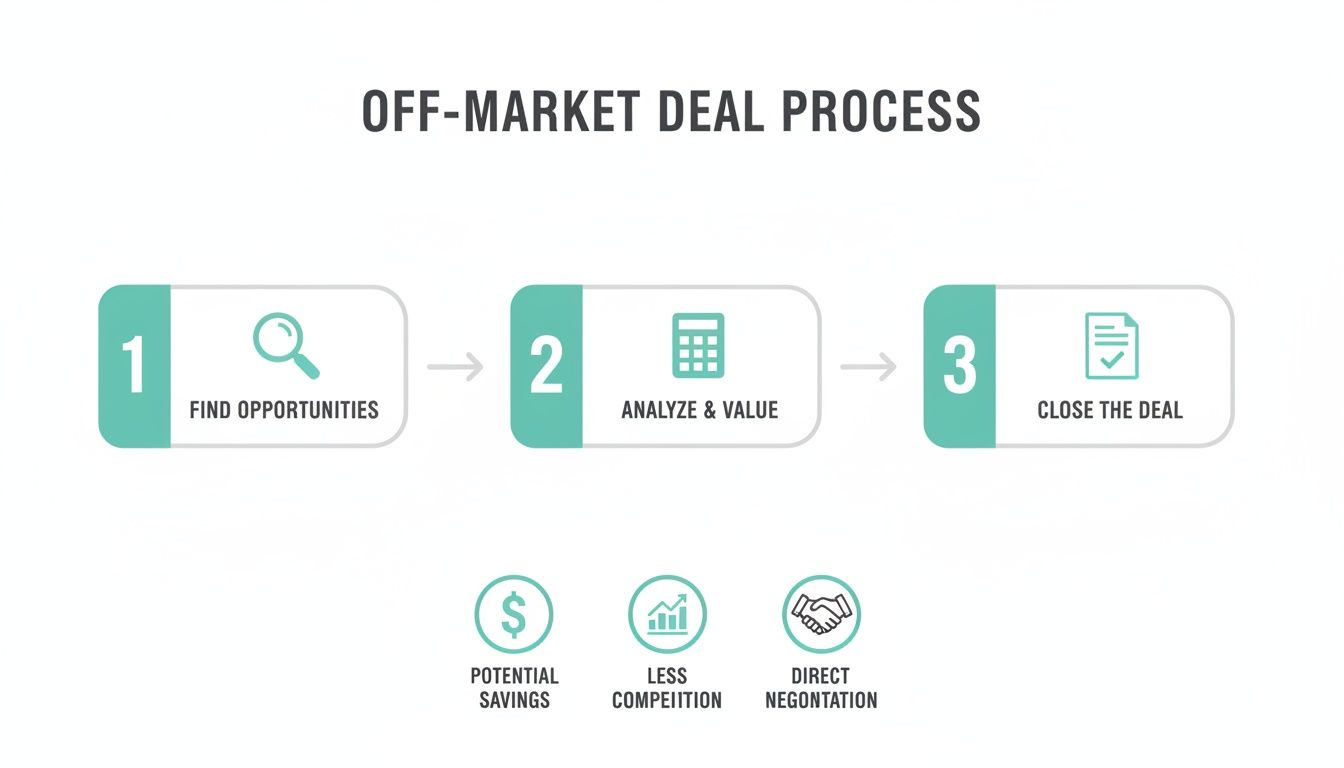
Success lies in moving from one stage to the next efficiently. In the off-market world, speed and confidence win deals.
The Power of a Professional Network
Your network is one of your most valuable assets for sourcing off-market real estate deals. The right professionals are often the first to know about a property long before it hits the open market.
Callout for Beginners: Start by introducing yourself to one new professional each week—an agent, a lender, a property manager. Ask them about their business and explain your investment goals clearly.
Callout for Experienced Investors: Re-engage your existing network. Let them know if your buy box has changed and ask for referrals to other high-performers (e.g., "Who's the best probate attorney you know?").
Here are the key people to build relationships with:
- Wholesalers: These are professional deal-finders. Position yourself as a serious, no-nonsense buyer with clear criteria. Once a wholesaler knows you can close without drama, you'll be on their short list.
- Investor-Friendly Real Estate Agents: While most agents focus on the MLS, some specialize in working with investors and hear about "pocket listings"—properties a seller wants to unload quietly.
- Property Managers: They have a direct line to tired landlords who are ready to sell their portfolios. A good PM knows which owners are struggling and looking for an easy exit.
- Attorneys: Lawyers specializing in probate, bankruptcy, or divorce constantly deal with clients who need to liquidate real estate quickly and privately. Become their go-to problem solver.
- Contractors: Plumbers, roofers, and electricians are inside properties daily. They see deferred maintenance and hear homeowners complain about repair costs—both are strong signs of a motivated seller.
Leveraging an Investor Marketplace
Online platforms are a modern, highly efficient way to find off-market deals. An investor marketplace and networking platform helps solve the core challenges of deal sourcing by connecting you directly with wholesalers and other investors.
On our marketplace, you can create a detailed profile outlining your "buy box," or investment criteria. Wholesalers can then search for investors whose criteria match their deals, eliminating wasted time for everyone. Instead of relying on a scattered buyers list, they can post a deal and instantly reach a network of pre-qualified investors who are actively looking for that exact type of property. This use of technology brings credibility, speed, and reliable deal flow to the process.
Using a Smart Buy Box to Filter Opportunities
Finding potential off market real estate deals is just the first step. The real skill is finding the right deals. This is where your “Smart Buy Box” comes in—it's your ultimate filter for every opportunity.

A buy box is a precise, data-driven definition of your investment criteria. It transforms you from a deal chaser into a deal magnet, attracting only the properties that align with your strategy.
Defining Your Core Investment Criteria
Your buy box is your business plan condensed into a set of rules. For beginners, it's a guardrail against buying the wrong asset. For seasoned investors, it’s a tool for systematic scaling.
Start by defining the non-negotiables:
- Asset Type: Single-family, small multifamily (2-4 units), commercial, or land. Be specific.
- Geographic Area: Define your target markets down to the zip code or neighborhood.
- Property Size & Layout: Specify bed/bath counts or required square footage.
- Property Condition: Are you hunting for turnkey rentals, light cosmetic rehabs, or full gut renovations?
Pinpointing Your Target ROI Metrics
This is what makes a buy box "smart." You define exactly what a "good deal" means in cold, hard numbers, based on your chosen strategy.
Key financial criteria to include:
- Capitalization Rate (Cap Rate): A core metric for buy-and-hold investors measuring a property's unleveraged return (Net Operating Income / Price). You might set a minimum 7% cap rate.
- Cash-on-Cash (CoC) Return: This measures the annual pre-tax cash flow relative to the total cash you invested. A BRRRR (Buy, Rehab, Rent, Refinance, Repeat) investor might target a CoC return of 12% or more after refinancing.
- After-Repair Value (ARV): For flippers, the entire deal hinges on the ARV, which is the estimated value of the property after all repairs are completed. A common guideline is the 70% Rule, where your offer is no more than 70% of the ARV minus repair costs.
A well-defined buy box is also a powerful networking tool. When a wholesaler knows you only buy deals that meet a specific profile, they bring you their best inventory first.
Sample Buy Box Criteria For Different Investor Types
| Investment Criterion | Single-Family Rental (BRRRR Strategy) | Small Multifamily (Buy & Hold Strategy) |
|---|---|---|
| Asset Class | Single-Family Home (Class B or C) | Duplex, Triplex, or Quadplex (Class B) |
| Location | Emerging neighborhoods with strong rental demand | Stable, established neighborhoods near employment centers |
| Property Condition | Value-add; requires cosmetic to moderate rehab | Turnkey or light value-add; minimal initial work |
| Occupancy | Can be vacant to allow for immediate renovation | Preferably occupied with tenants paying near-market rent |
| Price Point | Below $250,000 all-in (purchase + rehab) | Up to $500,000 |
| Min. Cash-on-Cash Return | 15% (post-refinance) | 8% (Year 1) |
| Min. Cap Rate | 8% (based on post-rehab rent) | 6.5% (on purchase price) |
| Min. Equity Capture | 25% of ARV after all costs | Not a primary metric |
Leveraging Technology to Automate Your Search
Manually sifting through hundreds of potential deals is a massive time sink. This is where an investor marketplace like Investor Deal Exchange becomes a game-changer.
Instead of chasing deals, you can build your Smart Buy Box directly into your investor profile on the platform. By inputting your exact criteria—from location and unit count to your target cap rate—the system does the heavy lifting, surfacing only pre-vetted deals that match your strict parameters. This saves countless hours and connects you directly with sellers and wholesalers whose inventory is a perfect fit.
How To Analyze A Potential Deal With Speed And Accuracy
In the world of off market real estate deals, speed is your secret weapon. While other investors are stuck in analysis paralysis, you need a rock-solid system to underwrite properties fast without cutting corners. Being able to confidently make an offer in hours—not days—is what separates the pros from the amateurs.

When you move quickly, you’re playing to the seller’s biggest motivation: a fast, private, and painless close. They're often willing to leave money on the table for it. This isn't just a hunch; Zillow analyzed 10 million transactions and found that sellers who sold off-market often accepted lower prices. You can get all the details in Zillow's full research on off-market seller losses.
Gathering Your Core Numbers
Before you can crunch any numbers, you have to get the raw data. This initial underwriting should take less than an hour once you have a system.
Purchase & Rehab Costs: Start with the asking price. For closing costs, budget 3-5% of the purchase price. The rehab budget is the trickiest part. For a quick screen, use a cost-per-square-foot estimate ($25/sqft for light cosmetic, $75/sqft for a full gut rehab). You'll get a contractor's quote during due diligence.
Income & Operating Expenses: Determine the Gross Potential Rent (GPR) using tools like Rentometer or Zillow Rental Manager. Always factor in a vacancy rate—5-8% of GPR is a conservative standard. For a quick analysis, the 50% Rule (assuming half your income goes to expenses) works well. For a deeper dive, estimate property taxes, insurance, repairs (5-10% of rent), and property management fees (8-10% of rent).
Calculating The Key Performance Indicators
With your numbers in hand, see if the deal fits your Smart Buy Box. These are the metrics that tell the real story.
Net Operating Income (NOI): This is your property's total income minus all operating expenses (before loan payments). It’s the purest measure of its profitability.
Gross Rental Income - Vacancy - Operating Expenses = NOI
Capitalization (Cap) Rate: This metric allows for an apples-to-apples comparison between properties. It measures your return if you paid all cash. Want to go deeper? Check out our guide on how to calculate cap rate for more examples.
NOI / Purchase Price = Cap Rate
Cash-on-Cash (CoC) Return: This is a favorite for investors using financing, as it measures the return on the actual cash you invested.
Annual Pre-Tax Cash Flow / Total Cash Invested = CoC Return
Real-World Example: Back-of-the-Napkin Math on a Duplex Let's run a quick analysis on a sample duplex.
- Purchase Price: $300,000
- Rehab & Closing Costs: $50,000 (This is your total cash invested if buying without financing)
- All-In Cost: $350,000
- Gross Rent (2 units @ $1,800/mo): $43,200 per year
- Estimated OpEx (50% rule): $21,600 per year
Now, let’s calculate the KPIs:
- NOI: $43,200 (Gross Rent) - $21,600 (OpEx) = $21,600
- Cap Rate: $21,600 (NOI) / $350,000 (All-In Cost) = 6.17%
- CoC Return (if cash): $21,600 (Cash Flow) / $350,000 (Total Cash) = 6.17%
This quick check tells you if a deal is worth pursuing further. If these numbers are in the ballpark of your targets, it's time to dig deeper.
Using Technology To Analyze Deals Faster
Building a spreadsheet for every potential property is a waste of time when the clock is ticking on a hot off market real estate deal. This is where a platform built for investors makes all the difference.
On our marketplace, investment calculators are built right into each listing. You can see the Cap Rate, CoC Return, and other key metrics calculated instantly. Better yet, you can adjust the numbers—change the rehab budget, tweak the projected rent—and watch how it impacts your returns in real time. This lets you analyze dozens of properties in the time it used to take for one, so you can make a data-backed offer and lock down the deal.
Negotiating Terms and Securing the Property
Successfully closing off-market real estate deals has little to do with aggressive haggling and everything to do with being a problem-solver.
When you're talking to a motivated seller, you’re not just buying a building; you’re stepping into a major life event. Maybe they inherited a house they can't manage, are a tired landlord, or face a financial crunch. Your first conversation should be about them. Ask open-ended questions and listen. Building rapport transforms the dynamic from an adversarial negotiation into a collaborative partnership.
Structuring a Winning Offer
Your proposal should be a direct answer to the seller’s pain points. In the off-market world, creative and flexible terms often matter more than the highest price.
- Lead with Simplicity and Speed: Your biggest advantage is offering a clean, fast close. Propose a quick closing date, an all-cash offer (even if you’re using hard money), and as few contingencies as possible to give them certainty.
- Consider Seller Financing: This can be a game-changer for a seller who doesn’t need a lump sum of cash, like a retiring landlord. You can often offer a higher purchase price in exchange for them acting as the bank, giving them a steady income stream and reducing your own cash out-of-pocket.
- Propose a Lease-Option: If a seller needs to move but isn't ready to sell, a lease-option lets you control the property today with the right to buy it later at a pre-agreed price.
Having access to cash provides a massive edge. Analysis of financing patterns shows the power of cash offers in the market. To learn more, you can read about the impact of cash buyers in the real estate market.
Remember, the best offer isn't always the highest offer. It's the one that most effectively solves the seller's problem. By listening first, you can craft a proposal that addresses their unique needs for speed, privacy, or convenience.
The Non-Negotiables Of Due Diligence
Off-market properties lack the standardized disclosures of an MLS sale, so the burden of verification falls on you. Rushing due diligence is the fastest way to turn a great deal into a financial nightmare.
Your due diligence period is when you confirm every assumption from your initial analysis. This process must be disciplined and thorough.
- Professional Property Inspection: This is not optional. Hire a qualified inspector to examine the structure, roof, foundation, plumbing, and electrical systems. The report is your final tool for negotiating repairs or credits.
- Comprehensive Title Search: You must confirm the seller has the legal right to sell and that the title is clean of liens or judgments. A title company handles this and provides title insurance to protect your investment.
- Financial and Lease Verification: If it’s a rental, verify every number. Scrutinize tenant leases, bank statements showing rent deposits, and actual utility bills. Never take the seller’s pro-forma or rent roll at face value.
Streamlining The Process With a Centralized Platform
Tracking conversations, documents, and deadlines across multiple deals via email and spreadsheets is a recipe for chaos. Using a real estate marketplace with built-in tools can be a huge help. For example, on a platform like Investor Deal Exchange, you can message sellers directly, store documents securely, and track each deal's progress from offer to closing. This centralized workflow keeps communication professional and ensures nothing gets missed during critical negotiation and due diligence phases.
Common Questions About Off-Market Real Estate Deals
Stepping into the world of off-market real estate can feel like joining a secret club. It’s normal to have questions. Here are answers to some of the most common ones.
Are Off-Market Deals Always Cheaper?
Not necessarily, and this is a common misconception. While you can find properties below market value due to less competition, the real "deal" is often in the terms or the opportunity itself.
The value might come from securing creative seller financing, finding a perfect property for a niche strategy like the BRRRR method, or gaining access to inventory no one else knows is for sale. The goal is to find value, which isn't always the same as the lowest price. A property priced at fair market value might have incredible long-term potential that makes it a home run. This is why your own due diligence is non-negotiable.
Should I Use A Real Estate Agent?
Yes, but with a major caveat: you need an investor-savvy agent. A great one can be a force multiplier for your business, with deep networks and access to "pocket listings" long before they hit the open market.
- For new investors: An experienced agent acts as a guide, bringing expertise in structuring offers, writing contracts, and navigating negotiations.
- For seasoned pros: They become an extension of your team, actively sourcing and pre-vetting opportunities that fit your buy box, freeing you to focus on scaling.
What Are The Biggest Risks?
The main risks with off-market deals boil down to a lack of the standardized transparency you get from an MLS listing. Being aware of these pitfalls is the first step to avoiding them.
- Inaccurate Valuation: Without public listing data and easy comps, determining a property's After-Repair Value (ARV) is trickier. You must become an expert at running your own numbers and never take the seller's word for it.
- Undisclosed Defects: A motivated seller might not be aware of—or may forget to mention—every issue. A thorough, professional inspection is your best defense and should be considered non-negotiable.
- Title Complications: Distressed or inherited properties can have messy histories with hidden liens or ownership disputes. Always get a comprehensive title search and purchase title insurance. It's cheap protection against a potentially massive headache.
Ready to find your next investment without the noise and competition of the open market? With Investor Deal Exchange, you can build a Smart Buy Box and get matched with deals that fit your exact criteria.
Create your free investor profile to get matched with deals that fit your criteria.