If you've been investing in real estate for any length of time, you know the best deals are rarely the ones everyone else is chasing. The real opportunities are found where most people overlook, and properties in probate for sale are a perfect example—a unique niche where investors can often find assets below market value. This guide provides a step-by-step framework for finding, analyzing, and closing on these misunderstood but highly profitable deals.
This happens for a simple, human reason: heirs often need a quick, no-fuss cash sale to settle an estate's debts and distribute what's left. That creates a highly motivated seller, which is the ideal scenario for any sharp investor looking for their next project.
Your Next Big Deal Might Be a Probate Property
For many investors, the word "probate" sounds like a legal headache. In reality, it’s just the court-supervised process for handling a deceased person's assets. When someone passes away, their estate—including any real estate—goes through this formal procedure to ensure debts are paid and the remaining property goes to the right people.
That legal requirement is exactly what opens the door for an investment opportunity. The heirs, or the estate's executor, are suddenly dealing with a property they likely never wanted and often can't afford to maintain. This creates a powerful motivation to sell, where speed and certainty are far more valuable than squeezing every last dollar out of the sale.
Why Probate Properties Are a Strategic Niche
Probate isn't just a legal formality; it's a distinct real estate channel with serious advantages for investors who know how to navigate it. Understanding what drives these sales is the key to seeing the potential beyond the paperwork.
- Below-Market Value Potential: The main goal is often to liquidate assets and close the estate, not to hold out for the highest possible offer. This means properties are frequently priced to move quickly.
- Less Competition: Many traditional homebuyers and even some investors are intimidated by the process. That means you’re often up against a much smaller pool of buyers.
- Value-Add Opportunities: Probate properties are almost always sold "as-is." They might be dated or need significant repairs, which is a perfect setup for a fix-and-flip or a BRRRR (Buy, Rehab, Rent, Refinance, Repeat) strategy.
An important thing to remember: for an investor, a probate sale isn't about capitalizing on a family's loss. It’s about offering a simple, clean solution during a complicated time. You provide a clear path forward, allowing the family to settle the estate without the drawn-out stress of a traditional home sale.
This guide will demystify the entire process. We’ll show you exactly how to find these deals, communicate with estate representatives, and handle the legal steps all the way to closing. Instead of seeing a hurdle, you’ll start to see properties in probate for sale as a steady source for your next great investment.
If you're ready to see what's out there right now, you can browse a variety of property types on our marketplace and find deals that fit your criteria.
How to Consistently Find Probate Real Estate Deals

Finding properties in probate for sale isn’t about luck; it’s about building a consistent, multi-channel system. Unlike deals that pop up on the MLS, these opportunities are almost always off-market, so you'll have to do some digging.
The good news is that once you nail down a process, you can create a reliable pipeline of potential deals that most other investors will never see.
The Direct Approach: Using Public Records
The most direct way to find these deals is to go straight to the source: your local county courthouse. This is where probate cases are filed, and these records are public information. Sifting through these filings lets you get the key details on new estates, including the property address and contact info for the executor.
This hands-on method is still one of the most powerful ways to get a jump on the competition. It takes more work, but the information is fresh and direct.
You’re looking for a document called the "Petition for Probate." This is the starting gun for the whole process—and a goldmine of information for you.
Here’s what to pull from the court files:
- Decedent's Information: The name of the person who passed away.
- Executor/Administrator Details: This is your primary contact. You’ll find their name and often their mailing address.
- Attorney Information: The estate's attorney is another key contact, especially for building long-term deal flow.
- Inventory of Assets: This list confirms whether real estate is part of the estate.
For Beginners: Just focus on the executor's information. They are the court-appointed decision-maker with the authority to sell the property.
For Experienced Investors: The attorney's contact info is just as valuable. Building a reputation with a few probate attorneys as a reliable, fast-closing buyer can lead them to send deals directly to you.
Building a Professional Network
While digging through public records is effective, building the right relationships can be a game-changer. Probate attorneys, estate planners, and CPAs are at the center of these situations. Families trust their advice, and they often have a huge influence on how and when a property gets sold.
Position yourself as a problem-solver. Let these professionals know you can bring a quick, fair, cash offer, allowing their clients to skip the headaches of listing, staging, and showing the property. A single great relationship with a busy probate attorney can bring you more deals than months of grinding it out at the courthouse. To learn more, check out our guide on how to build a strong real estate investor network.
Using Technology to Your Advantage
The manual process of sifting through records can be a serious time sink. Fortunately, technology offers a much more efficient path.
While some online services aggregate probate data for a fee, the competition on those lists can be fierce. A smarter, more targeted approach is using an investor-focused platform. On our marketplace, for example, you can set up a "buy box" with specific criteria that include "probate" or "estate sale." This flips the script and automates the search for you.
Instead of you hunting for deals, the deals find you. Wholesalers who specialize in probate can post their properties directly to the platform. If a deal matches your criteria—location, price, property type—you get an instant notification. This connects you with pre-vetted opportunities from motivated sellers, streamlining your entire acquisition pipeline.
Communicating with Empathy and Professionalism
Successfully acquiring properties in probate for sale comes down to a skill many investors overlook: communication. You’re not just calling a typical seller. You’re reaching out to an executor or administrator who is almost certainly going through a difficult time. That first contact requires a careful balance of genuine empathy and straightforward professionalism.
Your goal is to be seen as a helpful problem-solver, not just another aggressive buyer. Executors are often buried under legal tasks, family dynamics, and the responsibility of managing an estate. Offering a simple, fast, and fair solution can be a huge relief—if you approach them with respect.
Crafting Your Initial Outreach
How you first connect with the personal representative can make or break the deal. Whether you send a letter or make a phone call, the tone needs to be soft and helpful, never pushy.
Here are a few core principles for your outreach:
- Acknowledge Their Situation: Always start by expressing your condolences for their loss. A simple, sincere sentence shows you understand this is more than a business deal.
- Introduce Yourself Clearly: State who you are—a local real estate investor—and why you're reaching out. Skip the jargon and sales talk.
- Focus on Solving Their Problem: Frame your offer as a solution. Mention benefits like a quick cash closing, buying the property "as-is," and covering all closing costs. This speaks directly to their biggest pain points.
Key Takeaway: Your initial message should position you as a resource. The executor's job is to liquidate an asset to settle the estate, and you can make that process fast, predictable, and hassle-free.
Sample Outreach Script Framework
When you make contact, having a clear and concise message is everything. Think of this less as a rigid script and more as a framework for a natural conversation.
For a Direct Call to an Executor:
"Hello, [Executor's Name]. My name is [Your Name], and I'm a local real estate investor calling about the property at [Property Address]. First, I wanted to offer my sincere condolences for your loss. I know this must be a difficult time.
The reason I'm calling is that I specialize in helping families in these situations by providing a simple way to sell inherited property. I can make a fair cash offer and purchase the home in its current condition, which means you wouldn't have to worry about making any repairs or cleaning it out. We can also close on a timeline that works for you. Would you be open to talking about that?"
This approach is direct but respectful, and it immediately highlights the value you bring. It gives them an easy way to say "yes" to a conversation or "no" if they're not interested, without feeling pressured.
For Experienced Investors Approaching Attorneys
For seasoned investors looking to build a reliable pipeline, connecting with probate attorneys is a powerful strategy. Attorneys want to work with credible buyers who can close without drama. When you make their job easier, you become their go-to person.
When you contact an attorney, your approach should be more direct and focused on your credentials.
- Lead with Your Track Record: Briefly mention your experience and ability to perform.
- Emphasize Speed and Certainty: Highlight your capacity for cash closings and familiarity with the probate process.
- Position Yourself as a Go-To Resource: Frame the relationship as a partnership. You are their reliable buyer who can help them efficiently settle estates for their clients.
Building this kind of rapport is often the most critical step. Trust and professionalism will open doors that a lowball offer never will.
Due Diligence for Probate Properties
Once you've found a promising probate property and have a conversation going, it's time to figure out if the deal actually makes sense. Due diligence for properties in probate for sale is different from a standard transaction, as you're often dealing with a neglected property and a complex legal process.
Most of these homes are sold strictly "as-is," which means what you see is what you get. These properties can sit vacant for years, so your first order of business is to get a realistic handle on repair costs to build your renovation budget. This number is the bedrock of your entire calculation and feeds directly into your After Repair Value (ARV)—the projected market value of the property after renovations. By pulling comps of similar, recently updated homes, you can establish a solid ARV and work backward to determine your maximum offer price.
Uncovering Hidden Title Issues
Beyond the physical inspection, a thorough title search is non-negotiable. Estates often come with baggage in the form of outstanding debts, and a title search protects you from inheriting someone else’s financial problems.
A professional title company will uncover any claims that could cloud the title, such as:
- Unpaid property taxes
- Lingering mortgage liens
- Mechanic's liens from unpaid contractors
- IRS or state tax liens
- Judgments against the deceased
Finding these isn't necessarily a deal-killer. Often, these liens can be paid off from the sale proceeds at closing. However, you must know about them upfront for your financial analysis and negotiation leverage. For a deeper dive, check out our guide on analyzing real estate deals and conducting thorough due diligence.
Understanding the Two Types of Probate Sales
How you structure your offer and the expected timeline depend entirely on one crucial factor: the level of authority the court has granted the executor. This is a fork in the road that changes the game.
An executor with full authority under the Independent Administration of Estates Act (IAEA) can act much like a traditional seller. They can list the property, accept an offer, and close the deal without constant court supervision. For you, this is the fast track—simpler, quicker, and more predictable.
On the other hand, a sale requiring court confirmation is a more formal, drawn-out affair. The executor can accept your offer, but it’s conditional. The deal must then be presented in a public court hearing for a judge's approval. At that hearing, any other interested buyer can show up and "overbid" your accepted offer, potentially hijacking the deal.
Investor Insight: The court confirmation process scares off many new investors, and that’s where the opportunity lies. If you’re willing to navigate the red tape, you can often face less competition and get a property for a lower price, which can outweigh the risk of being overbid.
Probate Sale Types and Key Differences
The table below breaks down what you can expect with each scenario.
| Feature | Sale with Full Authority (IAEA) | Sale Requiring Court Confirmation |
|---|---|---|
| Speed | Faster, similar to a traditional sale. | Slower, with delays for court dates. |
| Certainty | High. An accepted offer is very likely to close. | Lower. Your offer can be overbid in court. |
| Offer Terms | Flexible, with standard contingencies usually allowed. | Rigid. Often requires a 10% deposit and no contingencies. |
| Competition | Standard market competition. | Less upfront, but becomes a public auction in court. |
Knowing which type of sale you're dealing with from the start is essential. It dictates your strategy, timeline, and risk tolerance.
Running the Numbers: A Practical Example
Let’s put this all together with a quick scenario. Say you find a probate property listed for $200,000. After a walkthrough, you estimate it needs about $40,000 in repairs. You run the comps and find the ARV is a solid $300,000.
Here's how a simple pro-forma sketch looks:
- Purchase Price: $200,000
- Rehab Costs: $40,000
- Total Investment: $240,000
- After Repair Value (ARV): $300,000
- Potential Profit (before holding/selling costs): $60,000
This quick calculation shows a potential return on investment of 25% ($60,000 profit / $240,000 total investment). If you finance the deal, your cash-on-cash return could be even higher. Many investor platforms have built-in calculators to help you run these numbers in seconds, giving you the confidence to craft a strong, informed offer.
Navigating the Legal Side of Closing
Getting your offer accepted on a probate property is a huge win, but the path to closing has more legal hurdles than a standard deal. This is where patience and attention to detail are critical.
The entire closing process for properties in probate for sale hinges on the executor's level of authority. A sale with "full authority" moves almost like a traditional sale. But if the sale requires court confirmation, you’re stepping into a completely different process.
The Court Confirmation and Overbidding Process
When a sale needs court confirmation, your accepted offer is just the opening bid. The deal is not final until a judge approves it in a public hearing, which is designed to ensure the property sells for the highest possible price.
This is where the overbidding procedure comes in. During the hearing, the judge will state your accepted offer price. At that moment, any other qualified buyer can stand up and try to outbid you. It's a live auction.
- The First Overbid: This bid must follow a specific formula, typically 10% of the first $10,000 of your offer, plus 5% of the remaining balance.
- Subsequent Bids: After that, the judge sets the minimum bid increments.
- The Deposit: Any overbidder must present a cashier's check for a deposit (usually 10% of their bid) to prove they are serious.
It’s a high-stakes moment, but for a seasoned investor, it's a calculated risk. The complexity of this process weeds out a lot of competition.
Timelines and Your Professional Team
One of the biggest adjustments for investors new to probate is the timeline. A normal deal might close in 30 to 45 days. A probate sale needing court approval can easily stretch out for several months due to legal notices and crowded court calendars.
Investor Insight: Don't navigate this maze alone. A real estate agent or title company with deep probate experience is invaluable. They know how to anticipate delays, manage the paperwork, and keep the deal moving forward, saving you from costly mistakes.
This decision tree gives you a clear visual of the two paths your deal can take.
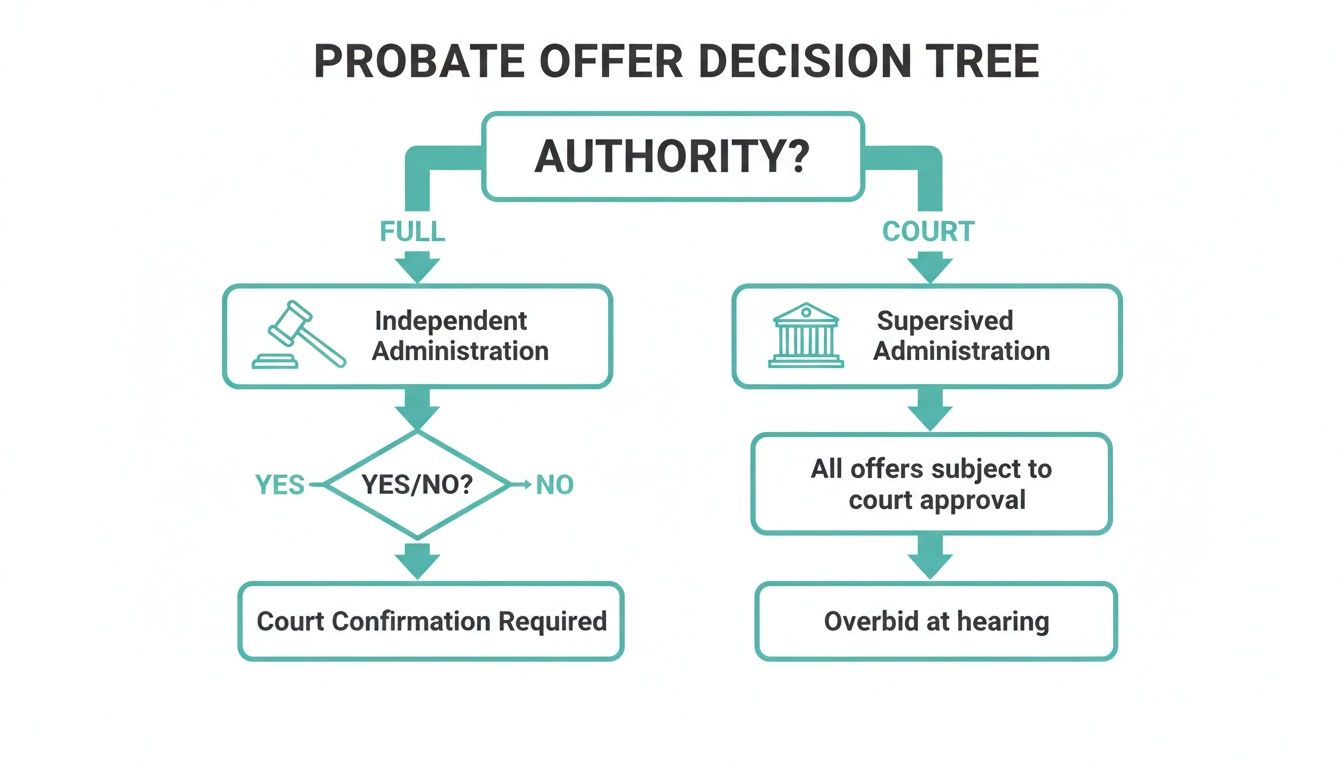
As you can see, figuring out the sale type from the beginning is everything. It dictates the speed, certainty, and complexity of the entire closing process.
Overcoming Financing Hurdles
The long, unpredictable timeline of a probate sale can make traditional lenders nervous. Most conventional banks are built for deals that close in 30 days. When a closing is delayed for a court date, a rate lock can expire, causing major issues.
This is why cash is king in the probate world. A cash offer gives executors and the court the speed and certainty they want. It removes the financing contingency, making your offer dramatically more attractive.
If you don't have cash ready, you still have great options:
- Hard Money Loans: These are short-term loans from private lenders who understand non-traditional deals and can fund them quickly.
- Private Money Lenders: These are individuals in your network who lend based on the strength of the deal and their trust in you.
- Transactional Funding: For wholesalers with an end buyer lined up, this provides the cash needed to close for a very short period, often just a day or two.
Successfully closing on properties in probate for sale comes down to mastering these legal and financial details. By preparing for the court process, building an experienced team, and lining up flexible financing, you can confidently navigate the final steps.
Common Questions About Probate Investing
Even for experienced investors, the world of properties in probate for sale can feel like a different game with its own rules and timelines. Answering key questions upfront is what separates a smooth, profitable deal from a frustrating one.
Let’s tackle some of the most common questions from investors diving into this niche.
How Long Does a Probate Sale Actually Take?
The answer depends entirely on the executor's level of authority.
- Full Authority (IAEA): If the representative has full authority, the process can be surprisingly fast. You could see a closing timeline similar to a normal sale, often within 30 to 60 days after your offer is accepted.
- Court Confirmation Required: This is the slower route. When the court must sign off, the process involves scheduling hearings and sending legal notices. These sales can often stretch out for four to nine months, sometimes longer if the estate is complex.
Investor Takeaway: Patience is a strategic advantage. The longer timelines of court-confirmed sales scare off most buyers, which means less competition and a better chance at a great price if you’re willing to wait.
Can I Use Traditional Financing for a Probate Property?
Technically, yes, but it’s often difficult. Traditional lenders are built for a neat 30-day closing. The unpredictable nature of many probate sales can cause major issues with underwriting and rate locks.
This is why cash offers are so powerful in probate. They bring the certainty and speed that executors and courts value most. If you don't have the cash on hand, alternative funding like a hard money or private money loan is a great fit, as these lenders are built for non-standard, time-sensitive deals.
Is It Okay to Contact the Family Directly?
Contacting the executor or administrator directly is often the most direct path to a deal, but it must be handled with care. You are reaching out to someone who is likely grieving while navigating a stressful legal process.
Your approach should be about offering a simple, helpful solution, not being a pushy investor. A soft, empathetic touch that focuses on making their life easier is the only way to succeed. Aggressive, lowball tactics will almost always fail.
What Happens if Someone Overbids Me in Court?
The court overbidding process is a real possibility in sales requiring confirmation. If another qualified buyer shows up, they can challenge your accepted offer. The first overbid must typically be 10% of the first $10,000 of your price, plus 5% of the remaining balance. After that, it becomes a live auction.
Losing a deal at the finish line is frustrating but a known risk. The best protection is to have solid financing and walk into court knowing your absolute maximum offer. Often, you’ll be the only serious buyer in the room, making it a calculated risk worth taking.
Ready to stop chasing the same old deals and start finding unique opportunities? Set up your investor profile on our platform to get instantly matched with properties, including estate sales, that fit your exact criteria. Create your free investor profile to get matched with deals that fit your criteria.