
In the world of real estate investing, finding a great deal is the name of the game. For serious investors, an off-market property marketplace is a critical tool—a specialized online platform where deals are bought and sold before they ever hit the public market. This guide provides a step-by-step framework for using these platforms to gain a competitive edge.
Think of it as a private network where investors get a first look at hidden inventory, sidestep the usual bidding wars, and connect directly with sellers. The outcome? A more efficient and often more profitable way to acquire properties.
Decoding the Off Market Property Marketplace

For decades, the Multiple Listing Service (MLS) has been the go-to source for properties. It’s a massive, effective database, but it's also a crowded and hyper-competitive arena open to every licensed agent and their clients. An off-market property marketplace flips that model on its head by granting access to a hidden market.
These aren't just generic listing sites. They're focused ecosystems built for investors. Sellers—often wholesalers or homeowners who need a quick, quiet sale—post their deals directly to an audience of vetted, ready-to-buy investors. This direct-to-investor model changes the deal-finding dynamic.
The Rise of the Hidden Market
The appeal of finding deals off-market is growing, especially in today's tricky economic climate. The off-market property marketplace is seeing a surge driven by two key factors: low inventory and the "lock-in effect."
This effect gained steam when mortgage rates jumped significantly. Homeowners who bought or refinanced at rock-bottom rates are now hesitant to sell and take on a much higher mortgage for their next home. This has choked off the supply of listings on the public MLS, pushing more deals into private channels.
You can learn more about how the lock-in effect is reshaping real estate and why it's so important for investors to understand. For investors, this shift is everything. Instead of fighting over the scraps on the MLS, they can tap into a dedicated marketplace to find opportunities the general public never even knows exist. This isn't just a clever tactic; it's an essential strategy.
Key Differences From the MLS
Grasping the difference between an investor-focused marketplace and the traditional MLS is key to seeing its true value. While both connect buyers and sellers, their purpose, audience, and operations are worlds apart.
If you're new, the biggest takeaway is this: An off-market platform helps you find deals with less competition. If you're experienced, it’s about efficiency—sourcing deals that perfectly fit your buy box without wasting time on irrelevant listings.
To make it crystal clear, let's break down how these two channels stack up side-by-side.
Off Market Marketplace vs Traditional MLS at a Glance
This table cuts right to the chase, showing you the core differences between sourcing deals on a private marketplace versus the public MLS. Pay attention to how the dynamics of competition, speed, and deal types change.
| Feature | Off Market Property Marketplace | Traditional MLS |
|---|---|---|
| Accessibility | Limited to platform members (investors, wholesalers). | Broadly accessible through licensed real estate agents. |
| Competition | Lower, as deals are exposed to a curated audience. | High, with properties visible to the entire public market. |
| Deal Types | Primarily investment-focused (distressed, rentals, flips). | Wide variety, including retail-ready homes for homeowners. |
| Speed & Process | Faster, with direct communication between principals. | More structured and often slower due to agent intermediaries. |
| Negotiation | More direct and often more flexible terms. | Formalized, typically managed through agents. |
Ultimately, an off-market property marketplace serves one primary purpose: to connect motivated sellers with serious, qualified investors in a private, efficient environment. It cuts through the noise of the public market, giving you a direct line to deals that align with your investment strategy.
The Real Advantages of Investing Off-Market
Going off-market gives you a strategic edge that you can't find on the public market. This isn't just about finding deals; it's about changing how you acquire properties. You get to operate with more control, better information, and a lot less noise.
The benefits boil down to three game-changers. First, you sidestep the bidding wars that have become standard on the MLS. Second, you tap into a hidden inventory of properties most investors will never know exist. Finally, you create direct lines to sellers, which speeds up the whole deal from start to finish.
Less Competition Means Better Prices
The first thing you'll notice about an off market property marketplace is the drastic drop in competition. When a property hits the MLS, it’s blasted out to thousands of agents and their buyers. That almost always kicks off a bidding war, pushing prices over asking. Off-market deals, on the other hand, are only shared with a smaller, curated group of investors.
This limited exposure is a huge advantage. Instead of being another offer in a giant stack, you have room to negotiate. You can focus on the property’s numbers and your own financial models without the pressure of outbidding emotional buyers. This dynamic often translates into better pricing and more favorable terms.
A fascinating analysis of on-market vs. off-market sales data from San Francisco found that off-market homes sell for about 17% less than their on-market twins, with some discounts hitting 19%. Why? Fewer eyeballs mean fewer bids. This underscores the massive pricing power investors can tap into here.
Exclusive Access to Hidden Deals
An off-market platform is your key to a hidden world of inventory. These are the properties you won't find scrolling through Zillow or Redfin. Sellers who list on these platforms usually have specific reasons for wanting a private, quiet sale.
Maybe they're dealing with financial trouble, sorting out an inherited property, or just can't stand the thought of endless showings. For them, a quick, certain sale to a serious investor is more valuable than trying to squeeze every last penny out of the public market.
This creates a unique pool of opportunities for investors who are in the right place at the right time.
For a buy-and-hold investor, this means finding a cash-flowing rental that hasn't been picked over. For a flipper, it's about securing a property with enough margin for a profitable renovation before it gets bid up.
Direct Connections and Faster Closings
Finally, off-market marketplaces are built to make deals happen faster. They cut out many of the middlemen who slow down a traditional sale. On a platform like ours, for example, you can talk directly with wholesalers or sellers, ask your questions, and get straight answers.
This direct line of communication is priceless. You're not playing telephone through multiple agents, which means you can build rapport and get a real sense of the seller’s motivations. That clarity helps you put together a stronger offer that solves their problem, which helps you get to the closing table faster and with fewer headaches.
Finding and Analyzing Deals on the Platform
Theory is great, but it doesn't close deals. A modern off market property marketplace isn't just a simple listing service; it's a dedicated engine for finding and underwriting opportunities. The goal is to stop wasting your time sifting through irrelevant listings and instead focus only on properties that fit your strategy.
It all starts with defining your criteria—think of it as a personalized digital filter that tells the platform exactly what you’re looking for. Instead of endlessly scrolling through deals that are a terrible fit, you define your ideal property right from the start.
Setting Up Your Investor Profile and Buy Box
Your "buy box" is your personal acquisitions assistant, working 24/7. On the platform, you can set up your investor profile with highly specific criteria to create a curated feed of deals that are a perfect match. This goes way beyond basic filters like city and price.
For instance, an investor can lock in criteria like:
- Property Type: Single Family, Multifamily (down to the unit count), Land, or Commercial.
- Location: Pinpoint specific neighborhoods, zip codes, or even entire counties.
- Financial Targets: Set your minimum thresholds for key metrics like cap rate (a property's return rate based on its income) or cash-on-cash return.
- Physical Attributes: Define the exact bed/bath counts for a rental or the minimum square footage for a commercial space.
Once you set these parameters, you instantly cut through the noise. Your deal feed transforms into a focused, actionable list of properties that already meet your core requirements. This is a clear benefit of an investor marketplace, as you get deals that fit your strategy sent to you.
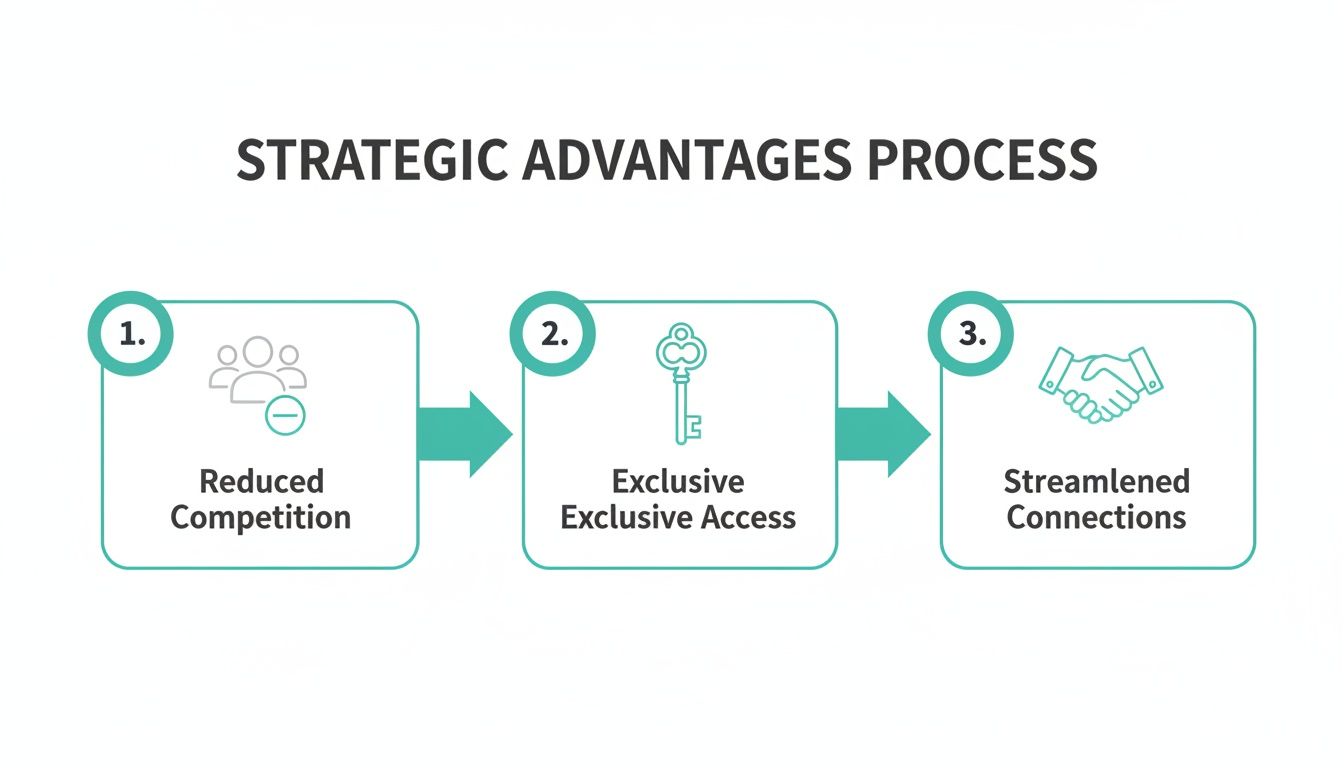
This simple flow shows how a platform gives you a real strategic advantage. You get to sidestep competition, gain exclusive access to deals, and connect directly with the source.
Instantly Analyzing a Deal's Potential
Okay, so a property in your feed catches your eye. What's next? The analysis. In the old days, this meant exporting numbers into a messy spreadsheet—a slow, clunky process. A true marketplace bakes these analytical tools right into every single listing.
With built-in investment calculators, you can underwrite a deal on the spot. Just plug in your estimates for rental income, operating expenses, and financing terms, and the platform will immediately show important key performance indicators (KPIs). You can learn more about how to find and analyze these opportunities in our guide to sourcing off-market properties.
For Beginners: Focus on using the calculators to get a solid grasp on the fundamentals, like potential cash flow and cap rate. It turns a complex task into a simple, data-driven decision.
For Experienced Investors: Use these tools for rapid screening. You can vet dozens of deals in the time it used to take to analyze one, saving your deep-dive due diligence for the most promising opportunities.
The integration of these two features—a smart buy box and instant calculators—is what transforms the platform from a passive website into an active workspace for sourcing and analyzing deals. It dramatically shortens the two most critical phases of any acquisition, helping you find the right deals and underwrite them faster. That efficiency is the core advantage of a purpose-built off market property marketplace.
How Top Investors Benefit from Off-Market Deals
An off-market property marketplace isn't just another listing site. Think of it as an ecosystem—a central hub where serious investors connect to get deals done without the noise and competition of the public market. Each type of investor gets something unique out of it, from wholesalers needing to move inventory fast to developers trying to find their next big project.
This shift toward private, off-market transactions is having a huge impact, as detailed in reports from outlets like HousingWire. As more investors with specific criteria skip the MLS, they create a more efficient market. You can read more about how investor demand is reshaping real estate on HousingWire.com.
Wholesalers and Flippers Gaining an Edge
For wholesalers, these platforms are a disposition game-changer. Instead of spending endless hours building a buyers list, they can upload a deal and instantly get it in front of a curated audience of vetted investors whose buy boxes match the property. This massively shortens the time from contract to closing and makes collecting that assignment fee more certain.
Fix-and-flippers use these marketplaces to find the lifeblood of their business: undervalued properties with enough margin for a profitable renovation.
- Targeted Sourcing: They can set their buy box to find distressed properties or homes with value-add potential in specific zip codes.
- Quick Analysis: Built-in calculators let them run numbers on the spot to see if a project makes sense, saving time on deals that will never pencil out.
- Direct Negotiation: By connecting directly with sellers or wholesalers, they can often lock down properties below retail value—a critical factor for a successful flip.
Buy-and-Hold Investors and Developers
Buy-and-hold investors, whether focused on single-family rentals or small multifamily buildings, use these platforms to find cash-flowing assets. Their goal is long-term wealth, which requires precision. They can filter for properties that hit specific cash-on-cash return or cap rate targets, ensuring every new acquisition fits their portfolio strategy.
The platform acts as a powerful screening tool, filtering out the noise of the public market and delivering only the properties that fit a defined, long-term strategy. This allows buy-and-hold investors to scale more predictably.
Finally, developers and commercial investors tap into the marketplace to find rare opportunities that almost never hit the open market. This could mean:
- Finding infill lots for new construction projects.
- Sourcing underutilized commercial buildings ripe for redevelopment.
- Locating specialized assets that meet a very specific, niche investment thesis.
For these pros, seeing a property's true potential is everything. For more on this, check out our guide on how to value a commercial property. By bringing all these investor types together, an off-market property marketplace creates a dynamic environment where every deal finds its perfect buyer, making the process faster and more efficient for everyone.
Building Your Deal Flow Management System

Finding a great deal on an off-market property marketplace is a huge win, but it’s only half the battle. The real secret to scaling an investment business isn't just about finding deals—it's about what you do after you find them. A great platform doesn’t just show you listings; it gives you the tools to organize, track, and close those opportunities like a pro.
Without a system, deal flow quickly turns into chaos. Juggling messy spreadsheets, digging through old emails, and trying to remember text messages from wholesalers is a surefire way to let golden opportunities slip through your fingers.
Introducing the Digital Deal Pipeline
A modern marketplace solves this headache with an integrated Deal Pipeline. Think of it as your acquisitions command center—a single, clean workspace where every deal lives, from the moment you spot it to the day you close. When a property in your feed catches your eye, you save it directly to your pipeline.
That one click transforms a passive listing into an active project. You’re no longer just browsing; you're systematically managing a funnel. This is the fundamental shift from an amateur hobbyist to a professional, scalable operator.
A solid Deal Pipeline lets you:
- Save and Organize Deals: Keep every potential property in one place, neatly sorted and instantly accessible.
- Add Private Notes: Jot down underwriting thoughts, due diligence questions, or reminders about a specific property.
- Track Deal Stages: See exactly where every deal stands at a glance—from "Under Review" and "Contacted Seller" to "Under Contract" and "Closed."
This organized workflow gives you a bird's-eye view of your entire acquisitions funnel, making sure no lead ever goes cold.
Streamlining Communication and Collaboration
Beyond just tracking, the real game-changer is integrated communication. Instead of digging through your inbox, the platform keeps all messages tied directly to the property listing. Got a question for a wholesaler? Need to clarify a detail with a seller? You message them right there.
This keeps every conversation in context and makes it simple to find later. All your communications, documents, and notes are logged in one spot, creating a single source of truth for each deal. The efficiency you gain is massive, especially when you’re juggling multiple opportunities. After all, building a strong network is everything, which we cover in our guide to creating a powerful real estate investor network.
An integrated system transforms your process from reactive to proactive. You’re no longer chasing information across different apps; you’re managing a repeatable, professional workflow that supports growth.
A purpose-built off market property marketplace delivers more than just deal flow—it provides the organized, repeatable system you need to manage that flow effectively. It replaces chaos with clarity, allowing you to close more deals with less effort.
How to Choose the Right Marketplace for Your Strategy
Not all off-market property marketplaces are created equal. The space is crowded, and each platform has its own focus, user base, and tools. Choosing the right one isn't about finding the site with the most listings; it's about finding the platform whose features align with your specific investment strategy.
A platform that’s a goldmine for a wholesaler might be useless for a buy-and-hold investor. The trick is to look past the marketing and figure out how it helps you execute your business plan. Making a smart choice upfront will save you time and the headache of wrestling with a tool that wasn't built for you.
Evaluate the Quality and Volume of Deals
The first, most critical test for any marketplace is its inventory. A platform can have the slickest interface in the world, but it’s worthless if it doesn't have a steady stream of quality deals in the markets you care about.
Start by asking a few practical questions:
- Is there enough deal flow in my market? Check the number of active and recently sold properties in your specific cities or zip codes. A platform boasting thousands of deals nationwide means nothing if your local market is a ghost town.
- Are the listings high-quality? Look for detailed property information, clear photos, and transparent financials. Vague listings with missing data are red flags, often pointing to a low-quality user base.
- Do these deals match my strategy? If you’re hunting for multifamily assets, a platform dominated by single-family flips is just noise. Make sure the property types available are the ones you're trying to buy.
Assess the Precision of its Tools
Beyond a feed of properties, the best marketplaces give you powerful tools that speed up your workflow. The goal is to move from sourcing to analysis as fast as possible without cutting corners. Your evaluation should zero in on how sharp and useful the platform’s features really are.
Think about how the platform handles these key functions:
- Filtering and Sorting: How granular can you get with your search? A top-tier off-market property marketplace lets you build a detailed buy box with criteria like your target cap rate, cash-on-cash return, and even specific unit counts. This turns a generic feed into a curated list of opportunities.
- Built-in Analytics: Does the platform have integrated investment calculators? The ability to instantly underwrite a deal for ROI and cash flow right on the listing page is a massive time-saver. It separates platforms built for serious investors from simple listing aggregators.
For a wholesaler, strong disposition tools and a large, active buyer network are paramount. For a buy-and-hold investor, robust cash flow analytics and detailed property financials are non-negotiable. Always match the tools to your trade.
Gauge the Professionalism of the Network
At the end of the day, an off-market platform is more than just a list of properties; it's a network of people. The quality of that network directly impacts your ability to get deals done. A professional, active community leads to smoother transactions, better communication, and more reliable partnerships.
Look for signs of a healthy ecosystem. Are sellers and wholesalers responsive to messages? Do the user profiles look complete and professional? A marketplace filled with serious, vetted investors is a powerful asset. It creates an environment where you can close deals efficiently and with confidence, turning a simple website into a professional network that will help you grow.
Your Questions, Answered
Jumping into the world of off-market marketplaces can bring up a few questions. Let's tackle some of the most common ones we hear from investors, whether they're closing their first deal or their fiftieth.
Are Off-Market Properties Actually Cheaper?
In many cases, yes. These properties aren't advertised on the public MLS, which means you're not competing in the same shark tank. Bidding wars are rare.
This gives you leverage to negotiate. Some data even shows investors snagging deals at 17% or more below what a similar on-market property would fetch. Of course, the final price always comes down to the seller's motivation and the property's condition.
Who Is Selling on These Platforms?
The sellers are usually just as motivated as the buyers. You'll often find wholesalers who need to assign a contract quickly to a reliable cash buyer.
You'll also find homeowners in a tight spot financially, people who've inherited a property they don't want, or tired landlords who just want a clean, private sale without endless showings and open houses.
What do they all have in common? A need for speed, certainty, and discretion. One common approach is for these sellers to take a fair, fast offer from a serious investor over gambling for top dollar on the open market.
Is This Just for Seasoned Pros?
Not at all. While experienced operators use off-market marketplaces to keep their deal pipeline full, beginners get a massive leg up here, too.
The entire setup—with filtered deal feeds and built-in analysis tools—is like a training ground for learning how to underwrite a deal properly. It’s a focused and less chaotic way to find and evaluate your first few properties, helping you build confidence with real numbers, not guesswork.
Ready to stop competing and start closing on a premier off market property marketplace? An investor marketplace provides the tools to find, analyze, and lock down your next deal with precision. Create your free investor profile to get matched with deals that fit your criteria.