
If you're looking to graduate from single-family rentals or want a powerful start in real estate, investing in multifamily properties is a proven path to building wealth. This guide will show you how to find, analyze, and finance these deals, offering the scalability and cash flow that a scattered portfolio of single-family homes often can’t match. By learning to operate these properties like a business, you can spread your risk, create efficiencies, and directly increase an asset’s value.
Why Investing in Multifamily Properties Is a Smart Move
Think of it this way: a single-family rental is like a small business with just one customer. If that customer—your tenant—leaves, your income instantly drops to zero. That’s a precarious position.
A multifamily property, on the other hand, is a business with multiple customers under one roof. When one tenant moves out of a 12-unit building, you still have 11 others paying rent. That one vacancy stings a lot less, giving you a crucial layer of financial stability that is fundamental to long-term success.
The Power of Scale and Efficiency
Beyond spreading risk, multifamily investing unlocks serious economies of scale. Instead of managing ten separate houses scattered across town, you’re managing ten units at a single address. That consolidation is a game-changer.
Consider the practical advantages:
- Lower Management Costs: It is more efficient for a property manager to oversee one 12-unit building than 12 individual houses. This nearly always means lower per-unit management fees, putting more money back in your pocket.
- Streamlined Maintenance: When a plumber or roofer needs to come out, they’re going to one location, not coordinating a dozen site visits. This saves an incredible amount of time and money on both routine repairs and major capital projects.
- Simpler Financing: Getting one larger commercial loan for a multifamily building is often a more straightforward process than juggling multiple smaller residential loans for single-family homes.
This built-in efficiency is what allows your portfolio to grow predictably. For seasoned investors, it’s the key to scaling. For beginners, it’s a structured way to own multiple rental units from day one.
Forcing Appreciation and Building Equity
This is where multifamily investing gets exciting. The single biggest advantage of investing in multifamily properties (especially those with five or more units) is the ability to force appreciation.
Unlike single-family homes, whose values are tied to comparable sales ("comps"), commercial multifamily assets are valued based on their Net Operating Income (NOI)—the property's income minus its operating expenses.
This is a critical distinction: by increasing income (like renovating units to justify higher rents) or decreasing expenses (like installing energy-efficient lighting), you directly increase the property's value. You are in control of your investment's growth.
This commercial valuation method shifts you from being a passive investor hoping the market goes up to an active asset manager creating real, tangible value. As you learn to analyze and improve a property's operations, you unlock a direct path to building substantial equity.
Getting a Feel for Different Multifamily Deals
Not all multifamily deals are the same. The right path for you boils down to your capital, experience, and long-term goals. Deals generally fall into two categories: small and large multifamily properties, each with its own rules for financing and management.
For anyone just starting out, small multifamily properties (2-4 units) are a fantastic entry point. These buildings—duplexes, triplexes, and fourplexes—are typically treated like residential properties by lenders. This is a huge plus, as it means you can often access more favorable financing, like a conventional loan with a lower down payment.
One of the smartest strategies for a new investor is "house hacking." It’s simple: you buy a 2-4 unit building, move into one of the units, and rent out the others. The rent from your tenants can dramatically reduce, or even completely cover, your mortgage. You get to live for less while someone else pays down your loan and builds your equity.
Making the Leap to Commercial Properties
Once you cross the line into five or more units, the entire game changes. These larger buildings are classified as commercial real estate, which means they are financed and valued differently. Lenders see them as a business, and the loan you get will be based on the property's financial performance, not just local comps.
This is where true scalability kicks in. While managing a fourplex is a great learning experience, managing a 20- or 50-unit building allows you to hire professional, on-site help and generate serious cash flow. Seasoned investors gravitate toward these larger assets because they offer a more direct route to building a significant portfolio and achieving financial independence.
Key Takeaway: The jump from four to five units is the dividing line that moves you from the residential world into the commercial one, fundamentally changing how you find, fund, and run your investments.
Small vs. Large Multifamily Investing at a Glance
Which path should you take? It depends on where you are in your journey. This table breaks down the core differences to help you focus your efforts.
| Characteristic | Small Multifamily (2-4 Units) | Large Multifamily (5+ Units) |
|---|---|---|
| Financing | Qualifies for residential loans (Conventional, FHA, VA) with potentially lower down payments. | Requires commercial loans, underwritten based on the property's income potential (NOI). |
| Management | Often self-managed by the owner, especially when house hacking. | Typically requires a professional property management company due to complexity and scale. |
| Scalability | Good for starting, but scaling requires acquiring multiple separate properties. | Offers greater potential for scale; one 20-unit building is easier to manage than five fourplexes. |
| Value Basis | Value is influenced by comparable sales (comps), similar to single-family homes. | Value is primarily determined by its Net Operating Income (NOI) and the market cap rate. |
Ultimately, small multifamily is the perfect training ground, while large multifamily is where you build an empire.
Following the Market's Lead
Where you invest is as critical as what you invest in. The U.S. multifamily market has been incredibly resilient, with recent national sales volume reaching $83.2 billion. Investors have been pouring capital into the Sun Belt and other booming secondary markets. Cities like Dallas and Seattle, for instance, each saw over $3.9 billion in deals.
This isn't random; it's a strategic move toward areas with strong job and population growth. You can learn more about these multifamily market trends to see where smart money is going. Whether you’re a beginner looking for a duplex or a seasoned pro hunting for a 100-unit complex, your strategy must align with market data. On a real estate investing marketplace, you can filter deals by location, size, and return metrics to find opportunities that fit your game plan.
How to Analyze a Multifamily Investment Deal
Great deals aren't just found; they're proven with numbers. Successful investors separate themselves by getting good at underwriting. Analyzing a multifamily deal might seem intimidating, but it boils down to a few core metrics that tell the story of a property's financial health.
This visual guide breaks down the core components of a multifamily deal, from property types to financing and key metrics.
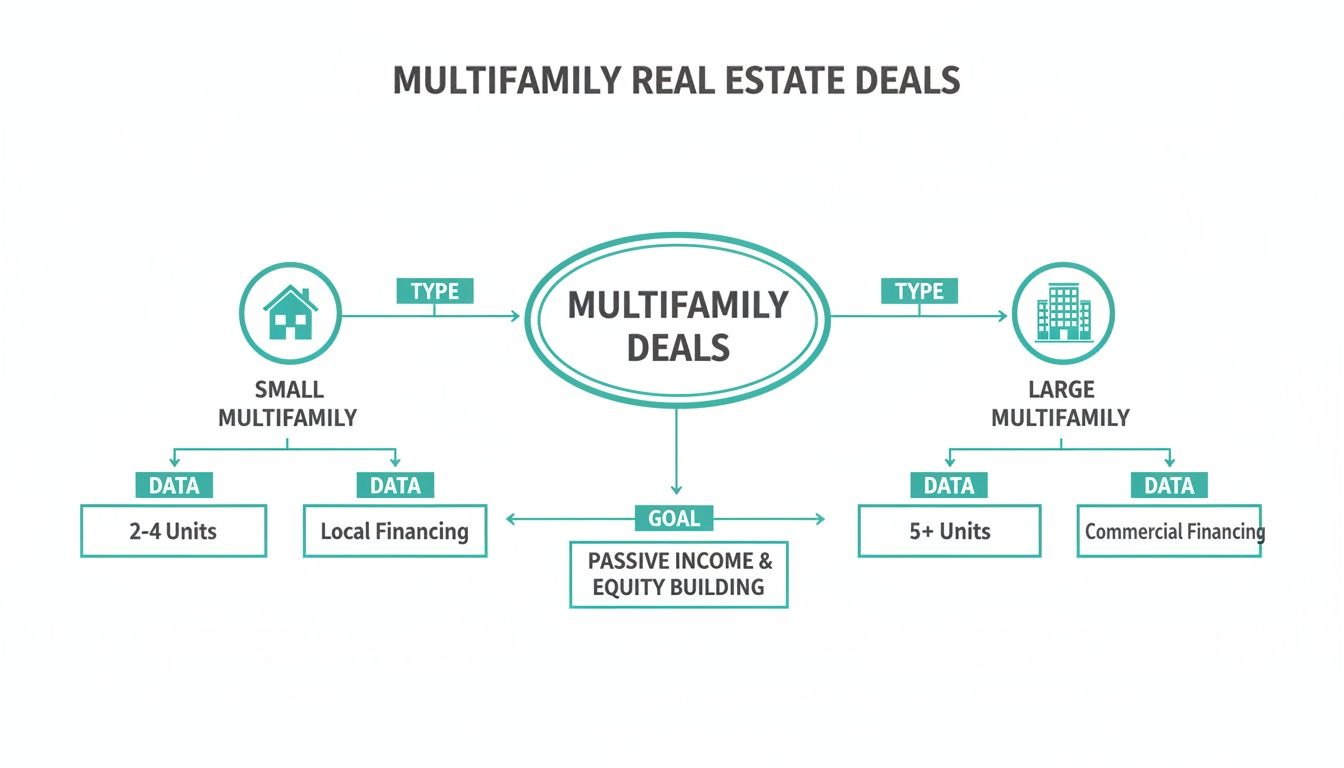
As you can see, small and large multifamily properties flow through distinct financing and valuation pathways, all driven by the investor's end goal, whether that’s immediate cash flow or long-term appreciation.
Let's break down the essential numbers you need to know.
Start with Net Operating Income (NOI)
The first and most important metric is Net Operating Income (NOI). Think of NOI as the property's pure profit before accounting for mortgage payments or income taxes. It's the cleanest measure of an asset's raw performance.
The formula is simple:
Gross Rental Income + Other Income – Operating Expenses = Net Operating Income (NOI)
Let’s run a quick example. A 10-unit building generates $120,000 in annual rent and another $5,000 from laundry fees. Its operating expenses (property taxes, insurance, management, repairs) total $50,000.
- NOI = ($120,000 + $5,000) - $50,000 = $75,000
This $75,000 is the engine of your investment. Every other key metric flows directly from it.
Use Cap Rate to Compare Opportunities
Next is the Capitalization Rate (Cap Rate). The Cap Rate is a yardstick that helps you compare the potential return of one property against another, regardless of price. It shows the property's annual return as a percentage of its purchase price, assuming you paid all cash.
Here's the formula:
Cap Rate = Net Operating Income / Purchase Price
Using our example, if that 10-unit building with a $75,000 NOI is listed for $1,000,000, the Cap Rate is:
- Cap Rate = $75,000 / $1,000,000 = 7.5%
A 7.5% cap rate means for every dollar you invest, the property generates 7.5 cents in annual income before debt service. This lets you quickly compare it to other deals in the same market. To go deeper, check out our guide on how to value a commercial property.
Calculate Your Actual Cash-on-Cash Return
While Cap Rate is great for comparing deals, the Cash-on-Cash Return (CoC) tells you what really matters: how hard your actual invested money is working for you. This metric accounts for your mortgage, showing the return on your down payment and closing costs.
The formula is:
CoC Return = Annual Cash Flow / Total Cash Invested
Let's continue with our example. You buy the $1,000,000 building with a $250,000 down payment (your total cash invested). Your NOI is $75,000, and your annual mortgage payments (debt service) are $50,000.
- First, find your Annual Cash Flow: NOI - Debt Service = $75,000 - $50,000 = $25,000
- Now, calculate the CoC Return: $25,000 / $250,000 = 10%
Your Cash-on-Cash return is 10%. This is a powerful metric for investors focused on generating immediate, spendable cash flow.
A Look at the Internal Rate of Return for Long-Term Plays
For experienced investors thinking about the entire life of an investment—including the final sale—the Internal Rate of Return (IRR) is the go-to metric. IRR is a more complex calculation that measures the total annualized return over the entire holding period. It factors in your initial investment, the annual cash flows, and the final profit when you sell the property.
While the math is best left to a spreadsheet, the concept is crucial:
- IRR accounts for the time value of money, recognizing that a dollar today is worth more than a dollar five years from now.
- It provides a complete, holistic picture of an investment's profitability from purchase to sale.
A value-add multifamily investor might target an IRR of 15-20% or more on a project. On a marketplace platform, built-in investment calculators can run these numbers for you instantly, letting you analyze deals faster and make data-driven decisions.
Financing Your Multifamily Property Purchase
Getting the right funding turns a good idea into a real asset. The financing path you take for a multifamily property almost always comes down to how many units it has. Lenders look at a duplex completely differently than a 20-unit building, and understanding that distinction is key.
For new investors, the most common entry point is through conventional residential loans. These are the same mortgages you’d get for a single-family home, but they have special provisions for properties with two to four units. This is a huge advantage, as you often get better terms, lower interest rates, and down payments as low as 20-25%. If you plan to "house hack" by living in one of the units, you might even qualify for an FHA loan with a minimal down payment.
Stepping Up to Commercial Financing
Once you cross into five or more units, you've entered the world of commercial real estate. The rules change here. Commercial loans aren’t underwritten based on your personal income; the lender’s focus shifts entirely to the property's ability to generate cash.
Their main question is: "Does this property's Net Operating Income (NOI) cover the mortgage payments with a healthy cushion?" This is measured by the Debt Service Coverage Ratio (DSCR), a metric that lenders use to assess risk.
Here are the main players in the commercial space:
- Agency Loans: These come from government-sponsored enterprises (GSEs) like Fannie Mae and Freddie Mac. They are the gold standard for stabilized properties, offering long-term, fixed-rate financing with some of the best rates. The catch? They have very strict underwriting standards.
- Bank Portfolio Loans: These are loans made by local or regional banks that they keep on their own books. This gives them more flexibility on terms, making them a great fit for properties that don't fit into the perfect box required by an agency loan.
- CMBS Loans: Also known as "conduit" loans, Commercial Mortgage-Backed Securities are bundled with other commercial loans and sold to investors. They can offer high leverage but are often rigid if you need to sell or refinance before the term is up.
Creative and Advanced Financing Strategies
Sometimes, a traditional loan won't work, especially if a property needs significant work. That's where creative strategies come into play.
Seller financing is a powerful tool where the property owner acts as the bank, financing some or all of the purchase. This can be a game-changer, potentially reducing your down payment and simplifying the closing process. This is often an option when an owner has paid off their mortgage.
Another smart strategy for scaling is syndication. This means pooling money from a group of passive investors to buy a much larger property than you could afford on your own. As the deal "sponsor," you do the heavy lifting—finding the deal, managing it, and executing the business plan—while your partners provide most of the capital.
Syndication allows an operator with proven expertise but limited capital to control large properties, creating a win-win for both the sponsor and the investors who back them.
Navigating these options takes planning. For a deeper look, our complete guide covers many other real estate financing options.
Sourcing and Vetting Multifamily Deals
Finding a great multifamily deal is an active process that combines old-school networking and modern technology. Success comes from being proactive, not just waiting for the phone to ring.
For years, the best deals came from building deep relationships with commercial brokers, and that method is still powerful. A good broker who understands your goals will bring you opportunities before they hit the open market. However, relying solely on brokers is a passive game that limits your control.
Using Technology to Gain an Edge
This is where a modern investor marketplace becomes your secret weapon. Instead of manually digging through listings or waiting on brokers, you get to take control. The key is creating a laser-focused profile of what you’re looking for—your investment criteria, or "buy box."
On a platform like ours, you can set up a profile with a Smart Buy Box that automatically filters opportunities. This isn’t just about location and price. You can specify the granular details that matter in multifamily investing, like:
- Unit Count: Set your sweet spot, whether it's a 5-unit building or a 100+ unit complex.
- Financial Metrics: Define your non-negotiables for Cap Rate or Cash-on-Cash Return.
- Location: Target specific neighborhoods, cities, or even entire states.
This system flips the script. Instead of you hunting for deals, the right deals find you. Wholesalers and sellers see your criteria and bring you properties that are a perfect match, saving you countless hours.
The Due Diligence Checklist
Once a promising property is on your radar, the real work begins. Vetting the deal is the most critical phase—it's where you verify every assumption from your initial analysis. A thorough due diligence process protects your capital and prevents you from inheriting someone else's problems.
Due diligence is your chance to look under the hood. It’s not about finding a perfect property—it's about understanding the real story behind the numbers and physical condition so you can buy with confidence.
Your investigation needs to be disciplined and structured around three core areas: financials, the physical building, and legal paperwork.
Financial and Legal Verification
First, you must confirm the property performs as advertised. Never take the seller's pro-forma at face value. Request and meticulously review these documents:
- Trailing 12-Month (T-12) P&L Statement: This shows the actual income and expenses over the last year, not a projection.
- Rent Roll: This is a list of every tenant, their unit, what they pay in rent, and their lease dates. Look for red flags like high vacancy, delinquencies, or many leases expiring at once.
- Lease Agreements: Spot-check a few leases. Ensure they match the rent roll and that you understand the landlord's obligations.
On the legal side, dig into title reports, surveys, and zoning regulations to ensure there are no hidden surprises that could derail your business plan.
Physical Inspection and Market Reality
While the numbers tell one story, the physical asset tells another. A professional property inspection is non-negotiable. This goes beyond a standard home inspection—it must cover big-ticket items like the roof, HVAC systems, foundation, and plumbing. Getting bids from contractors for any needed repairs is essential for locking in your renovation budget.
At the same time, understand what’s happening in the market. Demand for multifamily properties has stayed remarkably strong. Net absorption recently hit around 355,000 units—one of the highest annual figures in the last 25 years. Strong household formation and the high cost of single-family homes are keeping occupancy rates steady. You can explore more on these multifamily trends at cushmanwakefield.com to validate your market assumptions.
This combination of proactive sourcing and rigorous vetting is how you find and lock down profitable multifamily deals. To sharpen your sourcing skills, our guide on finding valuable off-market properties can help.
Managing and Scaling Your Multifamily Portfolio

You've closed on your first multifamily property. Congratulations. But the real work—and wealth creation—starts now. This is where you pivot from deal-hunter to asset manager.
Long-term wealth in this game is built on excellent management and smart, strategic growth. It’s time to stop thinking of it as just a property and start treating it like a business. The most powerful way to make your new asset more valuable is through forced appreciation. This is about actively increasing your Net Operating Income (NOI) by either boosting income or cutting expenses. Every dollar you add to your NOI has a multiplier effect on the property's value.
Powerful Value-Add Strategies
This is how you take an underperforming property and unlock its hidden cash flow. Even small, targeted improvements can make a huge difference to your bottom line.
Here are a few effective value-add strategies:
- Unit Renovations: Upgrades like new countertops, modern flooring, or an in-unit washer and dryer can justify significant rent bumps.
- Adding Amenities: Depending on the property, adding a dog park, a small fitness room, or secure package lockers can attract better tenants and command premium rents.
- Implementing Utility Bill-Back Systems: Setting up a RUBS (Ratio Utility Billing System) allows you to pass a portion of the property's utility costs to tenants, which directly slashes your operating expenses and boosts NOI.
These are strategic investments that systematically increase the asset's worth, creating real, tangible equity.
Self-Management vs Professional Management
One of the first big decisions you'll face is who will handle day-to-day operations. There’s no single right answer—it comes down to your experience, goals, and portfolio size.
For Beginners: If you're starting with a duplex or a fourplex, self-managing is an incredible learning experience. You'll get a crash course in tenant screening, maintenance, and expense control that no book can teach you.
For Experienced Investors: As you grow, your time becomes your most valuable resource. Hiring a professional property manager frees you from fixing leaky faucets so you can focus on what really moves the needle: finding the next deal and raising capital.
A good property manager isn't just a rent collector. They handle marketing, tenant relations, and coordinating repairs. While they charge a fee—usually a percentage of gross rents—their expertise often saves you more than they cost through lower vacancy rates and more efficient operations.
Building Systems to Scale Your Portfolio
Going from one property to a portfolio requires a mental shift from landlord to operator. That means building repeatable systems and using technology to manage your assets, whether you have five units or five hundred.
This is where a solid acquisition pipeline becomes crucial. Setting up a detailed investor profile on a marketplace platform ensures you get a steady stream of deals that fit your criteria, allowing you to spend your energy on analysis, not just searching.
The market itself is creating a window of opportunity. After a post-pandemic building frenzy, the multifamily construction pipeline is tightening, with new starts dropping over 40%. This slowdown in new supply, combined with steady renter demand, is setting the stage for lower vacancies and renewed rent growth. A scalable system will position you to ride that wave as it builds.
Common Questions About Multifamily Investing
As you dig into multifamily real estate, the same questions come up repeatedly. Getting straight answers is key, whether you're a beginner or a seasoned pro. Let's tackle some of the big ones.
What's the Minimum Amount I Need to Start?
There's no magic number, and the barrier to entry is often lower than people think. For a small multifamily property (2-4 units), you could get in with an FHA loan for as little as 3.5% down if you live in one of the units ("house hacking"). If you're buying it as a pure investment, plan on needing 20-25% down for a conventional loan.
A great strategy for investors with less cash is to team up. By forming a partnership or joining a real estate syndication, you can pool your money with others to buy a larger, more profitable asset than you could on your own.
How Is a Multifamily Property Valued Differently?
This is a critical distinction. A single-family home's value is based on what similar houses in the neighborhood have sold for ("comps"). But a multifamily property with five or more units is valued like a business—based on the income it generates.
The go-to valuation method uses its Net Operating Income (NOI). You divide the property's NOI by the market's Capitalization Rate (Cap Rate) to determine its value. This is exciting because it means you can directly increase the property's value by making smart moves to boost income or cut expenses—a concept called "forcing appreciation."
What Are the Biggest Risks in Multifamily Investing?
Every investment has risks, and multifamily is no exception. Here are the main ones to watch out for:
- Overpaying for the property. This often happens when you get too optimistic with income projections.
- Underestimating capital expenditures (CapEx). Big-ticket repairs like a new roof or HVAC systems can wreck your budget if you haven't planned for them.
- Bad management. This is a silent killer. Poor management leads to empty units, unhappy tenants, and a chaotic operation that bleeds cash.
- Market risk. Sometimes the local economy takes a nosedive. When that happens, rents and occupancy can suffer, and it's largely out of your control.
The best defense is thorough due diligence, conservative underwriting when you analyze a deal, and a rock-solid management plan.
Ready to stop searching and start analyzing? By setting up your criteria on an investor marketplace, you can get a curated feed of multifamily deals that match your exact strategy.
Create your free investor profile to get matched with deals that fit your strategy.