Finding a great rental property isn't about luck; it's about building a system. To stop scrolling endlessly and start making offers, you need a precise filter—what investors call a “buy box”—that lays out exactly what a good deal looks like to you. This guide provides a step-by-step framework to help you define your criteria, build your deal flow, and analyze opportunities like a pro.
Getting this foundation right separates professional investors from permanent window shoppers. It’s how you eliminate 99% of the noise and focus your time, energy, and capital only on properties with real potential to build wealth.
Building Your Foundation: Defining Your Investment Criteria
A well-defined buy box is your strategic roadmap. Without one, you'll waste countless hours analyzing deals that never fit your goals. Seasoned investors don't stumble upon great deals; they find them because they know with absolute clarity what they’re looking for.
Think of your buy box as a short, written document that forces you to move from a vague idea like "I want to buy a rental" to a concrete, actionable plan.
Selecting Your Target Markets
Your first big decision is where to invest. Don’t just default to your own backyard out of convenience. Instead, analyze markets based on the fundamental economic drivers that create long-term rental demand.
- Job Growth: Look for markets with diverse and expanding employment sectors. A town reliant on a single factory is far riskier than a city with strong healthcare, tech, and logistics hubs that can weather economic shifts.
- Population Trends: Is the population growing, shrinking, or treading water? Positive net migration is one of the strongest indicators of future housing demand.
- Landlord-Tenant Laws: Do your homework on state and local regulations. Some areas are notoriously tenant-friendly, which can create massive headaches for landlords when it comes to evictions or rent control.
Smart investors also look ahead. Take the Sun Belt, for example. After a period of high supply and flat rent growth, apartment construction is expected to slow. This shift is projected to stabilize the market and bring rent growth back to 1%–2% by 2026, creating a prime opportunity for investors who get in at the right time. You can read the full breakdown in the 2026 Apartment Housing Outlook from NAAHQ.
This image shows exactly how a modern platform helps you define and save these specific market criteria, turning your strategy into an automated search.
When you set up a buy box profile on an investor marketplace, you essentially put this filtering process on autopilot. You'll only see deals that actually fit your geographic and financial parameters, saving you from sorting through irrelevant listings.
Defining Your Ideal Property and Returns
Once you’ve zeroed in on a market, you need to define the asset itself. Get specific.
- Property Type: Are you looking for a single-family home? A small multifamily building (2-4 units)? Decide what fits your budget, management style, and long-term goals.
- Price Range: What's your realistic maximum purchase price? This isn't just about what you'd like to spend; it's about what you can truly afford and get financing for.
- Target Returns: Define your non-negotiable, minimum acceptable returns. For new investors, a great starting point is the cash-on-cash (CoC) return. This metric tells you the annual pre-tax cash flow you'll get back relative to the total cash you put into the deal.
Building a crystal-clear buy box is the single most critical step in learning how to find rental properties that actually work. If you want to dive deeper into sourcing these deals, check out our guide on building a real estate investor network.
Building Your Deal Flow: Mastering On-Market and Off-Market Strategies
Great investors don't stumble upon deals; they build systems to find them. The secret to a consistent pipeline of opportunities—what we call deal flow—is mastering both the publicly listed (on-market) and privately sourced (off-market) worlds. Your ability to work both sides of this coin will ultimately define your success.
On-market deals are what you see listed publicly, usually on the Multiple Listing Service (MLS). This is where most people start, and for good reason—the information is out in the open. The catch? So is the competition. Everyone is looking at the same listings.
How to Actually Win with On-Market Properties
You can't just scroll through Zillow and hope for the best. To find anything worthwhile on the MLS, you need a plan.
- Find an investor-savvy agent. This is non-negotiable. A great real estate agent who understands the investor mindset is a force multiplier. They can set up surgical MLS alerts that match your criteria and often hear about properties before they officially go live.
- Move with speed and conviction. When a solid deal pops up on the market, the clock is ticking. You have to be ready to analyze it and submit an offer, sometimes in a matter of hours. Having your financing pre-approved and your analysis process streamlined gives you a massive edge.
The Real Game: Finding Off-Market Deals
The real magic often happens off-market. These are properties that aren't for sale to the general public, which means you might be the only person making an offer. This is how you find some of the best deals with the most flexible terms.
Key Takeaway: While the MLS gives you volume, off-market deals give you a serious competitive advantage. Sourcing properties directly often means a better purchase price and more creative deal structures because you're talking to a motivated seller, not fighting in a bidding war.
This flowchart shows how your core criteria—for markets, properties, and returns—act as your North Star, guiding your search no matter where you're looking.
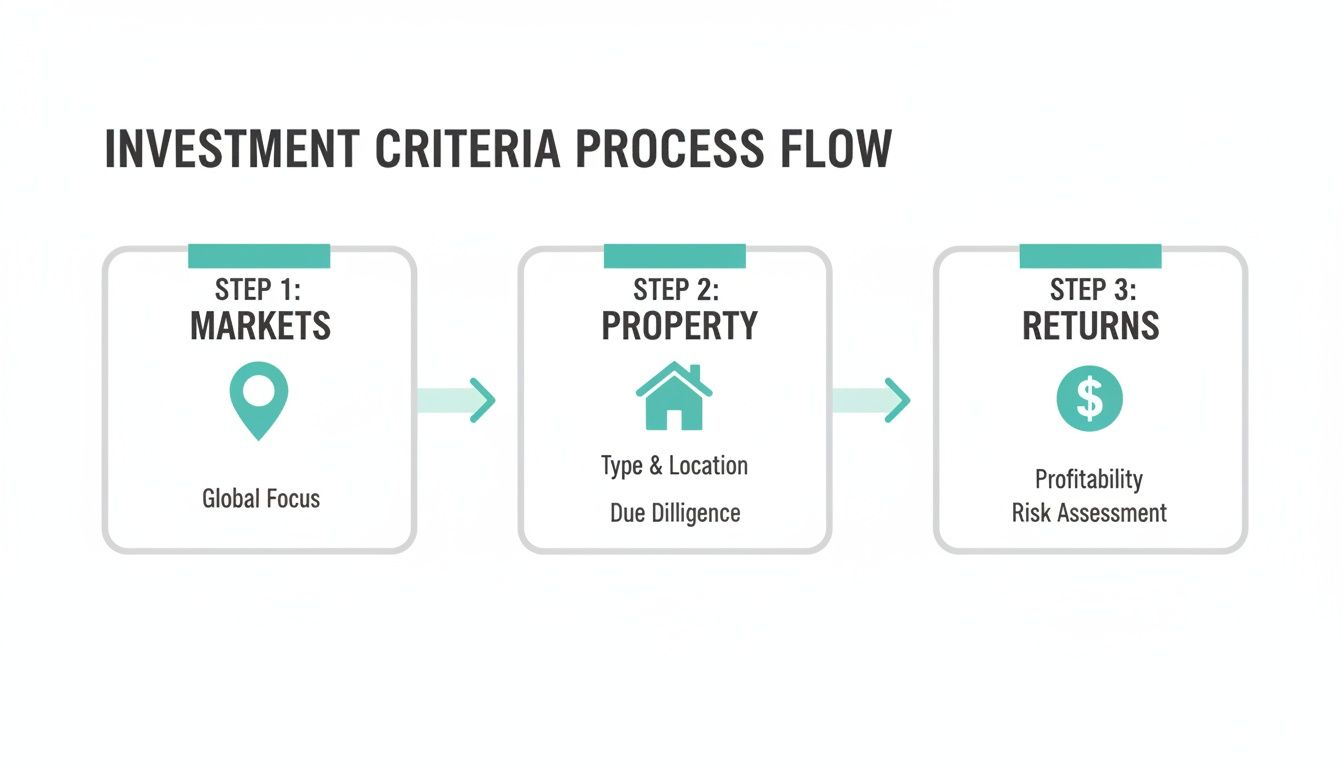
Whether you’re digging through the MLS or pounding the pavement, these predefined criteria are the filter that keeps your search focused and efficient.
So, how do you find these hidden gems? There are a few time-tested methods:
- Driving for Dollars: It sounds old school because it is—and it works. You physically drive through your target neighborhoods looking for signs of distress: overgrown lawns, boarded-up windows, or a roof that's seen better days. You then track down the owner's contact info and reach out.
- Direct Mail: Sending targeted letters to specific owner lists (e.g., absentee owners, seniors with high equity) can generate leads from sellers who are considering a move but haven't listed their property.
- Networking: Building real relationships with wholesalers, property managers, attorneys, and contractors creates a powerful referral engine. These are the people who are first to know when an owner needs to sell fast and quietly.
Modern platforms put this entire process on steroids. On our marketplace, for example, you can build a detailed profile of your exact buy box. Wholesalers and motivated sellers then see what you're looking for and bring opportunities directly to you. It’s a powerful way to get a curated pipeline of deals you'd never find on your own.
If you're ready to build out your own strategy, we've got more actionable tips in our complete guide to sourcing off-market properties.
Comparing On-Market and Off-Market Deal Sourcing
Understanding the pros and cons of each sourcing method helps you allocate your time and resources effectively. While both can lead to great investments, they require completely different approaches.
| Sourcing Method | Key Advantages | Common Challenges |
|---|---|---|
| On-Market (MLS) | - High volume of listings - Standardized information - Clear transaction process |
- Intense competition - Higher prices due to bidding - Less room for negotiation |
| Off-Market | - Little to no competition - Potential for lower prices - More creative deal structures |
- Sourcing is time-intensive - Requires marketing/networking - Deals can be more complex |
Ultimately, a balanced approach is best. Use the MLS for market data and potential deals, but dedicate serious effort to building your off-market channels. That's where you'll find the opportunities that others miss.
Analyzing Deals Quickly and Accurately
In a competitive market, speed is your secret weapon. The investors who win are the ones who can sift through dozens of potential deals, discard the duds, and lock in on a winner before anyone else. It all starts with simple, back-of-the-napkin math.
Your first pass should be lightning-fast. The 1% Rule is a quick gut check: does the gross monthly rent equal at least 1% of the purchase price? So, for a $200,000 property, you’d want to see at least $2,000 a month in rent. It's not a deal-maker, but it's a fantastic deal-breaker that helps you eliminate junk listings in seconds.

Next, use the 50% Rule to estimate your operating costs (everything except the mortgage) by assuming they'll be about 50% of your gross rental income. If that $2,000/month property brings in $24,000 a year, this rule suggests roughly $12,000 will go to taxes, insurance, maintenance, vacancy, and property management. Again, it’s a rough sketch, but it keeps you from falling for properties with deceptively high rents and even higher expenses.
Digging Deeper with the Core Metrics
If a property clears those first hurdles, it's earned a closer look. Now it’s time to move past estimates and get into the real numbers. For any rental property investor, it really boils down to three key metrics.
- Net Operating Income (NOI): This is your property's profit before debt. It’s the total income left over after you've paid all operating expenses. Crucially, NOI shows the property's raw profitability before you factor in your loan.
- Capitalization Rate (Cap Rate): You get this by dividing the NOI by the purchase price. Think of the cap rate as the annual return you'd get if you bought the property in all cash. It's the purest way to compare the earning potential of different properties. To get a better handle on this, check out our guide on how to calculate the cap rate.
- Cash-on-Cash Return: This is the one that really hits home. It answers the simple, all-important question: "For every dollar I put into this deal, how much cash do I get back each year?" It’s your annual pre-tax cash flow divided by the total cash you invested (down payment, closing costs, and initial repairs).
For any kind of value-add or rehab project, there's one more number you must nail: the After Repair Value (ARV). This is your best estimate of what the property will be worth once all the work is done. Your entire profit projection depends on getting this number right.
Putting It All Together: A Quick Pro-Forma
Let's walk through a simple scenario to see how these numbers play out.
| Metric | Calculation / Value | Notes |
|---|---|---|
| Purchase Price | $250,000 | - |
| Gross Monthly Rent | $2,500 | Passes the 1% Rule |
| Annual Gross Income | $30,000 | $2,500 x 12 months |
| Annual Expenses | $15,000 | Taxes, Insurance, Maintenance (using the 50% Rule) |
| Net Operating Income (NOI) | $15,000 | $30,000 (Income) - $15,000 (Expenses) |
| Cap Rate | 6.0% | $15,000 (NOI) / $250,000 (Price) |
| Total Cash Invested | $62,500 | 20% Down Payment + Estimated Closing Costs |
| Annual Debt Service | $13,500 | Estimated Mortgage Payments |
| Annual Cash Flow | $1,500 | $15,000 (NOI) - $13,500 (Debt) |
| Cash-on-Cash Return | 2.4% | $1,500 (Cash Flow) / $62,500 (Cash Invested) |
This entire process used to be a mess of manual spreadsheets. Thankfully, technology has caught up. Our platform has built-in investment calculators that let you punch in a few key numbers and instantly see the projected ROI and cash flow. This means you can make sharp, data-driven decisions on the spot instead of getting bogged down in the math.
Crafting Offers That Win Without Overpaying
Finding a killer deal and running the numbers is a huge win, but you haven't accomplished anything until you have a signed contract. This is where smart negotiation meets clear-headed strategy. It's all about structuring an offer that a seller will accept without you giving away your profit margin.
Before you throw out a number, you have to know your Maximum Allowable Offer (MAO). This isn't a gut feeling. It's a hard number calculated by working backward from your desired profit, subtracting all estimated repair costs, holding expenses, and closing fees.
Your MAO is your walk-away price. It’s the absolute ceiling you can pay and still hit your financial targets. Knowing this number with 100% certainty is what gives you the confidence to negotiate without emotion.
Structuring and Presenting Your Offer
How you present your offer is just as important as the number on the page. Whether you're working through an agent or talking directly to a homeowner, your approach needs to build trust and show you're a serious problem-solver.
Build Rapport First: Don't just dive straight into business. Take a minute to understand the seller's story. Are they facing foreclosure? Did they inherit a property they don't want? Are they just a tired landlord? Their motivation is your key to crafting an offer they can't refuse.
Focus on a Win-Win Solution: Frame your offer as a solution to their problem. Maybe a fast, all-cash close is what they need most. Or perhaps you can offer to be flexible on the closing date. Price is just one of many negotiating points.
Present a Clean Offer: Keep it simple. An offer loaded with confusing clauses and contingencies can spook sellers. A straightforward, easy-to-understand offer often beats a slightly higher but more complicated one.
Key Negotiation Points Beyond Price
A good negotiation is about much more than just haggling over the price tag. Veteran investors know that other terms in the contract can create just as much value, give you flexibility, and protect your downside.
Pro Tip: Never get emotionally attached to one deal. Always have multiple properties in your pipeline. When you aren't desperate to make one specific deal work, you can negotiate from a position of strength and walk away if the terms aren't right. That's your ultimate leverage.
Here are a few other levers you can pull during negotiations:
- Closing Date: A quick close can be a massive selling point for a motivated seller. On the flip side, offering a longer closing period could be valuable to someone who needs more time.
- Inspection Contingencies: This is non-negotiable. Ensure you have enough time for thorough due diligence. This clause gives you the right to renegotiate or back out if you find nasty surprises during inspections.
- Seller Concessions: Don't be afraid to ask the seller to contribute to your closing costs. This directly reduces the amount of cash you need to bring to the table.
By mastering these tactics, you can structure offers that are not just competitive but also smart, protecting your capital and ensuring your next rental is a profitable machine from day one.
Your Due Diligence Playbook: From Contract to Closing
Getting a property under contract is a huge step, but don’t celebrate just yet. Now the real work begins. The due diligence period is your safety net—that critical window to verify every assumption, hunt for hidden problems, and confirm you’ve found a winner.
Think of due diligence as your last chance to protect your capital. This is your final opportunity to either move forward with confidence, renegotiate based on new findings, or walk away from what could have been an expensive mistake.

The Physical Inspection Checklist
Bring in the pros. A great home inspector is worth their weight in gold, but your job isn’t to just wait for the report. Be there, walk the property with them, ask questions, and look over their shoulder. They’re your expert eyes for the big-ticket items that can vaporize your profits.
Your inspection needs to be a top-to-bottom review. Pay laser-focused attention to these four areas:
- Roof and Foundation: These are the two most expensive things to fix. Look for any sign of water intrusion, cracks in the walls, or settling. A bad foundation can be a deal-killer.
- Plumbing: Check for active leaks, test water pressure, and find out the age of the water heater. Small drips can signal huge problems behind the drywall.
- Electrical: An old electrical panel or shoddy wiring isn't just a future repair cost—it’s a fire hazard. Make sure it’s up to code and can handle modern demands.
- HVAC System: Find out the age and service history of the furnace and AC units. A replacement can run into the thousands.
The Financial and Legal Audit
While your inspector is in the attic, you need to be digging through paperwork. Auditing the property's financial and legal health is every bit as important as checking for a leaky roof, especially for an occupied rental. Your mission is to verify that the numbers the seller gave you are real.
Due diligence is where the story of the property meets the facts. Your job is to make sure there are no surprise plot twists. Verifying every lease, utility bill, and maintenance record protects you from inheriting someone else’s problems.
Get copies of every lease to confirm rent amounts, end dates, and security deposit details. Demand the last 12-24 months of utility bills and any maintenance records. This is the only way to get a true picture of the property's actual operating expenses, not just rosy projections.
On the legal side, your title company or attorney should run a title search. This is non-negotiable. It confirms the seller has the right to sell and ensures there are no surprise liens or claims. You'll also want to double-check that the property's current use complies with local zoning regulations—a critical step for multifamily buildings. This comprehensive playbook is how you close a deal with your eyes wide open.
Got Questions About Finding Rentals? We've Got Answers.
Even with a solid game plan, questions always pop up when you're looking for a rental property. It doesn't matter if you're a beginner or a seasoned pro refining your process—getting straight answers is what keeps you moving forward.
Let's clear up some of the most common questions we hear.
How Much Money Do I Really Need to Start?
There's no single magic number; it comes down to your market and your strategy. In many affordable markets, you might get into your first deal with a 20-25% down payment on a property under $150,000.
Creative approaches can also dramatically lower your barrier to entry. Consider house hacking—buying a duplex or triplex, living in one unit, and renting out the others. Your tenants can essentially pay your mortgage for you.
For a classic single-family rental, a good budget looks like this:
- The Down Payment: For an investment property loan, you're almost always looking at 20-25% of the purchase price.
- Closing Costs: Plan for another 2-5% of the purchase price to cover fees.
- Cash Reserves: This is non-negotiable. Aim to have 3-6 months of total expenses (mortgage included) stashed away for vacancies or unexpected repairs.
What's the Best Way for a Beginner to Find That First Deal?
Your first deal is about simplicity and managing risk. It’s tempting to chase complex off-market deals, but the most straightforward path is often working with an investor-friendly real estate agent. They can set up MLS alerts that match your criteria, giving you a steady stream of properties to analyze.
The goal of your first deal isn't to hit a home run; it's to get on base. A solid, simple deal that cash flows even a little bit will teach you more than months of just analyzing properties.
Networking is another powerhouse strategy for beginners. Show up at local real estate investor meetups or connect with wholesalers on investor-focused platforms. This puts you in a position to see deals that have already been vetted by someone else, which can seriously shorten your learning curve.
How Can I Find Off-Market Properties with a Small Budget?
Finding off-market deals doesn't have to mean dropping a fortune on a massive direct mail campaign. The single most effective low-budget strategy is building your network. Here, your time is your currency.
Start connecting with the people who are in the trenches every day: wholesalers, property managers, contractors, and real estate attorneys in your target area.
Tell them exactly what you're looking for—your "buy box." These are the folks who are first to know about distressed properties or motivated sellers. A single great relationship can turn into a consistent source of deal flow. An online investor marketplace is another budget-friendly shortcut. You can build your profile and let wholesalers bring pre-vetted deals right to you, saving you a ton of time and marketing dollars.
Finding the right rental properties consistently comes down to having a clear strategy and the right tools. By defining your criteria and building a system for deal flow, you can move from analyzing to acquiring.
Create your free investor profile on Investor Deal Exchange to get matched with deals that fit your criteria.