Finding a great investment property isn’t about luck or some frantic, endless search; it’s about having a clear, repeatable system. The most important work happens before you ever look at a listing. You have to know exactly what a "good deal" looks like for you, turning your financial goals into a concrete blueprint. This is what separates reactive deal-chasers from proactive investors who consistently find properties that perform.
This guide provides a step-by-step framework for building that system. We'll cover how to define your criteria, build a deal flow pipeline, analyze properties quickly, and navigate the closing process.
Define Your Investment Criteria (Your "Buy Box")

You can't find what you haven't defined. Chasing every property that seems "hot" is a classic beginner mistake that leads to analysis paralysis or, worse, a bad investment. Your personal investment criteria, often called a "buy box," is the foundation of your search. It’s a set of specific, non-negotiable parameters that a property must meet before you'll even consider it. This filter ensures you only spend time on deals that align with your strategy.
First, lock in your strategy. Are you hunting for steady cash flow from a turnkey rental? Or are you aiming for a significant equity gain with a value-add project, like using the BRRRR (Buy, Rehab, Rent, Refinance, Repeat) method? Your strategy will dictate all the other filters you set.
Translating Goals into Concrete Criteria
A buy box is your personal deal-filtering system. It's a set of hard parameters that a property must meet for you to consider running the numbers. This is where you get granular.
- Financial Metrics: Define your minimum acceptable returns. Key metrics include Cash-on-Cash Return (annual pre-tax cash flow divided by total cash invested) and Capitalization Rate (Cap Rate), which is the property's Net Operating Income divided by its price. A solid starting point for many rental investors is a 7-10% cash-on-cash return.
- Geographic Footprint: Where are you willing to invest? Some investors stick to a 30-minute driving radius to self-manage, while others invest out-of-state for better returns. Define your target states, cities, and even specific zip codes known for strong rental demand.
- Property Type & Condition: Get laser-focused. Are you only looking for 2-4 unit multifamily properties? Single-family homes with at least 3 bedrooms and 2 bathrooms? Decide on the property's condition as well. Are you equipped for a full gut rehab, or do you prefer properties needing only cosmetic updates?
On an investor marketplace, you can set up your buy box criteria to get automatically notified when a matching deal is posted. This feature acts as your automated filter, cutting through the noise so you only see properties that fit your exact strategy, from location and price down to your required cap rate.
Refining Your Criteria for Your Experience Level
Your buy box should evolve as you gain experience. What makes sense for a beginner is often too restrictive for a seasoned pro.
- If you're new: Your main goals are simplicity and risk mitigation. Keep your first buy box tight. Stick to one or two zip codes you know well, a single property type (like a 3/2 single-family home), and deals that require minimal rehab. The mission is to complete a clean transaction and build confidence.
- If you're experienced: It's all about optimization and scaling. Your buy box can become more sophisticated. You might target assets with specific value-add potential, like properties zoned for an accessory dwelling unit (ADU), or adjust financial metrics to reflect changing market conditions, perhaps accepting a lower Year 1 return in a market you know is poised for appreciation.
Build a Diversified Deal Flow Pipeline

With your buy box defined, the next challenge is generating a steady stream of opportunities. Relying on a single source is a common mistake. Professional investors build a diversified sourcing engine that constantly pulls in deals from multiple channels, ensuring their pipeline never runs dry.
Mixing on-market (publicly listed) and off-market (not publicly advertised) strategies is key. On-market deals offer volume and transparency but come with high competition. Off-market deals offer the potential for better pricing and less competition but require more proactive effort to find.
Finding On-Market Opportunities
On-market properties are primarily found on the Multiple Listing Service (MLS). However, simply scrolling through public websites is inefficient. A smarter approach is crucial.
- Investor-Savvy Real Estate Agents: Your most valuable asset here is an agent who understands investors. They speak your language—cap rates, cash-on-cash return, and After Repair Value (ARV). A great agent sets up automated MLS alerts that notify you the moment a property matching your buy box hits the market.
- Investor Marketplaces: Platforms built for investors streamline this process. On our marketplace, for example, you can enter your buy box criteria and receive a curated feed of deals that fit your strategy. This saves you from manually sifting through hundreds of irrelevant listings on consumer-facing sites.
Finding Off-Market Deals
While on-market deals provide volume, the best profit margins are often found off-market. This is where you shift from waiting for opportunities to creating them.
- Wholesalers: These individuals and companies specialize in finding distressed properties and motivated sellers. They get properties under contract and then assign that contract to an end-buyer (like you) for a fee. Building relationships with a few reliable wholesalers in your target market can provide a consistent source of pre-vetted deals.
- Networking: Attend local real estate investing association (REIA) meetings and other industry events. These are goldmines for connecting with other investors, wholesalers, private lenders, and contractors. A single conversation can lead to your next deal or a critical partnership.
- Direct Outreach: This is the most proactive strategy. It can mean sending direct mail to targeted lists (e.g., absentee owners, landlords with high equity) or "driving for dollars"—spotting distressed properties and then looking up the owner's contact information.
- Online Platforms & Marketplaces: Many wholesalers and investors now post their off-market deals directly to online marketplaces. This gives them immediate access to a network of vetted buyers, and it gives you a centralized place to find opportunities without cold outreach.
A diversified approach is non-negotiable. Mastering the art of uncovering properties nobody else knows about is what truly sets professional investors apart. For more advanced tactics, you can learn more about finding off-market properties in our detailed guide.
Comparing On-Market vs Off-Market Deal Sourcing
Understanding the trade-offs between these two channels helps you allocate your time and resources effectively.
| Channel | Pros | Cons | Best For |
|---|---|---|---|
| On-Market (MLS) | - High volume and easy access - Standardized transaction process - Transparent pricing and history |
- High competition and bidding wars - Lower potential for deep discounts - Slower transaction timelines |
Investors new to a market or those looking for stabilized, turnkey properties. |
| Off-Market | - Less competition, better negotiating power - Potential for significant equity - More creative deal structures possible |
- Requires more effort and networking - Inconsistent deal flow initially - Can involve complex seller situations |
Experienced investors and wholesalers looking for value-add opportunities and higher returns. |
A winning strategy combines the scale of on-market sourcing with the high-margin potential of off-market hunting. By using technology to filter public listings while dedicating real time to building relationships, you create a powerful deal-finding machine.
How to Analyze a Potential Deal Quickly

Finding a property that looks good is just the first step. The real skill is learning to quickly and accurately determine if it's actually a good deal. Many investors get bogged down here, spending hours in spreadsheets while great opportunities get snapped up by someone faster. The key is a repeatable system for rapid evaluation, focusing on a few core metrics to weed out bad deals fast.
The Key Metrics That Matter
When you're giving a property its first look, only a handful of numbers truly matter.
- Net Operating Income (NOI): This is the property's total income minus all operating expenses, before mortgage payments. NOI shows how profitable the asset is on its own, independent of your financing.
- Capitalization Rate (Cap Rate): Calculated as NOI / Purchase Price, the cap rate is the best metric for comparing the relative value of properties in the same market. It represents the property's unleveraged annual return.
- Cash-on-Cash Return: This answers the critical question: "How much cash will I get back this year based on the cash I actually put in?" It’s your annual pre-tax cash flow divided by your total cash invested (down payment, closing costs, and initial repairs).
These three metrics are your initial gut check. If a property can't meet your minimum thresholds for these, it's an immediate "no," and you move on.
Quick Underwriting with a Pro-Forma
A pro-forma is a simple financial projection. For an initial look, a quick "back-of-the-envelope" calculation is all you need to see if a deal is worth a deeper dive.
- Estimate Gross Income: Start with the expected monthly rent and multiply by 12. Verify this against market data from a tool like Rentometer.
- Factor in Vacancy: No property stays occupied 100% of the time. Use a conservative vacancy rate of 5-8%. Subtract this from your gross income.
- Budget for Operating Expenses (OpEx): The 50% Rule is a useful stress test. It assumes that 50% of your gross rental income will go toward operating expenses (this excludes the mortgage). While not perfectly accurate, it's a quick way to check if a deal has a chance of working.
For example: A property rents for $2,000/month, for an annual gross income of $24,000. Using the 50% Rule, you'd budget $12,000 for OpEx, leaving an estimated NOI of $12,000. If the purchase price is $200,000, your estimated cap rate is 6% ($12,000 / $200,000).
This simple process takes less than five minutes. If you want to go deeper, you can learn more about how to calculate cap rate and why it's such a vital tool.
Calculating After Repair Value (ARV)
For any flip or value-add strategy like BRRRR, the After Repair Value (ARV) is a critical calculation. ARV is the estimated value of the property after all planned renovations are complete. It's determined by analyzing recently sold comparable properties ("comps") in the same updated condition you're aiming for. An accurate ARV is the cornerstone of a profitable rehab project, dictating your purchase price, rehab budget, and potential profit.
As real estate markets stabilize, solid fundamentals are more important than ever. Forecasts point to a 3.1% global return for real estate, a blend of steady income with moderate growth. Sharp deal analysis is the critical skill for pinpointing high-potential properties. For more on this, check out the global real estate outlook from Aberdeen.
Systemize Your Search with a Deal Pipeline
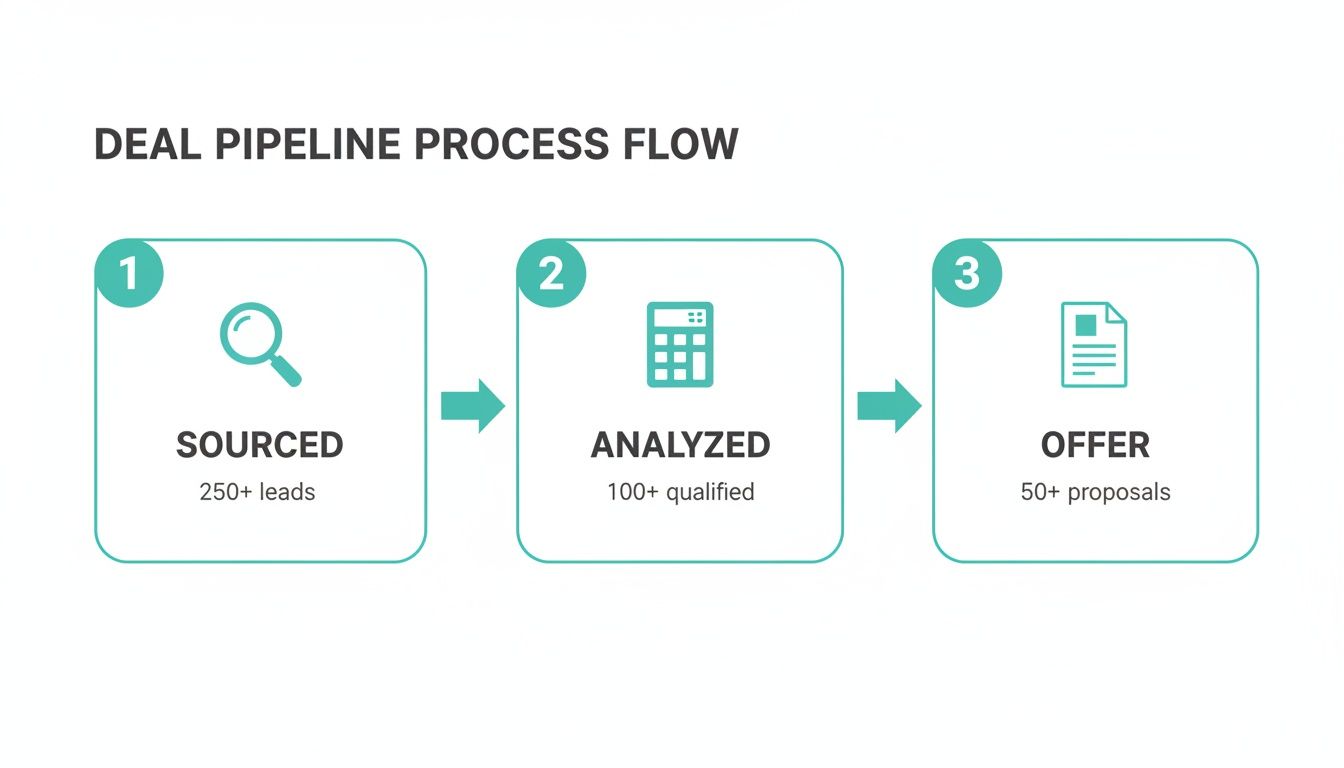
If you treat finding investment properties like a hobby, you'll get hobby-level results. Professionals manage their search like a business using a deal pipeline—a simple, visual system for tracking every opportunity from initial discovery to closing. This structured approach turns a chaotic mess of emails and spreadsheets into an organized workflow, ensuring a great deal never falls through the cracks.
The Core Stages of a Deal Pipeline
Whether you use a spreadsheet or a dedicated tool, your pipeline should have clear, distinct stages that give you a snapshot of your deal flow.
- Sourced: Every potential deal from any channel starts here.
- Under Initial Review: Properties that pass a quick glance move here. This is where you run your back-of-the-envelope numbers (NOI, cap rate, CoC). Most deals will die right here, which is the point—fail fast.
- Full Underwriting: Deals that survive the initial screen graduate to this stage. Now you dig deep: verifying seller numbers, getting repair estimates from contractors, and building a detailed financial model.
- Offer Submitted: Once you send a letter of intent or a formal purchase offer, the deal moves here.
- In Due Diligence: The seller accepted your offer. Now the clock is ticking on your inspection and financing contingencies.
- Closed / Dead: Every deal ends up here. Tracking dead deals is as important as tracking wins; it helps you learn why opportunities fell apart so you can avoid the same mistakes.
Why a Pipeline Is a Game Changer
For new investors, a pipeline enforces discipline. It's a numbers game; you have to analyze many properties to find one great one. For seasoned investors, a pipeline is the only way to scale effectively. You can't manage dozens of active leads in your head.
For example: If you see 30 properties stuck in the "Sourced" stage but only one in "Full Underwriting," you don't have a deal flow problem—you have an analysis bottleneck. That insight tells you to block off more time for running numbers or create better analysis templates.
Modern platforms built for investors often integrate this workflow. You can find a property on a marketplace, save it to your pipeline, and keep your analysis, documents, and communications in one organized place. This system is a non-negotiable part of learning how to find investment properties consistently and helps you build a more robust real estate investor network.
From Offer to Close: Navigating Due Diligence
You've run the numbers, and the deal pencils out. Now the real work starts: verification. The due diligence phase is your opportunity to meticulously check every assumption you made to protect your capital and ensure there are no surprises at the closing table.
A strong offer is competitive but includes protections. These protections are called contingencies—clauses that give you a legal way to back out of the deal and get your deposit back if certain conditions aren't met.
Crafting a Winning Offer
Your offer needs to balance aggression with caution. Two contingencies are critical for most investors:
- Inspection Contingency: This gives you a specific window (usually 7-14 days) to have professionals inspect the property. If major, unexpected issues are found, you can renegotiate, request repairs, or walk away.
- Financing Contingency: Unless you’re paying all cash, this is non-negotiable. It makes the deal conditional on you securing a loan. If your financing falls through, this clause lets you retrieve your earnest money deposit.
A clean offer backed by a pre-approval letter from a reputable lender signals to the seller that you're a serious, qualified buyer.
Your Practical Due Diligence Checklist
The moment your offer is accepted, the clock starts. A methodical approach is the only way to avoid buying someone else's problems. Break your diligence into three core areas.
1. The Physical Property
Go beyond a standard home inspection.
- Major Systems: Get a professional opinion on the HVAC, electrical, and plumbing to understand their age and condition. A failing HVAC system is a $5,000-$8,000 expense you need to budget for.
- Structural Integrity: Check the foundation, roof, and siding for signs of water intrusion or damage.
- Pest Inspection: Termites and other wood-destroying insects can cause thousands in hidden damage. Always get a professional inspection.
2. The Financials and Leases
For rental properties, you're not just buying a building; you're buying a business.
- Lease Audit: Scrutinize every lease. Verify rent amounts, end dates, security deposits, and legal compliance.
- Expense Verification: Ask for recent utility bills, tax statements, and insurance policies. Compare these real numbers to your initial assumptions.
- Tenant Estoppel Certificates: This is a document signed by each tenant verifying the key terms of their lease (rent, security deposit, etc.). It prevents future disputes after you close.
3. The Legal and Title Work
Your title company and attorney ensure you receive a "clean" title, free from hidden claims.
- Title Search: A title company searches public records for any liens, judgments, or other encumbrances on the property.
- Zoning Compliance: Verify with the local municipality that the property's current use is legal and properly permitted.
- Survey: A survey confirms property lines and identifies any encroachments, which is cheap insurance against boundary disputes.
Value-add and opportunistic strategies dominated 2025 fundraising, pulling in 64.5% of the $77.1 billion raised globally in the first half of the year. This shows that savvy investors are actively targeting properties that require this kind of deep due diligence. You can see more details in the real estate market report from With Intelligence.
Key Takeaway: Due diligence isn’t about finding reasons to kill a deal. It's about uncovering the truth so you can walk into closing with your eyes wide open, fully confident in what you’re buying.
Your Questions, Answered
Here are answers to some of the most common questions from both new and experienced investors.
What’s a “Good” Cash on Cash Return for a Rental Property?
The honest answer is: it depends on your market, risk tolerance, and strategy. However, a widely accepted benchmark that many investors aim for is in the 8-12% range.
- If you're starting out: Target 8% or higher. This provides a healthy buffer for unexpected expenses and ensures you're generating positive income from day one.
- If you're more experienced: You might accept a lower initial return (e.g., 5-7%) for a property in a high-appreciation area or a value-add project where you can force returns higher later on.
Cash-on-cash return is a great metric for measuring how hard your invested capital is working, but it should be considered alongside other metrics like cap rate and total ROI.
How Many Properties Should I Analyze Before Making an Offer?
While there's no magic number, a common piece of advice is to analyze 100 properties before making an offer on one.
This isn't about the busywork; it's about training your brain. After underwriting dozens of deals, you develop an intuitive understanding of your market. You'll instantly recognize what market rents should be, typical renovation costs, and what a property is worth. This repetition turns analysis from a chore into a rapid, reflexive skill, allowing you to act with confidence when a true opportunity appears.
Should I Focus on Appreciation or Cash Flow?
In a perfect world, you get both. In reality, you often have to prioritize one, especially early in your investing career.
- Cash Flow is the monthly profit left after paying all expenses. It provides immediate income and financial stability for your portfolio.
- Appreciation is the increase in the property's value over time, building long-term wealth.
For new investors, the answer is almost always cash flow. Positive cash flow is your safety net, covering vacancies and unexpected repairs without requiring you to pay out-of-pocket. Once you have a stable base of cash-flowing properties, you can begin to target deals with more appreciation potential.
Keeping an eye on market dynamics is crucial. For instance, the global real estate market saw transaction volumes hit a staggering $739 billion over the trailing 12 months in 2025. You can discover more about these real estate trends and tactics at Nuveen to stay ahead of the curve.
Learning how to find investment properties is about building a system. By defining your criteria, building a diverse deal pipeline, analyzing deals efficiently, and performing thorough due diligence, you can consistently find opportunities that meet your financial goals.
Create your free investor profile to get matched with deals that fit your criteria.