Finding high-potential foreclosed homes can feel daunting, but for savvy investors, it's one of the most reliable ways to secure deals with built-in equity. This guide provides a practical framework for sourcing, analyzing, and acquiring these distressed properties without the hype. We'll break down the entire process, focusing on the three main stages where investors can find opportunities: pre-foreclosure, auction, and bank-owned (REO).
Your Framework for Finding and Buying Foreclosed Homes
If you're just getting started, consider this your roadmap to finding foreclosed homes. For experienced investors, we'll dig into nuanced tactics to sharpen your competitive edge. The goal is simple: to give you the confidence to navigate this specialized corner of the market, whether you’re lining up your first flip or scaling a rental portfolio.

Why Foreclosures Are a Key Opportunity for Investors
Foreclosed properties are assets being sold to settle a debt, which often means they hit the market priced below their true value. For an investor, this creates a powerful opportunity to acquire properties with built-in equity from day one.
However, success here requires a different mindset than traditional real estate. It’s a game of intensive upfront research, a realistic tolerance for risk, and the ability to act decisively when a good deal surfaces. It's not a "get rich quick" scheme; it's a methodical business strategy.
For investors targeting distressed properties, the current environment offers a balanced opportunity. There's a steady inventory of foreclosed homes entering the market without the systemic distress that characterized previous cycles.
The foreclosure landscape is always in motion, shaped by economic currents and local market pressures. Recent data shows a gradual return to normal foreclosure activity, suggesting a sustainable pipeline of investment opportunities rather than a panic-driven flood.
Understanding Market Trends to Find Deals
The U.S. foreclosure market has seen significant movement, with 367,460 properties receiving foreclosure filings in the last year and lenders initiating the process on 289,441 of them. That’s a 14% increase from the previous year—a clear signal for prepared investors.
While activity is up, it remains below historical peaks, creating a stable, less frantic environment for sourcing deals. A methodical, data-driven approach is essential here. This is a core part of building a strong real estate investor network—relying on solid numbers rather than speculation.
Each stage of the foreclosure process presents a different type of opportunity with its own set of rules, risks, and rewards. Understanding these distinctions is the first step to developing a winning strategy.
The Three Stages of Foreclosure Opportunities
| Foreclosure Stage | Property Status | Typical Acquisition Method | Key Investor Benefit |
|---|---|---|---|
| Pre-Foreclosure | Owner is in default but still holds the title. | Direct negotiation with the homeowner. | Opportunity to find off-market deals with less competition. |
| Auction | Lender has repossessed the property and is selling it publicly. | Competitive bidding at a live or online auction. | Potential for deep discounts, but often with high risk. |
| Bank-Owned (REO) | Property failed to sell at auction and is now owned by the bank. | Purchase directly from the bank, often via an agent. | A more traditional buying process with clearer title. |
Knowing the ins and outs of each stage allows you to tailor your strategy. Do you prefer negotiating directly with a motivated seller, or are you more comfortable buying a clean, bank-owned asset? Your answer will shape your entire approach.
Where to Find Foreclosure Listings Before Your Competition
To gain an edge in foreclosure investing, you have to know where to look before everyone else does. The best deals are typically found before they hit the mainstream market, which requires a smart mix of old-school legwork and modern technology. Some investors swear by traditional methods like digging through public records, while others rely on digital tools. The most successful investors do both.
The Old-School Sourcing Methods
The classic way to find foreclosures is by going straight to the source: public records. These methods require more hands-on effort but can uncover pre-foreclosure and auction properties that haven't been widely advertised.
- County Courthouse Records: This is ground zero. Here you'll find official filings like the Notice of Default (NOD) or Lis Pendens, the first public signals that a property owner is in financial distress. A trip to the county recorder's office or a disciplined search of their online portal can put you weeks ahead of the competition.
- Sheriff's Sale Announcements: When a property is scheduled for a foreclosure auction, the local sheriff's department typically manages the sale. They publish lists of upcoming auction properties in local newspapers and on their websites. Monitoring these announcements is a direct way to build your auction pipeline.
These traditional paths are often less crowded, giving you a chance to analyze deals without a feeding frenzy. The downside? They’re time-consuming and require a consistent, disciplined routine to be effective.
Modern Digital and Professional Channels
For investors who value speed and scale, an entire ecosystem of online platforms and professional networks can deliver curated leads directly to you. These methods are excellent for covering more ground in less time.
- For Beginners: Working with a real estate agent who specializes in distressed properties is a solid move. They have direct access to the Multiple Listing Service (MLS) and can set up alerts for bank-owned (REO) listings. A good agent understands how to negotiate with banks and can be a huge asset.
- For Experienced Investors: While an agent is useful, scaling requires more direct deal flow. Online foreclosure listing sites and direct-to-seller marketing can supplement MLS-based searches.
The real breakthrough for many investors happens when they start using specialized platforms that pull all these deal sources into one place. Instead of checking a dozen different websites every day, you get pre-vetted opportunities delivered to you. It's a massive time-saver.
Streamlining Your Search with an Investor Marketplace
Ultimately, the goal is to spend less time digging for deals and more time analyzing and closing them. This is where an investor-focused marketplace becomes your most powerful tool. It automates the grunt work of sourcing.
On our platform, for example, you can set up a Smart Buy Box that acts as your 24/7 deal scout. You input your exact criteria—location, property type, price range, even target ROI—and the system notifies you when a matching distressed or bank-owned property is posted. This is how you get ahead of the curve. You'll see this same principle at play when you're sourcing other types of off-market properties too.
This laser-focused approach means every property that lands in your inbox is already a potential fit. For a new investor, this cuts through the noise. For a seasoned pro, it systematizes deal flow, freeing up your time and capital to pursue more opportunities. The right platform transforms your search from a manual chore into an automated, efficient machine.
Navigating the Foreclosure Auction Process
This is where the real action is. Buying a property at a foreclosure auction can yield the deepest discounts, but it's a high-stakes environment that requires serious preparation. Whether it's a trustee sale on the courthouse steps or a sheriff's sale, the process is fast, competitive, and unforgiving.
Unlike buying a bank-owned REO, an auction purchase is over in minutes. These properties are almost always sold "as-is, where-is," meaning no inspections, no contingencies, and no backing out. The entire burden of due diligence falls squarely on your shoulders before you bid.
This visual breaks down the common paths investors take to find foreclosure deals, from digging through public records to working with agents and using specialized websites.
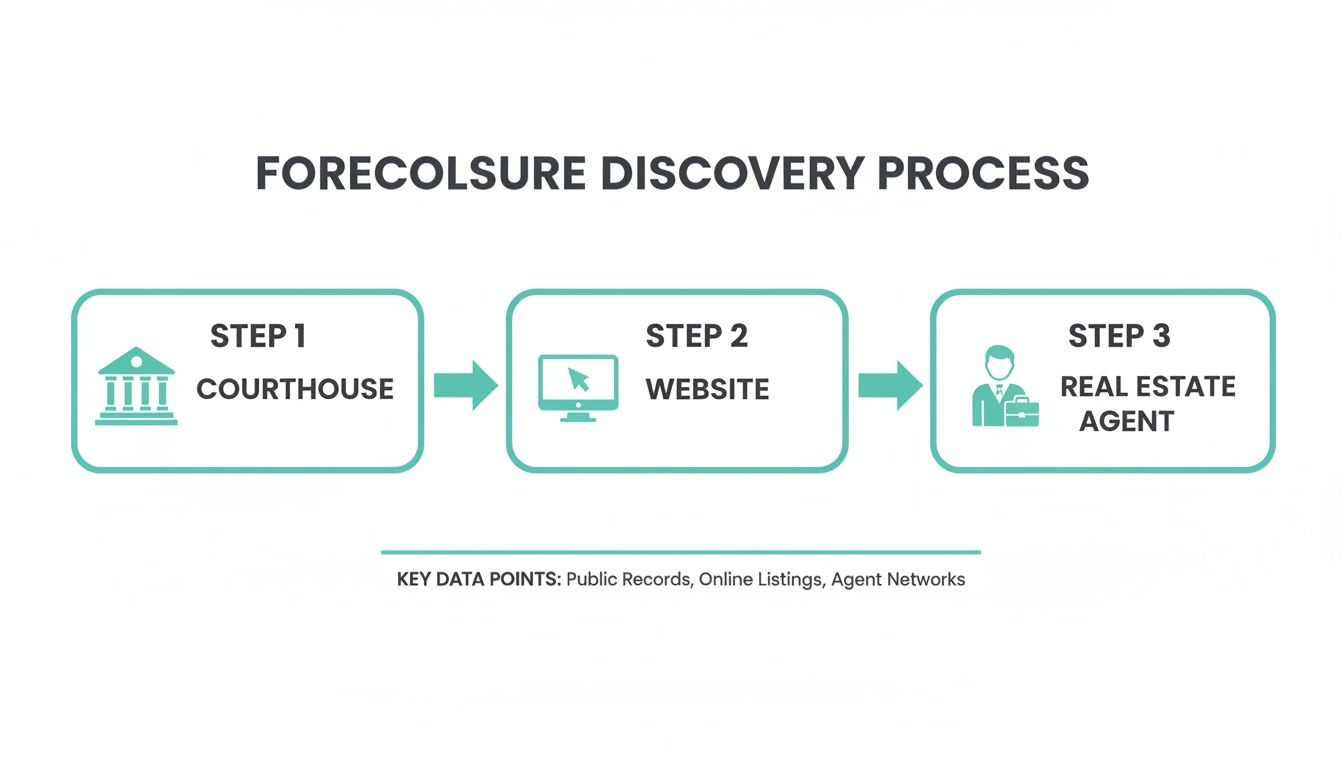
Each of these channels taps into a different stage of the foreclosure timeline. The auction is a critical, high-reward opportunity for investors who are prepared to move decisively.
Your Most Critical Task: Pre-Auction Due Diligence
The research you do before the auction is what separates a home run from a financial disaster. Since you likely can’t inspect the property's interior, your external research must be exhaustive.
Your first move should be a preliminary title search. Many seasoned investors hire a title company or an attorney for this, and it’s money well spent. You're looking for any liens or other encumbrances that could survive the sale and become your financial responsibility.
- Senior vs. Junior Liens: The auction typically wipes out liens that are junior (recorded later) to the mortgage being foreclosed. But senior liens—like unpaid property taxes or a first mortgage if a second one is foreclosing—often remain and must be paid by the new owner.
- Other Encumbrances: Look out for issues like IRS tax liens, mechanic's liens, or outstanding judgments against the previous owner that might cloud the title.
This research is non-negotiable. Buying a property with a surprise $50,000 IRS lien attached can vaporize your profits before you even get the keys.
Understanding Auction Financing and Bidding
Foreclosure auctions are almost exclusively cash-only affairs. You cannot use a traditional mortgage. You must have your funds liquid and accessible.
Most auctions require a cashier's check for a specific deposit amount just to register, with the full purchase price due within a few hours or, at most, 24 hours. This is why auctions are dominated by cash buyers and investors using hard money loans. You can learn more about real estate financing options in our complete guide to ensure you have the right capital lined up.
For Beginners: Attend a few auctions with no intention of bidding. Just watch. Observe the auctioneer, see how experienced investors behave, and get a feel for the rhythm. It's the best way to get comfortable with the rapid pace before you put real money on the line.
Key Bidding Terms and Strategies
Once you’re at the auction, you'll hear a few key terms repeatedly.
- The opening bid is where the auctioneer starts the bidding, often set by the foreclosing lender.
- A credit bid is a bid made by the lender itself. The lender can bid up to the total amount it's owed without bringing cash. If no outside bidder goes higher, the property reverts to the bank and becomes an REO.
A smart bidding strategy is about discipline. Set a firm maximum price based on your analysis and stick to it. It's easy to get caught up in the excitement and overpay. Calculate your max bid by starting with your After Repair Value (ARV) and then subtracting rehab costs, holding costs, your desired profit, and a contingency fund. What's left is the most you can pay.
After winning, you receive a Certificate of Sale. Depending on your state, the former homeowner may have a redemption period—a set time to reclaim the property by paying your full auction price plus costs. Knowing your state's redemption laws is a critical final step.
How to Analyze Bank-Owned REO Properties
When a property doesn't sell at auction, it becomes a bank-owned or Real Estate Owned (REO) property. The process then shifts from the chaos of an auction to a more traditional-looking sale, but with its own unique quirks. You're no longer dealing with a motivated homeowner but an institution aiming to liquidate a non-performing asset.
The major advantage of buying an REO is the ability to conduct proper inspections. You can get inside the house, assess the "as-is" condition, and build a rehab budget based on facts, not guesswork. Given the previous owner's financial hardship, expect to find deferred maintenance.
Building Your Due Diligence Checklist
When evaluating an REO, your diligence must be meticulous. The bank will not provide a list of the property’s problems; it's on you to uncover every potential issue before making an offer. A systematic process is key.
A solid due diligence checklist is your best defense against budget-breaking surprises.
- Comprehensive Home Inspection: This is non-negotiable. Hire a qualified inspector to assess the foundation, roof, plumbing, electrical, and HVAC systems. This report is the foundation of your renovation plan.
- Specialized Inspections: Depending on the property's age and location, you might need specialists for pests, mold, radon, or septic systems. Don't skip these if there are any red flags.
- Clear Title and Lien Search: While the foreclosure should have cleared most liens, you must run a fresh title search to confirm the bank holds a clean title and that no encumbrances survived the process.
- Neighborhood Comps Analysis: Pull recent sales data for similar properties in the immediate area to establish a realistic After Repair Value (ARV). Your ARV is the single most important number in your financial projections.
This detailed approach ensures your offer is based on cold, hard data.
Mastering the Key Financial Metrics
Successful REO investing is a numbers game. Your ability to accurately project costs and returns separates a profitable deal from a money pit.
It all starts with calculating your potential profit, working backward from your ARV. A simple formula many investors use is:
ARV - (Purchase Price + Rehab Costs + Holding Costs + Closing Costs) = Potential Profit
Once you have that baseline, you can dig into the key performance indicators (KPIs) that experienced investors use to gauge a deal's strength.
- Return on Investment (ROI): This measures your total return against your total investment, calculated as (Net Profit / Total Investment Cost) x 100. A healthy ROI is the ultimate sign of a successful flip.
- Cash-on-Cash Return: For buy-and-hold investors, this metric measures the annual pre-tax cash flow relative to the total cash invested. The formula is (Annual Cash Flow / Total Cash Invested) x 100. It shows the efficiency of your initial capital.
Using Technology to Analyze Deals Faster
Running these numbers in a spreadsheet for every property is a massive time sink. This is where an investor marketplace with built-in analysis tools provides a significant advantage.
On our platform, you can use investment calculators to do the heavy lifting. You plug in the numbers—purchase price, estimated rehab budget, and projected rent or ARV—and the system instantly crunches the ROI, cap rate, and cash-on-cash return. This allows you to vet dozens of REO properties in the time it used to take to analyze one, enabling fast, data-driven decisions that align with your financial goals.
Using Regional Data to Pinpoint Foreclosure Hotspots
Smart foreclosure investing isn't just about finding a single distressed property; it's about understanding market dynamics. Success often depends on knowing where to look. By using regional data, you can identify high-opportunity markets before they become saturated with other investors.
Foreclosure rates are not uniform. They vary significantly between states and even neighboring cities due to economic shifts, local job markets, and state-specific laws. For a savvy investor, this regional variation is a powerful strategic tool.
Deciphering the Data to Find Your Next Market
The key is to follow the numbers. Tracking foreclosure trends allows you to focus your time and capital on areas where deal flow is strongest. The goal is to be proactive, not reactive—entering a market as opportunities begin to surface.
For example, states with high foreclosure rates one quarter, like Delaware, Illinois, and Nevada, might be replaced by others, such as New Jersey and Florida, in the next. These state-level shifts are exactly what you should monitor when setting up your buy box with specific geographic targets. We've seen regions like the Mid-Atlantic and Southeast show consistently elevated foreclosure activity, hinting at broader trends that can inform your investment strategy.
Turning Macro Data Into Actionable Deals
High-level stats are just step one. The real advantage comes from plugging that intelligence directly into your deal-sourcing strategy. It’s one thing to know a state is a hotspot; it’s another to turn that knowledge into qualified leads.
An investor marketplace is the bridge between data and deals. Instead of just knowing a state has potential, you can take immediate, targeted action.
- Set a Geographically-Focused Buy Box: On the platform, you can configure your Smart Buy Box to zero in on the specific states, counties, or zip codes your research flagged as prime hunting grounds.
- Get Hyper-Specific Alerts: Layer in criteria beyond location, such as property type, price range, and target ROI, to ensure you only get notified about deals that fit your exact strategy.
- Analyze State Timelines: Data can also reveal how long the foreclosure process takes in different states. Some states move in months, while others can take years. This intelligence is critical for managing your capital and setting realistic timelines.
By combining macro-economic data with the filtering tools of an investor platform, you transform broad market trends into a personalized, actionable deal pipeline. You're no longer guessing where the opportunities are—you're letting data guide you to them. This focused approach is a core principle in knowing how to find foreclosed homes efficiently and at scale.
Answering Your Foreclosure Investing Questions
When you start digging into distressed properties, questions arise quickly. The rules are different, the risks seem higher, and the process is unlike a standard home purchase. Here are clear, practical answers to the most common questions from investors.
Can You Get a Traditional Mortgage for a Foreclosed Home?
The short answer is: it depends. The type of financing available is tied directly to the foreclosure stage and the property's condition.
For a bank-owned (REO) property, the answer is often yes. If the home is in habitable condition, you can typically use traditional financing like a conventional or FHA loan. However, if the REO has significant issues—like a missing kitchen or a failing roof—most lenders won't finance it until major repairs are completed.
Auctions are a different story. You cannot use a traditional mortgage for a property bought at a sheriff's or trustee's sale. These sales require immediate payment, typically with cash or a cashier's check, often within 24 hours. This is why auctions are dominated by cash buyers and investors who have pre-arranged hard money loans or private financing.
What Are the Biggest Risks When Buying a Foreclosure?
While foreclosures can offer significant discounts, they come with unique risks. Knowing these pitfalls is half the battle.
- Hidden Liens and Title Issues: This is a major risk, especially at auction. While the sale is meant to clear junior liens, some—like property tax debt or IRS liens—can survive and become your responsibility. A thorough title search before you bid is non-negotiable.
- Unknown Property Condition: At an auction, you are typically bidding blind on the interior condition. Even with REOs where inspections are allowed, deferred maintenance is a given due to the previous owner's financial distress.
- Vacancy and Vandalism: Foreclosed homes often sit empty for extended periods, making them targets for theft of materials like copper pipes, vandalism, or squatters.
- The Redemption Period: In some states, the original homeowner has a legal right to buy the property back from you after the auction by repaying your purchase price plus costs. You must know the specific redemption laws in your state, as this can derail your project.
A classic rookie mistake is underestimating the rehab budget. A practical approach is to build in a contingency fund of at least 15-20% of the total renovation estimate to cover the inevitable surprises.
How Is Buying an REO Property Different From a Regular Home?
On the surface, buying an REO from a bank can seem like a normal real estate transaction. However, there are crucial differences in the dynamic and the paperwork.
You are not negotiating with an emotional homeowner but with a large institution. Communication can be slow, and decisions are made by an asset manager focused purely on the numbers. REO properties are almost always sold "as-is, where-is." The bank will not make repairs, offer credits for issues found during inspection, or provide a seller's disclosure. The due diligence responsibility is 100% yours.
Finally, the contract will include a lengthy addendum written by the bank's lawyers to limit their liability. It’s critical to have your agent or an attorney review this document carefully so you understand exactly what you're signing.
Ready to put these strategies into action? An investor marketplace can connect you directly with wholesalers and other investors who have distressed properties that fit your criteria.
Create your free investor profile to find deals that fit your strategy.