Finding undervalued real estate is the foundation of any successful investment strategy. The key to consistently finding distressed properties isn't a single magic trick; it's about combining smart on-market tactics with powerful off-market strategies to build a reliable deal pipeline. This guide provides an actionable playbook for investors at any level to find and secure profitable deals.
Why Distressed Properties Are a Smart Investment

A distressed property is a home being sold below its market value because the owner is facing a difficult situation, or "distress." This could be financial hardship, like facing foreclosure, or a personal challenge, such as a divorce or inheriting an unwanted property.
For an investor, that seller's motivation translates directly into opportunity. It's your chance to buy a property with built-in equity from day one.
The core principle is simple: you make your money when you buy. Acquiring a property for significantly less than its After Repair Value (ARV)—what it will be worth after renovations—creates a financial cushion and sets the stage for a profitable exit, whether you flip it or hold it as a rental.
Top Sourcing Methods for Distressed Properties at a Glance
| Sourcing Method | Typical Lead Type | Effort Level | Equity Potential |
|---|---|---|---|
| MLS & Foreclosures | Bank-owned (REO), short sales, fixer-uppers | Low-Medium | Medium |
| Real Estate Auctions | Foreclosures, tax liens, bank-owned | Medium | High |
| Wholesalers | Motivated sellers, pre-foreclosures | Low | Medium-High |
| Driving for Dollars | Visibly distressed, vacant properties | High | Very High |
| Direct Mail/Outreach | Probate, divorce, tax delinquent owners | High | Very High |
| Online Marketplaces | Off-market deals, FSBOs, auctions | Low-Medium | Medium-High |
As the table shows, methods requiring more direct effort often unlock deals with the highest equity potential. However, lower-effort channels can still yield excellent opportunities if you know what to look for.
The Current Market for Distressed Deals
Recent economic shifts have created a compelling environment for investors. Foreclosure activity in the United States, for instance, has been climbing steadily.
In a recent quarter, roughly 94,000 properties entered foreclosure, which is about one in every 1,515 homes. In the first half of that same year, bank repossessions (known as REOs, or Real Estate Owned) jumped 41% year-over-year. That represents a significant increase in the inventory that savvy investors target. You can explore more data on these distressed property trends to see the full picture.
Key Takeaway for Investors: A growing inventory of distressed properties means less competition for every deal. This provides more negotiating leverage and a better chance of acquiring properties that meet your financial criteria.
Mastering these sourcing techniques is non-negotiable for building a healthy deal flow. It puts you in control, rather than passively waiting for a deal to appear online. Let's dive into the proven methods for making that happen.
Mastering On-Market Sourcing Methods
On-market channels are where most investors begin, and while they can be competitive, many seasoned pros know how to find distressed properties hiding in plain sight. Success here isn’t about luck; it’s about a disciplined strategy for filtering out the noise.The three core on-market sources are the Multiple Listing Service (MLS), bank-owned properties (REOs), and real estate auctions. Each offers unique opportunities but also comes with its own rules and risks.
Tapping into the Multiple Listing Service
The MLS is the largest database of properties for sale and a goldmine for those who know how to search it. The most crucial step is partnering with an investor-friendly real estate agent. You need an agent who understands your goals, not just one looking for a commission on a turnkey home.
A good agent can set up automated searches using specific keywords that indicate distress or seller motivation.
Here are some of the most powerful keywords to use:
- "Fixer-upper" or "needs TLC": These are direct signals that the property requires work.
- "As-is": This phrase suggests the seller is unwilling or unable to make repairs, often due to financial or personal hardship.
- "Investor special" or "handyman special": The seller's agent is explicitly targeting investors.
- "Priced to sell": This often means the seller prioritizes a fast, clean closing over getting top dollar.
For Beginners: Ask your agent to show you five properties flagged with these terms. It's the fastest way to learn how to estimate repair costs and see what "distress" looks like in your market.
Buying Directly from the Bank with REOs
A Real Estate Owned (REO) property has already gone through foreclosure and is now owned by the bank. Banks are not in the business of property management; they want these assets off their books, and that urgency creates opportunities.
The single biggest advantage of buying an REO is a clean title. Since the bank has navigated the legal complexities of foreclosure, you typically avoid the liens and title issues that can complicate other distressed sales.
However, there are trade-offs. REO properties are almost always sold "as-is, where-is." The bank has never occupied the property and provides limited disclosures. This means thorough due diligence, especially a professional inspection, is absolutely non-negotiable.
For Experienced Investors: Leverage with REOs comes from relationships. Get to know the local REO agents who handle listings for multiple banks. Being on their shortlist can mean getting a call about a new property before it is widely marketed, putting you ahead of the competition.
Navigating Property Auctions
Property auctions offer the potential for the biggest discounts but also carry the most significant risks. These are fast-paced events that demand serious preparation and a strong stomach.
The biggest hurdle is limited due diligence. You often cannot inspect the interior and must rely on drive-by viewings and public records. A comprehensive title search is essential to uncover liens or other issues that could become your problem after the sale.
Furthermore, auction purchases typically require you to be an all-cash buyer or have financing that can close within a very tight timeframe, as there are no financing contingencies. If you win the bid and cannot close, you will lose your deposit. This high barrier to entry is precisely why the discounts can be so significant for prepared, well-capitalized investors.
Going Direct: How to Find Deals Before They Ever Hit the Market

While the MLS is a good starting point, the most profitable deals are often found before they are listed publicly. Going direct-to-seller is a proactive strategy that puts you in control.
You get to speak with motivated sellers first, giving you a chance to sidestep the bidding wars that plague on-market properties. It takes more hustle, but the payoff can be huge when you create your own opportunities.
The Classic Move: Driving for Dollars
One of the oldest and most effective methods to find distressed properties is Driving for Dollars. The concept is simple: you systematically drive through target neighborhoods, looking for properties with visible signs of neglect or vacancy.
These visual cues are often the first sign that an owner is struggling, which can mean they are motivated to sell.
What to look for:
- Overgrown lawns or wild landscaping: This is the most common and obvious sign.
- Boarded-up windows or doors: A clear indicator the property is vacant and a potential burden to the owner.
- Mail or newspapers piled up: Suggests no one is home, pointing to a vacancy or an out-of-town owner.
- Obvious exterior damage: A tarp on the roof, peeling paint, or a broken fence are all signs of deferred maintenance.
Once you spot a potential lead, note the address. The next step is to use public records or a skip-tracing service to find the owner's contact information to start a conversation.
Building Your Direct Mail Playbook
With a list of potential leads, you can launch a direct mail campaign. This strategy is about consistency and targeting the right audience with a clear message, not just mass-mailing an entire zip code.
Focus your mailers on lists of homeowners with a higher probability of being motivated.
High-Potential Lists for Direct Mail:
- Pre-Foreclosures: Owners who have received a notice of default but have not yet lost the property.
- Probate: Properties in an estate after the owner has passed away. Heirs often prefer a quick sale.
- Tired Landlords: Owners of rental properties, especially those dealing with difficult tenants or deferred maintenance.
- Tax Delinquents: Owners behind on property taxes are under pressure and may welcome a quick sale.
Keep your message simple, empathetic, and professional. A straightforward postcard or letter is often more effective than a flashy, corporate-looking mailer. For a deeper dive, check out our guide on how to find off-market properties.
It's All About Your Network
Your personal and professional network is one of your most powerful deal-finding tools. Building relationships with key players in your market can create a steady pipeline of referrals. These are the people—attorneys, contractors, property managers—who are often the first to know when a property owner is in distress.
On a networking platform, you can connect with wholesalers who specialize in finding these types of deals. By building repeat relationships, you can get early access to their inventory before it's marketed broadly.
Key Takeaway: Don't just collect contacts—build real partnerships. Offer value first. One strong relationship with a wholesaler or an attorney can be worth more than sending thousands of mailers.
Get Your Deal Flow on Autopilot with Technology
Manual methods like driving for dollars and direct mail work, but they are time-consuming. To scale your real estate business, you need to leverage technology to build repeatable systems. Investor-focused marketplaces and networking platforms are designed to solve this exact problem.
These platforms act as a powerful filter, connecting you directly with the opportunities you're seeking. The hours you used to spend searching can be repurposed for analyzing qualified leads that come directly to you.
Build Your Personal Deal-Finding Machine with a Smart Buy Box
The most powerful tool on an investor marketplace is the Smart Buy Box. It’s your personal, automated deal-finding assistant. By creating a profile that details your exact investment criteria, the platform does the heavy lifting for you.
A well-designed buy box lets you get surgically precise with criteria like:
- Location: Target specific neighborhoods, zip codes, or even draw a custom map.
- Property Specs: Set your price range, bed/bath count, square footage, and property type.
- Financial Metrics: Define your non-negotiables, like a minimum Capitalization Rate (Cap Rate)—a metric used to compare the rate of return on different properties.
- Deal Type: Filter specifically for wholesale assignments, REOs, or fixer-uppers.
Once your buy box is set up on the platform, you get notified the moment a matching property is posted. This means you’re no longer hunting for deals; they’re hunting for you, giving you a massive speed advantage.
Key Takeaway: A well-defined Smart Buy Box transforms deal-finding from an active hunt into a passive, automated system. You’ll spend less time digging and more time analyzing qualified opportunities.
Analyze Deals in Minutes, Not Hours
Finding a potential deal is just the start. The real work is in the underwriting—running the numbers to confirm it’s a profitable investment.
Modern platforms integrate analysis tools directly into their listings. As you view a property, you can use built-in calculators that instantly surface key metrics.
For example, you can often see:
- An estimated After Repair Value (ARV) based on recent comparable sales.
- A rough rehab budget based on the property’s condition.
- Instant projections for potential ROI, Cap Rate, and Cash-on-Cash Return.
This allows you to qualify or discard a deal in minutes. For newer investors, it’s a structured way to learn deal analysis. For experienced pros, it’s a tool that allows them to evaluate dozens of opportunities in the time it used to take to analyze one.
A Better Way to Offload Deals for Wholesalers
Technology isn't just for buyers. For wholesalers, the biggest challenge is often disposition—finding a reliable cash buyer for your contract.
An investor marketplace flips this model. Instead of you chasing buyers, buyers are already on the platform with their criteria defined in their buy boxes.
When you upload a wholesale deal to the marketplace, it’s instantly matched with a network of pre-vetted investors actively looking for that exact property type. This provides direct access to serious buyers, helping you move deals faster and build your reputation.
How to Analyze and Qualify a Distressed Property
Finding a lead is just the first step. The real money is made in the analysis, where you separate genuine opportunities from money pits through disciplined, data-driven decisions.
Your analysis must start with the After Repair Value (ARV). This is your best estimate of what the property will be worth on the open market after renovations. To get a realistic ARV, you or your agent must pull recent "comps"—comparable properties that have sold in the last 3-6 months.
Estimating Repair Costs Accurately
With a solid ARV, the next piece is the repair budget. This is where most new investors make costly mistakes. Underestimate this number, and your profit can vanish.
Repairs generally fall into three categories:
- Cosmetic Updates: Paint, flooring, new fixtures, and basic landscaping. These are relatively inexpensive and predictable.
- System Replacements: Big-ticket items like a new HVAC, roof, plumbing, or electrical work.
- Structural Issues: These are potential deal-killers, such as foundation problems or termite damage, which often require specialists and can be very expensive.
A trusted contractor is one of the most valuable members of your team. Have them walk the property with you to get a professional opinion on what needs to be fixed and what it will cost in your local market.
The flowchart below illustrates how a tech-forward approach helps you define criteria from the start, making the entire analysis process more efficient.
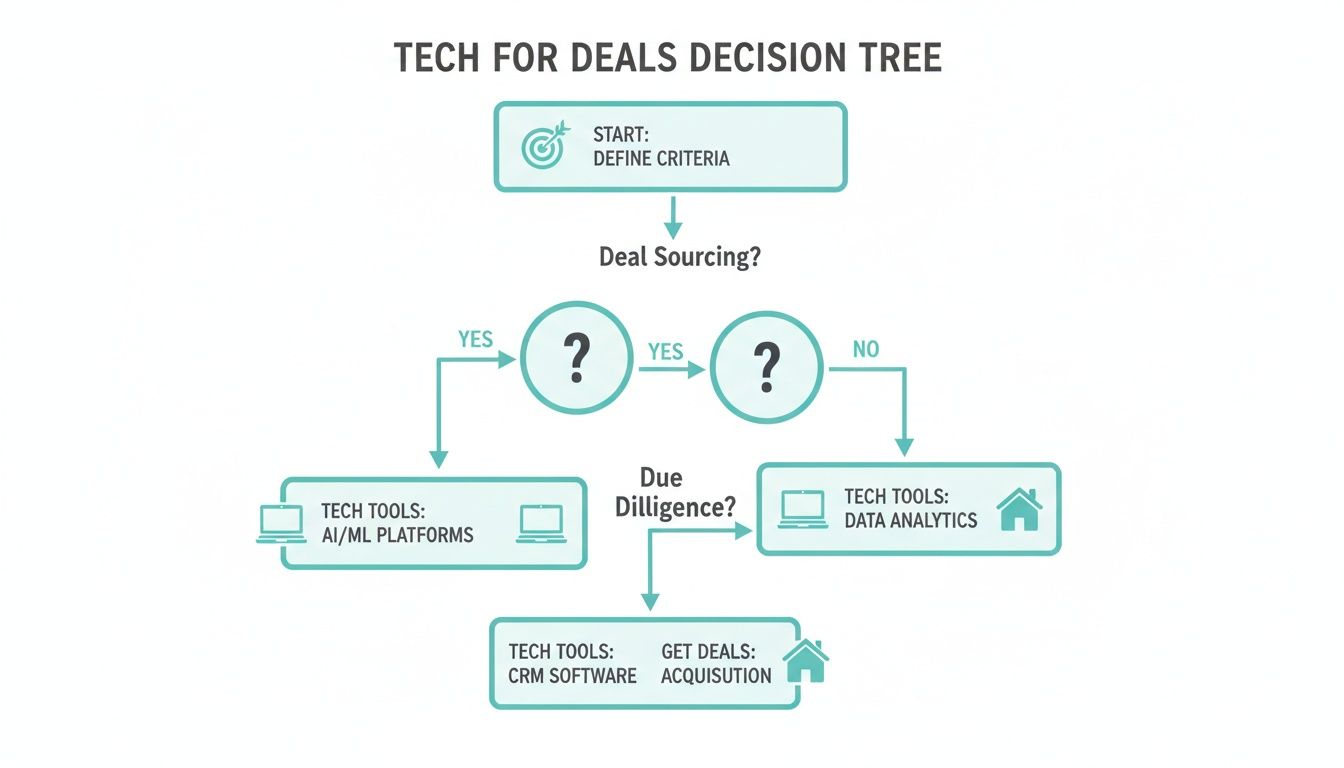
By setting clear investment goals first, you can use technology on our marketplace to automatically surface deals that are already a good fit, saving you time analyzing properties that were never going to work.
Running the Numbers for Different Strategies
Your analysis depends entirely on your exit strategy. A house flipper and a buy-and-hold investor look at deals through different lenses.
For flippers, a common guideline is the 70% Rule. It states that you should pay no more than 70% of the ARV, minus the repair costs.
Formula: (ARV x 0.70) – Estimated Repairs = Maximum Offer Price
This formula builds in a 30% margin to cover financing, closing costs, holding costs, and your profit. It's a conservative but effective starting point for any offer.
Buy-and-hold investors focus on long-term performance and cash flow. Key metrics include:
- Cash-on-Cash Return: Measures the annual pre-tax cash flow against the total cash you invested.
- Capitalization (Cap) Rate: The rate of return if you bought the property with all cash. It’s a great tool for comparing different properties. Learn how to calculate cap rate in our detailed guide.
Deal Analysis Checklist for Distressed Properties
Use this checklist to ensure you cover all critical analysis steps before making an offer.
| Analysis Step | Key Metric / Action | Beginner Tip | Experienced Investor Tip |
|---|---|---|---|
| Initial Screening | Verify property details and ownership status. | Double-check public records to confirm the seller has the right to sell. | Look for signs of multiple liens or encumbrances early on. |
| ARV Calculation | Pull 3-5 comps sold in the last 90 days. | Ask your agent for a Comparative Market Analysis (CMA). | Adjust comps for differences in square footage, lot size, and condition. |
| Repair Estimation | Get a detailed quote from a trusted contractor. | Always add a 10-15% contingency buffer to your repair budget. | Get multiple quotes for any job over $5,000 to spot outliers. |
| Strategy-Specific Analysis | Run the 70% Rule (for flips) or cash flow projections (for rentals). | Stick to the formulas. Don't let "potential" fudge the numbers. | Stress-test your numbers—what if repairs go 20% over or rents are lower? |
| Financing & Costs | Account for loan costs, closing fees, and holding costs. | Get pre-approved for a loan so you know your budget and costs. | Factor in points, origination fees, and the cost of capital. |
| Final Review | Calculate Maximum Allowable Offer (MAO). | Your MAO is your walk-away number. Don't get emotional in negotiations. | Re-run all your numbers one last time right before submitting your offer. |
By running these numbers before you make an offer, you can negotiate from a position of strength, confident in what the property is worth to you.
Building a System to Find Deals Consistently
Finding one great deal is a thrill, but building a real estate business requires consistent, predictable deal flow. A repeatable system is what separates amateurs from professionals.
The biggest mistake investors make is trying to do everything at once, leading to burnout. The key is to pick one or two sourcing methods and commit to them for the next 90 days.
Your 90-Day Action Plan
If you’re just starting, your plan could be dedicating every Saturday morning to Driving for Dollars. This method costs little and is the best way to learn your target neighborhoods at a street level.
For a more seasoned investor, the 90-day plan might focus on scaling a hyper-targeted direct mail campaign to a niche list, like probate leads. The goal is to build a full follow-up sequence to nurture those leads over time.
Key Takeaway: Consistency beats intensity. One focused, repeated action will generate more quality leads than sporadically trying five different strategies. Pick a method that fits your budget and schedule, then execute it relentlessly.
Track Everything to Find What Really Works
You cannot improve what you do not measure. As you execute your plan, track Key Performance Indicators (KPIs) for each sourcing channel. A simple spreadsheet is all you need.
Monitor these metrics:
- Leads Generated: How many potential deals did each channel produce?
- Offers Made: How many leads were strong enough to warrant an offer?
- Deals Closed: What was your conversion rate from lead to closed deal?
- Cost Per Lead/Deal: How much did you spend in time and money to acquire each deal through that channel?
This data will show you what’s working in your market. You might find that direct mail has a higher upfront cost but produces more motivated sellers, leading to a lower cost per closed deal.
Putting Your Deal Flow on Autopilot
Once you know which strategies deliver results, you can use technology to scale.
Setting up a detailed Smart Buy Box on an investor platform acts as your digital scout, working 24/7. It automatically sifts through deals from wholesalers and other sellers, ensuring you only see opportunities that match your criteria.
This type of system automates your deal-finding and connects you to a valuable real estate investor network. By combining consistent action with the right tech, you can build a reliable deal pipeline to fuel your portfolio's growth.
Got Questions? We've Got Answers.
Diving into distressed properties can feel overwhelming. It’s normal to have questions, so let’s address a few of the most common ones.
What's the Best Way for a Beginner to Find a Distressed Property?
If you're new, start with a real estate agent who understands investment properties. Find someone who knows what ARV means and isn't afraid of homes that need work.
Have them set up an MLS search for properties listed 'as-is,' 'fixer-upper,' or those on the market for over 90 days. This is a great way to learn analysis with a professional safety net. Another excellent starting point is 'Driving for Dollars.' It costs little more than time and gas but provides an invaluable, on-the-ground education about your target neighborhoods.
How Much Money Do I Really Need to Buy a Distressed Property?
The amount of cash required varies significantly. While courthouse auctions often demand cash, that's just one sourcing method.
Many distressed properties can be purchased with financing, including:
- Conventional loans, if the property is in habitable condition.
- Renovation loans (like an FHA 203(k) or Fannie Mae HomeStyle), which combine the purchase and repair costs into one loan.
- Hard money loans, which are private loans ideal for properties traditional banks won't finance.
You can also get creative by partnering with other investors or using wholesaling to get a property under contract with minimal upfront cash.
Are Pre-Foreclosures Actually a Good Source for Deals?
Absolutely. Pre-foreclosures can be a goldmine because you are reaching a motivated seller before the bank takes over. This creates a win-win: the homeowner avoids foreclosure, and you acquire a property below market value.
However, this strategy requires a thoughtful approach. You are dealing with people in a stressful situation, so empathy and professionalism are critical. You will need to source data from public records or specialized services and be prepared for a sensitive negotiation.
Ready to stop chasing deals and start having them come to you? On our marketplace, you can set up your investor profile and get automatically matched with deals that fit your criteria. Create your free investor profile today to build a consistent pipeline of the right opportunities.