Analyzing a potential real estate deal can feel overwhelming, but before you build a complex spreadsheet, you need a quick way to filter the good from the bad. That's where the capitalization rate, or cap rate, comes in. It’s the single most important metric for rapidly comparing one investment property against another.
If you just need the short answer, here it is: you calculate cap rate by dividing a property's Net Operating Income (NOI) by its purchase price. But simply knowing the formula is like knowing the ingredients without the recipe. Understanding how to apply it is what separates successful investors from the rest.
Why Cap Rate Is Your First Look at Any Investment Deal
Think of cap rate as your go-to filter. It’s the back-of-the-napkin math that tells you whether a deal is even worth your time, long before you dive into a full underwriting analysis.
It answers one simple but powerful question: What is the unlevered annual return on this property if I paid all cash?
This single number lets you compare a duplex in one neighborhood to a small apartment building in another, cutting through the noise to see how their core performance stacks up. Getting this right is the first step toward making faster, more confident investment decisions. It helps you instantly spot deals that fit your criteria and toss the ones that don't.
The Foundation of Deal Analysis
At its core, the cap rate is the universal language of real estate investors. It’s calculated by dividing a property's net operating income (NOI)—the annual income left after all operating expenses are paid—by its purchase price or current market value, and it's always expressed as a percentage.
It’s also incredibly sensitive to market shifts. For example, as the market cooled and property values adjusted recently, single-family rental cap rates rose to an average of 6.8%—their highest point in over six years. This tells you that investors are now getting more income relative to the price they're paying. You can dig into more of these multifamily and single-family cap rate trends over at BatchData.io.
The real power of this metric is that it completely ignores financing. By looking only at the property’s ability to generate income relative to its price, you get a clean, unbiased snapshot of its operational health.
For beginners: Think of cap rate as a quick gut check. It tells you if a property is in the right ballpark for your goals.
For experienced investors: Cap rate is the starting line for deeper analysis. It’s the initial 'go' or 'no-go' signal that determines whether you’ll spend the next few hours—or days—underwriting a potential investment.
Ultimately, knowing how to calculate the cap rate for a rental property gives you the fundamental tool for evaluating any deal. It doesn't matter if you're a wholesaler posting an opportunity on a marketplace or a buy-and-hold investor building a legacy portfolio. This is the core skill that underpins every sound real estate investment.
Cap Rate at a Glance
| Component | What It Is | Why It Matters |
|---|---|---|
| Cap Rate | A percentage showing the unlevered return of a property. | It’s the best tool for quick, apples-to-apples deal comparisons. |
| Net Operating Income (NOI) | All property income minus all operating expenses. | This is the true measure of a property's profitability before debt. |
| Purchase Price | The amount you pay for the property. | This is the denominator in the formula; a lower price means a higher cap rate. |
| Operating Expenses | Ongoing costs to run the property (taxes, insurance, maintenance). | Overlooking or underestimating these will kill your real returns. |
This table is your cheat sheet. Master these four components, and you’ll have the foundation you need to analyze deals like a pro.
Calculating Net Operating Income: The Engine of Your Cap Rate
Your cap rate is only as reliable as your Net Operating Income (NOI). Getting this number right is completely non-negotiable, as it’s the purest measure of a property’s ability to make money before you factor in loans or taxes.
Frankly, a sloppy NOI calculation leads to a misleading cap rate, and that’s how investors make terrible decisions. The process is straightforward: start with the property's total potential income, then subtract all legitimate, ongoing costs of running the place.
This chart breaks down that simple but critical path from gross income to Net Operating Income—the absolute heart of your cap rate calculation.
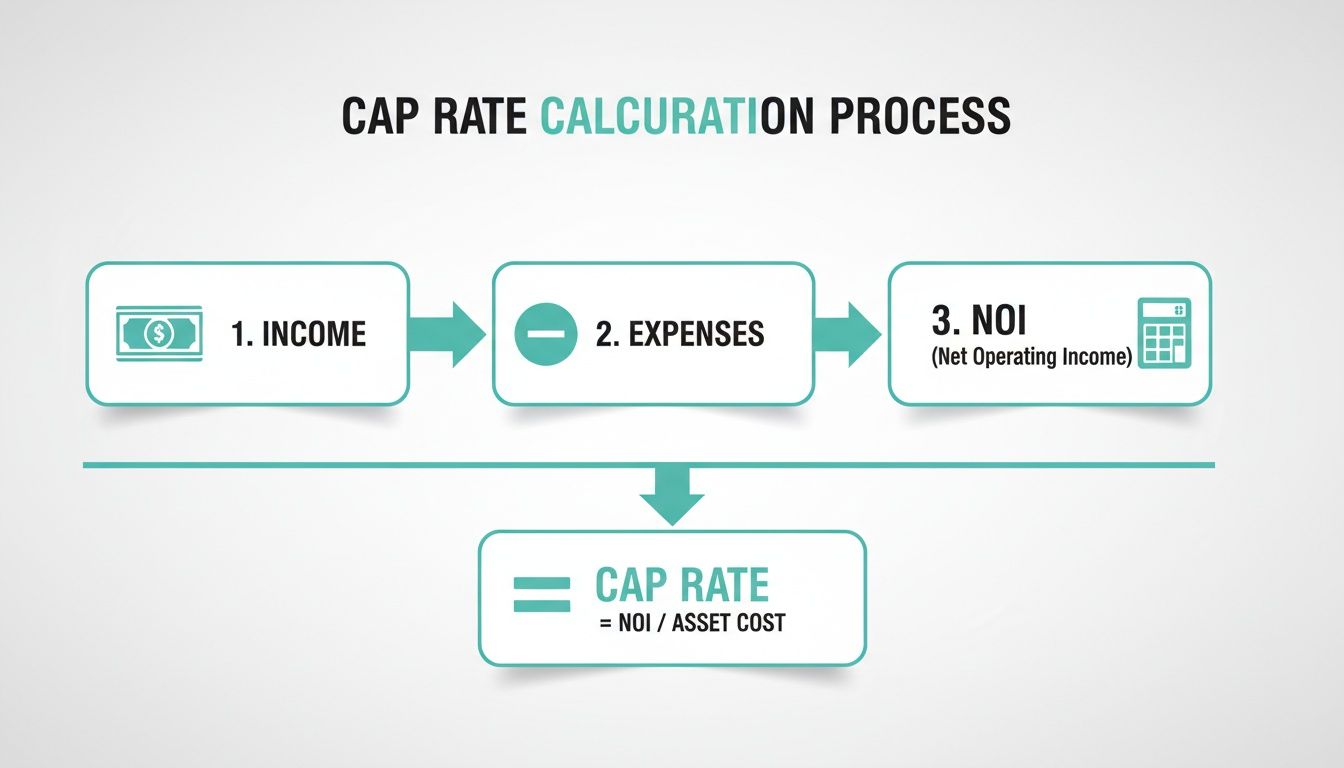
The key takeaway here is that NOI is what’s left after the property pays for itself, but before the owner pays the bank. It's a measure of the asset, not the owner's financing.
What to Include in Operating Expenses
To get an accurate NOI, you have to be ruthlessly realistic about a property's ongoing costs. These are the expenses required to keep the lights on, the tenants happy, and the property in good shape.
Your list of operating expenses absolutely must include:
- Property Taxes: The annual bill from your local county or municipality. This one’s not optional.
- Insurance: This is your landlord or property insurance premium, not the renter's insurance your tenants carry.
- Property Management Fees: Even if you plan to self-manage, you should always budget for this. A standard rate is 8-10% of collected rent. For a deep dive into what this covers, you can check out our ultimate guide to property management.
- Repairs & Maintenance: You need a budget for routine upkeep—think leaky faucets, running toilets, and appliance fixes, not a new roof. A common rule of thumb is to set aside 5-10% of the gross rent.
- Utilities: Any services you, the landlord, are on the hook for. This often includes water, sewer, or trash in a multifamily building.
- Vacancy & Credit Loss: No property stays 100% occupied forever. A conservative estimate of 5-8% of gross potential rent is a smart, standard assumption to account for empty units and tenants who don't pay.
What to Exclude From Operating Expenses
Knowing what to leave out of your NOI calculation is just as important as knowing what to put in. These are costs related to the investor, not the property itself, and confusing the two is one of the most common mistakes new investors make.
Never include your mortgage payment (debt service), depreciation, income taxes, or major capital expenditures (like replacing a roof or HVAC system) in your NOI calculation. These are owner-specific costs, not operational expenses.
Including your loan payment, for example, would tell you about your personal cash flow, but it messes up the NOI. It wouldn’t help you compare the property's raw performance to another property with different financing. By keeping these items out, the NOI remains a pure measure of the asset’s standalone ability to generate profit.
The Cap Rate Formula in Action
Alright, now that you’ve got a solid Net Operating Income (NOI), you're ready to put it to work. This is the final and most straightforward part of figuring out the cap rate on a rental property.
The formula itself is beautifully simple.
Cap Rate = Net Operating Income (NOI) / Property Value
Let’s run through a couple of real-world scenarios to see how this plays out with different types of properties. We'll kick things off with a classic single-family rental.
Putting It to the Test: A Single-Family Home
Imagine you’re looking at a single-family home with an asking price of $350,000. After doing your homework on rental comps and running the numbers on expenses, you’ve landed on a realistic annual NOI of $21,000.
Plugging this into the formula is a piece of cake:
- NOI: $21,000
- Purchase Price: $350,000
- The Math: $21,000 / $350,000 = 0.06
To get the percentage, just multiply by 100. That gives you a 6.0% cap rate. This number is now your baseline—a clear benchmark to compare this deal against other single-family homes in the area.
Scaling Up: A Small Multifamily Example
Now, let's look at a small four-unit building. The seller wants $800,000, and your detailed underwriting shows a combined annual NOI of $48,000. You've already factored in the higher utility costs and professional management fees that come with a multifamily property.
Let’s run those numbers:
- NOI: $48,000
- Purchase Price: $800,000
- The Math: $48,000 / $800,000 = 0.06
Just like the house, this fourplex is also trading at a 6.0% cap rate. Even though these properties are in totally different leagues in terms of price and day-to-day operations, the cap rate instantly shows you that their unlevered returns are identical at the current asking prices.
A Quick Word on "Property Value"
Here's a small detail that trips up a lot of investors: which "Property Value" should you actually use in the formula? The answer really depends on what you're trying to figure out.
- When Analyzing New Deals: Use the asking price or, even better, your target offer price. This tells you the potential return you'd get if you bought the property today.
- When Evaluating Your Portfolio: Use the property’s current market value, not what you paid for it years ago. This calculates the real-time return your equity is generating and helps you decide if it’s time to sell, refinance, or hold tight.
Getting this distinction right is crucial for making smart decisions. If you want to run these numbers without pulling out a spreadsheet every time, you can always use tools like our free investment property calculators to speed things up.
Interpreting the Numbers: What a Cap Rate Really Tells You
Running the numbers on a cap rate is a science, but actually interpreting what they mean? That’s an art. A "good" cap rate doesn't exist in a vacuum—it's completely dependent on context. A savvy investor knows how to read what’s happening between the lines.
Many beginners make the mistake of chasing the highest possible cap rate, assuming bigger is always better. While a high cap rate can signal a fantastic return, it can just as easily be a warning sign for high risk.
The Story Behind High and Low Cap Rates
- Low Cap Rates (e.g., 4-5%): This usually means investors are willing to pay a premium for a stable, low-risk asset. Think of a well-maintained building in a prime, appreciating area with strong tenants. You’re trading a lower initial cash-on-cash return for what you believe is lower risk and a higher potential for appreciation.
- High Cap Rates (e.g., 8-10%+): This suggests a lower purchase price relative to its income. It could mean higher risk (bad neighborhood, economic uncertainty) or a management-intensive property. For experienced investors, a high cap rate often signals a value-add opportunity to force appreciation by improving operations and raising rents.
The key is to understand why the cap rate is what it is. Is it high because the market is a gamble, or is it high because there’s untapped potential you can unlock?
Using Cap Rate Spreads for Deeper Analysis
To add another layer of professional analysis, experienced investors look at the cap rate spread. This is simply the difference between a property's cap rate and a risk-free benchmark, like the 10-Year Treasury yield. The spread tells you how much you're being compensated for taking on the risks of real estate over a hands-off government bond.
This metric gives you crucial context, especially in changing economic climates. Historically, cap rate spreads have been wider than 200 basis points (or 2%) about 70% of the time since 1965. If you want to dive into the data, you can explore the history of cap rates and interest rates.
By tracking the current spread, you can judge if you're being paid enough for the risk you're taking. If spreads are compressing (getting smaller), it might mean the market is getting overheated. If they're widening, it could signal a good buying opportunity.
Finding Deals That Match Your Target Cap Rate
Manually sifting through hundreds of listings to run the numbers on every property is a fast track to burnout. It's an exhausting process that guarantees you'll miss good deals. The old way of getting lost in spreadsheets is dying, and for good reason.
A modern investor marketplace flips this entire process on its head. Instead of getting bogged down in manual calculations, investors on our platform can set specific criteria to get pre-vetted deals delivered to them, saving dozens of hours.
From Manual Spreadsheets to a Smart Buy Box
The real advantage in today's market comes from leveraging technology built for investors. On our platform, you can set up a Smart Buy Box, which lets you define your perfect investment criteria with incredible precision.
This goes way beyond just location and price. You can dial in your exact requirements for:
- Target Cap Rate Range: Immediately filter out any deals that don't meet your minimum return threshold.
- Cash-on-Cash Return: See only properties that align with your financing and cash flow goals.
- Property Type: Focus exclusively on single-family, small multifamily, or whatever niche fits your strategy.
- Key Metrics: Set specific parameters for NOI, square footage, and even value-add potential.
Once you’ve set your criteria, the platform becomes your own personal deal-sourcing engine. It automatically scans the market and notifies you only when a property that fits your strategy pops up. This is particularly effective for finding off-market properties.
Instant Analysis for Faster Decisions
The moment a matching deal hits your inbox, the heavy lifting has already been done. Built-in deal analysis tools instantly calculate the key metrics you care about, presenting them in a clear, easy-to-read format.
This screenshot from our deal analysis tool shows exactly how metrics like cap rate, NOI, and cash flow are laid out for a quick, at-a-glance evaluation.
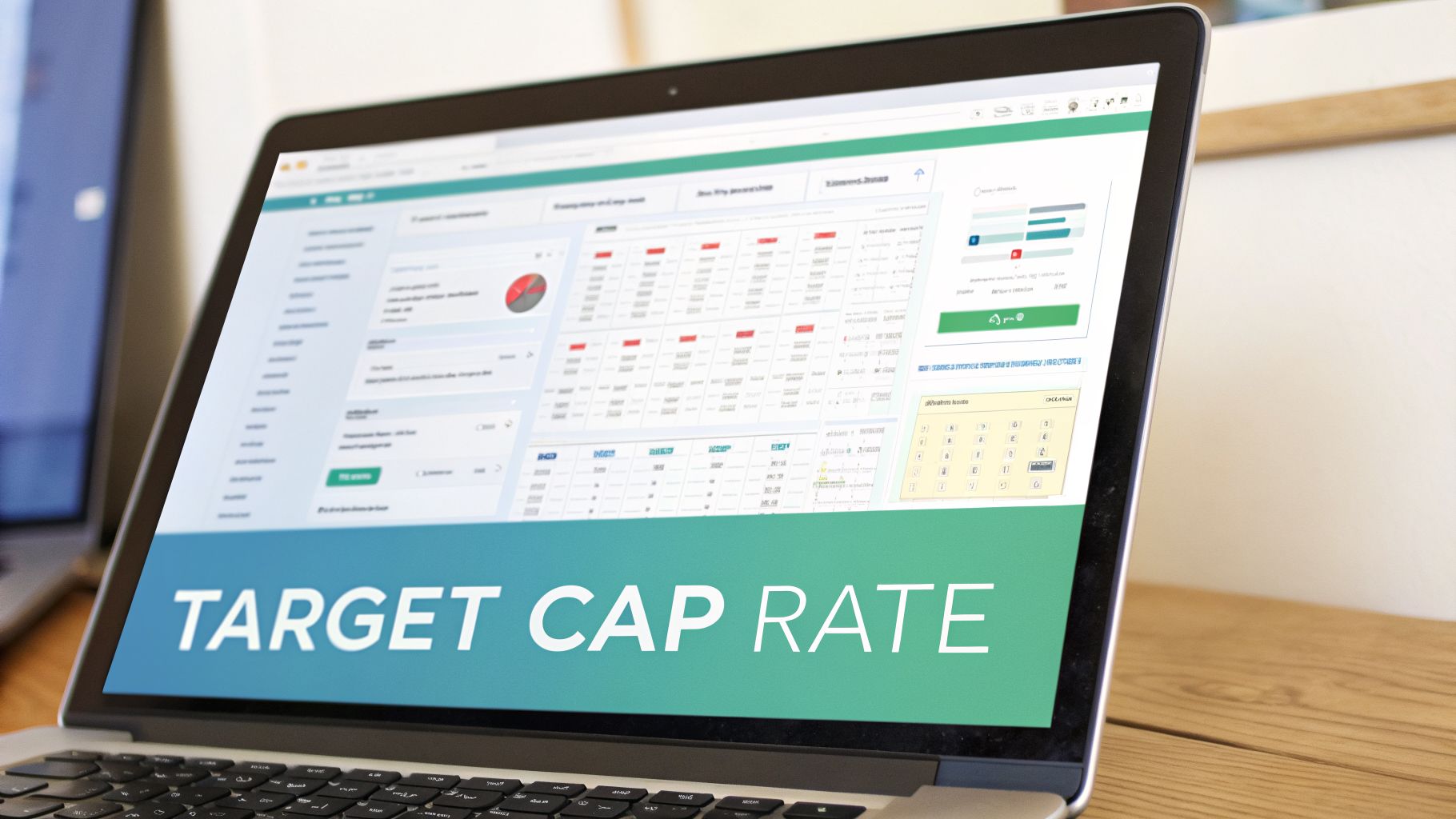
You can see in seconds if a property’s projected return meets your standards—without ever touching a calculator. This lets you move from discovery to decision-making in minutes, not hours.
By automating the initial filtering and analysis, you can shift your focus from tedious data entry to high-value strategic thinking—like negotiating better terms and structuring deals, which is where the real money is made.
Answering Your Biggest Cap Rate Questions
Once you get the hang of the basic formula, you’ll find the real world is full of tricky little details. Let's tackle some of the most common questions that pop up when you're running the numbers on an actual deal.
Should I Include Closing Costs in the Purchase Price?
This is a great question that separates a quick glance from a serious analysis. While the textbook cap rate formula just uses the purchase price, most seasoned investors calculate a “total project cost” cap rate.
This means you add all your acquisition costs—closing fees, inspection costs, initial repair money—to the purchase price. Why? Because it gives you a much truer picture of the return on every single dollar you have to bring to the table. The most important thing here is to be consistent when comparing properties.
How Do Value-Add Strategies Affect Cap Rate Calculations?
For a value-add deal, you’re telling a "before and after" story with two different cap rates.
- The "Going-In" Cap Rate: Calculated using the property's current, underperforming NOI and the asking price. It tells you the return you’re getting on day one.
- The "Stabilized" Cap Rate: A future projection calculated using the expected NOI after you've finished the renovations and raised rents, divided by your total project cost (purchase price + rehab budget).
Underwriting a value-add deal is all about the spread between these two numbers. That gap is where you create equity and build serious cash flow.
Can a Cap Rate Be Negative and What Does It Mean?
Absolutely, and it’s a massive red flag. A negative cap rate means the property's operating expenses are higher than its income, giving you a negative Net Operating Income (NOI).
A negative cap rate means you are losing money every single year before you even pay one dollar toward the mortgage.
This usually happens with properties that are severely distressed or horribly mismanaged. They're financial black holes that will bleed cash from the moment you take ownership. For any buy-and-hold investor, a negative cap rate is almost always an instant deal-killer.
Why Is Cap Rate a Better Metric Than Gross Rent Multiplier?
The Gross Rent Multiplier (GRM) is a quick but shallow metric. Its formula (Price / Gross Annual Rent) completely ignores all operating expenses. You could have two properties with the same rent, but one has sky-high taxes and needs constant repairs. The GRM would make them look identical, but one is a solid investment and the other is a financial disaster.
The cap rate, because it uses Net Operating Income, forces you to account for all those critical costs. Think of it this way: GRM is a glance, while cap rate is the beginning of a real investigation into a property's true profitability.
Knowing how to calculate cap rate on rental property is essential, but finding deals that meet your criteria is the real challenge.
Create your free investor profile today to set your buy box criteria and get matched with deals that actually work for your strategy.