Building a real estate portfolio is one of the most reliable paths to long-term wealth, but it doesn't happen by accident. To succeed, you need to stop chasing random deals and start executing a deliberate strategy. This guide provides an actionable framework to build your personal investment blueprint and scale from your first property to a profitable portfolio.
Without a clear plan, you’ll fall victim to "shiny object syndrome"—jumping at every opportunity that comes across your desk, regardless of whether it moves you closer to your real goals. Your blueprint isn't a vague mission statement. It’s a concrete plan that makes sure every move you make is intentional, from your first deal to your fiftieth.
Build Your Personal Investment Blueprint
Before you analyze a single deal, you need to define what success looks like for you. It all begins with getting brutally honest about your goals, risk tolerance, and available resources.
Get Crystal Clear on Your Financial Goals and Timeline
Vague goals like "achieve financial freedom" are motivating but not actionable. To build a real plan, you need to attach specific numbers and timelines to your ambitions.
Ask yourself the hard questions:
- Target Monthly Cash Flow: Are you trying to generate an extra $1,000 a month in passive income within two years? Or is the goal $10,000 a month in five years?
- Desired Net Worth: What's your target net worth from real estate in the next 10 or 20 years?
- Number of Doors: How many rental units will it take to hit your income goals? For example, if you figure each door can realistically generate $250 in monthly cash flow, you’ll need 20 doors to hit a $5,000 per month target.
Answering these questions turns a fuzzy dream into a measurable mission. It also lets you work backward to figure out the pace and scale at which you need to acquire properties.
Honestly Assess Your Risk Tolerance and Resources
Your appetite for risk will shape your entire strategy. Are you comfortable with the high-stakes, high-reward world of flipping houses, or do you prefer the slower, steadier income from a portfolio of turnkey rentals? Be honest about your available capital, how much time you can really commit, and your current skillset.
One common approach is to match your strategy to your life. An investor with a demanding full-time job and limited cash might find a high-volume flipping business leads to burnout. A strategy requiring less hands-on management might be a better fit.
This decision tree shows how your starting capital and risk profile can point you toward an initial strategy.
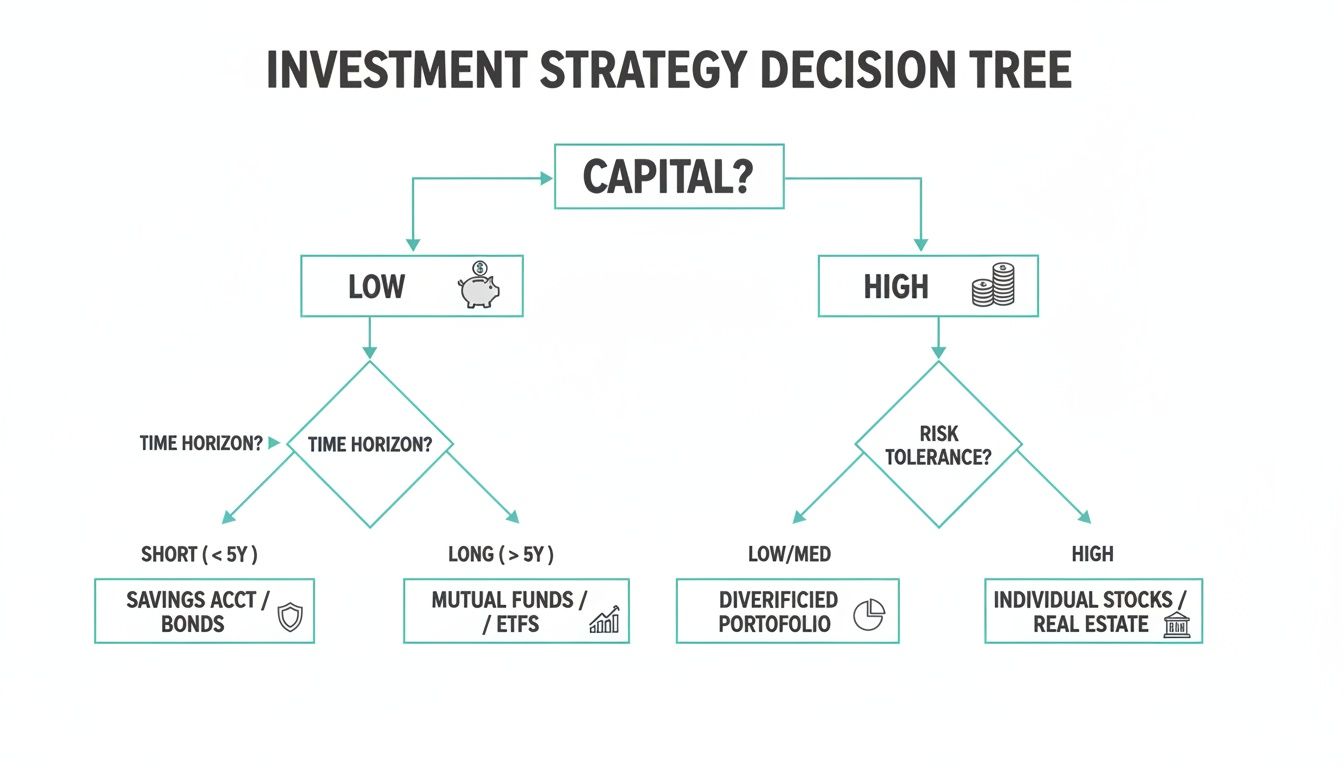
As you can see, investors with lower capital often start with strategies like wholesaling or house hacking, while those with more cash can jump right into traditional buy-and-hold or even small development projects.
Choose Your Starting Strategy and Niche
With your goals and resources clearly defined, you can pick a starting point. While a diversified portfolio is often the long-term goal, most successful investors start by mastering one niche.
Looking at where institutional money flows can reveal high-growth areas. Data from firms like Exis Global shows a 29% year-over-year surge in this kind of investment in markets like India, reaching $8.5 billion, driven heavily by industrial and logistics assets. While you may not build a data center, this highlights the power of focusing on a specific, in-demand niche.
Here are a few common entry points for individual investors:
- Wholesaling: This strategy involves finding undervalued properties and assigning the purchase contract to another investor for a fee. It's a low-capital way to enter the market but demands serious marketing and negotiation skills.
- The BRRRR Method: This stands for Buy, Rehab, Rent, Refinance, Repeat. It's a powerhouse strategy for building a rental portfolio by recycling your initial capital from one deal into the next.
- Turnkey Rentals: These are rent-ready properties, often sold and managed by a specialized company. It’s a more passive option ideal for investors who have more capital than time.
- House Hacking: A popular strategy where you buy a small multifamily property (2-4 units), live in one unit, and rent out the others. The goal is for your tenants' rent to cover most, if not all, of your mortgage.
Finding and Vetting Deals That Actually Work
With your investment blueprint set, it's time to find the properties that will build your portfolio. Great deals aren't just found; they’re manufactured through a disciplined process of sourcing and analysis.
You have to build a system that brings opportunities to you, so you’re not just chasing whatever pops up on public listing sites.

Build Your Deal Flow Funnel
Experienced investors don’t wait for the phone to ring. They build a "deal flow funnel" that consistently surfaces potential investments from multiple sources.
- Networking: Connect with real estate agents who specialize in working with investors, not just retail homebuyers. Build relationships with local wholesalers, property managers, and other investors who can bring you deals before they hit the market.
- Direct-to-Seller: For more experienced investors, direct mail or driving for dollars (spotting distressed properties) can put you in touch with motivated sellers nobody else is talking to.
- Investor Marketplaces: An online marketplace for investors is a massive advantage. On our platform, wholesalers can upload deals directly, and you can set specific criteria to get notified about properties that fit your strategy, saving you dozens of hours of manual searching.
The goal is to have multiple lines in the water at all times so you have a consistent stream of opportunities to evaluate.
Use a Smart Buy Box to Stop Wasting Time
The single most important tool for an investor is a well-defined "Buy Box." This is a non-negotiable set of criteria a property must meet before you’ll even consider it. A Buy Box acts as your personal filter, screening out distractions and saving you from analyzing deals that were never a good fit.
A well-defined Buy Box transforms you from a deal-chaser to a deal-selector. You stop asking, "Is this a good deal?" and start asking, "Does this deal fit my proven criteria?" This simple shift is fundamental to building a real estate portfolio at scale.
Your Buy Box should be brutally specific:
- Location: Down to the zip code or neighborhood.
- Property Type: Single-family, 2-4 unit multifamily, etc.
- Price Range: A firm minimum and maximum.
- Financial Metrics: A non-negotiable minimum Cash-on-Cash Return or Capitalization (Cap) Rate.
On an investor marketplace, you can create a profile with your buy box criteria. This allows the system to automatically match you with deals that fit your strategy, ensuring you only spend time on properties with a real shot of making it into your portfolio. Our guide on finding off-market properties dives deeper into sourcing exclusive opportunities.
The Only Metrics That Really Matter for Underwriting
Once a property passes your Buy Box filter, it’s time to underwrite it. This is where you stress-test the numbers. Three core metrics will tell you 90% of what you need to know.
First is Net Operating Income (NOI). This is your total rental income minus all operating expenses (property taxes, insurance, maintenance, management fees). Crucially, this is before your mortgage payment. NOI tells you if the asset itself is profitable.
Next is the Capitalization (Cap) Rate. You get this by dividing the NOI by the purchase price. A 6% cap rate means the property generates an annual return of 6% of its value, before debt. It’s the best way to compare the relative value of different properties.
Finally, there’s the Cash-on-Cash (CoC) Return. This measures the return on the actual money you pull out of your pocket. It’s your annual pre-tax cash flow (NOI minus mortgage payments) divided by your total cash invested (down payment, closing costs, and rehab funds).
Understanding macro trends is also key. For example, research from CBRE projects that U.S. multifamily demand will stay positive through 2026, even with new supply hitting some markets. This kind of insight helps you make informed decisions about which markets and asset classes to target.
Structuring Financing to Fund Your Growth
Capital is the lifeblood of your portfolio. Without a repeatable way to fund deals, even the best deal-sourcing engine will grind to a halt. Knowing how to structure financing separates amateurs from the pros who build real estate empires.
Your toolkit should include a mix of traditional, creative, and commercial funding options that you can deploy depending on the deal. This gives you the flexibility to move fast and craft compelling offers.

Traditional and Portfolio Lending
- For Beginners: Traditional financing is the most common path for your first few properties. A conventional mortgage from a bank or credit union typically requires a 20-25% down payment for an investment property. The upside is competitive rates and long repayment terms, which helps maximize monthly cash flow.
- For Experienced Investors: After acquiring a few properties, banks may become hesitant to offer more conventional loans. This is when a portfolio loan becomes useful. It bundles several properties under a single loan, simplifying your finances and increasing your borrowing capacity.
However, traditional loans can be slow, and strict debt-to-income rules can become a roadblock to rapid growth.
Creative Financing for Faster Scaling
Creative financing is about solving problems for sellers and creating opportunities for yourself. These methods are your ticket to buying more assets, more quickly.
- Seller Financing: The property owner acts as your bank. You negotiate the down payment, interest rate, and term directly with them. This can be a powerful tool, especially with sellers who own their property free-and-clear and prefer steady income over a lump sum.
- Hard Money Loans: These are short-term, asset-based loans from private lenders, perfect for fix-and-flips. The loan is based on the property's After Repair Value (ARV), or its projected value once renovations are complete. Rates are higher (often 8-12%), but they provide the speed needed to secure deals that won’t wait for a bank.
- Private Money: This involves borrowing from individuals in your network. The terms are entirely negotiable. Building a credible investor profile on a networking platform can help you attract private capital by showcasing your track record and deal-sourcing capabilities.
Advanced Strategies for Experienced Investors
As you grow, your financing needs become more complex. You'll start thinking like an operator, optimizing your capital stack—the mix of debt and equity for each deal. This could mean using a senior loan from a bank, then layering in mezzanine debt or preferred equity from private investors to cover the remaining costs.
Mastering the full spectrum of funding is non-negotiable. For a deeper dive, check out our complete guide to real estate financing options.
Implementing Effective Asset Management
Acquiring a property is just the starting line. The race to build wealth is won through smart asset management—the ongoing process of maximizing income and minimizing expenses to boost your portfolio's value.
This requires a shift in mindset: you must evolve from a passive landlord who collects rent into an active asset manager obsessed with increasing Net Operating Income (NOI).
Self-Manage or Hire a Professional
Your first big decision is whether to manage the property yourself or hire a third-party property management (PM) company.
- Self-management can be a great way to start. You’ll save on the management fee (typically 8-10% of gross monthly rent) and learn the business from the ground up. The trade-off is your time—you're the one handling tenant calls and maintenance issues.
- Hiring a professional PM is essential for investors who value their time, live far from their properties, or are focused on scaling. A great PM brings systems for marketing, screening tenants, and managing maintenance, which frees you to focus on finding your next deal.
A Checklist for Vetting a Great Property Manager
Hiring the wrong PM can destroy an investment's profitability. Use this checklist to screen potential partners:
- Local Market Expertise: Do they manage other properties in your specific neighborhood?
- Clear Fee Structure: Get a full breakdown of their fees, including charges for leasing, renewals, and supervising repairs.
- Systematized Operations: Ask how they handle rent collection, maintenance requests, and financial reporting. Look for modern software and documented processes.
- Eviction Experience: Have they handled evictions? You need a manager who understands the legal process and can execute it efficiently if necessary.
You can dive deeper into finding the right partner in our ultimate guide to property management.
Optimizing Operations to Maximize NOI
For serious operators, asset management is about actively hunting for ways to increase revenue and cut expenses. Even small tweaks can have an outsized impact on your property’s value, since it’s often calculated as a multiple of its NOI.
An asset manager's job is to find hidden value. A landlord waits for the rent check; an asset manager asks, "How can I make this property generate 5% more income this year?" That's the difference between owning a property and running a real estate business.
Consider these strategies to boost your bottom line:
- RUBS (Ratio Utility Billing System): Instead of absorbing utility costs, a RUBS program bills tenants for water, sewer, and trash based on a fair metric like square footage.
- Ancillary Income: Get creative with new revenue sources like paid parking, coin-operated laundry, or rentable storage units.
- Negotiating Vendor Contracts: Regularly bid out contracts for landscaping, snow removal, and insurance to ensure you’re getting competitive rates.
Scaling Your Portfolio for Long-Term Wealth
Getting from your first rental to a true wealth-building portfolio requires an identity shift. You have to graduate from being an investor who finds deals to an operator who builds a business. This means creating repeatable systems, assembling a team, and knowing when to hold an asset versus when to trade up.

The BRRRR Method as a Scaling Engine
For investors looking to scale without infinite cash, the BRRRR (Buy, Rehab, Rent, Refinance, Repeat) method is an incredibly powerful tool. It’s a cycle that lets you pull your initial investment capital out of a deal to roll into the next one.
Here’s how it works:
- Buy: You acquire a distressed property, often using short-term financing like a hard money loan.
- Rehab: You execute a strategic renovation to force appreciation and hit a target After Repair Value (ARV).
- Rent: You place a qualified tenant in the newly renovated property to establish cash flow.
- Refinance: You go to a traditional bank for a cash-out refinance based on the new, higher appraised value. The bank will typically lend you up to 75-80% of the ARV.
- Repeat: In a successful deal, the new loan pays off your original purchase and rehab costs, returning most—if not all—of your initial capital. You then use that cash to repeat the process on the next property.
Building Your "Core Four" Team
You cannot scale a real estate portfolio alone. Trying to be the agent, contractor, lender, and manager is a recipe for burnout. The key is to build your "Core Four," a trusted team of professionals.
- An Investor-Friendly Agent: An agent who understands your buy box and actively sources deals that fit your criteria.
- A Creative Lender: A mortgage broker or banker who can access a variety of loan products.
- A Reliable Contractor: A GC who provides accurate rehab budgets and delivers quality work on time.
- A Systematized Property Manager: A PM who handles the day-to-day operations, freeing you to focus on growth.
Platforms that connect investors with real estate professionals can be invaluable for building this team. You can search for agents, lenders, and managers with proven experience and read reviews from other investors on the platform.
Knowing When to Exit or Exchange
Part of scaling is knowing when to sell an asset to unlock equity and redeploy it into bigger opportunities. Selling, however, can trigger a large capital gains tax bill.
A 1031 exchange is a game-changing solution. This IRS code allows you to defer all capital gains taxes by rolling the entire proceeds from a sale into a "like-kind" replacement property. This is the rocket fuel for portfolio growth, letting you trade up from a single-family rental to a duplex, and from a duplex to a small apartment building, all while keeping your capital working for you.
Common Questions on Building a Portfolio
Even with a solid playbook, questions will arise. Here are direct answers to some of the most common hurdles investors face.
How Much Money Do You Really Need to Start?
It’s less about a specific dollar amount and more about your strategy.
- Low Capital: Strategies like wholesaling allow you to control a property with little to no money down by assigning the contract to another buyer. House hacking is another powerful option; using an FHA loan, you can often buy a multifamily property with as little as 3.5% down, live in one unit, and have tenants pay your mortgage.
- Some Capital: With more funds, you can pursue a traditional buy-and-hold rental with a 20-25% down payment or fund a BRRRR deal using private or hard money.
A lack of massive savings isn't a dead end; it's a signal to get more creative with your strategy.
Is a Single-Family Home or Multifamily Better for a First Investment?
This choice comes down to a trade-off: simplicity versus scale.
- Single-Family Home (SFH): An SFH is often a smoother entry point. Management is simpler, and it serves as a great real-world classroom for learning the landlord business without being overwhelmed.
- Small Multifamily (2-4 units): This puts you on a faster track to scaling. Cash flow is stronger and more resilient—a vacancy in one unit doesn't wipe out your entire income for the month.
For beginners, an SFH is a great way to learn core landlord skills. For investors focused on scaling, a small multifamily offers built-in risk mitigation and faster growth.
What Are the Biggest Risks for a New Investor?
The most dangerous pitfalls are almost always self-inflicted and avoidable.
- Poor Deal Analysis: The number one risk is letting emotion drive decisions. New investors often underestimate expenses and overestimate rents to make a deal look better on paper. The fix: be disciplined, trust your underwriting, and never fudge the numbers.
- Lack of Liquidity: The second biggest risk is pouring every last cent into a deal, leaving no cash reserves for unexpected repairs or vacancies. A good rule of thumb is to have three to six months of total expenses for each property set aside in an emergency fund.
How Do I Know When to Go Full-Time?
Making the leap to full-time real estate investing is more about achieving predictable income than hitting a certain number of doors.
First, your portfolio's net cash flow must reliably cover all personal living expenses, plus a buffer. You need to see this performance consistently for at least six to twelve months.
Second, you need a personal emergency fund of 6-12 months of living expenses that is completely separate from your property reserves.
Finally, your systems for finding, funding, and managing deals should be running like a well-oiled machine. When your systems are making you money, not just you working for it, you’re ready.
Ready to stop wasting time on irrelevant listings and start finding deals that perfectly match your strategy? Building a real estate portfolio begins with consistent, high-quality deal flow.
Create your free investor profile to get matched with deals that fit your criteria.