
Finding great investment properties isn’t about luck—it’s about building a system. To move from hoping to find a deal to ensuring qualified opportunities consistently land in your inbox, you need a repeatable process. This guide provides an actionable framework for building that system.
Building Your System for Finding Investment Properties
If you want to find quality deals in any market, you have to stop "deal hunting" and start building a funnel that consistently brings potential investments to you. This approach allows you to spend your time where it matters most: analyzing properties and making offers, not just scrolling through listings.
This entire system rests on three core methods for sourcing deals. Each has its own advantages and challenges.
For investors just getting started, on-market listings are the most accessible entry point. As you gain experience, your focus will naturally shift toward off-market channels and specialized platforms where you can find a real competitive edge.

The Three Pillars of Deal Sourcing
Every successful investor builds their deal flow using a mix of these three channels. Understanding each one is fundamental to finding properties consistently.
- On-Market Properties: These are deals listed publicly on the Multiple Listing Service (MLS) with a real estate agent. This channel offers the highest volume of listings and transparent data, but it also comes with the most competition.
- Off-Market Properties: These are properties that are not publicly for sale. Finding them requires proactive effort—direct outreach, networking, and targeted marketing—to connect with motivated sellers before they list. The competition is lower, and the potential for better deals is much higher.
- Investor Marketplaces: These online platforms act as a bridge, connecting sellers (often wholesalers with a deal under contract) directly with vetted buyers. They provide a curated flow of pre-screened deals, saving investors significant time. On a platform, you can set your buying criteria and get matched with deals that fit your strategy.
A strong system never relies on just one of these channels. While you might monitor the MLS for market data, you will likely dedicate more energy to building your off-market and marketplace pipelines, as that's where the most profitable investments are often found.
Key Takeaway: Stop hunting for one-off deals and start building a multi-channel system. Your goal isn't to find a property; it's to create a reliable pipeline of opportunities you can analyze, filter, and act on with confidence.
Key Deal Sourcing Channels for Modern Investors
To make sense of it all, here’s a practical breakdown of where to look for deals, who each channel is best for, and the honest pros and cons you can expect.
| Sourcing Channel | Best For | Pros | Cons |
|---|---|---|---|
| MLS | New investors, market research | High volume, transparent data, agent support | Extreme competition, typically higher prices |
| Auctions | Experienced investors, cash buyers | Potential for deep discounts, fast transactions | High risk, little to no due diligence time |
| Wholesalers | Investors needing consistent deal flow | Pre-vetted deals, less direct sourcing effort | Thinner margins, need to verify numbers |
| Direct Mail | Investors targeting specific neighborhoods | Highly targeted, less competition | High cost, low response rates, requires scale |
| Driving for Dollars | Local investors in specific markets | Uncovers deals nobody knows about, minimal cost | Extremely time-consuming, manual process |
| Networking | All investors, especially for partnerships | Access to exclusive deals, builds relationships | Takes a long time to build an effective network |
| Marketplaces | Busy investors, those investing out-of-state | Curated deals, efficient process, good data | Can have platform fees, competition from pros |
No single channel is perfect. The best investors learn to blend several of these together to create a funnel that works for their specific market and investment strategy.
The Role of a "Buy Box" in Your System
The engine that makes your deal-finding system run is your buy box. This is a crystal-clear set of criteria that defines exactly what you’re looking for. Without it, every property feels like a potential opportunity, and you'll drown in analysis paralysis.
A sharp buy box is your automatic filter. When a property hits your desk—whether from the MLS, a wholesaler, or a marketplace alert—you can decide in seconds if it's worth a deeper look. It's the most critical first step to managing your deal flow effectively.
We'll dive into crafting a Smart Buy Box in the next section, but for now, understand its role as the gatekeeper. It ensures only the most relevant properties get through, making your process more effective and less time-consuming. Learning more about building your real estate investor network is also a huge part of this, as the right connections will fill your pipeline with opportunities that perfectly fit your criteria.
Defining Your Smart Buy Box to Filter Out the Noise
Searching for investment properties with a vague idea of what you want is a recipe for wasted hours and missed opportunities. It’s the fastest path to analysis paralysis, where every listing seems like a possibility and you end up chasing nothing.
A “Smart Buy Box” solves this. It's your non-negotiable, data-driven set of rules for what makes a deal a "yes." Think of it as an instant filter that lets you say no to 99% of properties in seconds, so you can focus all your energy on the 1% that actually fit your strategy.

Financial Metrics: The Core of Your Criteria
Before you even look at a property photo, your buy box must be anchored in solid financial metrics. These numbers tell you whether a deal can actually be profitable.
Get crystal clear on these fundamentals:
- Capitalization (Cap) Rate: This is your return if you bought the property in all cash (Net Operating Income / Property Value). It’s a quick way to compare the raw earning potential of similar assets in the same market, independent of financing.
- Cash-on-Cash (CoC) Return: Arguably the most important metric for any investor using leverage, CoC return measures your annual pre-tax cash flow against the actual cash you invested (Annual Cash Flow / Total Cash Invested). It answers the simple question: "For every dollar I put in, what am I getting back each year?"
- Net Operating Income (NOI): This is the property's engine. It's all revenue (rents, fees) minus all necessary operating expenses—before you factor in your mortgage payment. NOI reveals the pure profitability of the asset itself.
Your buy box needs a firm minimum for these. For example, a newer investor might set a floor of an 8% CoC return. A seasoned pro might be comfortable with a 6% CoC return on a Class A building in a market with strong appreciation potential. Define your floor and stick to it.
Physical and Location-Based Criteria
Once you have your financial guardrails locked in, you can layer on the physical details. This is where you get hyper-specific to cut through the noise.
Your physical buy box needs to be precise:
- Property Type: Are you hunting for single-family homes? Small multifamily (2-4 units)? Or are you scaling up to 5+ unit buildings?
- Property Class: Decide where you want to operate. Class A (newer, prime locations), Class B (a bit older but well-maintained, solid workforce housing), or Class C (older, needs work, higher cash flow potential but more management intensive)?
- Size and Unit Mix: Be specific. For single-family, maybe it's "3-bed, 2-bath, 1,500-2,000 sq ft." For multifamily, it might be "a mix of 1- and 2-bedroom units."
- Geographic Focus: Don't just say "Phoenix." Dial it down to specific zip codes, neighborhoods, or even street boundaries, factoring in things like school district ratings and commute times.
- Condition and Value-Add Potential: What’s your business plan? Are you looking for turnkey rentals? Or do you want a property that needs a light cosmetic rehab to force appreciation?
For Experienced Investors: Gain an edge with more nuanced filters. Add criteria like specific zoning that allows for an Accessory Dwelling Unit (ADU), a lot that can be subdivided, or properties with assumable low-interest-rate loans. These are the details that unlock hidden value.
Hunting for Off-Market Properties and Wholesale Deals
The best deals are often the ones nobody else can see. While the MLS provides volume, real profits are frequently made in the world of off-market and wholesale properties. These are homes not publicly listed, giving you a direct line to the seller and a chance to sidestep bidding wars.
Success here isn’t about waiting for the perfect deal to appear. It's about proactive effort to create your own opportunities.

Classic Strategies for Finding Motivated Sellers
Going off-market means finding owners who need to sell but haven't put a sign in the yard yet. These motivated sellers often care more about a quick, hassle-free, as-is sale than getting top dollar on the open market.
Here are a few time-tested ways to find them:
- Direct Mail Campaigns: This old-school tactic still works. It’s a numbers game where you pull targeted lists of owners—like absentee landlords or those behind on taxes—and send a simple letter or postcard. Consistency is key.
- Driving for Dollars (D4D): This is as boots-on-the-ground as it gets. You drive through target neighborhoods looking for neglected properties. Jot down the address, find the owner's info through public records, and reach out.
- Networking with Local Pros: Get to know probate attorneys, divorce lawyers, and property managers. Let them know you’re a serious buyer who can close fast, and you might become the first person they call with a lead.
These methods take real effort but can unearth deals with massive equity potential. For a deeper dive, our guide on how to find off-market properties lays out even more strategies.
Tapping into the Wholesale Ecosystem
Wholesaling is a massive part of the off-market universe. A wholesaler finds motivated sellers, gets their property under contract at a discount, and then assigns that contract to a cash buyer (like you) for a fee.
For investors, good wholesalers function as a pre-vetted deal pipeline. They do the heavy lifting of marketing and negotiation, and you get access to the inventory.
If you’re new, start attending local Real Estate Investor Association (REIA) meetings. Introduce yourself to wholesalers, get on their buyers lists, and learn about the types of deals they find.
If you’re experienced, identify the top wholesalers in your market. Build a real relationship with them and prove you can perform. Soon, you'll get a "first look" at their best deals before they're sent to a mass email list.
The game is about speed and credibility. Wholesalers can't afford to work with buyers who waste their time. If you can analyze a deal in minutes and close without drama, you'll quickly become one of their preferred partners.
How a Marketplace Connects You with Wholesalers
Historically, the wholesale world has been inefficient. Wholesalers struggled to build reliable buyers lists, and investors were buried in irrelevant emails. Investor marketplaces solve this by creating a central hub for connection.
- For Wholesalers: Instead of managing a messy email list, you can post a deal to a platform of verified investors who are actively looking to buy. Seeing their exact buying criteria makes the disposition ("dispo") process much faster.
- For Buyers: This is the game-changer. You set up your Smart Buy Box once, and the platform acts as your personal filter. You only get alerts for deals that hit your specific criteria—location, property type, ROI, everything. No more noise, just relevant opportunities.
It's a true win-win. Wholesalers find serious buyers quickly, and investors get a steady, curated flow of off-market deals.
Analyzing Potential Deals Quickly and Confidently
Once a promising property hits your radar, the clock starts ticking. The investors who consistently win are those who can analyze a deal with speed and accuracy. They treat underwriting—the process of vetting a deal's financial health—like a reflex, not a research project.
You don't need a complex, 50-tab spreadsheet for your first pass. You need a simple framework to run the numbers, spot red flags, and decide in minutes whether to dig deeper or move on.
Running the Essential Numbers
For a quick first look, focus on a few core metrics. These numbers provide about 80% of the story and allow for apple-to-apples comparisons.
- After Repair Value (ARV): For flippers, this is the estimated value of the property after all renovations are complete. You determine this by analyzing recent sales of comparable, fully updated properties (comps) in the immediate neighborhood.
- Net Operating Income (NOI): For rental properties, this is your total income from rent and fees, minus all operating expenses (taxes, insurance, maintenance, vacancy). Importantly, this is before your mortgage payment. A healthy NOI is the bedrock of a good rental investment.
- Capitalization Rate (Cap Rate): This is simply your NOI divided by the Purchase Price. It's a powerful metric because it measures the raw, unleveraged return on an asset, making it perfect for comparing properties without financing getting in the way. You can dive deeper in our guide on how to calculate cap rate.
For example, a property with an NOI of $12,000 and a price of $200,000 has a Cap Rate of 6%. If a similar property has an NOI of $14,000 at the same price, you instantly know it’s the better deal on paper.
The Power of Built-In Analysis Tools
Manually calculating these numbers for every property is a massive time-suck. This is where a modern investor marketplace gives you a huge advantage. On our platform, every listing comes with built-in investment calculators. You can plug in the purchase price, estimated rehab budget, and projected rent to get an instant analysis of potential ROI, Cap Rate, and Cash-on-Cash return.
This transforms underwriting from a tedious spreadsheet chore into a quick, decisive action. You can screen five deals in the time it used to take to analyze one, giving you a serious edge.
The Initial Due Diligence Checklist
If the quick numbers look good, it’s time for a slightly deeper dive. This isn't the full due diligence you'll do once under contract, but it's a critical second step to spot obvious deal-killers.
- Verify the Financials: Ask the seller for the current rent roll (a list of tenants and what they're paying) and a trailing 12-month (T12) profit and loss (P&L) statement. Look for discrepancies between their claims and the actual paper trail.
- Check the Big-Ticket Items: You don't need a full inspection yet, but you must assess the major systems. Look for obvious signs of trouble with the roof, foundation, HVAC, and main plumbing lines, as these can vaporize your profits.
The global real estate market is heating up. Projections show investment climbing 7% to US$747 billion in 2024 and jumping again to US$952 billion in 2025. This influx of capital means more competition. Tools like a Smart Buy Box that filter deals by location, NOI, and development potential are no longer a luxury—they're essential. You can get more insights on these global real estate trends from PwC.com.
Managing Your Deal Pipeline from Offer to Close
Finding and analyzing a deal is only half the battle. The investors who consistently close are masters of follow-up—disciplined operators who manage every opportunity from first contact to final signature.
Without a system, you're just winging it. Promising leads get lost, follow-ups are forgotten, and you lose out to more organized competitors.
Building a simple, effective deal pipeline is what separates amateurs from pros. It's how you track multiple properties at once, know the exact status of every deal, and ensure no critical details fall through the cracks.
The Five Stages of a Deal
Every property you pursue moves through a predictable lifecycle. Understanding these stages helps you organize your workflow and focus your energy. Think of it as a funnel: many leads go in the top, but only the best make it to the closing table.
Here are the key stages every deal goes through:
- Lead: Any potential property that has crossed your desk, before it has been vetted against your buy box.
- Underwriting: The property passed your initial screen. Now you're running the numbers—calculating ARV, projecting NOI, and estimating rehab costs.
- Offer Made: You’ve submitted a formal offer, moving the deal from quiet analysis to active negotiation.
- Due Diligence: Your offer was accepted. Now the clock is ticking on your inspection period to verify financials, conduct physical inspections, and lock in financing.
- Closed: The deal is done. You’ve signed the papers, funds have been wired, and you are the new owner.
A central place to manage this is essential. A simple spreadsheet works when you're starting out, but as you scale, a platform with a built-in deal pipeline is a game-changer. Drag-and-drop functionality keeps you organized and efficient.
Key Takeaway: Systematizing your workflow is a force multiplier. It lets you handle a higher volume of deals with less stress and ensures you’re always pushing the most viable opportunities forward.
Outreach and Crafting a Winning Offer
Once you’ve found a solid prospect, your outreach and offer structure are everything. This is where you position yourself as a credible buyer who can get the job done.
When you make first contact, be prepared. Know your numbers cold, state your intentions clearly, and listen to understand their motivation. Is it about price, or do they need a quick, hassle-free close? A seller who needs to get out fast cares more about certainty than squeezing every last dollar out of the deal.
Your offer should be the solution to their problem. A clean, all-cash offer with a short inspection period can often beat a slightly higher offer bogged down with financing contingencies. Make your offer simple to understand and easy to accept. On an investor marketplace, you can often message sellers directly to build that initial connection and make your offer stand out.
Using an Investor Marketplace to Accelerate Your Growth
In today's market, speed is everything. If you're still sourcing investment properties the old-fashioned way—manually scrolling through listings or waiting for your agent to call—you're already behind.
This is where a specialized investor marketplace completely changes the game. These platforms are built to solve the biggest headaches investors face: finding good deals, avoiding analysis paralysis, and connecting with serious players. They transform a scattered hunt into a focused, data-driven workflow.
From Manual Searching to Automated Matching
The real power of a good marketplace is the "Smart Buy Box." Instead of you hunting for deals, the right deals find you.
You digitally codify your exact investment strategy—target cap rate, property types, specific zip codes—and the platform does the heavy lifting. This flips the script. Now, wholesalers and brokers can push their deals directly to a pre-qualified audience, which helps them move inventory faster.
For you, the buyer, this is a massive time-saver. You stop wasting hours sifting through irrelevant properties and instead get instant alerts on deals that actually fit your criteria. Most of these platforms also have built-in calculators to help you run numbers on the fly.
This lets you build and manage a real deal pipeline.
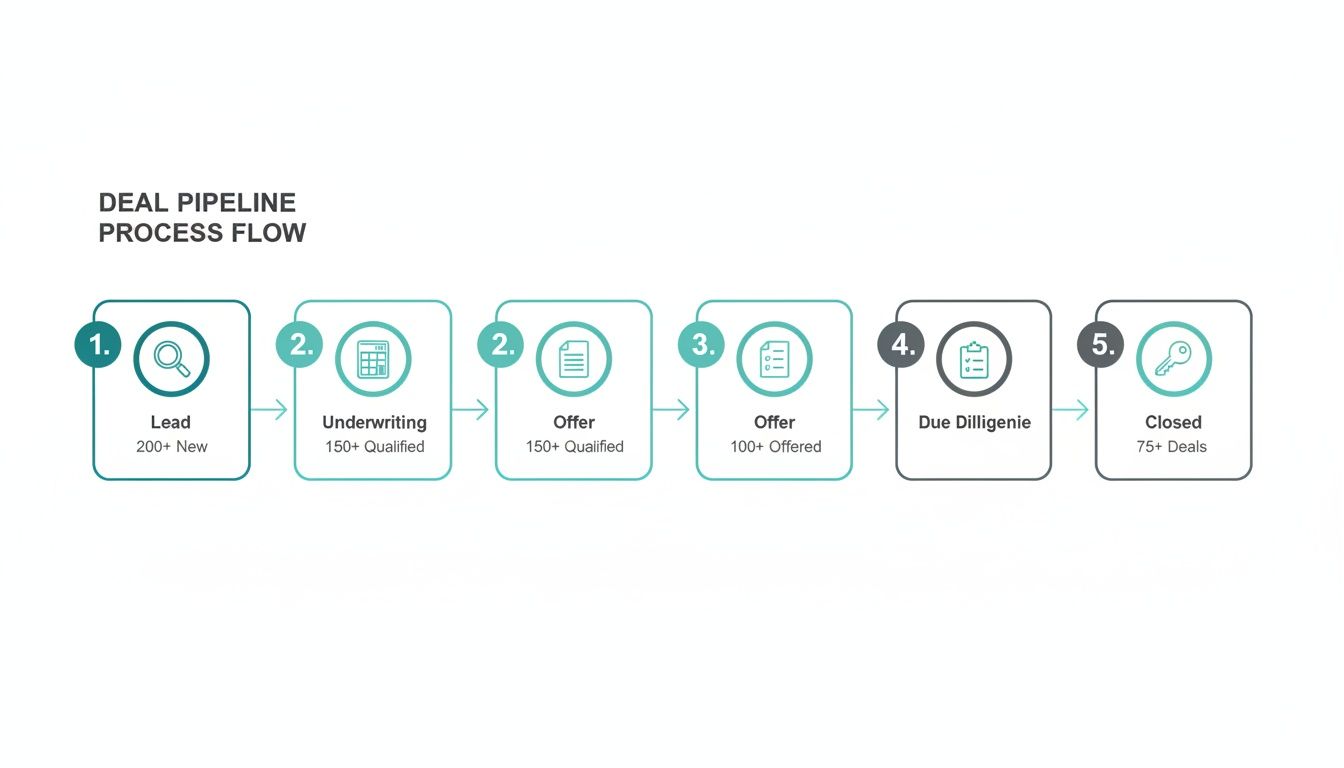
It’s a systematic approach that lets you spend your time on what counts: deep analysis and negotiation, not endless searching.
A Central Hub for Serious Investors
These platforms aren't just about deal flow; they're about creating a more efficient ecosystem. Direct messaging features cut out endless email chains, so you can get questions answered and submit offers in a fraction of the time.
Ultimately, it helps you build a network of credible, reliable partners. When you find good people to work with, repeat business follows, creating a more stable deal flow for everybody.
The market is not waiting around. In 2025, global real estate direct investment volumes shot up by 19% from 2024, and cross-border investments jumped 25% year-over-year. Here in the U.S., the living sector saw a 24% rise in transactions, with forecasts predicting total investments will blow past US$250 billion by 2026.
This data, which you can dig into deeper with JLL's global investment trends report, makes one thing clear: you need tools that let you vet deals quickly. In a hot market, being able to analyze matching listings on a platform built for serious buyers is a necessity.
Got Questions About Finding Deals?
Every investor, from beginner to pro, runs into the same roadblocks. Let's tackle some of the most common questions about sourcing good properties.
I'm Just Starting Out. Where Should I Even Be Looking?
If you're new to the game, your first job isn't to find the perfect deal—it's to get your reps in by analyzing many properties to build muscle memory.
The Multiple Listing Service (MLS) is the perfect place to start. While competitive, it provides a high volume of deals with transparent data. Spending time on the MLS will force you to master your local market, understand pricing, and clarify your buy box.
Once you have that foundation, start connecting with local wholesalers. The best place to find them is your local Real Estate Investor Association (REIA) meeting. Show up, network, and learn who the real players are. This is your gateway to off-market deals without having to fund your own marketing campaigns.
This Market Is Crazy Competitive. How Do I Actually Win a Deal?
In a hot market, two things matter more than anything: speed and certainty. Wholesalers and motivated sellers want to work with someone who is decisive, professional, and can actually close.
Your reputation as a serious operator is your single greatest asset. Build it by analyzing deals in minutes, making clean offers, and closing without drama. The more you prove you can perform, the more "first look" opportunities will come your way.
This is where having a system beats winging it every time. Using a platform that centralizes your deal flow and analysis lets you move at a professional pace. When you can underwrite a property in minutes, you're already miles ahead of the competition.
What's the Real Difference Between On-Market and Off-Market Deals?
It all boils down to one word: competition.
On-market deals, like those on the MLS, are public. You’re competing against everyone. That exposure almost always pushes prices up to full market value.
Off-market deals are the opposite. They aren't publicly listed. You find them through your own direct outreach, your network, or on specialized marketplaces. Because you're dealing with a much smaller pool of buyers, you have a real shot at negotiating better terms and buying a property below its true market value. That’s how you create instant equity from day one.
Ready to stop hunting for deals and start building a real pipeline? On an investor marketplace, you can set your Smart Buy Box and get a curated feed of properties that match your exact criteria.
Create your free investor profile to get matched with deals that fit your strategy.