Finding a good foreclosure deal requires knowing where to look and when to act. This guide will give you a step-by-step framework for sourcing, analyzing, and closing on distressed properties, whether you're a new investor or a seasoned pro. Opportunities exist at three distinct stages: pre-foreclosure, the public auction, or as a bank-owned (REO) property.
Each stage offers a different balance of risk, competition, and potential reward. Mastering how to navigate them is the key to building a profitable portfolio of foreclosure properties.
Understanding the Modern Foreclosure Market
The playbook for finding distressed properties has changed. After pandemic-era protections created historically low foreclosure rates, the market has shifted back toward normal. For investors, this means a more consistent and predictable flow of opportunities is returning. Understanding this new environment is the first step to building a winning sourcing strategy.
The Return of Foreclosure Activity
After the record-low foreclosure rates of 2020 and 2021, the market saw a notable uptick. During the peak of homeowner protections, U.S. foreclosure rates fell to a tiny 0.11 percent. But with those programs expired, the numbers have been steadily normalizing.
By early 2024, filings were up significantly year-over-year. This isn't a crash—it's a market correction. It signals that a larger volume of distressed inventory is hitting the market, creating more deal flow for savvy investors. You can dig into the latest foreclosure trends on Statista.com.
If you're new, the increasing number of foreclosures means more chances to find your first deal. A practical approach is to focus on REO properties—they offer a more straightforward path with fewer legal headaches than other stages.
If you’re experienced, this rising volume is a cue to specialize. Now is the perfect time to dial in your sourcing systems to target specific stages or property types within this growing inventory, like pre-foreclosures in a particular submarket.
The Three Stages of Foreclosure
Every foreclosure follows a clear path, and each stop along the way presents a different kind of investment opportunity. Knowing how to operate in each phase is what separates successful investors from those who struggle.
This diagram shows the journey a property takes from the first notice of default to eventually becoming a bank-owned asset.
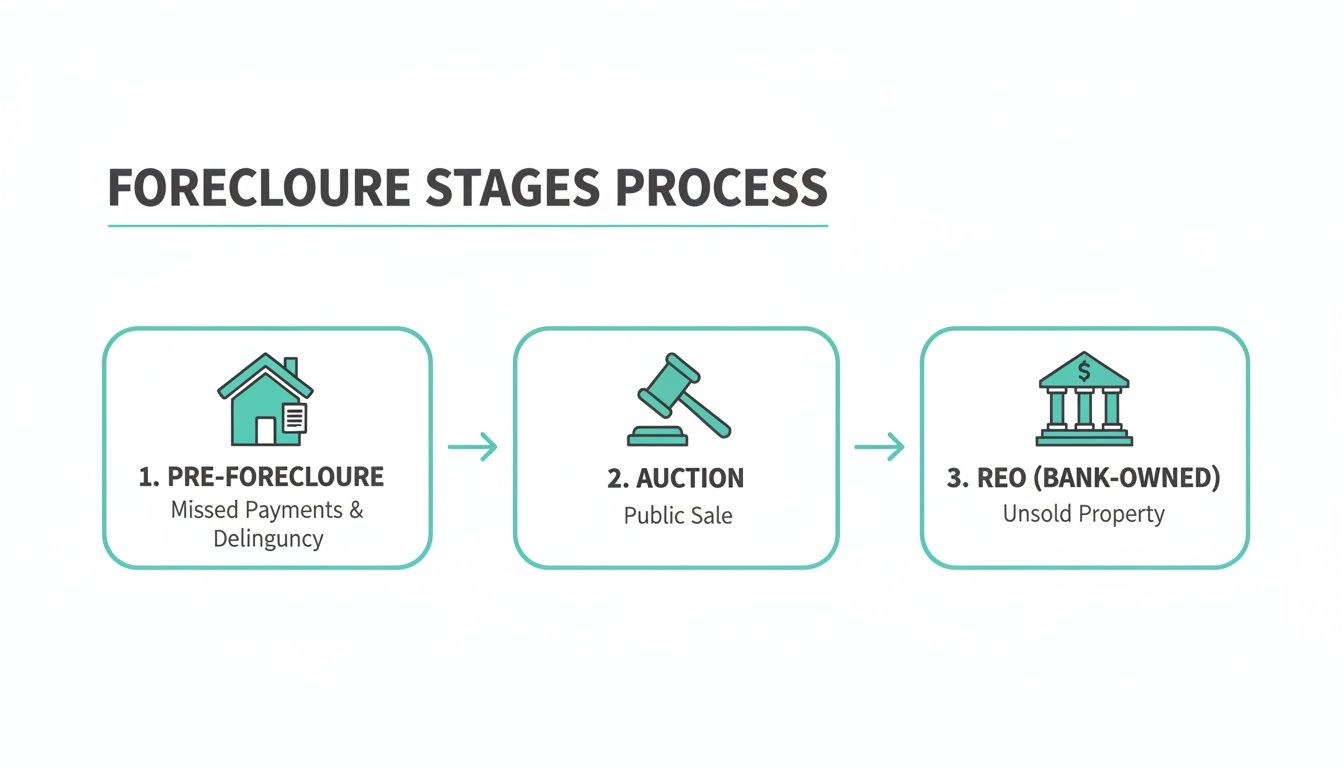
As you can see, you can enter the process at multiple points. The key is to understand that the risk and potential reward shift dramatically with each step.
To make it even clearer, let's break down what each stage means for you as an investor. This table outlines the core characteristics of each phase, the nature of the opportunity, and the primary risk involved.
Foreclosure Stages and Investor Opportunities
| Stage | Description | Investor Opportunity | Primary Risk |
|---|---|---|---|
| Pre-Foreclosure | The owner has received a default notice but the home hasn't been auctioned yet. | Connect directly with a motivated seller to negotiate a deal below market value, often helping them avoid foreclosure. | Requires strong negotiation skills, empathy, and navigating complex emotional and financial situations. |
| Foreclosure Auction | The property is sold to the highest bidder at a public auction, often held at the local courthouse. | Potential to acquire properties at a significant discount if competition is low. | High-risk. You often buy sight-unseen, with no inspections, and must pay in cash almost immediately. |
| REO (Bank-Owned) | The lender takes ownership after the property fails to sell at auction and lists it on the market. | A safer transaction. You can often get financing, perform inspections, and receive a clear title with title insurance. | The discount is usually smaller as the bank wants to recoup its losses. You're competing with traditional homebuyers. |
Each of these stages attracts a different type of investor for a reason. Pre-foreclosures are where you can find deep discounts and create true win-win situations, but they demand hustle and strong soft skills.
The foreclosure auction is the high-stakes poker game of real estate. You can score big, but you can also lose your shirt if you don't know exactly what you're doing. It's fast, intense, and unforgiving.
Finally, REO properties are the most "normal" of the bunch. The bank clears up any liens, and you can buy the home much like a traditional property. While the deals might not be as jaw-dropping, the reduced risk and ability to use financing make REOs a fantastic and reliable entry point for building a rental portfolio.
How to Source Foreclosure Deals Before Your Competition
The secret to landing the best foreclosure deals isn't some magic formula; it's getting there before everyone else. While many investors wait for a property to appear on the MLS, the pros dig through a mix of old-school and new-school channels to find opportunities first. The real key is building a repeatable system that brings you leads from multiple sources.
For many, that journey starts with public records. Monitoring Lis Pendens filings (the first public notice of a foreclosure action) at your local county clerk's office is a direct way to find homeowners just entering pre-foreclosure. This gives you a chance to reach out before the situation gets crowded, but it's a delicate process that requires empathy.
Traditional Sourcing Channels
These time-tested methods still work, but they demand patience, legwork, and a willingness to build real relationships.
- Courthouse Auctions: This is the ultimate high-risk, high-reward arena. You'll need to find the auction schedule, usually posted online by the county sheriff or a trustee. The real work is pre-auction due diligence, which often means only a drive-by inspection and title research, since you typically can't get inside.
- Direct-to-Bank (REO Departments): When a house doesn't sell at auction, it becomes Real Estate Owned (REO). By building relationships with REO asset managers at local and regional banks, you might get a first look at these properties before they’re handed to an agent. This is a long-term networking play.
- Attorneys and Trustees: The law firms and trustees who manage foreclosure cases are a goldmine of information. Networking with them can provide a heads-up on upcoming auctions and properties about to hit the market.
If you're new, jumping straight into courthouse auctions or trying to network with bank managers can be overwhelming. A more manageable starting point is to focus on REO properties already on the MLS or to work with wholesalers. These routes provide more time for inspections and traditional financing.
Modern and Efficient Sourcing Strategies
Technology has opened up powerful new avenues for finding foreclosure deals, letting you source and analyze properties with greater speed and accuracy.
Online Auction Sites Platforms like Auction.com and Hubzu have moved the courthouse steps online, aggregating hundreds of foreclosure and REO properties into one searchable database. They offer more transparency, often with photos, property details, and sometimes even title reports. The trade-off? They attract a huge audience, so competition can be intense.
Wholesalers and Investor Marketplaces This is where the game really changes for sourcing deals efficiently. Real estate wholesalers are specialists who find distressed properties—including pre-foreclosures—and get them under contract. They then sell that contract to another investor for a fee.
Finding a solid, reliable wholesaler can be a grind. The best ones operate on specialized investor marketplaces and networking platforms. On our platform, for example, you can check a wholesaler’s deal history and see what other investors have said about working with them. This adds a layer of credibility and trust you won't find on social media or in a random email blast.
This approach is a game-changer for both new and seasoned investors:
- For Beginners: You get access to pre-vetted deals without having to spend the time and money on direct marketing to distressed homeowners yourself.
- For Experienced Investors: You can scale your deal flow without scaling your marketing budget. It lets you spend your time analyzing good deals instead of just finding them.
By combining these methods, you create a powerful system for finding off-market properties before the competition knows they exist. By setting up a buy-box on an investor marketplace, you can get automatic alerts the moment a wholesale or REO deal that fits your exact criteria—like a 3-bed, 2-bath single-family rental in a specific zip code—gets posted. This flips sourcing from a manual chore into an automated, competitive edge.
Identifying High-Opportunity Foreclosure Markets
To consistently find good foreclosure deals, you have to think like a prospector—go where the gold is. Not all markets are created equal. Some parts of the country have a higher concentration of distressed properties, giving you more chances to find a deal that fits your strategy.
Swapping out random property searches for a data-driven approach is what separates amateurs from pros. It turns your search from a frustrating guessing game into a targeted, efficient operation.
Following the Data to Find Deals
Recent market data makes it clear that foreclosure rates swing wildly from one region to another. Some states are chronic hotbeds for distressed properties. Digging into this information is the first step to building a geographic focus that actually works.
For example, in one recent month, Delaware had one of the highest foreclosure rates in the nation, followed by states like Nevada and Florida.
But these trends shift. A few quarters earlier, New Jersey led the pack, followed by Delaware and South Carolina. These trends tell a story about where opportunities are bubbling up.

This data is crucial, but don’t forget about the raw numbers. In one recent month, Texas saw over 3,000 foreclosure starts, with Florida close behind at nearly 2,800. These aren't just statistics; they represent a massive pipeline of potential deals for investors who are ready to act.
From Macro Trends to Micro Opportunities
Drilling down from the state level to specific cities is where you find actionable intelligence. Major metros often become hotspots for REO properties, which are generally a safer bet if you're just getting started.
For example, recent data showed Chicago led major metros in REO properties, with Philadelphia and Houston also showing high volumes. Knowing this lets you stop casting a wide, useless net and start focusing on specific neighborhoods where the deals are.
This is where you move from theory to execution. An investor targeting Houston could zero in on zip codes with a high concentration of REOs and then cross-reference that information with local job growth and rental demand. This is how you find not just a cheap house, but a profitable investment. If you’re new to running these numbers, a good starting point is our guide on how to calculate cap rate.
Activating Your Strategy With a Buy-Box
Manually tracking data from dozens of markets is inefficient and a surefire way to burn out. The smartest way to use this information is by plugging it directly into your deal-sourcing workflow on an investor marketplace.
You do this by setting up your "buy-box." Think of it as your personal, automated deal scout that works 24/7 to find properties matching your exact criteria.
Here’s how this turns market data into actual opportunities:
- Geographic Targeting: You can tell your buy-box to only show you deals in high-foreclosure states like Florida or Texas. You can even get as granular as specific counties or zip codes in cities like Philadelphia or Houston.
- Property Type Focus: Filter out the noise. Specify that you only want to see single-family REOs, distressed duplexes, or pre-foreclosure wholesale deals.
- Financial Criteria: Layer in your numbers. Set rules for your maximum purchase price, minimum After Repair Value (ARV), or a target cash-on-cash return.
By creating these simple rules, you automate the initial screening process. Instead of drowning in hundreds of irrelevant listings, you get an alert the second a wholesaler posts a deal or an REO hits the market inside your pre-defined "hot zones." This data-first approach ensures you’re one of the first to see the deals that matter, giving you a critical head start.
Your Due Diligence Checklist for Foreclosure Properties
A low price on a foreclosure listing is tempting, but the real risk isn't the sticker price—it's the expensive, hidden problems you don’t find until after closing. A rock-solid due diligence process is the only thing that separates a calculated investment from a costly gamble.
Getting this right means investigating three critical areas: the property's title, its physical condition, and its occupancy status.
Uncovering Hidden Title and Lien Issues
The biggest financial landmines in foreclosure investing are almost always buried in the property’s title report. Unlike a normal purchase, you could inherit a host of debts tied to the property. A professional title search is non-negotiable.
Here’s what a title search looks for:
- Junior Mortgages: A second or third mortgage that wasn't wiped out when the primary lender foreclosed.
- Tax Liens: Unpaid property taxes often take priority over all other liens, including the mortgage.
- Mechanic's Liens: Claims filed by contractors who did work on the house but were never paid.
- Judgments: Court-ordered debts from the previous owner that have been legally attached to the property.
Real-World Example: An investor buys a house at auction for a great price, assuming the foreclosure wiped the slate clean. They later discover a $30,000 IRS tax lien that survived the sale. That "great deal" instantly became a money pit, because that lien was now their problem to solve.
For REO properties, always budget for and insist on getting title insurance. If you're bidding at an auction, you’ll need to order a preliminary title report yourself before you even consider bidding.
Assessing the Physical Property Condition
One of the trickiest parts of finding homes in foreclosure is that you often can't get inside for a proper inspection, especially with auction properties. This is where you have to become a detective.
If you can't get inside, you must get creative and assess the condition from the outside.
- Do a Thorough Drive-By: Don't just glance. Get out of the car and take photos from every angle. Look for obvious signs of neglect like a sagging roof, peeling paint, an overgrown yard, or broken windows. Binoculars are your best friend here.
- Check Public Records for Permits: Head to the local building department's website. Pulled permits can tell you about past renovations, major repairs, or when the roof was last replaced. A lack of permits for visible work is a massive red flag.
- Talk to the Neighbors: This is an underrated tactic. Neighbors can give you the real story—how long the house has been vacant, whether it was cared for, and other priceless information.
For beginners: Stick to REO properties. The ability to get an inspection contingency is a safety net you can't afford to skip. Buying a property sight-unseen is an advanced (and risky) strategy. For experienced investors: When buying at auction, you must build a "worst-case scenario" repair budget into your maximum bid. Assume the interior is completely trashed, and be pleasantly surprised if it's not.
Verifying Occupancy Status
The final piece of your due diligence is figuring out who, if anyone, is still in the house. A property occupied by the former owner or tenants adds a legal and logistical layer to the deal. You can't just change the locks.
You must understand the local laws for removing occupants, which vary wildly by state and even city.
- Tenants with a Lease: If there are tenants with a valid lease, you may be legally required to honor it until it expires. Federal laws like the Protecting Tenants at Foreclosure Act (PTFA) provide specific rights.
- Former Owners: If the previous homeowners are still living there, you must follow the formal eviction process if they refuse to leave voluntarily.
A common and often effective strategy is a "cash for keys" agreement. This is where you offer the occupant cash to move out by a certain date and leave the property in decent condition. It's often much faster and cheaper than a formal eviction but requires careful negotiation and a solid written agreement.
How to Finance and Close Your Foreclosure Deal
Financing a distressed property isn't like getting a mortgage for a primary residence. It’s a completely different sport where the rules are about speed and flexibility—two things traditional lenders are not known for.
Here’s the single most important piece of advice: get your funding lined up before you start looking for deals. Waiting until you find the perfect property is a rookie mistake. The best opportunities are gone in days, not weeks. Being able to confidently tell a seller, "I can close in 10 days," is your single greatest advantage.
Common Funding Strategies for Foreclosures
Seasoned investors have a specialized toolkit for financing these deals. The right choice depends on the property, your financial situation, and how quickly you need to move.
- Cash: At a courthouse auction, cash isn't just king—it's often the only currency accepted. It gives you unmatched speed and certainty, making your offer nearly impossible to beat. The only real downside is that it ties up a massive amount of capital, which can limit how many deals you can pursue at once.
- Hard Money Loans: This is the workhorse for investors who need to close fast without draining their bank accounts. Hard money lenders focus on the property's potential value (specifically the After Repair Value or ARV) more than your personal income. They can fund a deal in as little as 7-14 days. The trade-off is the cost: expect interest rates between 10-15% and 2-5 points upfront (one point is 1% of the loan amount).
- Private Money Loans: This is where you borrow from individuals—other investors, friends, or family. The terms can be incredibly flexible. If you have a solid relationship, you might negotiate lower rates or more creative repayment structures.
Building a track record is everything when it comes to raising private money. A well-organized profile on an investor networking platform can add serious credibility. When you can show potential lenders your deal history, defined buy-box, and professional approach on our marketplace, it transforms you from a stranger asking for money into a serious operator with a plan.
When Conventional Financing Works
While traditional loans are usually too slow for the initial purchase of a distressed property, they have a place, especially with bank-owned (REO) properties that are in reasonably good shape.
- Conventional Mortgages: If you find an REO that’s already habitable and can pass a standard appraisal, a conventional loan might be an option. Just be prepared for a 30-45 day closing process, which can put you at a disadvantage against faster offers.
- Renovation Loans (like FHA 203k): These are great for fixer-upper REOs you plan to hold as a long-term rental or live in yourself. They roll the purchase price and repair costs into one loan. The downside is they come with significant paperwork and lender oversight, making them a poor fit for a fast-paced flip.
The financing landscape is complicated. To go deeper, check out our complete guide on real estate financing options for investors. Ultimately, your financing needs to match your investment strategy. The crucial first step is to start talking to lenders now so you're ready to pull the trigger the moment a great foreclosure deal appears.
Common Questions About Foreclosure Investing
Diving into foreclosures brings up a ton of questions, and for good reason. The process is different from a typical home purchase—it’s a world with its own jargon, risks, and incredible opportunities. Let's get straight answers to the questions we hear all the time.
Can a Beginner Really Buy a House at Auction?
Short answer: Yes, but it's not recommended. Going straight to the courthouse steps is like jumping into the deep end of the pool before you've learned to swim. These auctions are fast and almost always demand you pay in full cash—usually with a cashier's check—immediately after winning. You're buying the property “as-is,” which often means sight-unseen with no chance for an inspection.
The biggest risk is inheriting hidden problems like tax liens or a second mortgage. The moment the gavel falls, those problems become yours.
Our advice for beginners: Don't start here. You’re far better off focusing on REO (bank-owned) properties or finding a wholesale deal through a trusted investor marketplace like ours. Those routes give you time to do inspections, get title insurance, and line up financing.
What Is the Difference Between a Short Sale and a Foreclosure?
While both arise from homeowner distress, they are two completely different processes.
A short sale happens before the bank forecloses. The lender agrees to let the owner sell the property for less than what is owed on the mortgage. As an investor, you negotiate with both the homeowner and their bank. This process is notoriously slow, as bank approval can take months.
A foreclosure is the legal process where the lender takes back the property. It is then sold at a public auction. If it doesn't sell, the bank takes ownership, and it becomes an REO. In a foreclosure, you’re dealing with the court system (at auction) or the bank's asset manager (for an REO)—the original homeowner is out of the picture.
How Can an Investor Platform Help Me Find Foreclosures?
An investor marketplace like Investor Deal Exchange is built to take the grunt work out of finding these deals. Instead of spending hours digging through county records, it streamlines the whole process:
- Automated Sourcing: You set up your "buy-box" with your exact criteria—location, property type, price point. The platform then automatically alerts you to distressed properties, REOs, and wholesale deals that match. Good opportunities come straight to your dashboard.
- Access to Wholesalers: Many professional wholesalers who are experts at finding pre-foreclosure deals list their properties on our platform. This gives you access to off-market inventory you’d never find on the MLS. You can even check a wholesaler's deal history and reviews, which adds a crucial layer of trust.
- Faster Analysis: The best platforms have built-in analysis tools. You can quickly run the numbers on a potential deal, calculating key metrics like ROI and cash-on-cash return right from the listing page, enabling fast, data-driven decisions.
What Is the Right of Redemption and How Does It Affect Me?
This is a critical legal concept that can be a costly mistake to ignore. The Right of Redemption is a law in some states that gives the original homeowner a set amount of time after the foreclosure sale to buy back their property. To do this, they must pay the full price you paid at auction, plus any other costs like interest and taxes.
Not every state has this. But in the ones that do (like Alabama or Texas), the redemption period can be anywhere from a few months to a whole year.
This is a massive risk to factor in. If the former owner exercises their right, you lose the house. You'll get your money back, but you've wasted your time and lost any potential profit. Before you buy at auction, always talk to a local real estate attorney to find out if a statutory Right of Redemption exists in your market and how it could impact your deal.
Ready to stop wasting time and start finding foreclosure deals that fit your strategy? Create your free investor profile to get matched with deals that fit your criteria.