
If you want to succeed in real estate, finding cash buyers isn't a one-time task—it's a core business system. The most successful investors build a vetted list of reliable buyers before they even have a deal. This guide will show you exactly how to build that list, giving you the speed, certainty, and confidence to close more deals.
Why a Vetted Cash Buyer List Is Your Single Biggest Asset
In real estate, a cash offer is powerful. For sellers, it means no financing contingencies, no painful lender approvals, and a much lower risk of the deal falling apart. That certainty is what makes your offer stand out.
For you, the investor, a strong buyers list translates directly into a more stable, scalable business.
- For Wholesalers: Your cash buyers list is your business. A strong list means you can assign contracts quickly, building a reputation as a go-to source for deals. You can lock up a property with confidence because you already have buyers ready.
- For Flippers: A solid list of cash buyers is your safety net. It dramatically cuts down your holding costs and market risk by ensuring you can sell your finished project fast, either to another investor or an end-user with cash.
This is why building your network is so critical. When you know who is buying and what they’re looking for, you can focus on sourcing valuable off-market properties that fit their specific criteria.
Cash Is King, and Its Influence Is Growing
The power of cash isn't just a saying; it’s a major market trend. Recent data shows a significant spike in cash transactions, highlighting the influence these buyers have. In early 2025, cash deals accounted for 32% of U.S. home sales—the highest level since 2014.
This surge was powered by a $56 billion wave of foreign capital, with a 33.2% year-over-year jump in purchases from foreign buyers. A staggering 47% of those deals were all-cash.
The data below breaks down where the cash is coming from.
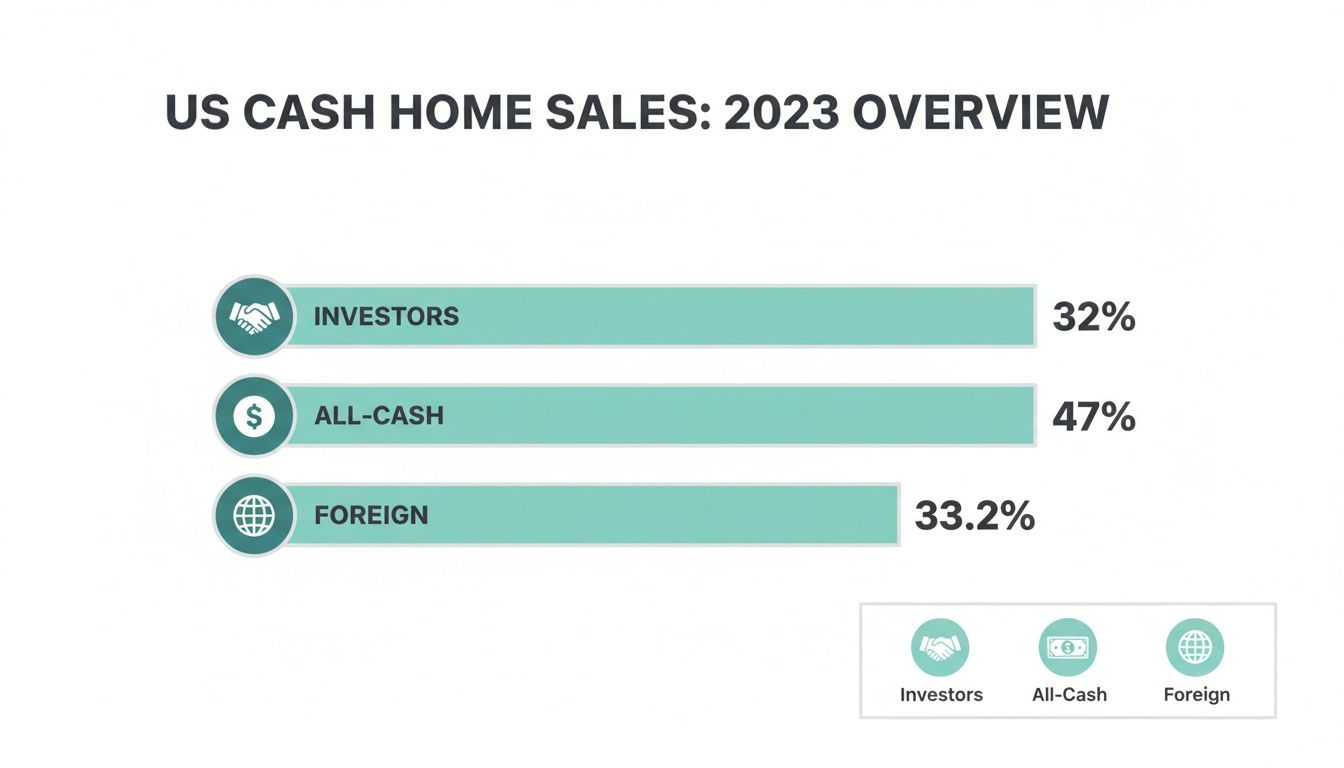
This chart makes it clear: investors are a major force in the market. If you're not connected to this group, you're missing a massive opportunity.
Cash Buyer Prospecting Channels at a Glance
Finding the right cash buyers means knowing where to look. Some channels are quick but yield lower-quality leads, while others take more work but connect you with serious players. Here’s a quick breakdown to help you focus your energy.
| Channel | Effort Level | Typical Buyer Quality | Best For |
|---|---|---|---|
| Public Records | High | High | Finding hyper-local, active investors. |
| Investor Networks | Medium | Medium-High | Building relationships and finding repeat buyers. |
| Filtered Marketplaces | Low | Very High | Quickly finding pre-vetted, ready-to-buy investors. |
| Real Estate Auctions | Medium | High | Identifying serious buyers with proven funds. |
| Social Media/Forums | Low-Medium | Low-Medium | Casting a wide net and finding emerging buyers. |
| Brokers & Agents | Medium | Medium | Tapping into established networks for vetted contacts. |
Many investors find that a blended approach works best. Use low-effort channels to build volume and high-effort channels to cultivate a handful of "A-list" buyers you can count on.
Understanding the Different Types of Cash Buyers
Not all cash buyers are the same. They have different goals and buying criteria. Knowing who you're talking to helps you frame your deals in a way that resonates. Your goal isn't just to find any cash buyer; it's to find the right cash buyer for your specific deal.
Your buyers list should include a mix of these key players:
- Individual Flippers: These local pros hunt for distressed properties they can rehab and sell for a profit, a strategy often called "fix-and-flip." For them, it’s all about the After Repair Value (ARV) and a clear path to adding value.
- Buy-and-Hold Investors: These investors buy properties to rent for long-term cash flow. They focus on metrics like cash-on-cash return, capitalization rate (cap rate), and net operating income (NOI).
- Institutional Funds: These are large-scale operators like iBuyers and private equity funds buying hundreds of homes a year. They operate with rigid, data-driven "buy boxes" and care about scale and efficiency.
When you build relationships with each of these buyer types, your business becomes more resilient.
Digital Strategies to Find Active Cash Buyers Online
The most efficient way to find cash buyers is to meet them where they already are: online. This isn't about spraying your deal across the internet and hoping for a response. It's about using targeted strategies to connect with proven investors who have capital ready to deploy. Think of it as fishing in a well-stocked pond instead of casting a net in the open ocean.
Go Where the Buyers Are: Investor Marketplaces
The fastest way to find vetted buyers is by using a platform where they’ve already raised their hands and said, "I'm looking for deals." This flips the old prospecting model upside down. Instead of you chasing them, you post your deal, and the right buyers come to you.
On our marketplace, for example, buyers create detailed profiles that function as a “Smart Buy Box.” This is a digital profile where an investor specifies exactly what they're looking for:
- Property Type: Single-family rentals, multifamily buildings, or raw land.
- Geographic Area: Specific cities, zip codes, or entire counties.
- Deal Size: Target price range and ideal square footage.
- Financial Metrics: The numbers that matter, like a target cap rate, cash-on-cash return, or desired After Repair Value (ARV).
When you list a property, the platform’s technology does the heavy lifting, instantly matching your deal to investors whose buy boxes are a perfect fit. You go from manual outreach to automated, targeted matchmaking.
Find Gold in Your Social Media Feeds
Social media can be a valuable source of leads if you have a plan. Stop scrolling and start searching with intent.
- Facebook Groups: Join local and national real estate investing groups. Use the search bar for terms like "cash buyer," "adding to my portfolio," or "send me deals." The real value is in the comments. Pay attention to who consistently asks smart, specific questions—those are often active players.
- LinkedIn: This is where you'll find more established investors and industry professionals. Position yourself as an authority by sharing analysis of a recent deal or insights on local market trends. Engage with posts from hard money lenders, real estate attorneys, and large portfolio managers to tap into their networks.
Pro Tip: Always lead with value. A thoughtful comment on another investor's post will get you much further than a cold message that just says, "Are you a cash buyer?"
Watch Online Auctions Like a Hawk
Online property auction sites are a treasure trove of information. These platforms don't just list properties; they show you who is actively bidding on and winning deals with cash in your target market. Pay close attention to the auction results.
You can see the names of the individuals and LLCs who are buying properties repeatedly. This is smart market research. Note the winning bidders on properties similar to the ones you wholesale or flip. A public records search can often uncover contact information for these entities, giving you a pre-qualified list of proven closers.
The fact that they're winning auctions proves they have both the funds and the motivation. And these buyers are a huge force in the market. In the first half of 2025, a staggering 32.8% of all U.S. home sales were all-cash transactions. You can see more data on how cash buyers are impacting the market over at Fortune.com.
Building Your Local Network with Offline Methods
While digital tools are fast, real estate remains a relationship-driven business. The most consistent and profitable deals often come from people you know on the ground. These are the relationships that feed you opportunities when online funnels run dry. This is about building a small, powerful network where key people become your eyes and ears, sending deals your way because they know, like, and trust you.
Mine Public Records for Proven Buyers
To find people with cash who are actively buying, go straight to the source: public records. They offer undeniable proof of who is closing deals in your target neighborhoods.
Every time a property sells, the transaction is recorded with the county. You’re looking for a specific footprint: a recent sale with no mortgage attached. This indicates the buyer likely paid cash. The buyer is often an LLC (Limited Liability Company), which is a strong sign of a serious investor.
Key Clues to Hunt for in Public Records:
- Buyer Name: An LLC usually means they're a professional investor.
- Property Type: Are they buying single-family homes, duplexes, or small multifamily? This reveals their buy box.
- Transaction Date: Look for sales in the last 6-12 months to find currently active buyers.
- Absence of a Mortgage: No mortgage deed recorded with the property deed is the classic signal of an all-cash transaction.
Once you have an LLC name, a quick search on your state’s Secretary of State website will often pull up the registered agent or owners, giving you a name to contact.
Network Effectively at REIA Meetings
Real Estate Investor Association (REIA) meetings are the central gathering place for local investors. However, simply showing up isn't enough; you need a game plan. Avoid being the person who walks in and announces, "I'm looking for cash buyers!" Your real goal is to build genuine connections and be seen as a peer who solves problems.
Lead with value, not with what you need. Ask people about their business and what they're seeing in the market. A great opener is, "What's the most interesting deal you've worked on this quarter?" This gets them talking about their strategy. Your job is to listen more than you speak.
For a deeper dive, check out our guide on how to build a powerful real estate investor network.
Form Alliances with Investor-Friendly Professionals
Some of your best buyer leads will come from the professionals who serve them every day. Think of these people as gatekeepers to a curated list of cash-heavy clients.
Your Professional Alliance Hit List:
- Investor-Friendly Real Estate Agents: These agents specialize in working with investors and often have a "pocket list" of buyers waiting for a deal.
- Title Company Representatives: Escrow and title officers see every closing. They know who pays cash and how often they do it.
- Property Managers: They manage rental portfolios and know which of their buy-and-hold clients are looking to acquire more properties.
When you approach these professionals, show them how you can make their job easier. Tell an agent, "I find off-market distressed properties that are perfect for your flipper clients." This changes the conversation from a one-sided ask to a mutually beneficial partnership.
How to Qualify Buyers and Avoid Tire Kickers

Finding a potential buyer is easy. The real work is qualifying them to ensure they are serious and capable. Wasting time on "tire kickers" who can’t actually close drains your momentum and hurts your credibility. A solid qualification process is essential to protect your time and build a list of buyers you can count on.
The First Vetting Call
Your first conversation with a potential buyer should be designed to quickly determine if they are a serious investor. Get them talking about their business with a few open-ended questions.
- "What are your exact buying criteria right now?" A real buyer will give specifics like 3/2s under $200k in the 75206 zip code, not "I'll look at anything."
- "What does an ideal deal look like for you?" This reveals their strategy—whether they are a flipper focused on ARV or a landlord seeking cash flow.
- "How many cash deals have you closed in the last 12 months?" This separates the talkers from the doers.
A seasoned buyer will have immediate, precise answers. Vagueness is a major red flag.
The Litmus Test: Proof of Funds
After a good initial call, it’s time to ask for a Proof of Funds (POF). This is the single most effective way to filter out pretenders. Professional investors expect this question and will have a POF ready.
A simple way to phrase the request is: "Great, it sounds like we could do some business together. My process includes verifying funds for all buyers so I can move quickly and confidently for my sellers. Can you send over a recent POF?"
Any hesitation should be treated as a deal-breaker. A legitimate POF is typically one of these:
- A recent bank statement: It must show a liquid cash balance sufficient for a purchase.
- A letter from a financial institution: A formal letter on bank letterhead confirming the buyer's name and available funds.
- A hard money lender's approval letter: Many "cash" buyers use hard money. A pre-approval from their lender is also valid. For more on this, see our guide to real estate financing options.
Creating Your Tiered Buyers List
Once you’ve vetted your buyers, organize them into tiers. This allows you to be strategic, ensuring your best deals go to your best buyers first.
- Tier 1 (A-List): Proven closers you've already done deals with. They are decisive, communicate well, and perform without drama. They get your first call.
- Tier 2: Verified buyers you haven't worked with yet. They've provided a solid POF and have clear buying criteria, showing they have the intent and ability to close.
- Tier 3: Everyone else. This includes new contacts, investors with less experience, or buyers who are slow to respond. They see deals only after your top tiers have passed.
This tiered system is the engine of an efficient disposition process. It helps you find cash buyers in real estate you can truly rely on.
Using Technology to Manage and Nurture Your Buyers
Finding potential investors is one thing; organizing, managing, and communicating with them is where the real money is made. Your system—or lack thereof—determines how efficiently you can move a deal.
While a simple spreadsheet works when you're starting out, it becomes overwhelming as you scale. This is when technology, specifically an investor marketplace, becomes a necessity. It automates tedious tasks so you can focus on what matters: connecting the right deal with the right person.
From Manual Spreadsheets to Smart Systems
For your first handful of buyers, a spreadsheet is a great tool. Be sure to track the right information to make it effective.
Essential Spreadsheet Fields:
- Buyer Name & Contact Info: Name, LLC, phone, and email.
- Buying Criteria: Be specific: property types (SFH, multifamily), zip codes, price range, and target metrics (cap rate, cash-on-cash return).
- POF Status: A simple "Verified" or "Not Verified" column.
- Last Contact Date: This helps you keep relationships warm.
- Notes: Document key details from conversations, like "prefers cosmetic flips only" or "hates dealing with HOAs."
This setup is effective initially, but once your list grows beyond 20-30 serious buyers, a manual approach breaks down.
The Power of Automated Matching with a Buy Box
For any investor serious about scaling, a platform with a “Smart Buy Box” feature is the next logical step. Instead of you digging through notes, the technology does it for you in seconds.
On our marketplace, investors build a detailed profile of their exact buying criteria. When you upload a property, the platform’s algorithm acts as your virtual assistant, instantly notifying only the investors whose criteria match your deal.
This is how you build a responsive buyers list. You stop being the person who spams every deal to everyone and become the trusted source who only sends relevant, pre-vetted opportunities. It prevents list burnout and keeps your best buyers engaged.
This method transforms your process from high-effort, low-accuracy outreach to a low-effort, high-precision system of automated matchmaking.
Simple Templates for Effective Communication
Whether you're using a spreadsheet or a platform, your communication needs to be professional, direct, and valuable. Here is a simple template you can adapt.
Template for Presenting a New Deal:
Subject: New Off-Market Duplex - 78704 - 8% Pro-Forma Cap
Hi [Buyer Name],
I got an off-market duplex under contract in 78704 and thought of you. It seems to align with the criteria we discussed—a 2/1 per side in solid condition, with a clear path to force appreciation by updating units and increasing rents.
- Address: 123 Main St, Austin, TX
- Price: $450,000
- ARV: $575,000
- Est. Rehab: $40,000
I’ve attached a brief with photos and my analysis. Please let me know if you’d like to schedule a walkthrough this week.
This targeted approach shows you were paying attention and builds your reputation as a credible source for deals.
Common Questions About Finding Cash Buyers
Even with a solid plan, questions will come up. Here are straightforward answers to some of the most common challenges investors face.
How Many Cash Buyers Do I Actually Need on My List?
Quality over quantity is the rule. A list of 500 unvetted names is less valuable than a list of 5-10 real, vetted closers.
Your goal should be to find 2-3 go-to buyers for each type of property you target (e.g., small single-family flips, duplex rentals). That way, you know exactly who to call when you get a deal under contract.
Most investors who consistently close deals operate with a "Tier 1" list of fewer than 20 core buyers. These are the proven performers who see every deal first.
How Do I Ask for Proof of Funds Without Being Awkward?
Asking for a Proof of Funds (POF) isn't awkward—it’s a standard business practice that shows you're a professional.
After building rapport and confirming their interest, simply say:
"Great, it sounds like we’re looking for the same things. My process is to verify funds with all potential buyers so I can present a solid offer to the seller. Can you send over a recent POF letter or a redacted bank statement?"
A serious buyer will expect the question and have their POF ready. Any pushback is a red flag.
Should I Find a Deal First or Build My Buyers List First?
The answer is almost always: build your buyers list first. This strategy is often called "reverse wholesaling," and it de-risks your entire operation.
When you start by knowing what active buyers in your market want, your marketing for motivated sellers becomes laser-focused. You are no longer pushing random deals; you become a specialist who sources in-demand properties with a buyer already in mind.
How Does an Investor Platform Speed This Up?
An investor marketplace is a powerful tool for efficiency. It automates the most time-consuming parts of building a buyers list, giving you instant access to a network of active investors.
On our platform, for example, investors define their exact buying criteria in a "Smart Buy Box." When you post a wholesale deal, the technology plays matchmaker.
- Instant Matching: The system notifies qualified buyers who are actively looking for that property type, in that area, and within that price range.
- No More Spamming: You avoid blasting your deal to an indifferent list, which keeps your opportunities fresh and your reputation intact.
- Filters Out the Noise: You connect directly with serious players who have already declared their intent to buy.
This efficiency allows you to focus on what you do best: finding great deals. It’s the modern way to find cash buyers for real estate with speed and scale.
Ready to stop chasing buyers and let them come to you? At Investor Deal Exchange, our platform connects your deals directly with vetted investors whose criteria match your property. Create your free investor profile to get matched with deals that fit your criteria, or post your wholesale deal to reach investors actively looking for this property type.