
Finding a great investment property can feel like searching for a needle in a haystack. If the regular MLS is a sprawling, public market for houses, a real estate investor marketplace is a private, members-only exchange built for serious pros. It’s an online platform that connects people selling investment properties—like wholesalers—directly with qualified buyers who are actively looking for deals, not just their next family home.
The entire point is to cut through the noise. Instead of sifting through thousands of retail listings, these platforms are designed from the ground up to focus on the numbers that matter to investors, making deal-finding and analysis faster and more efficient.
Who's Actually Using These Marketplaces?
A real estate investor marketplace is a digital meeting spot that solves the biggest headaches every active investor faces: finding good deals, analyzing them quickly, and building a reliable network. The entire system is built for speed and data, connecting a few key players who need each other to get deals done:
- Wholesalers: These are the deal-finders. They find distressed or undervalued properties, get them under contract, and then assign that contract to another investor for a profit. Their biggest challenge is finding a reliable buyer, fast.
- Fix-and-Flippers: These are the renovators. They buy properties to fix up and resell, usually within a few months. They need a steady stream of deals with enough profit margin—based on the After Repair Value (ARV)—to make the project worthwhile.
- Buy-and-Hold Investors: These are the landlords. They buy properties, often single-family homes or small multifamily buildings, to rent out for long-term cash flow and appreciation. They're hunting for properties that hit specific cash-flow and Cap Rate targets.
A Central Hub for Getting Deals Done
On a marketplace platform, these investors can connect directly. A wholesaler can post a new contract and instantly put it in front of hundreds of pre-vetted flippers and landlords whose investment criteria—their "buy box"—perfectly match that property.
This eliminates the old-school grind of cold-calling, emailing a messy buyers list, and hoping someone bites. Instead of chasing buyers, sellers can reach a pre-qualified network ready to transact.
The need for platforms like this is growing. With global private real estate values on the rise, transaction volumes in major markets have already seen a 12% year-over-year jump. This kind of growth is why specialized platforms are becoming essential. They allow serious investors to capitalize on a market that's projected to climb from $4.58 trillion to over $7 trillion by 2034. You can explore more about these trends and what they mean for the market.
A real estate investor marketplace isn't just a place to list properties. It’s a trusted network where deals actually happen. It swaps the chaos of the open market for a curated, data-rich environment built for one thing: action.
How The Marketplace Works For Buyers and Sellers
Think of a real estate investor marketplace as a highly efficient filter for the property market. It’s designed to cut through the noise of the traditional MLS, connecting the right property with the right investor at the right time. Instead of a chaotic, wide-open search, the entire process is built around specific investment goals, creating a focused environment for making deals happen.
The flow is simple but powerful: sellers list investment-grade properties, the platform analyzes them, and qualified buyers get instant notifications.
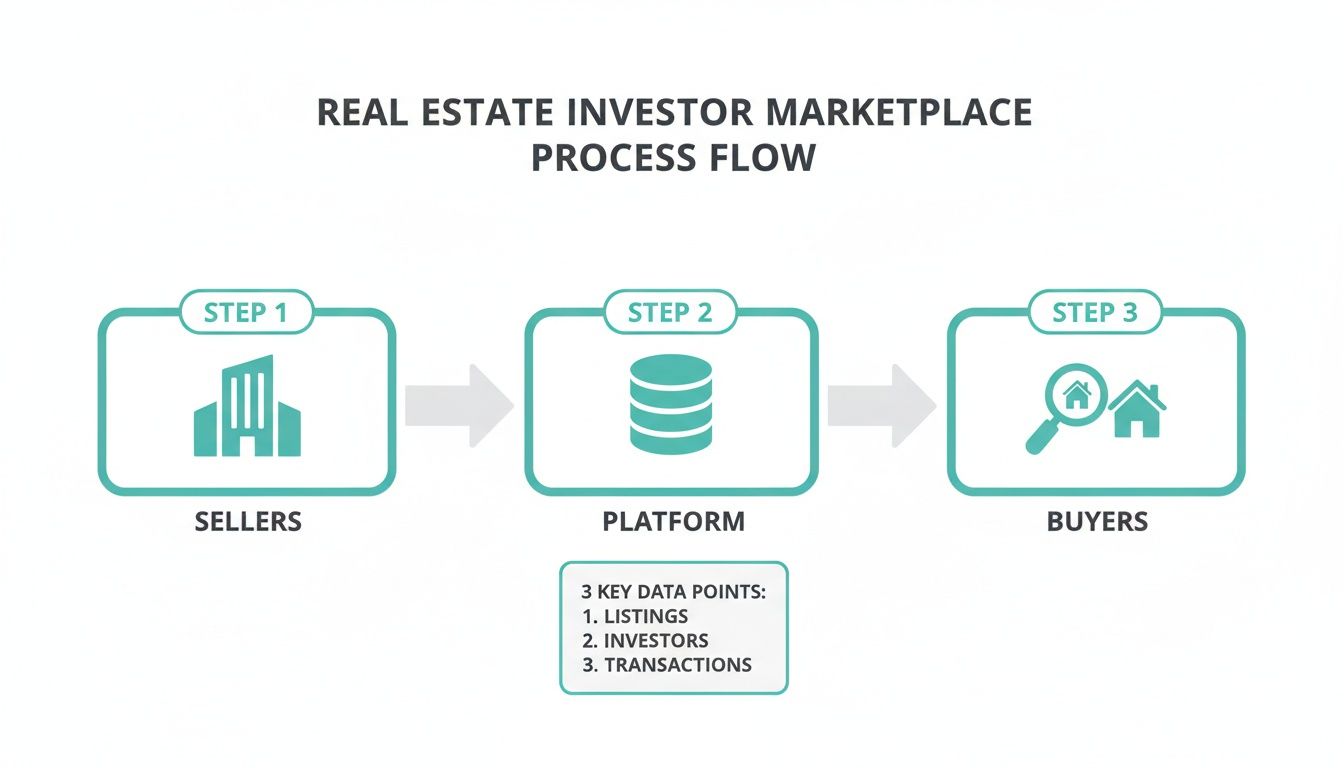
This setup means sellers get their deals in front of a targeted audience instantly, and buyers receive a curated feed of opportunities that actually fit their criteria. No more wasted time for anyone.
The Buyer Experience: From Frustrating Hunt to Automated Alert
For buyers, the platform flips the script. You go from an active, often frustrating hunt for deals to a passive, automated alert system. It all starts with setting up your "buy box"—basically, a digital profile of your perfect investment.
Instead of scrolling through thousands of listings, you tell the system exactly what you want:
- Location: Pinpoint specific cities, counties, or even a handful of zip codes.
- Property Type: Filter for single-family homes, small multifamily, land, or other asset classes.
- The Numbers: Set your target price, desired After Repair Value (ARV), minimum cash flow, or required cap rate.
- Property Specs: Narrow it down by bed/bath count, square footage, or lot size.
Once your buy box is locked in, the platform takes over. You stop searching for deals because the deals start finding you. The moment a seller lists a property that ticks all your boxes, you get an immediate alert. This puts you at the front of the line, which is a massive advantage for snagging those hard-to-find off-market properties.
The Seller Experience: From Unreliable Lists to Direct Connection
For sellers, especially wholesalers, the workflow is just as transformative. Forget spending all your time building and nurturing a huge, often unreliable buyers list. Here, you get direct access to a pre-vetted network of active investors who are ready to pull the trigger.
The process is incredibly direct:
- Upload the Deal: The seller inputs all the relevant property information, like the address, key characteristics, and access details.
- Provide the Financials: This is where you add the purchase price, estimated repair costs, and projected ARV. Good photos and a walkthrough video are crucial to painting the full picture.
- Get Instant Matches: The second the deal goes live, the platform’s algorithm cross-references it against every single buyer's buy box.
In an instant, the deal lands in front of a pre-qualified list of investors who have already said, "This is the exact type of property I am looking for." This data-driven precision is what makes these marketplaces so effective.
To really understand the shift, it helps to see the two workflows side-by-side. The traditional MLS process is a game of volume and luck, while an investor marketplace is about precision and speed.
Traditional MLS vs Investor Marketplace Workflow
| Stage | Traditional MLS Process | Investor Marketplace Process |
|---|---|---|
| Discovery | Manually sift through thousands of public listings, many of which are not suitable for investment. | Receive automated alerts for deals that match your pre-set buy box criteria. |
| Analysis | Pull data from multiple sources (comps, tax records, rental estimates) to underwrite a potential deal. | Access pre-packaged underwriting with key metrics like ARV, ROI, and repair estimates on the listing page. |
| Communication | Contact listing agents who may not understand investor needs or deal structures. Multiple back-and-forths. | Message the seller (often a wholesaler or another investor) directly on the platform to ask questions or make an offer. |
| Speed | Slow. Good deals can get snapped up by other buyers while you're still running the numbers. | Fast. You can analyze and make an offer within minutes of receiving the notification. |
| Focus | Broad and general-purpose, designed for retail homebuyers. | Niche and investor-focused, designed for flips, rentals, and other investment strategies. |
The difference is clear. One path is a slow, manual grind. The other is a direct line to the opportunities you actually want. This is why on our platform alone, over 500 investors have driven more than $85M in volume. Features like direct messaging with the property owner turn browsing into decisive action.
Ultimately, this system transforms deal sourcing from a numbers game into a precision tool. It saves wholesalers countless hours on disposition and helps buyers focus their energy on analysis and offers—not on an endless, frustrating search.
You can see what deals are available right now when you browse the live marketplace.
The Core Benefits For Different Investor Types
A real estate investor marketplace isn't a one-size-fits-all tool. The real value comes from how it solves the specific, nagging problems each type of investor faces every single day.
It's not just a big list of properties; it's a system designed to deliver exactly what you need, whether that's a quick assignment fee or decades of steady cash flow. Understanding how it caters to different strategies is the key to seeing why it’s more than just a listing site—it's an engine for growing your portfolio.
For Wholesalers: Speed and Certainty
For wholesalers, the entire game comes down to disposition, or "dispo"—the art of finding a qualified, cash-ready buyer for your contract before time runs out. A great deal is worthless if you can't find someone to sell it to. Here, the marketplace delivers two things that matter most: speed and certainty.
Instead of scrambling through a messy buyers list or making endless cold calls, a wholesaler can upload a property and get it in front of a network of vetted investors, instantly.
- Instant Exposure: The deal goes straight to buyers whose investment criteria match the property. All the manual work of finding leads? Gone.
- Qualified Buyers: The platform is a magnet for serious investors who know what they're looking for. That means way less time wasted on tire-kickers.
- Building a Reputation: When you consistently bring good deals to the table, you build a credible profile on the platform. This attracts repeat buyers and builds trust across the entire network.
On a marketplace, a wholesaler’s job shifts from desperately finding a buyer to simply choosing the best one. This shortens the deal cycle and dramatically cuts the risk of a contract falling through.
For Fix-and-Flippers: Deal Sourcing With Clear Margins
Fix-and-flippers live and die by their margins. Their entire business hinges on finding properties cheap enough to absorb renovation costs and still turn a healthy profit, all based on the After Repair Value (ARV). For them, a marketplace is a pipeline for deals with enough "meat on the bone."
The biggest win here is the ability to rapidly sift through properties that meet their strict profitability rules. Instead of wading through MLS listings geared toward retail buyers, flippers get a curated feed of distressed and undervalued assets that are perfect for a reno project. This frees them up to focus on what really matters: accurate underwriting and managing the project, not the hunt.
Investor marketplaces are making access to these premium deals more common. With global investment projected to reach $4.58 trillion this year, platforms like this are becoming essential. They help investors focus on asset-level wins, which is crucial as 45% of investors plan to increase their private real estate allocations. You can discover more about the latest global investment trends and see how to stay ahead of the curve.
For Buy-and-Hold Investors: A Direct Line to Cash Flow
Buy-and-hold investors are playing a completely different game. They’re in it for the long haul, focused on building wealth through rental income and appreciation. They aren't looking for a quick paycheck; they're hunting for assets that generate predictable, sustainable cash flow. For this crew, the marketplace is a direct line to deals that hit their precise financial targets.
Their main advantages are all about precision and access:
- Precision Filtering: They can set up a buy box to filter for properties based on the metrics that matter, like cap rate, cash-on-cash return, and Net Operating Income (NOI).
- Access to Off-Market Deals: Let's be honest, many of the best rental properties never hit the open market. A marketplace gives them access to this hidden inventory.
- Scalability: The automated deal flow lets landlords find and buy new properties more efficiently, helping them grow their portfolios without a massive increase in effort.
This kind of precision saves hundreds of hours that would otherwise be wasted analyzing properties that were never going to meet their long-term goals. The platform just delivers a steady stream of viable rental candidates right to their inbox.
Key Features And Metrics You Need To Understand
To get the most out of a real estate investor marketplace, you need to speak the language. These platforms are built around key numbers and tools that turn raw property data into smart decisions.
Just browsing deals is a waste of time. You need to know how to analyze them quickly. Understanding the core metrics is what separates the pros who are closing deals from the amateurs who are just window shopping.

Core Metrics Driving Investment Decisions
The entire world of deal analysis really boils down to a few critical numbers. They might sound intimidating, but they’re just straightforward ways to answer the only question that matters: "Will this property make me money?"
Here are the four metrics you'll see everywhere. Master these, and you can compare any two deals apples-to-apples.
Return on Investment (ROI): This is the ultimate scorecard. It tells you exactly how much profit you made as a percentage of the cash you put into the deal. For a fix-and-flipper, this is the gold standard.
Net Operating Income (NOI): Think of NOI as the property's annual profit before you pay the mortgage. It’s all the income the property generates (rent, fees) minus all its operating expenses (taxes, insurance, repairs). It’s a pure measure of a property's own ability to make money.
Capitalization Rate (Cap Rate): This metric lets you compare properties on an even playing field, regardless of how you finance them. You find the Cap Rate by dividing a property's NOI by its price. A higher cap rate usually points to higher potential returns, but it often comes with more risk. To really get this, check out our guide on how to calculate cap rate.
Cash-on-Cash Return: If you’re a buy-and-hold investor, this is the number that hits home. It measures the annual cash flow you get back versus the actual cash you paid out of pocket (your down payment and closing costs). It answers the question, "How much money is this property putting in my bank account each year?"
On a marketplace, these aren't just abstract numbers on a spreadsheet. They're built right into the listings, letting you run a quick analysis on the fly. In a competitive market, that speed is your biggest advantage.
Platform Features That Turn Metrics Into Action
Knowing the numbers is one thing, but using them to actually find deals is another. This is where the platform's features come in, turning your investment goals into a real, actionable workflow.
Two features are absolutely critical: the buy box and the deal pipeline. They work together to help you find and manage opportunities without losing your mind.
The Buy Box: Your Personal Deal Filter
Your buy box is where you tell the platform exactly what kind of deals you want to see. It’s way more than just a search bar for location and price. It’s a set of financial rules you create.
Instead of sifting through hundreds of listings, you can set criteria like:
- A minimum desired Cap Rate of 7% for rental properties.
- A projected ROI above 20% for flips.
- A specific price range and target After Repair Value (ARV).
This feature does the initial heavy lifting for you. You stop wasting hours analyzing properties that were never going to fit your strategy anyway. The platform serves up a curated list of deals that already meet your financial benchmarks.
The Deal Pipeline: Your Investor Command Center
Once you find a deal that catches your eye, the Deal Pipeline becomes your mission control. Think of it as a specialized CRM just for your investments, helping you track every opportunity from the first look to the closing table.
You can organize all your potential deals into clear stages:
- Interested: Properties you've saved for a closer look later.
- Analyzing: Deals you are actively running the numbers on.
- Offer Sent: A clear view of where you have offers out.
- Under Contract: Manage the deals moving toward closing.
- Closed: A record of your wins.
This system brings order to the chaos. It replaces that messy pile of spreadsheets, emails, and sticky notes with a clean, professional workflow, making it possible to manage multiple deals at once without letting anything fall through the cracks.
How Marketplaces Beat Traditional Deal Sourcing
For generations, finding investment properties was a game of pure grit and a little bit of luck. Methods like driving for dollars, burning cash on direct mail, or just hoping your agent calls you first all have their place. But they all stumble when it comes to the three things modern investors really need: scale, speed, and data.
This is the exact problem a real estate investor marketplace was built to solve.
Let’s be honest—cruising neighborhoods is incredibly slow and offers zero guarantee you'll find a seller who's actually motivated. Direct mail is a brutal numbers game with notoriously low response rates, making it an expensive way to chase leads. And while a great agent is priceless, they often can't deliver the steady stream of off-market deals you need to truly scale your portfolio.
A marketplace takes the best part of these old-school tactics—direct access to deals—and injects it with technology. It’s not about getting rid of relationships; it’s about connecting the right people faster so they can build more of them.
A Head-to-Head Comparison of Deal Sourcing
To really see the difference, it helps to put these methods side-by-side. A marketplace completely changes the math on your time and money. While the traditional ways can still work, they demand way more effort for a much less predictable outcome.
For a deeper look, check out our complete guide to finding off-market properties and the strategies that actually move the needle today.
A marketplace gives you leverage. It crushes the three biggest hurdles in off-market sourcing by giving you a scalable system, instant access to deals, and the data you need to act with confidence.
This direct comparison shows exactly why so many investors are making the switch. The old ways force you to hunt. A marketplace brings the hunt to you.
Comparison Of Deal Sourcing Methods
Finding a great deal comes down to how efficiently you can use your time and money. Here’s a quick breakdown of how the different methods stack up against each other.
| Method | Pros | Cons |
|---|---|---|
| Investor Marketplace | Highly efficient and scalable; provides instant access to pre-vetted deals that fit your criteria; built-in analysis tools. | Can be competitive; requires understanding platform features to maximize effectiveness. |
| Driving for Dollars | Low financial cost; excellent for finding visibly distressed properties that others may miss; helps you learn a market intimately. | Extremely time-consuming; not scalable without a team; success is inconsistent and hard to predict. |
| Direct Mail | Can be targeted to specific demographics or property types; allows for direct communication with homeowners. | Very expensive with low response rates (typically 1-2%); requires significant volume to be effective; managing responses is a job in itself. |
| Agent Networking | Agents can bring you deals from the MLS and their own network; they provide professional guidance on contracts and closing. | Top investor-friendly agents are hard to find; you are competing with all their other clients for the best deals. |
| Auctions | Potential to get properties at a deep discount; process is transparent and has a clear timeline. | Highly competitive; requires cash and quick decisions; often little to no time for thorough due diligence. |
Ultimately, a marketplace wins by creating an efficient ecosystem built on trust. Wholesalers and sellers find motivated buyers faster, which leads to more repeat business. For buyers, it turns deal sourcing from a frustrating, manual grind into a streamlined, data-driven process.
You spend less time searching and more time doing what matters: analyzing and closing deals.
Your First Steps On An Investor Marketplace
Ready to stop digging for deals and start closing them? Getting started on a real estate investor marketplace is a simple, step-by-step process designed to move you from setup to analyzing your first matched deal in no time. The whole point is to cut through the noise and get you in the game.

Think of it as a simple, five-step plan. Each step builds on the last, making sure you’re not just browsing properties, but actively setting yourself up to find and buy the ones that actually fit your business. This is how you stop wasting time and start building a real network.
1. Define Your Investment Strategy First
Before you even create an account, get crystal clear on what you're looking for. This is the most important step. Are you a flipper who needs a minimum ROI to make a deal work? A landlord focused on a specific cash-on-cash return? Or a wholesaler who needs to find a buyer, fast?
Knowing your numbers inside and out makes every other step work. You can't build a useful buy box if you haven't decided what a "good deal" even looks like for your strategy.
2. Create A Credible Investor Profile
Your profile is your digital handshake. Sellers, especially good wholesalers, want to know they're talking to a serious buyer who can actually close. A complete, professional-looking profile isn't optional.
Make sure you include:
- Your investment focus: Be direct. State clearly if you’re hunting for flips, rentals, or land.
- Your experience level: Be honest. It doesn't matter if you're a newcomer or a seasoned pro, just be upfront about it.
- Your target markets: List the specific cities, counties, or even zip codes where you’re actively buying.
This simple information builds instant credibility and makes sellers far more likely to take you seriously.
3. Set Up Your First Buy Box
Now it's time to turn your strategy into something the platform can use. Your buy box is the real engine here—it's where you plug in all the criteria you just figured out. The key is to be specific.
Don’t just set a price range. Go deeper. Add your target ROI, required cap rate, bed/bath count, and your goal for After Repair Value (ARV). The more precise you are, the better the deals that land in your inbox will be.
4. Analyze Your First Matched Deal
Once your buy box is live, you’ll start getting alerts for properties that fit your criteria. Open one up and get familiar with the platform’s built-in tools. Take a look at the ROI, cap rate, and cash-on-cash return calculators they provide.
This is your chance to practice analyzing a deal in minutes, not hours. See how the seller's numbers line up with your own quick estimates. The goal is to build the muscle memory to know a good opportunity when you see one.
5. Send A Professional First Message
Found a deal that looks like a winner? Your first message to the seller needs to be professional and get straight to the point. Don't just send a lazy, "Is this available?"
Instead, write something that proves you've done your homework: "Hi [Seller Name], I see your property on Main St. fits my criteria for a fix-and-flip. I've reviewed the numbers. Can you provide access for a walkthrough this week?" This immediately signals that you're a serious investor, not a tire-kicker.
Following these steps isn't just about joining another website; it’s about firing up a system built to bring your next deal directly to you.
Got Questions? We've Got Answers.
Diving into a new platform always brings up a few questions. Here are some straight answers to the most common things we hear from investors sizing up a real estate investor marketplace.
Is This Platform Only for Pros?
Not at all. It’s built to serve investors at every level of the game.
- For Beginners: A marketplace gives you a massive leg up. You get access to curated deals and built-in analysis tools that can shave months, or even years, off your learning curve. It’s a much safer sandbox to learn how to evaluate properties.
- For Experienced Investors: It’s all about efficiency and scale. The platform takes over the most tedious parts of deal sourcing. This frees you up to do what you do best: underwriting, negotiating, and closing more deals.
How Are These Deals Different From the MLS?
This is probably the most important distinction. The deals you find on an investor marketplace are almost always off-market or pre-market. This means they're sourced directly from other investors—think wholesalers and flippers—long before they ever hit the public market.
The entire focus is different. MLS listings are built for retail homebuyers, so they highlight things like curb appeal and shiny new features. Marketplace deals are all about the numbers: investment potential, profit margins, and cash flow. This gives you a serious edge, showing you opportunities the general public will never see.
So, Do I Fire My Real Estate Agent?
Absolutely not. A great, investor-friendly real estate agent is still a critical part of your team. While the platform helps you find the deal, your agent provides on-the-ground expertise. They’re essential for drafting solid contracts, navigating quirky local regulations, and making sure your closing goes smoothly.
Think of it this way: the marketplace gives you the lead, but it’s your boots-on-the-ground team—your agent, your lender, your contractors—who actually get the deal across the finish line. One approach is to use the platform to source opportunities and then bring in your trusted agent to handle the transaction.
How Do You Keep Bad Deals Off the Platform?
While you are always responsible for your own due diligence—that never changes—these platforms are built on reputation. This isn't some anonymous listing site. It's a community where your track record actually matters.
Quality is maintained through a system of built-in transparency and accountability. Things like detailed member profiles, deal history, and peer reviews help build trust and naturally weed out the pretenders over time.
Consistently bringing garbage deals to a marketplace is the fastest way to torch your credibility. This community-driven oversight creates an environment where sellers are pushed to present their deals honestly and professionally, which makes for a much more reliable ecosystem for everyone involved.
Ready to find deals that actually match what you’re looking for? Create your free investor profile to get matched with deals that fit your strategy.