
Before you analyze a real estate deal, there’s one number that can single-handedly get your financing approved or denied: the Debt Coverage Ratio (DSCR). This guide will break down exactly what DSCR is, how to calculate it, and why mastering this metric is critical for both new and experienced investors looking to secure financing and build a profitable portfolio.
In the simplest terms, DSCR answers the one question every lender has: does this property generate enough income to pay the mortgage? It’s a direct snapshot of a deal's financial health and the first hurdle you must clear to get a loan.
What is the Debt Coverage Ratio and Why is it Critical?
Think of the debt coverage ratio—often shortened to DCR or DSCR—as a lender’s primary financial health score for an income-producing property. It’s calculated by taking a property's Net Operating Income (NOI), which is all income minus operating expenses, and dividing it by the total annual mortgage payments (also known as the annual debt service).
If the number is above 1.0, the property brings in more cash than it needs to cover its debt. If it’s below 1.0, you have a problem—the property is losing money every month before you even take a dollar of profit.
- For Beginners: Imagine your personal budget. Your monthly income is your NOI, and your mortgage is your biggest bill. The DSCR is the "cushion" you have left over. A bigger cushion means less financial stress and a much healthier investment.
- For Experienced Investors: A strong DSCR across your portfolio creates a powerful buffer against market downturns, unexpected vacancies, or a sudden, expensive capital expenditure. It’s what ensures your assets can handle economic pressure without threatening your solvency.
Why DSCR Matters to All Investors
This metric is non-negotiable for getting a loan. For lenders, it’s the primary way they measure risk. But a strong DSCR does more than just get you a "yes"—it can unlock much better loan terms.
- Better Interest Rates: A high DSCR proves your deal is low-risk, which often translates to a lower interest rate from the bank.
- Higher Loan Amounts: When a property shows it can generate significant excess cash flow, lenders are usually willing to offer more capital.
- Increased Flexibility: A solid ratio gives you real negotiating power on other loan terms, like the amortization period or prepayment penalties.
Understanding the debt coverage ratio is a foundational step in mastering the world of real estate financing options.
A strong DSCR is more than just a number on a spreadsheet; it's a strategic tool that proves a deal's resilience and profitability, giving both you and your lender confidence in the investment's future.
How to Calculate DSCR Step by Step
Let's run the numbers. Calculating the debt coverage ratio is straightforward once you have two key figures: your property’s Net Operating Income (NOI) and its Total Debt Service.
The formula is designed to give you a clear, immediate answer to the most important question: can this property pay for itself?
The Formula: DSCR = Net Operating Income (NOI) / Total Debt Service
This flowchart breaks down the process visually. You start with your income, subtract all your operating costs to get your NOI, and then see how that stacks up against your mortgage payment.
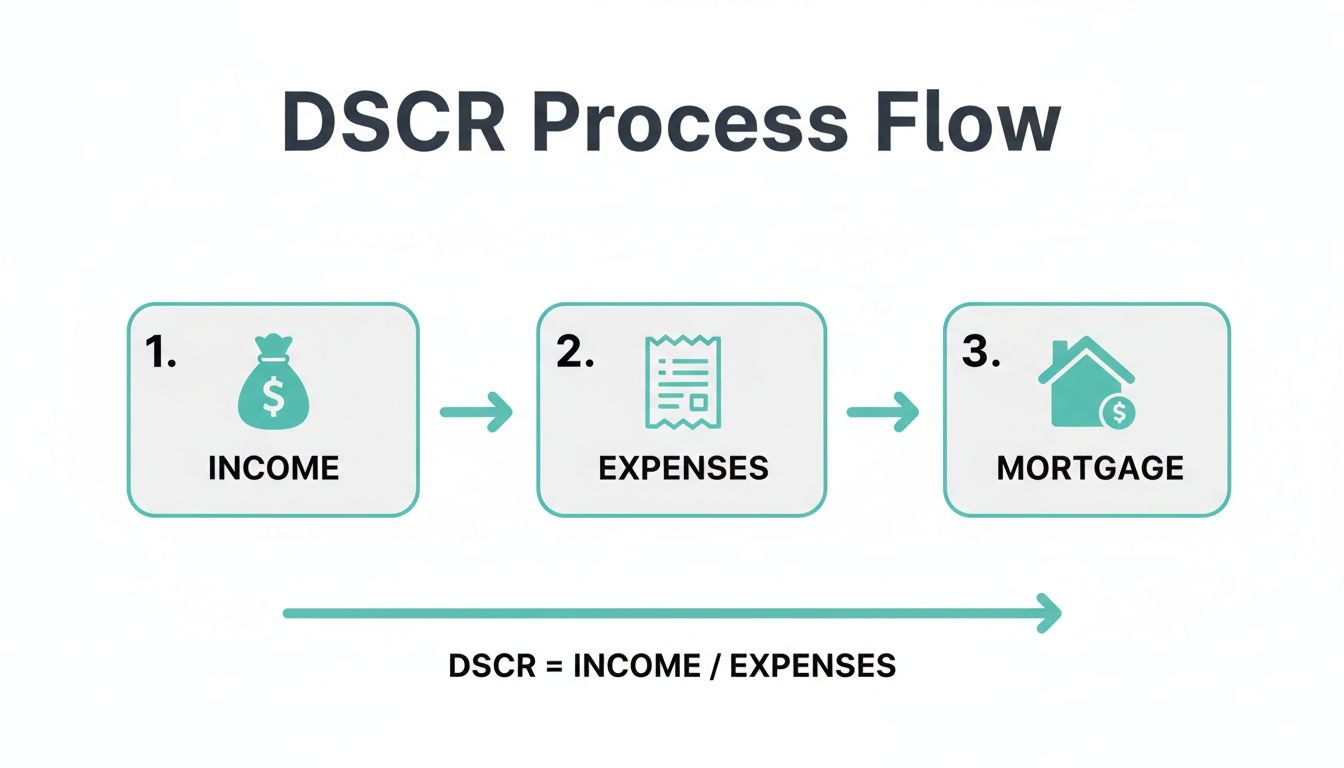
As you can see, a healthy DSCR boils down to your income being greater than your expenses and your debt combined. Let's walk through it with a real-world style example.
Step 1: Find the Net Operating Income (NOI)
Before you can calculate DSCR, you must accurately determine your Net Operating Income (NOI). This is the property’s total income minus all its operating expenses—but here's the key—before you factor in the mortgage. A classic beginner mistake is being too optimistic with expenses, which inflates your NOI and makes a deal look better than it is.
Let's break it down for a hypothetical single-family rental:
- Gross Potential Rent: $2,000/month or $24,000/year
- Vacancy (5%): -$1,200/year
- Property Taxes: -$3,000/year
- Insurance: -$1,200/year
- Repairs & Maintenance (5%): -$1,200/year
- Property Management (8%): -$1,920/year
Your total operating expenses come out to $8,520.
Now for the NOI calculation: $24,000 (Gross Rent) - $8,520 (Total Expenses) = $15,480 (Annual NOI).
Getting this number right is everything. To dig deeper into this, our guide on how to calculate a property's cap rate is a great resource, as it also hinges on an accurate NOI.
Step 2: Determine the Total Debt Service
Next up is the easy part: your Total Debt Service. This is simply your total annual mortgage payments, including both principal and interest.
For our example property, let's say the mortgage is $1,000 per month, making the annual debt service $12,000.
Step 3: Calculate the Final DSCR
With both numbers ready, just plug them into the formula. This final step reveals if the property's cash flow is strong enough to handle its debt load.
DSCR = $15,480 (NOI) / $12,000 (Debt Service) = 1.29
A DSCR of 1.29 is a solid number. It means the property is generating 29% more cash than it needs to cover the mortgage, giving you a healthy cushion for vacancies or unexpected repairs. Most lenders require a minimum DSCR of 1.20 to 1.25, ensuring the property’s income exceeds its debt service by at least 20-25%. Hitting that mark is a critical step toward securing financing.
What Lenders Consider a Good DSCR
So you’ve run the numbers and calculated your property’s debt coverage ratio. To get a deal financed, you need to see that final figure through a lender’s eyes. It’s not just about being profitable; it’s about proving you have a safety net.
A DSCR of 1.0 is the absolute breakeven point. At this level, the property generates exactly enough income to cover its mortgage payments, with nothing left over. For any lender, this is a massive red flag. A single unexpected repair would instantly push the property into the red, making it an unacceptably high-risk loan.
The Minimum Threshold for Approval
Because of that risk, lenders require a cushion. The most common minimum benchmark you’ll encounter for a debt coverage ratio in real estate is 1.20 to 1.25.
A DSCR of 1.25 means the property's Net Operating Income is 125% of its annual debt service. Put another way, it generates 25% more cash than what's needed to pay the mortgage.
That extra 25% isn’t just your profit—it’s the lender’s buffer. It provides confidence that the property can handle minor financial bumps, like a slow tenant turnover, without missing a loan payment. For you, the investor, this buffer is your margin of safety and the source of your cash-on-cash return.
How Property Type Influences DSCR Requirements
While 1.25 is a solid rule of thumb, the required DSCR isn’t one-size-fits-all. Lenders adjust their requirements based on how stable they perceive an asset to be. A property with predictable income can often get approved with a lower DSCR than one with more volatile revenue streams.
For example, a multifamily apartment building with a long history of near-100% occupancy is seen as a very stable asset. On the flip side, a hotel's income can swing wildly based on the season or economy, making it a much riskier bet for a lender.
This table gives you a good idea of the typical minimums you might see when seeking financing for different property types.
Typical Lender DSCR Requirements by Property Type
This table shows common minimum DSCR thresholds lenders require for different types of real estate investments, helping investors set realistic targets for their deals.
| Property Type | Typical Minimum DSCR | Lender's Perceived Risk |
|---|---|---|
| Multifamily / Apartments | 1.20 - 1.25 | Low |
| Self-Storage | 1.25 - 1.30 | Low to Moderate |
| Industrial / Warehouse | 1.25 - 1.35 | Low to Moderate |
| Anchored Retail Center | 1.30 - 1.40 | Moderate |
| Office Building | 1.30 - 1.40 | Moderate |
| Hotel / Hospitality | 1.40 - 1.50+ | High |
Understanding these benchmarks is key to underwriting deals that can actually get funded. When analyzing a potential acquisition, you should aim to meet or beat the likely lender requirement for that specific asset class.
How Market Cycles Impact Your DSCR
The debt coverage ratio in real estate isn't a static number you calculate once and forget. It’s a living metric that moves with the market, tightening and loosening along with economic cycles. Understanding this relationship is what separates investors who survive downturns from those who get wiped out.
When the economy is booming, optimism is high. Rents climb, vacancies drop, and lenders get more aggressive, often loosening their DSCR requirements to compete for deals. A property that might need a 1.30 DSCR in a normal market could get funded at 1.20 during a peak.
But when a recession hits, the reverse happens. Job losses lead to higher vacancies and downward pressure on rents. Your property’s Net Operating Income (NOI) can shrink fast, causing a once-healthy DSCR to plummet.
Surviving Economic Downturns
This is why a strong DSCR is more than a box to check on a loan application—it’s your primary financial shock absorber. An investor who locks in a loan with a robust 1.45 DSCR has built a massive buffer. If their NOI drops by 15-20%, they can still comfortably cover the mortgage.
Meanwhile, a highly-leveraged investor who barely qualified at a 1.20 DSCR could face a cash flow crisis almost immediately.
The lessons from past downturns, like the 2008 financial crisis, are clear. In the aftermath of the crash, lenders slammed on the brakes and adopted much stricter standards.
The debt service coverage ratio (DSCR) has always been a critical buffer against financial crises in U.S. commercial real estate. After the global financial meltdown, lending standards tightened dramatically. By 2019, most property types, including apartments and industrial, were consistently hitting DSCRs well above a 1.25 threshold—a huge improvement from the shaky averages we saw before 2007. To see how these trends have played out, you can explore detailed statistics on U.S. commercial real estate lending.
Stress-Testing Your Portfolio
Experienced investors use this history as a vital risk management playbook. It’s not enough to underwrite a deal based on today's numbers. You have to "stress-test" it against future possibilities.
- Model a Rent Reduction: What does your DSCR look like if rents in your market fall by 10%?
- Project a Vacancy Increase: What happens to your cash flow if vacancy jumps from 5% to 12%?
- Factor in Interest Rate Hikes: If you have a variable-rate loan, how would a 2% rate increase impact your debt service and, in turn, your DSCR?
Running these scenarios reveals a property’s true resilience. Building a portfolio with a conservative, cycle-aware approach to your debt coverage ratio is key to ensuring your assets can thrive through any economic weather.
Actionable Ways to Improve a Property's DSCR
What happens when you find a great property, but its debt coverage ratio is just below what a lender requires? This is a common problem, not a deal-breaker.
A borderline DSCR means it's time to get strategic. You have two main levers to pull: increase the Net Operating Income (NOI) or decrease the annual debt payments.

Turning a "maybe" from a lender into a "yes" almost always comes down to having a solid value-add plan that nudges these numbers in the right direction.
Strategies to Increase Net Operating Income (NOI)
Boosting NOI is the most powerful way to fix your debt coverage ratio real estate metric because it directly increases the underlying value of your asset.
Here are a few proven, actionable strategies:
- Raise Rents to Market Rates: The most direct approach. If current rents lag behind the neighborhood average, bringing them up to market provides a massive lift to gross income.
- Add Ancillary Income Streams: Get creative. Can you add coin-operated laundry, rent out storage units, or charge for reserved parking? These small additions create new revenue streams that add up.
- Implement Utility Bill-Backs: A Ratio Utility Billing System (RUBS) allows you to pass a portion of common utility costs (like water or trash) on to tenants, which directly cuts your operating expenses.
- Audit and Cut Operating Expenses: Go through your profit and loss statement with a fine-tooth comb. Can you get a better deal on insurance? Could you find a more affordable landscaping service or renegotiate vendor contracts? Every dollar saved drops straight to your NOI.
Tactics for Reducing Annual Debt Service
You have less control over this side of the equation, but negotiating the right loan terms can still make a significant difference in your annual payments.
The primary tactic is extending the amortization period. For example, stretching a loan from a 20-year to a 30-year amortization schedule will lower your annual debt service, even if the interest rate is identical. This gives your DSCR an immediate boost.
It also pays to shop around for different loan products. If you're looking for financing with more flexible underwriting, our guide on how to refinance a rental property is a great place to start your search.
Speed Up Your Deal Analysis on an Investor Marketplace
Manually calculating the debt coverage ratio in real estate for every single deal is a massive time sink. In a fast-moving market, that inefficiency can cause you to lose out on great opportunities while you’re stuck in a spreadsheet.

This is where a dedicated investor marketplace changes the game. Instead of grinding through slow, manual underwriting, you can leverage technology to put your entire analysis process on hyperdrive.
Put Your Underwriting on Autopilot with a Buy Box
On our marketplace, you can set up a "buy box"—a profile with your exact investment criteria. You can specify property type, location, and key financial metrics, including the minimum DSCR you're willing to accept.
By plugging in a minimum DSCR like 1.25 into your buy box, the platform acts as your personal deal scout. It automatically sifts through the marketplace, only alerting you to deals that already clear your most important lending hurdle.
This proactive filtering saves you from wasting hours on properties a bank would never finance. You can focus all your energy on analyzing viable opportunities that actually fit your strategy. Wholesalers and sellers on the platform also benefit, as they can instantly see which investors are a good match for their properties, speeding up the entire transaction process.
This automation gives you a serious competitive edge. By analyzing more qualified deals faster, you can make confident, data-backed decisions and pursue properties before the competition has even finished their first spreadsheet.
Got Questions About DSCR? We've Got Answers.
As you dig into deals, a few common questions always pop up around the debt coverage ratio. Getting these details straight can be the difference between a deal that sails through underwriting and one that hits a wall. Let's clear up a few of the most frequent ones.
What Is the Difference Between DSCR and Debt Yield?
Think of DSCR and Debt Yield as two different tools in a lender's toolbox. They both measure risk, but from different angles.
DSCR is all about cash flow and answers the question, "Is this property making enough money right now to cover its mortgage payment?" It’s a real-time health check on the property's ability to pay its monthly bills.
Debt Yield, on the other hand, is the lender's "what if" metric. It ignores the interest rate and amortization, focusing on a worst-case scenario. By dividing the NOI by the total loan amount, it answers the lender's ultimate question: "If I have to foreclose, what kind of return am I getting on the capital I deployed?" Lenders use DSCR to gauge operational stability and Debt Yield to measure their downside risk.
Can I Get a Loan if My DSCR Is Below 1.0?
Getting a traditional loan with a DSCR below 1.0 is nearly impossible. A ratio under 1.0 is a blinking red light for any conventional lender because it means the property's income isn't enough to cover the mortgage. It’s a guaranteed monthly loss, and no bank wants that risk.
The primary exception might be a hard money or bridge loan. If you have a solid value-add plan to dramatically boost the NOI—and you can prove it with a detailed pro-forma—a private lender might take the risk. But be prepared to pay a much higher interest rate for that flexibility.
How Does Amortization Affect DSCR?
This is one of the most powerful levers you can pull to make a deal work. A longer amortization period directly improves your DSCR, even if the property's income doesn't change.
When you stretch a loan from a 20-year term to a 30-year term, you're spreading the principal payments out over a longer period. This lowers your annual debt service payment—the denominator in the DSCR formula. A smaller denominator means a bigger, healthier ratio. It's a simple adjustment that can often turn a borderline deal into one a lender can confidently approve.
Ready to stop wasting time on deals that don't meet your criteria? You can set a minimum DSCR in your investor profile to automatically filter the marketplace for properties that already fit your financing needs.
Create your free investor profile to get matched with deals that fit your criteria.