
If you want to analyze real estate deals like a professional, there’s one number you must master: Net Operating Income (NOI). NOI is the single most important metric for understanding an income property's true profitability because it shows you exactly what’s left over from its core operations before you factor in debt or income taxes.
Think of it as the property’s annual paycheck. It’s all the money a property brings in from rents and other sources, minus the necessary, day-to-day costs of keeping it running. Mastering this metric is the first step to making smart, data-driven investment decisions instead of just guessing.
Why Net Operating Income Is Your Most Important Metric
Getting a handle on what net operating income is in real estate is non-negotiable for any serious investor. It's the universal language of property valuation, allowing you to assess an asset's performance completely independent of the owner's specific financing or tax situation.
Imagine you're comparing two small businesses. One owner took out a massive loan to get started, while the other owns their equipment outright. Just looking at their final bank balance wouldn't tell you which business is actually run more efficiently.
NOI does the same thing for real estate. It strips away the owner's unique loan details and tax burden to reveal the raw operational health of the underlying asset, making it possible to compare different deals on a level playing field.
The Foundational Formula for NOI
At its core, the formula is surprisingly simple but incredibly powerful. It gives you a clean, clear measure of a property's ability to generate cash from its day-to-day activities.
Net Operating Income (NOI) = Gross Operating Income (GOI) - Total Operating Expenses
This simple equation is the foundation of property analysis. It tells you exactly how much money a building produces after paying for its own upkeep but before paying the mortgage or income taxes. This clean separation is what makes NOI the industry standard.
Before we go deeper, here’s a quick snapshot of the key pieces that make up the NOI calculation.
NOI Formula at a Glance
This table breaks down the core components you'll need to calculate Net Operating Income for any property.
| Component | Description | Example (Annual) |
|---|---|---|
| Gross Operating Income (GOI) | All income the property generates after accounting for vacancy and credit loss. This is your realistic total revenue. | $100,000 |
| Total Operating Expenses | All the necessary, day-to-day costs to run and maintain the property (e.g., property taxes, insurance, utilities, management fees). | $45,000 |
| Net Operating Income (NOI) | The property's profit before debt service and income taxes are paid. This is GOI minus Operating Expenses. | $55,000 |
Understanding these components is the first step, but the real power comes from knowing why we separate them this way.
Making Apples-to-Apples Comparisons
So why is this so critical? Because every investor's financing situation is different. One buyer might put 20% down with a 7% interest rate, while another is an all-cash buyer. Their mortgage payments will be completely different.
If you included debt payments in your initial analysis, you could never fairly compare two properties. NOI solves this problem by focusing only on what the property itself can produce.
- For Beginners: Think of NOI as a property's report card. A high NOI relative to the purchase price suggests a healthy, well-run asset. A low NOI might be a red flag, signaling operational problems or a bad deal.
- For Experienced Investors: You already know that NOI is the engine that drives a property's value. When you "force appreciation" by strategically raising rents or cutting unnecessary expenses, you are directly increasing the property's NOI. That, in turn, increases its market value based on prevailing cap rates.
Ultimately, mastering NOI lets you see past surface-level numbers and evaluate the true financial engine of any real estate deal. It’s the first and most important step toward building a profitable portfolio.
How to Calculate Net Operating Income Step by Step
Calculating Net Operating Income isn't complex, but it does demand precision. The process boils down to two main stages: figuring out all the money coming in, and then subtracting all the relevant costs of running the property.
The formula itself is straightforward:
Gross Operating Income (GOI) - Total Operating Expenses = Net Operating Income (NOI)
Let's walk through each piece of that formula, step-by-step, using a real-world example to see how the numbers come together.
This flowchart lays it out visually, showing the basic path from income to expenses, landing you at the final NOI figure.
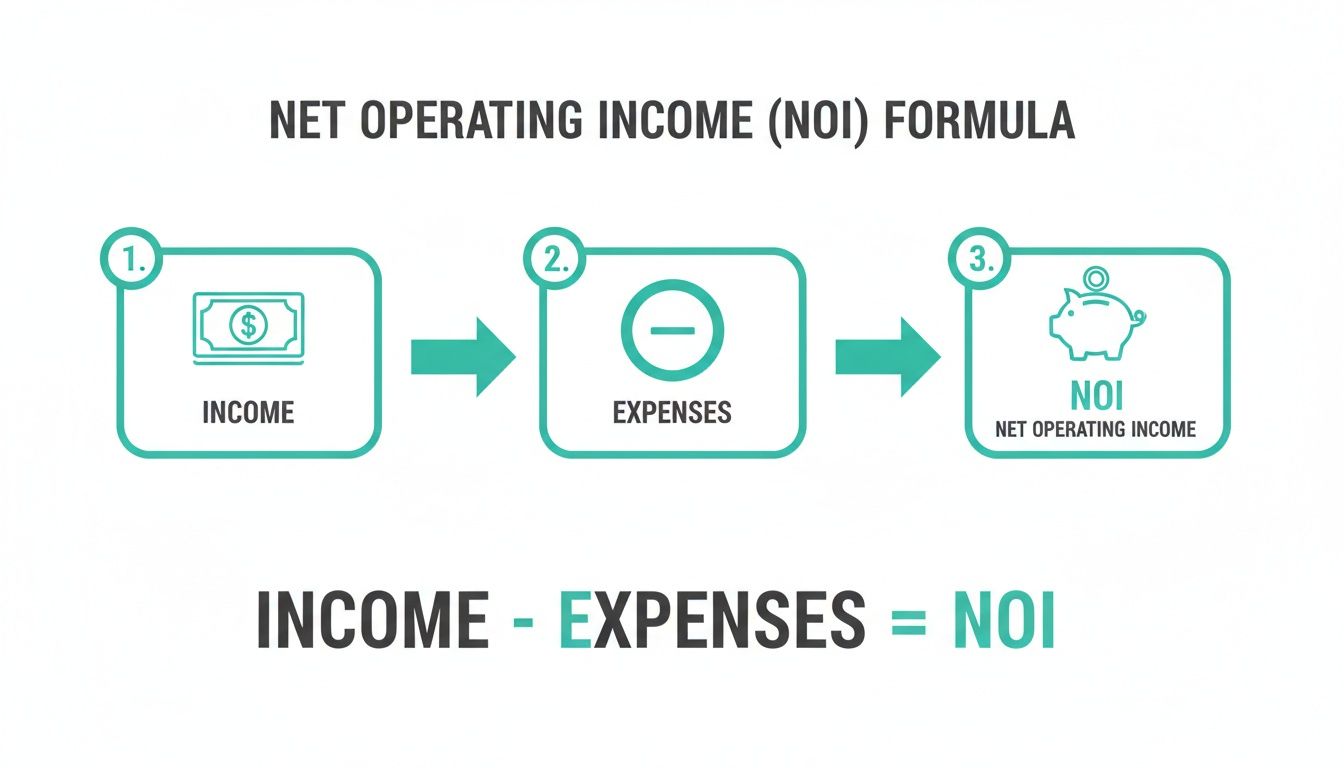
As you can see, NOI is purely about the property's ability to make money on its own, completely separate from your mortgage or other financing costs.
Step 1: Calculate Gross Operating Income
First, you need to pin down the Gross Operating Income (GOI). This isn't just the theoretical rent you could collect; it’s the realistic income you can actually expect after accounting for the fact that units don't stay full 100% of the time.
Here's how you get there:
- Start with Gross Potential Income (GPI): This is your best-case scenario—the total rent you'd collect if every single unit was occupied for the entire year.
- Subtract Vacancy and Credit Loss: No property stays full all the time. You have to account for empty units (vacancy) and tenants who don't pay their rent (credit loss). A good rule of thumb is 5-10% of your GPI, but you should always use real data from your local market if available.
- Add Other Income: This is where you add revenue from things like coin-operated laundry machines, rented parking spots, storage units, or pet fees.
Let's run the numbers for a small four-plex apartment building.
Example A: Calculating GOI for a Four-Plex
- Each of the four units rents for $1,500 per month.
- Gross Potential Income (GPI): 4 units x $1,500/month x 12 months = $72,000
- Vacancy Loss (we'll use 5%): $72,000 x 0.05 = $3,600
- Other Income (from laundry machines): $1,200 per year
Now, just plug it in: $72,000 (GPI) - $3,600 (Vacancy) + $1,200 (Other Income) = $69,600 (GOI)
Step 2: Calculate Total Operating Expenses
Next, you have to add up all the Total Operating Expenses (OpEx). These are the necessary, day-to-day costs of keeping the property up and running so it can actually generate income. Underestimating expenses can make a great-looking deal turn into a financial nightmare.
Your typical operating expenses will include:
- Property Taxes: The annual bill from your city or county.
- Property Insurance: Coverage for things like fire, liability, and other potential damages.
- Utilities: Any costs the owner pays, like water, sewer, trash, or power for common areas.
- Repairs & Maintenance: The ongoing budget for fixing leaky faucets, patching drywall, and general upkeep. This is for the small stuff, not major renovations.
- Property Management Fees: If you hire a pro, expect to pay 8-10% of the rent they collect.
- Landscaping & Snow Removal: The cost to keep the outside of the property looking good.
- Pest Control: Regular treatments to keep bugs and other pests away.
Step 3: Put It All Together to Find NOI
This is the easy part. Just subtract your Total Operating Expenses from the Gross Operating Income you calculated earlier. The number you're left with is the property's Net Operating Income.
Example B: Completing the NOI Calculation for the Four-Plex
- Gross Operating Income (from Step 1): $69,600
- Property Taxes: $6,500
- Insurance: $1,800
- Utilities (owner-paid): $2,400
- Repairs & Maintenance: $3,500
- Property Management (8% of GOI): $5,568
- Total Operating Expenses = $19,768
And now for the final calculation: $69,600 (GOI) - $19,768 (OpEx) = $49,832 (NOI)
This $49,832 is the annual profit this four-plex generates from its operations alone. It's the number you'll use to figure out the property's value, calculate its cap rate, and ultimately decide if it's a solid investment. If you're ready to see how this number drives valuation, check out our guide on how to calculate cap rate.
What to Include and Exclude from Operating Expenses
Getting Net Operating Income right boils down to knowing exactly what counts as an operating expense and what doesn't. Nail this, and you’re on your way to a smart investment. Mess it up, and you could make a terrible deal look fantastic on paper.
The core idea is simple: NOI is designed to measure the health and performance of the property itself, completely separate from the owner's personal financial situation. You must separate the routine costs of running the building from major, one-off capital projects or the financing used to buy it.

What to Include in Operating Expenses
Operating expenses are the predictable, recurring costs required to keep the property running and generating rent checks. Think of them as the regular bills you can count on paying to maintain the asset.
Your checklist of included expenses should always contain:
- Property Taxes: The annual bill from the city or county.
- Property Insurance: Standard coverage for things like liability, fire, and other hazards.
- Utilities: Any utilities the landlord pays for, like water, sewer, trash, or common area electricity.
- Repairs & Maintenance: The ongoing budget for routine upkeep—fixing leaky faucets, landscaping, cleaning hallways, and other minor repairs.
- Property Management Fees: Usually 8-10% of collected rent if you hire a professional firm.
- Administrative & Marketing Costs: Expenses for things like advertising vacant units, legal fees for leases, or bookkeeping.
These items are all directly tied to the property's daily function. Tallying them up gives you a clear, honest picture of what it truly costs to run the asset.
Why Certain Major Costs Are Excluded
This is where many new investors get tripped up. Several large expenses are intentionally left out of the NOI calculation, and for very good reasons.
Key Takeaway: Excluding financing and capital costs isn't about ignoring them; it’s about isolating the property’s performance. These expenses are analyzed later when you calculate cash flow and overall investment returns.
Here’s a breakdown of what you must exclude and, more importantly, why:
- Mortgage Payments (Principal & Interest): This is the big one. Your loan is specific to you—your down payment, your credit score, your interest rate. Another investor might pay all cash. By excluding the debt service, you can compare two properties on an apples-to-apples basis, regardless of how they’re financed.
- Capital Expenditures (CapEx): These aren't your everyday repairs. CapEx refers to large, infrequent expenses for major improvements that extend the property's life, like a brand-new roof, replacing an entire HVAC system, or repaving the parking lot. These are considered capital investments, not daily operating costs.
- Depreciation: This is a non-cash expense used for tax purposes. It’s an accounting concept to reflect an asset's wear and tear over time. Since no actual money leaves your bank account, it has no place in NOI.
- Income Taxes: Your personal or corporate income tax bill is unique to your financial situation. It’s not a property-level operating expense, so it’s kept separate.
This deliberate separation is precisely what makes NOI such a powerful and universally trusted metric for evaluating real estate deals.
To make this crystal clear, here’s a simple table to help you classify costs correctly every time you’re analyzing a property.
Included vs. Excluded Expenses in NOI Calculation
| Expense Type | Included in Operating Expenses (YES) | Excluded from Operating Expenses (NO) |
|---|---|---|
| Property Management Fees | YES - A recurring cost for managing the property. | |
| Mortgage Payments | NO - This is a financing cost, not an operating one. | |
| Property Taxes | YES - An essential, annual operating cost. | |
| Repairs & Maintenance | YES - The routine costs to keep things running. | |
| Capital Expenditures (CapEx) | NO - Major, one-time improvements (e.g., new roof). | |
| Landlord-Paid Utilities | YES - Predictable costs for common areas or included units. | |
| Property Insurance | YES - Necessary protection for the asset. | |
| Depreciation | NO - This is a non-cash, "paper" expense for tax purposes. | |
| Income Taxes | NO - A personal or corporate expense, not property-specific. |
Getting this right isn't just about following a formula; it's about developing the discipline to analyze a property based on its own merits.
From Quick Analysis to Deep Diligence
Once you have this framework down, you can analyze deals faster and with more confidence.
For Beginners: The 50% Rule If you're quickly screening a deal without full financials, the 50% Rule is a helpful rule of thumb. It suggests that a property's operating expenses will be about 50% of its gross income. It’s not a precision instrument, but it’s fantastic for quickly weeding out deals that are obviously not going to work before you waste hours on a deep dive.
For Experienced Investors: Playing Detective When a seller provides their financial statements (the "pro forma"), your job is to be a skeptic. Look for red flags. Are the property taxes suspiciously low? The seller might be showing you a pre-assessment value that’s about to jump. Is the repairs budget unrealistically small? They've likely been deferring maintenance that you'll have to pay for. Always compare a seller's stated NOI against data from similar properties to benchmark the deal and spot numbers that seem too good to be true.
How Investors Use NOI to Value Properties
Now that you can calculate a property's Net Operating Income, it's time to put that number to work. For real estate investors, NOI isn't just a figure on a spreadsheet; it's the engine that drives a property's valuation. The direct link between performance and value happens through a critical metric: the capitalization rate.
The capitalization rate, or cap rate for short, is a metric that shows the potential rate of return from a property based on its income. Think of it as a quick way to gauge an asset's profitability relative to its price.
The formula that ties it all together is simple but incredibly powerful:
Property Value = Net Operating Income (NOI) / Capitalization Rate (Cap Rate)
This relationship is the key to unlocking a property’s market value. If you know a property's NOI and the going cap rate for similar properties in that specific market, you can quickly estimate a reasonable purchase price.
Finding and Using the Right Cap Rate
The cap rate is not a universal constant. It is a direct reflection of a specific market’s conditions and investor sentiment. A lower cap rate usually indicates a lower-risk, higher-demand property (like a new apartment building in a prime location). A higher cap rate often signifies higher perceived risk or a less desirable asset (like an older building in a secondary market).
So where do you find the right cap rate for your analysis?
- Talk to Commercial Brokers: Local real estate agents who specialize in investment properties are your best source for real-time market data.
- Analyze Recent Sales (Comps): Look at what similar properties have sold for recently. If you can get their NOI and you know the sale price, you can calculate the cap rate they sold at.
- Use Market Reports: Large commercial real estate firms often publish reports with average cap rates for different property types and submarkets.
Cap Rate in Action: A Tale of Two Properties
Let's see how this plays out with a real-world scenario. Imagine two different duplexes, both generating an identical Net Operating Income of $30,000 a year.
- Property A is in a hot, rapidly growing neighborhood. The market cap rate for properties like this here is 5%.
- Property B is in a stable but higher-risk area. The typical cap rate there is 7.5%.
When we plug these numbers into the valuation formula, the difference in their market values is stark:
- Property A Value: $30,000 / 0.05 = $600,000
- Property B Value: $30,000 / 0.075 = $400,000
Even with the exact same annual profit, Property A is worth $200,000 more because of its location and lower perceived risk, all reflected in that lower cap rate. This is exactly why you can't just guess a cap rate; you have to know the specific market. For a deeper dive, check out our complete guide on how to value a commercial property.
Working Backward to Set Your Offer Price
This formula is also your secret weapon for underwriting deals and deciding what you should offer. Instead of reacting to the seller's asking price, you can start with your own investment goals.
Let's say you have a rule: you only buy properties that will generate at least a 7% cap rate. You come across a property with a verified NOI of $56,000. Now you can calculate the maximum you'd be willing to pay to hit your target.
Maximum Offer Price = $56,000 (NOI) / 0.07 (Your Target Cap Rate) = $800,000
If the seller is asking $900,000, you know instantly that the deal doesn't meet your criteria at that price. This data-driven approach removes emotion from negotiating and grounds your offers in solid financial strategy.
Actionable Strategies to Increase Your Property's NOI
Understanding what net operating income is in real estate is step one. Actively improving it is how you build wealth.
A higher NOI doesn't just mean more cash in your pocket each month—it directly increases your property's market value. This is called "forcing appreciation," and it's a core strategy for savvy investors who don't just wait for the market to do the work for them.
You only have two levers to pull to make this happen: increasing revenue or decreasing expenses. Let's dig into some practical strategies for both.

Strategies to Increase Revenue
Boosting your Gross Operating Income is the most direct way to grow your NOI. Even small, incremental gains can have a massive impact on your bottom line and the property's overall valuation.
Here are a few proven methods:
- Adjust Rents to Market Rates: The most obvious tactic is often the most powerful. Conduct regular rent surveys to ensure your pricing is competitive. Even a modest increase of $50 per month across a 10-unit building adds $6,000 to your annual NOI.
- Minimize Vacancy and Turnover: An empty unit is a revenue killer. Retain good tenants by providing excellent service and a well-maintained property. When a unit does become vacant, have a system to turn it over fast—fresh paint, professional cleaning, and aggressive marketing can cut your vacancy time from weeks to days.
- Introduce New Income Streams: Get creative and find ways to "monetize" your property beyond just rent. Many tenants are willing to pay for convenience.
- Charge for reserved or covered parking spots.
- Add coin-operated or card-ready laundry facilities.
- Offer onsite storage units for a monthly fee.
- Implement a pet policy that includes a one-time fee and monthly "pet rent."
Strategies to Decrease Expenses
Cutting costs is the other side of the NOI coin. Trimming your operating expenses means every dollar saved drops directly to your bottom line, boosting profitability without raising rents.
For Experienced Investors: Scrutinizing the seller's expense report is a goldmine for finding value-add opportunities. If you see bloated costs for insurance, maintenance, or utilities, you have a clear roadmap for increasing NOI the day you take over.
Here are some high-impact areas to focus on:
- Protest Your Property Taxes: Property tax assessments are not set in stone. If you believe your assessed value is too high compared to similar properties, you can and should appeal it. A successful appeal can save you thousands of dollars annually.
- Shop for Better Insurance: Don't just auto-renew your insurance policy every year. Get quotes from multiple providers to ensure you're not overpaying. Bundling multiple properties with one carrier can also lead to significant discounts.
- Implement Energy-Efficient Upgrades: Reducing utility consumption is a win-win. Installing LED lighting in common areas, low-flow toilets and showerheads in units, and smart thermostats can lead to substantial, long-term savings—especially if you are responsible for any utility bills.
- Perform Preventative Maintenance: It is almost always cheaper to prevent a problem than to fix it. Regular HVAC servicing, gutter cleaning, and plumbing inspections can help you avoid massive emergency repair bills that can destroy your budget and your NOI.
How an Investor Marketplace Helps You Analyze Deals
Calculating Net Operating Income for every single property that crosses your desk is a grind. As your deal flow increases, building spreadsheets manually becomes a massive bottleneck that can cause you to miss out on great opportunities.
This is exactly why modern investment platforms are built to do the heavy lifting for you. On our marketplace, wholesalers and sellers upload their deals with key financial metrics already calculated, saving you hours of manual work. You get to spend less time in Excel and more time actually analyzing the deal and doing your due diligence.
Filter Deals Using Your Specific Criteria
The real power of an investor network comes from its filtering tools. Instead of sifting through hundreds of listings that don’t fit your strategy, you can set up a "buy-box" or investor profile on the platform to automatically bring the right deals straight to you.
Imagine setting your preferences to only see properties that meet these thresholds:
- A minimum Net Operating Income of $50,000 annually
- A cap rate of 7% or higher
- Located only in your target zip codes
This is where the concepts we've discussed become actionable tools. You’re no longer just learning about NOI; you're actively using it to hunt for deals. When a new property gets listed that matches your criteria, you get an instant notification. This frees you up to analyze more properties and make faster offers. If you need help with your underwriting, you can check out our real estate investment calculators.
By creating a detailed investor profile on the platform, you let the technology work for you. It transforms deal sourcing from a manual, time-consuming chore into an efficient, automated process, giving you a huge competitive edge.
Common Questions About Net Operating Income
Once you get the formula down, a few key questions about Net Operating Income always seem to surface. Nailing these distinctions is what separates a surface-level grasp from the kind of practical knowledge you need to analyze deals with real confidence. Let's clear up the most common points of confusion.
What Is the Difference Between NOI and Cash Flow?
This is easily the most frequent question, and the distinction is absolutely critical. Think of it this way: NOI measures the property's profitability, while cash flow measures your investment's profitability.
NOI gives you a clean look at whether the property itself is a good, standalone business, completely separate from any financing. Cash flow, on the other hand, is the actual money left in your bank account after you’ve paid the mortgage (that’s both principal and interest).
- NOI: Gross Operating Income - Operating Expenses
- Cash Flow: NOI - Debt Service (Mortgage Payments)
It's entirely possible for a property to have a fantastic NOI but negative cash flow if the investor took on a high-interest loan with very little money down. Conversely, if you bought the property with all cash, your cash flow would be much closer to the NOI.
Is a Higher NOI Always Better?
Generally, yes—a higher NOI points to a more profitable asset. But NOI never tells the whole story on its own. It only becomes truly meaningful when you stack it up against the property's purchase price. That relationship is what gives you the cap rate.
For instance, which of these is the better deal?
- Property A: $100,000 NOI with a $2 million price tag (a 5% Cap Rate)
- Property B: $80,000 NOI with a $1 million price tag (an 8% Cap Rate)
Property B is the more attractive investment. Why? Because it generates a much stronger return relative to what it costs. The goal isn't just a high NOI; it's the highest possible NOI for the price you pay.
Why Are Capital Expenditures Not Included in NOI?
This one trips people up, but the logic is sound. Operating expenses are the routine, predictable costs of keeping the lights on and the property running day-to-day. Capital Expenditures (CapEx), however, are major, infrequent upgrades that either extend the asset's life or boost its value.
A new roof, a full HVAC system replacement, or repaving an entire parking lot aren't daily operational costs. They are long-term investments back into the property itself.
By leaving CapEx out of the NOI calculation, you get a much cleaner, more stable picture of a property's consistent, year-over-year performance. Smart investors absolutely account for CapEx by setting aside reserves, but they analyze it separately from the core profitability that NOI is designed to measure.
Ready to find deals that match your specific investment criteria? On our marketplace, you can set your investor profile to filter properties based on NOI, cap rate, and dozens of other metrics.
Create your free investor profile to get matched with deals that fit your criteria.