A wholesaler sends you a property that looks promising. You check the address, ask for photos, and make a note to follow up. Two days later, you’re searching through text messages for the asking price while trying to remember whether you already contacted your contractor.
Meanwhile, another investor asks what you’re buying. You send a quick reply, but it’s vague. The conversation stalls because neither of you has enough information to take the next step.
These aren’t necessarily problems with effort. They’re problems with how information moves through your business.
A useful Real Estate system gives deals, contacts, and follow-ups a clear place to go. It helps you spend less time reconstructing conversations and more time deciding which opportunities deserve your attention.
For flippers, investors, and wholesalers, that system should connect two things: the work of evaluating opportunities and the relationships that bring those opportunities to you.
Here’s how to build one without turning your business into an administrative project.
Start With the Work You Keep Repeating
Before choosing software, look at where your week gets interrupted.
Are you repeatedly asking contacts for missing property details? Searching for photos? Sending deals to buyers whose criteria you don’t remember? Following up because you can’t tell whether someone received your last message?
For a few working days, keep a short friction log. Write down the task, what made it difficult, and what information would have made it easier.
An entry might look like this:
“Reviewed a property twice because my original notes were saved on my phone instead of with the property record.”
That’s specific enough to fix. “Need to get organized” isn’t.
Choose the two or three problems that cause the most repeated work. Start there rather than trying to redesign everything at once.
The tradeoff is that some frustrations will remain temporarily. That’s usually better than introducing a complicated system that takes more effort to maintain than the problems it solves.
Define What a Relevant Deal Looks Like
A system can organize information, but you still need to tell it what matters.
Write down your buying criteria in language another person can use. Include your target locations, property types, price range, renovation comfort level, and preferred strategy.
“Looking for good investment properties” leaves too much open to interpretation.
A more useful description might be:
“I’m looking for single-family properties in these three counties, with renovations that don’t require major structural work. I’m evaluating purchases for resale rather than long-term rental.”
If your criteria depend on the situation, say so. You might accept a heavier renovation in a familiar neighborhood but not in a market you haven’t worked in.
For wholesalers, apply the same thinking to buyers. Record what each buyer actually wants, not simply that they’re “an investor.”
Clear criteria give you a starting filter. They shouldn’t become a substitute for judgment. Review them when your available capital, team capacity, or strategy changes so your system doesn’t keep steering you toward yesterday’s priorities.
Give Each Opportunity One Home
The goal isn’t to stop using email, texts, or phone calls. It’s to stop treating those channels as the only record of your business.
Choose one primary place to track each opportunity. Depending on your workload, that could be a structured spreadsheet or software designed for your process.
Each property record should answer a few basic questions:
What is the property, and who introduced it?
What information has been provided?
What still needs verification?
What stage is the opportunity in?
What happens next, and who is responsible?
Link supporting documents and photos to that record rather than creating disconnected copies.
You don’t need to paste every message into it. Summarize decisions and commitments: “Seller contact agreed to provide access Friday” is more useful than a long conversation with no clear outcome.
Consistency matters more than elaborate formatting. If you work with a partner, agree on where updates belong. Two well-maintained systems can still create confusion when nobody knows which one contains the latest information.
Keep Your Deal Stages Simple
A long pipeline can look impressive while making everyday decisions harder.
Start with stages that reflect actions you actually take. For example:
New opportunity
Waiting for information
Under review
Pursuing
Under contract
Closed or passed
Define what moves a property from one stage to another. “Under review” might mean you have enough basic information to begin evaluation. “Pursuing” might mean you’ve decided to request access, discuss terms, or prepare an offer.
The labels matter less than having a shared meaning.
Add a reason when you pass on an opportunity. “Outside target area,” “scope beyond current capacity,” or “seller expectations don’t fit analysis” gives you more useful history than “not interested.”
Avoid adding stages for every minor event. If changing a status requires too much thought, you’ll be tempted to skip it. Your pipeline should clarify the next decision, not become another decision itself.
Make the Next Action Impossible to Miss
A property can sit in a neatly organized database and still go nowhere.
Every active opportunity needs a next action, an owner, and a date. Even if you work alone, assigning yourself as the owner makes the responsibility explicit.
Compare these notes:
“Follow up.”
“Ask the wholesaler for interior photos and the proposed access schedule on Tuesday.”
The second note tells you what to do without requiring you to reconstruct the situation.
Use the same approach for relationships. Instead of “stay in touch with buyer,” record “confirm whether buyer is still purchasing small multifamily properties before sending new opportunities.”
Set deadlines around actual commitments, not arbitrary pressure. If someone says they’ll have information next week, schedule your follow-up accordingly.
There’s a balance here. Too many reminders can become background noise. Keep them tied to actions that advance a decision, resolve a missing detail, or fulfill something you promised.
Build a Network Around Fit, Not Contact Count
A large contact list doesn’t tell you who to call about a particular property.
Organize relationships by useful context: location, investment strategy, property preference, current activity, and the last meaningful conversation.
Keep notes factual. “Interested in duplexes near existing rentals” is actionable. “Seems wealthy” is neither useful nor a sound basis for deciding whom to approach.
Make your own profile equally clear. Explain what you’re looking for, where you operate, and what information you need to consider an opportunity.
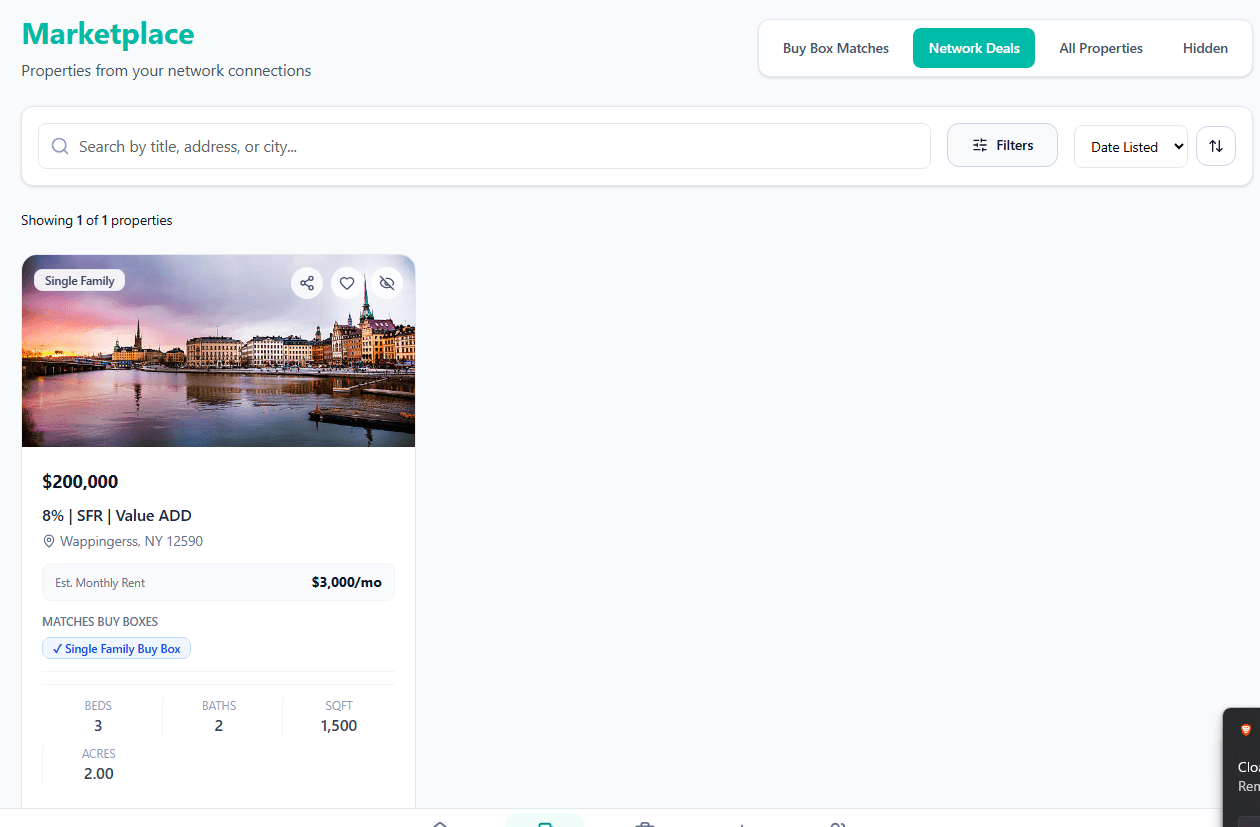
This is where networking software can fit into a broader Real Estate system. Investor Deal Exchange offers software focused on helping real estate participants connect with like-minded individuals and find deals.
That addresses the relationship and discovery side of the process. Your evaluation, follow-through, and recordkeeping still need a clear workflow.
Connecting is the beginning. A relevant introduction becomes more useful when both parties can quickly understand whether their goals align and what a productive next conversation would cover.
Hypothetical Example: A Flipper Who Keeps Reviewing the Same Properties
Consider a hypothetical owner-operated flipping business evaluating properties from several wholesalers.
The owner receives photos by text, prices by email, and renovation observations during phone calls. When an opportunity resurfaces, they start the review again because the earlier conclusion is difficult to find.
Instead of adding more tools, the owner creates one property record for every serious lead.
Each record contains the source, asking price, date received, available photos, open questions, and decision history. A short checklist separates the initial screen from a more detailed review.
If a property falls outside the target area, it’s marked as passed with that reason. If it needs further review, the owner records the missing information and schedules one specific follow-up.
Now, when someone resends the property, the owner can see the previous assessment and ask what has changed.
This doesn’t guarantee a better purchase or a faster closing. It creates a more manageable process for reaching a decision.
The tradeoff is a small amount of data entry upfront. The owner keeps it practical by recording decision-relevant information rather than documenting every conversation word for word.
Standardize the Information You Request and Share
Repeated questions are a good place to introduce a checklist.
Create a basic intake format for new opportunities. Depending on your strategy, it might request the property address, asking price, property type, occupancy information, available photos, known condition issues, access arrangements, and the source of the information.
Allow “unknown” as an answer. A blank field can look like an oversight; “unknown” makes the information gap visible.
Separate supplied information from your own assessment. A contact’s repair estimate is not automatically your repair estimate. Label who provided a figure and when.
When sharing opportunities, use a consistent summary so recipients can find the essential details quickly. Include uncertainties rather than smoothing them over.
The tradeoff is that an intake form can feel demanding if you send it too early or make every field mandatory. Keep the initial request short, then gather more detail as the opportunity becomes relevant.
A good checklist supports conversation. It shouldn’t turn every introduction into an application.
Hypothetical Example: A Wholesaler With an Unclear Buyer List
Imagine a hypothetical wholesaler with a buyer list assembled from networking events, referrals, and online conversations.
The list contains names and phone numbers, but little information about buying preferences. Every new opportunity leads to the same question: “Who should receive this?”
The wholesaler starts by reviewing recent conversations and asking active contacts to confirm their target areas, property types, renovation preferences, and current interest.
Instead of sending every property to everyone, the wholesaler uses those details to choose a more relevant group. Each response is recorded against the opportunity, including questions and stated reasons for passing.
If several contacts ask about occupancy, that detail moves into the standard property summary. If a buyer changes strategy, their record gets updated.
The process is still relationship-driven. The software doesn’t decide whether a buyer is suitable or whether a transaction should proceed.
The tradeoff is ongoing maintenance. Preferences change, so the wholesaler schedules periodic checks rather than treating the list as permanently accurate.
The practical benefit is a clearer starting point for each conversation—not a promise that every opportunity will find a buyer.
Automate Reminders Before You Automate Judgment
Once your workflow is clear, consider which repetitive steps can run without constant attention.
Start with low-risk tasks: reminders, reusable information requests, or notifications when a record needs review. Where your chosen tools support it, a missing next-action date could trigger a prompt to complete the record.
Keep personal review around messages that involve negotiation, commitments, or sensitive circumstances.
A template can save drafting time, but read it before sending. Remove anything that doesn’t fit the conversation, and stop scheduled messages when someone replies or asks not to be contacted.
Don’t automate a messy process just because a tool allows it. First decide what should happen, then decide what software can handle reliably.
Check whether new automation creates duplicate records or extra notifications. If you must spend time correcting it every week, simplify the rule or remove it.
The best starting point is usually the task you repeat consistently—not the decision that requires the most experience.
Protect Information Without Making Work Unnecessarily Difficult
Centralizing information also means thinking carefully about what you collect and who can see it.
The Federal Trade Commission recommends keeping only personal information needed for legitimate business purposes and limiting access according to employees’ responsibilities. Its guidance also calls for secure disposal when information is no longer needed, subject to applicable retention requirements.ftc
Apply that principle to your workflow. Keep ordinary networking notes separate from sensitive financial or identity documents. Don’t collect confidential material simply because your system has space for it.
Before selecting software, ask how access permissions work, how records can be exported, and what happens when a team member leaves.
These are questions to verify with a provider, not features to assume.
Retention decisions can involve legal, contractual, and other obligations. Get qualified guidance where needed rather than adopting a blanket deletion schedule.
The aim is sensible access: enough information for someone to do their job, without giving everyone unrestricted visibility.
Introduce the System in Manageable Steps
You don’t need to reorganize years of records before making progress.
Start with active opportunities and the contacts connected to them. Use your new intake format for incoming deals. Add a clear next action to each property you’re currently considering.
Then hold a short weekly review. Look for opportunities waiting on information, overdue commitments, duplicate records, and contacts whose preferences need updating.
Evaluate whether the system is helping with the original problems. Are you still reconstructing conversations? Can you explain why a deal was passed on? Does each active opportunity have an owner and a next step?
If the same breakdown keeps returning, a consultant could help map the workflow, clarify responsibilities, or compare tools against your actual requirements. You may also be able to solve it yourself by removing unnecessary fields or tightening one handoff.
Either way, resist adding features before understanding the problem.
A useful Real Estate system should make the next action clearer. It should leave you with fewer loose ends, not more software to manage.
Give Your Next Connection a Better Starting Point
You don’t have to replace your entire way of working. Start with clear buying criteria, a consistent home for opportunities, and follow-ups that tell you exactly what comes next.
Then connect that process to people whose real estate interests align with yours.
Investor Deal Exchange helps flippers, investors, and wholesalers across the United States connect with like-minded individuals and find deals. If that fits how you want to build your network, sign up and introduce what you’re looking for.