
Finding the right real estate joint venture partners is a critical strategy for scaling your portfolio. It allows you to combine capital, expertise, and resources to tackle larger, more profitable deals you couldn't do alone, moving you beyond solo projects into a new league of investing. This guide provides an actionable framework for finding, vetting, and structuring partnerships that are built for success.
Why Joint Ventures Are Essential for Scaling Your Portfolio

In real estate investing, "going it alone" has its limits. There's only so much capital you can personally deploy and only so much time you can dedicate to finding, analyzing, and managing properties. This is where forming partnerships becomes a core strategy for growth. A joint venture (JV) is a formal agreement where two or more parties pool their resources for a specific real estate project.
This collaboration allows you to break through the ceiling that often holds solo investors back. Suddenly, larger apartment buildings, small commercial centers, or even land development deals become attainable. Instead of competing for the same single-family flips, you can operate in a different league with potentially higher returns.
The Two Core Partner Roles
Most real estate JVs have two fundamental roles. Figuring out where you fit and what kind of partner you need is the first step.
- The Operating Partner: This is the "boots-on-the-ground" expert. They find the deal, run the numbers (the "underwriting"), manage the rehab or construction, and execute the business plan. An operator’s value is their expertise, deal flow, and ability to steer the asset toward profitability.
- The Money Partner: Also known as the capital partner, this person or group provides the cash needed for the down payment, closing costs, and renovation budget. They are typically more passive, trusting the operating partner to manage the day-to-day. Their contribution is primarily financial.
Key Takeaway: A successful JV marries the operator's expertise with the money partner's capital. One without the other often results in a stalled project. Knowing which role you can fill best is crucial before you even start looking for a partner.
- For Beginners: Acting as a money partner on a smaller deal can be a fantastic way to learn the ropes with less hands-on risk while earning a return.
- For Experienced Investors: Finding a reliable money partner lets you take down more deals without exhausting your own cash reserves.
Shifting from Solo Investor to Strategic Partner
The mindset shift from "I have to do it all" to "we can achieve more together" is what separates stagnant investors from those who build serious portfolios. Partnering allows you to specialize. If you're great at finding undervalued properties, you can focus on that while your partner handles the financing.
This division of labor makes you far more efficient and dramatically increases the number of deals you can handle. A strong real estate investor network is essential for this, as it's how you meet potential collaborators. On a platform like ours, investors can clearly define their roles and criteria, making it easier to find a compatible match and start building a scalable system for acquiring assets.
How to Find and Vet the Right Investment Partner
Finding the right real estate joint venture partner requires more than swapping business cards at a local meetup. While networking events are a start, you need a systematic approach to find a collaborator who is genuinely aligned with your goals and work ethic. The best partnerships are built on proactive sourcing and rigorous vetting.
The trend toward teaming up is undeniable. PwC's latest report on real estate investment trends highlights that with investment sentiment on the rise, a significant portion of capital is expected to be deployed through joint ventures, as investors pool local expertise with outside capital to navigate market shifts. Knowing how to find and screen reliable partners has never been more critical.
Using Online Platforms to Find Partners
Online investor marketplaces have fundamentally changed how partners connect. Instead of relying on chance encounters, you can build a detailed profile on a platform that actively attracts the right kind of people, making your search far more efficient.
Think of your investor profile as a magnet. By clearly spelling out your strategy, you automatically filter out people who aren't a fit and attract those who are already on the same wavelength.
For instance, an Operating Partner can create a profile that specifies:
- Deal Type: "I find and manage 10-20 unit value-add multifamily properties."
- Target Market: "Focused on B-class assets in the Dallas-Fort Worth MSA."
- Capital Needed: "Seeking a money partner to fund a $250,000 down payment and $100,000 for renovations."
- Track Record: "Successfully completed 5 flips and currently hold 2 small multifamily buildings."
This level of detail means that when a potential Money Partner finds you, they already know you’re a serious operator whose deals may fit their risk and return criteria.
The All-Important Due Diligence Checklist
Once you make an initial connection, the real work begins. Vetting isn’t about being distrustful; it’s about building confidence by verifying everything. A thorough due diligence process protects everyone involved and prevents costly mistakes.
A partnership is easy to get into and incredibly hard to get out of. Do the hard work on the front end to verify everything. Trust is earned through transparency, not blind faith.
Treat this process like you’d underwrite a deal—because you are. Start with these non-negotiable steps:
1. Verify Their Track Record Don’t just take their word for it. Ask for concrete proof of past deals.
- Get the addresses of properties they’ve owned or operated.
- Ask for before-and-after photos of their rehab projects.
- Request to see a settlement statement (HUD-1) from a past deal to prove they actually closed it.
2. Talk to Their References This is one of the most valuable things you can do.
- Ask for at least two references from previous partners, lenders, or property managers.
- Ask direct, pointed questions: "What was it like working with them when something went wrong?" "How did they handle unexpected challenges?" "Would you partner with them again?"
3. Check Their Financials and Alignment You must know your partner can hold up their end of the bargain.
- For a Money Partner: A "proof of funds" letter is standard practice to show the capital is liquid and ready to deploy.
- For an Operating Partner: You don't need their full bank statement, but you need to understand their financial footing. Are they overleveraged? Do they have cash reserves for surprises?
4. Watch for Glaring Red Flags Sometimes, the smartest move is to walk away. Keep an eye out for these warning signs:
- Resistance to a Formal Agreement: Hesitation to sign a detailed operating agreement is a deal-breaker.
- A History of Blame: If every failed partnership was someone else's fault, they are likely the common denominator.
- Vague or Evasive Answers: A trustworthy partner will be an open book about their wins and their losses.
- Mismatched Philosophies: If you’re a conservative buy-and-hold investor and they’re an aggressive flipper, your core strategies may be incompatible.
This process isn’t about being cynical; it’s about being a professional and setting your partnership up for success from day one.
How to Structure Your Joint Venture for Success
Finding a great partner is only half the battle. Many promising real estate deals fall apart not because of the property, but because the partnership agreement was a mess. A poorly defined structure creates ambiguity, which is a breeding ground for conflict.
A solid joint venture (JV) agreement aligns everyone's incentives, clarifies expectations, and provides a roadmap for how money flows and decisions get made. The goal is to move past vague handshakes and build a transparent framework that protects everyone. When you get this right, the agreement becomes the foundation of trust for your partnership.
Defining Roles and Responsibilities
Before discussing equity splits, you must nail down who does what. Any ambiguity here is a recipe for resentment and dropped balls. Your operating agreement needs to explicitly spell out each partner’s duties.
Key responsibilities to assign include:
- Acquisitions & Due Diligence: Who is responsible for finding deals, underwriting them, and managing the inspection process? (Typically the Operating Partner).
- Financing: Who is in charge of securing the loan and acting as the main point of contact for the lender?
- Asset Management: Who oversees the property manager, approves budgets, and ensures the business plan is executed post-closing?
- Capital Contributions: Who is funding the deal, and when are those funds due?
- Exit Strategy: Who makes the final call on when to sell or refinance? (Often requires a unanimous vote).
The process of sourcing, vetting, and aligning is a funnel. By the time you’re discussing deal structures, you should have already built a baseline of trust.
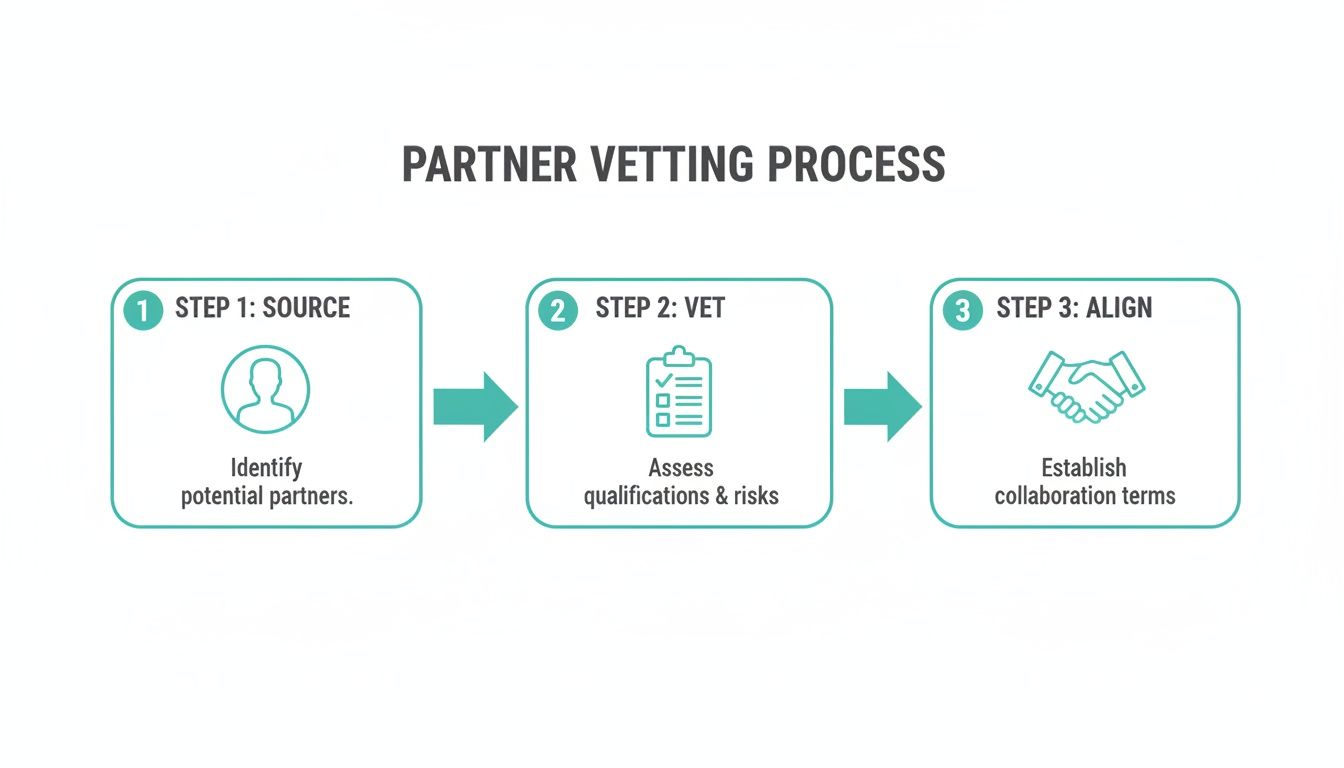
This logical flow ensures that when you get to the money conversation, you’re already on the same page about the big picture.
Common Equity Splits and Profit Distributions
How profits are divided is the heart of any JV structure. There's no single "right" way to do it; the best approach depends on the deal, the market, and each partner's contribution.
Pro Tip for Beginners: Don't get fixated on a 50/50 split. A smaller piece of a successful deal is infinitely better than 100% of a deal that never gets funded or goes sideways. Focus on what’s fair, not just what’s equal.
Let's break down the key concepts.
Equity Splits This determines your ownership percentage. A straightforward 50/50 split is common when partners contribute equally. However, a 70/30 split is also common, where the Money Partner might get 70% equity for providing the capital, while the Operating Partner gets 30% for finding and managing the deal. For a deeper dive, check our complete guide on real estate financing options.
Preferred Return ("Pref") This is an essential concept for attracting capital partners. A preferred return ensures the Money Partner gets paid first. It's an annual return on their investment (a common rate is 6-8%) that must be paid before any other profits are distributed. It prioritizes the return of capital, significantly de-risking the investment for the Money Partner.
Waterfall Distributions This is a sophisticated structure that outlines how profits are distributed after the preferred return is paid. It creates tiers, or "hurdles," that trigger different profit splits as the deal becomes more successful.
Here’s a simple numeric example of a small multifamily deal:
- Purchase Price: $1,000,000
- Money Partner's Capital: $300,000 (for down payment and rehab)
- Structure: 8% preferred return to the Money Partner, then a 50/50 split of all remaining profits.
After two years, you sell the property with $150,000 in total profit to distribute. Here's how the math works:
Pay the Preferred Return: The Money Partner gets their 8% pref for two years.
- $300,000 (Capital) x 8% (Pref) x 2 (Years) = $48,000
Calculate Remaining Profit:
- $150,000 (Total Profit) - $48,000 (Pref Paid) = $102,000
Split the Remainder: This $102,000 is now split 50/50.
- Money Partner's Share: $102,000 x 50% = $51,000
- Operating Partner's Share: $102,000 x 50% = $51,000
In this scenario, the Money Partner's total profit is $99,000 ($48k pref + $51k split), while the Operating Partner earns $51,000. This structure fairly rewards the operator for a successful deal while first protecting the person who put up the cash. This is where negotiating with experienced real estate joint venture partners pays off.
The Legal and Tax Framework for Your Partnership
Once you’ve found a partner and agreed on the numbers, the next step is non-negotiable: formalizing the deal with a rock-solid legal and tax framework. A handshake deal is a recipe for disaster. You're running a business, and it needs to be treated like one from day one to protect yourself, your capital, and your relationship with your real estate joint venture partners.
Think of it as setting the rules of the game before the clock starts. A formal agreement ensures everyone knows their rights, responsibilities, and what happens if things don't go according to plan.
Choosing the Right Legal Entity
For most real estate JVs, the Limited Liability Company (LLC) is the go-to entity. It combines the liability protection of a corporation with the tax benefits of a partnership. By forming a deal-specific LLC, you build a legal firewall between the property’s liabilities and your personal assets.
If a tenant slips and falls or a contractor sues, the claim is generally limited to the assets inside that LLC. This prevents creditors from coming after your personal home, car, or other investments. It’s a simple but powerful layer of protection.
The Operating Agreement: Your Partnership Bible
The cornerstone of your JV's legal structure is the operating agreement. This document is the constitution for your partnership, translating verbal agreements into a legally binding contract. A vague or missing operating agreement isn't just a red flag; it's a five-alarm fire.
Your operating agreement must clearly define several critical components:
- Capital Contributions: Who is putting in how much cash, and by what date?
- Distribution Schedules: How will money be paid out? Detail the waterfall structure, including any preferred returns and profit splits.
- Management Duties: Who handles day-to-day operations, tenant relations, and renovations?
- Decision-Making Authority: Which decisions can the Operating Partner make alone (e.g., repairs under $1,000), and which require a group vote (e.g., selling or refinancing)?
- Exit Strategies: What happens if a partner wants out? Specify terms for a buyout, the sale of a share, or dissolving the LLC.
The time and money spent on a well-drafted operating agreement is the cheapest insurance you will ever buy. It’s the playbook you’ll turn to during a disagreement, ensuring a resolution based on pre-agreed rules, not emotion.
Understanding the Tax Implications
With an LLC, you can typically choose to be taxed as a partnership. This means the LLC itself doesn't pay taxes; instead, all income, losses, and depreciation are "passed through" to the individual partners to report on their personal tax returns.
This pass-through of depreciation is a huge perk, as it can create a "paper loss" that helps offset taxable rental income. Sophisticated JVs are reshaping global real estate, with strategies like programmatic JVs giving investors access to premium assets they couldn't touch alone—for example, CBREIM using JVs to acquire student housing in undersupplied European markets. As institutional investors increase their use of co-investments, understanding these advanced legal frameworks is what separates amateurs from pros.
Avoid giving legal or tax advice. Always state that investors should consult qualified professionals to structure their entity and review their operating agreement to ensure their venture is built to last.
Using Technology to Streamline Your JV Deals

Finding, vetting, and managing real estate joint venture partners used to be a messy, time-consuming process that hinged on who you knew. Today, that old model is obsolete. Modern real estate platforms solve the biggest headaches in assembling and managing a JV.
These platforms have become an essential tool, acting as both a matchmaker and a project manager. They remove the guesswork and create a data-driven space where partners can connect, analyze deals, and collaborate with confidence.
How an Investor Marketplace Helps
An online real estate investment marketplace provides the infrastructure to solve partnership challenges.
- Finding Partners: On a platform, your profile and "Buy Box" act as a powerful signal to attract the exact partner you need. An Operator can broadcast their need for capital for a specific deal, while a Money Partner can specify their investment criteria. This flips the script from a passive search to an active magnet, pulling in pre-qualified collaborators.
- Connecting Deals with Capital: A major hurdle for wholesalers and operators is finding funded buyers. An online marketplace demolishes this barrier by creating a pre-vetted audience of investors. A wholesaler can post a deal and instantly get it in front of hundreds of potential capital partners who are actively searching for that exact asset type, replacing the old grind of manual outreach.
- Collaborative Underwriting: Once a partnership forms around a deal, technology provides tools for transparent, collaborative analysis. Built-in calculators for key metrics like ROI (Return on Investment), cap rate, and cash-on-cash return let both partners dig into the numbers using the same data. This shared workspace builds trust and ensures everyone is aligned before any money changes hands. You can see how this works by exploring deals on our investor marketplace.
The flow of capital into these partnerships is only getting stronger. The H1 2026 market report from RealFin shows that fundraising for opportunistic strategies—often structured as JVs—is at record levels, proving that serious capital is pouring into partnerships and creating more opportunities than ever for investors on our platform.
Got Questions About JVs? We’ve Got Answers.
Jumping into a partnership brings up practical questions for everyone, from first-timers to seasoned pros. Let's tackle some of the most common questions about real estate joint venture partners so you can move forward with confidence.
How Much Capital Do I Need to Be a Money Partner?
The honest answer is: it depends on the deal. There’s no magic number. For a small single-family flip, an operator might need $25,000. For a small multifamily property, that number could easily be $100,000 or more to satisfy the lender and fund renovations.
A quick tip for beginners: It's often smarter to be a significant capital partner in a smaller, manageable deal than a tiny partner in a massive project. You'll have more say and get a better hands-on learning experience.
On an investor marketplace, you can filter for deals and sponsors looking for capital that fits your budget, taking the guesswork out of finding a good match.
What Happens If a Partner Doesn’t Fulfill Their Obligations?
This is exactly why a professionally drafted operating agreement is non-negotiable. It's your playbook for handling tough situations. A solid agreement must include a "default" clause that spells out the consequences if a partner fails to perform.
Common remedies include:
- Forced Buyout: The non-defaulting partners may get the right to buy out the defaulting partner's share, often at a discount.
- Equity Dilution: The defaulting partner’s ownership stake could be reduced.
- Removal as Manager: If an Operating Partner is not performing, the agreement should provide a clear process for Money Partners to vote them out.
While open communication should always be the first step, this legal document is your backstop to protect the investment.
Can I Use My IRA or 401k to Fund a Real Estate JV?
Yes, you can use a self-directed IRA (SDIRA) to act as a passive Money Partner. This can be a phenomenal strategy for tax-advantaged growth, but you must follow strict IRS rules. The most important rule is that you cannot engage in "self-dealing." This means if you invest your SDIRA funds, you cannot personally provide any "sweat equity"—your role must be 100% passive.
Also, the LLC that owns the property must be owned by your IRA custodian, not you personally. All funds must flow through the SDIRA account. Breaking these rules can trigger a "prohibited transaction," potentially resulting in massive penalties. It is essential to work with a specialized SDIRA custodian and a CPA with experience in these transactions.
Who Has the Final Say in Major Decisions?
Decision-making authority must be spelled out in your operating agreement to prevent deadlock. A well-structured agreement creates checks and balances.
- Day-to-Day Decisions: The Operating Partner usually has authority to handle routine management (e.g., minor repairs under $1,000, paying approved bills) without a vote.
- Major Decisions: These are big-ticket items that affect the entire investment and should require a majority or unanimous vote.
These "major decisions" must be explicitly listed and almost always include:
- Selling the property.
- Refinancing the property.
- Approving the annual operating budget.
- Making any capital expenditure over a pre-set limit (e.g., over $5,000).
This structure gives the operator freedom to run the property efficiently while ensuring capital partners have control over critical moments that define the investment's success.
Using real estate joint venture partners is a proven way to grow your portfolio faster and more effectively than you could alone. Finding the right people and creating the right structure are the keys to long-term success. Create your free investor profile today to get matched with deals and collaborators that fit your exact criteria.