
Before you put in an offer, you need a repeatable, data-driven system for analyzing investment properties. This isn't just about running a few numbers; it's the single most effective way to protect your capital and spot deals with real potential for cash flow and growth. This guide provides a step-by-step framework you can implement immediately.
Why Property Analysis Is Your Most Critical Skill

Jumping into a real estate deal without rigorous analysis is one of the fastest ways to lose money. A systematic, numbers-first approach is non-negotiable, whether you’re buying your first rental or your fiftieth.
It's the foundational skill that separates professional operators from hobbyists. This guide gives you the practical framework to master real estate investment property analysis.
Moving Beyond Gut Feelings
Relying on emotion or a "good feeling" about a property is a common but costly mistake. A solid real estate investment property analysis replaces guesswork with a structured process. It’s about vetting every opportunity through the same financial lens to see what it's truly worth.
Think of this process as your primary line of defense. Core financial metrics aren't just numbers on a spreadsheet; they are the tools you use to stress-test a deal and protect your hard-earned capital.
The benefits are clear, no matter your experience level:
- For Beginners: Analysis is your number one risk-mitigation tool. It stops you from overpaying, underestimating costs, and buying a property that drains your resources instead of building your wealth.
- For Experienced Investors: In a competitive market, sharp analysis is how you find an edge. It helps you uncover hidden value, spot opportunities others miss, and deploy capital with confidence for the best risk-adjusted returns.
The Foundation of Smart Investing
Ultimately, learning to analyze a property correctly empowers you to make decisions with confidence. It turns investing from a gamble into a calculated business move. When you know your numbers inside and out, you can negotiate more effectively, secure financing more easily, and build a profitable, sustainable portfolio.
A great property in a bad market is still a bad investment. Likewise, a property with flawed numbers can't be saved by a hot market. Your analysis is what bridges the gap, ensuring both the asset and the financials are sound.
On an investor marketplace, strong analytical skills are even more vital. They let you sift through dozens of listings quickly, zeroing in on the few that actually align with your goals. By having a repeatable system, you can evaluate deals efficiently and let the data—not the hype—drive your decisions.
First Things First: Define Your 'Buy Box' Before You Analyze Anything

Smart real estate investment analysis doesn't begin with a spreadsheet. It starts with defining what a "good deal" actually looks like for you. This list of criteria is what investors call a "buy box."
Without a buy box, you're just browsing. Every listing becomes a potential distraction, and you’ll burn countless hours analyzing properties that never had a chance of meeting your financial goals. This is a one-way ticket to analysis paralysis. A well-defined buy box acts as a filter, bringing focus and speed to your search.
Core Components of Your Buy Box
Think of your buy box as the business plan for how you acquire assets. It needs to be specific enough to guide your decisions but flexible enough to adapt as you gain experience.
Start with your primary financial outcome: are you hunting for monthly cash flow, long-term appreciation, or a combination of both? That one decision will steer everything else.
Your buy box needs to lay out your non-negotiables for:
- Financial Metrics: Nail down your minimum acceptable return thresholds. This means a target cash flow per door (e.g., $200/month), a minimum cash-on-cash return (e.g., 8%), and a target capitalization rate (cap rate) range that makes sense for your market.
- Property Type: Get specific. Are you after single-family rentals (SFRs), small multifamily (2-4 units), or larger apartment buildings? A vague goal like "multifamily" is weak. "Duplexes and triplexes built after 1980" is an actionable goal.
- Geographic Location: Pinpoint your target markets down to the city, neighborhood, or even specific zip codes. This is where you factor in things like job growth, population trends, and local landlord-tenant laws.
- Property Condition: Decide how much work you are willing to do. Are you looking for turnkey rentals, properties needing light cosmetic rehabs, or full-blown gut renovations for a strategy like BRRRR (Buy, Rehab, Rent, Refinance, Repeat)?
Putting Your Buy Box to Work
Once documented, your buy box becomes your most powerful tool. It turns an overwhelming, chaotic search into a focused, targeted mission.
For beginners, a tight buy box is your greatest defense against chasing "shiny objects." For seasoned pros, it lets you automate the initial screening process and delegate deal sourcing with total clarity.
This is where an investor marketplace is indispensable. Instead of manually digging through hundreds of listings that don't fit, you can plug your buy box criteria right into the platform. The system does the heavy lifting, serving you only the deals that meet your rules. You spend less time hunting and more time performing a deep real estate investment property analysis on qualified opportunities.
When a wholesaler posts a property that fits your buy box, you can analyze it and act fast with confidence. You already know it aligns with your core strategy; now you just have to verify the numbers. That speed and focus are what give you a serious competitive edge.
Gathering the Essential Data for Your Analysis
An analysis is only as good as the numbers you plug into it. The old saying "garbage in, garbage out" is especially true here. This step involves collecting the actual income and expense figures that will tell you if a deal is a winner or a dud.
Your main job is to verify every single number provided by the seller. A seller’s pro forma can be a starting point, but you must treat it with healthy skepticism. You're building your own analysis from the ground up, based on figures you can independently confirm.
Sourcing Your Income Figures
The most important number on the income side is the potential rent. Even if a property is occupied, you need to find out if the current rents are at, above, or below the going market rate.
Here’s where you can dig up reliable rental data:
- Rental Comps: Look at active listings for similar properties in the immediate neighborhood—same bed/bath count, square footage, and condition. Websites like Zillow and Rentometer are great for a quick look, but shouldn't be your only source.
- Local Property Managers: This is a pro-level move. Call a couple of local property management companies and ask them what a similar property would rent for. They have the most accurate, real-time data on the ground.
- Investor Networks: On platforms like ours, you can connect with other investors who own property nearby to get their direct feedback on what the market is really bearing. This is a key advantage of a strong professional network.
Never rely solely on the seller's stated rent roll. Existing leases might be about to expire, or tenants could be paying a below-market rate. Confirming the true market rent is absolutely non-negotiable.
Uncovering the Real Expenses
Expenses are where many new investors get burned. It's incredibly easy to underestimate costs, which can turn a property that looks great on paper into a money pit. A detailed, realistic expense list is your best defense.
Your expense checklist needs to cover:
- Property Taxes: Don't just take the seller's current tax bill at face value. A sale often triggers a reassessment, which can lead to a significant tax hike. Go straight to the local county assessor’s website for the most recent tax records.
- Insurance: Get actual quotes. Call your insurance agent with the property details. Rates can swing wildly based on the property's location (e.g., flood zone), type, and age.
- Utilities: If the owner is responsible for any utilities (like water, sewer, or trash), ask for the last 12 months of bills to calculate an accurate average.
- HOA Fees: If the property is in a homeowners' association, verify the current fees and ask if any special assessments are planned.
Planning for the Big Four Variables
Beyond fixed monthly bills, you have to account for the variable expenses that can make or break your returns. These are often estimated as percentages, but it pays to be more thoughtful.
- Vacancy: Assume the property won't be occupied 100% of the time. A common rule of thumb is to budget 5-10% of the gross potential rent for vacancy, but this number should reflect demand in your specific market.
- Repairs & Maintenance: This is your budget for small items—a leaky faucet, a broken appliance, or touch-up paint. A typical estimate is 5-10% of gross rent.
- Capital Expenditures (CapEx): Don't confuse this with maintenance. CapEx is for big-ticket items that wear out over time, like the roof, HVAC system, and water heater. Setting aside another 5-10% of gross rent is a common approach.
- Property Management: Even if you plan to self-manage, you should include a management fee of 8-12% of collected rent in your analysis. This ensures the deal still works if you hire a manager later and properly values your own time.
While a good investor marketplace might provide much of this data upfront, it's always your responsibility to verify every line item. For a deeper dive, you can learn more about how to value a commercial property in our detailed guide. Building your analysis on a foundation of verified, conservative numbers is what turns a hopeful guess into a sound investment.
Calculating the Four Core Investment Metrics
Once you have your verified income and expense numbers, it's time to run the calculations that matter in a real estate investment property analysis. These four metrics are the universal language of real estate investors. They cut through the sales pitch and tell you the real story of a property's financial health.
Getting comfortable with these calculations is essential. It’s how you compare different properties on an apples-to-apples basis. Many platforms (including our marketplace) have built-in calculators to make this a breeze when you're analyzing a deal.
Net Operating Income (NOI)
Net Operating Income (NOI) is the property's annual profit before accounting for your mortgage. It’s a pure measure of how much cash the asset itself is capable of generating.
The formula is straightforward:
- NOI = Gross Operating Income - Total Operating Expenses
Gross Operating Income is your total potential rent minus a vacancy allowance, plus any other income (like laundry or parking fees). Total Operating Expenses is the list we just built—taxes, insurance, maintenance, CapEx, and property management fees.
Your mortgage payment (principal and interest) is not included in this calculation. NOI tells you if the property is a sound investment, separate from how you finance it. A property with a strong, positive NOI is a fundamentally healthy asset.
Capitalization Rate (Cap Rate)
The Capitalization Rate (Cap Rate) is the most-used metric for quickly comparing the value of similar properties in a market. It shows you the unlevered annual return you'd get if you bought the property with all cash.
Here’s the formula:
- Cap Rate = Net Operating Income (NOI) / Property Purchase Price
If a property has an NOI of $10,000 and a purchase price of $200,000, your Cap Rate is 5% ($10,000 ÷ $200,000).
Generally, a higher cap rate suggests a higher potential return but often comes with more perceived risk. A lower cap rate usually signals a safer, more stable asset with a lower return. There's no single "good" cap rate—it's all relative to the local market and asset class.
If you’re new: Get to know the typical Cap Rate for your target neighborhoods. If you know duplexes in an area usually trade at a 6% Cap Rate, you have an instant baseline to judge if a new listing is a bargain or overpriced.
Want to go deeper? We have a complete guide on how to calculate and use cap rate effectively.
Cash-on-Cash Return
While Cap Rate ignores your loan, Cash-on-Cash (CoC) Return is all about it. This metric measures the annual cash flow you receive relative to the actual cash you invested out-of-pocket.
It answers the most important question for many investors: "For every dollar I put into this deal, how many cents do I get back each year?"
First, find your Annual Pre-Tax Cash Flow:
- Annual Cash Flow = NOI - Annual Debt Service (Your Total Mortgage Payments for the Year)
Then, calculate your CoC Return:
- CoC Return = Annual Cash Flow / Total Cash Invested
Your Total Cash Invested includes your down payment, all closing costs, and any cash spent on immediate repairs. If your annual cash flow is $5,000 and you invested $50,000, your CoC Return is 10%. For buy-and-hold investors focused on income, this metric is king.
Total Return on Investment (ROI)
Finally, Return on Investment (ROI) provides the most complete picture of your investment's performance over time. It considers not only cash flow but also the equity you build from paying down your loan and the wealth created through market appreciation.
A simple way to look at total ROI after one year is:
- Total ROI = (Annual Cash Flow + Principal Paid Down + Appreciation) / Total Cash Invested
While cash flow and principal paydown are predictable, appreciation is always an educated guess. Many conservative investors focus on immediate returns like Cash-on-Cash and treat appreciation as a bonus. Still, understanding your potential total ROI helps you see the full wealth-building power of an asset.
These four metrics are the foundation of any solid real estate analysis. Here's a quick cheat sheet to keep them straight.
Key Investment Metrics at a Glance
| Metric | What It Measures | Why It's Important for Investors |
|---|---|---|
| Net Operating Income (NOI) | The property's annual profitability before financing. | Tells you if the asset itself is a healthy, income-producing machine, regardless of the loan. |
| Capitalization Rate (Cap Rate) | The unlevered rate of return if purchased with all cash. | The best tool for quickly comparing the relative value of similar properties in the same market. |
| Cash-on-Cash (CoC) Return | The annual cash flow relative to the total cash invested. | Shows the direct return on your out-of-pocket cash, making it crucial for income-focused investors. |
| Total Return on Investment (ROI) | The overall return, including cash flow, equity, and appreciation. | Provides the most complete long-term view of the investment's wealth-building potential. |
By running these numbers, you move past gut feelings. You'll be making decisions based on cold, hard data—which is how you win in this business.
Due Diligence: Going Beyond the Spreadsheet
A deal that looks perfect on paper can hide a world of expensive problems. Once your initial financial analysis gives you the green light, the real detective work begins. This is the due diligence phase, where you verify everything in the real world.
Think of it this way: your financial analysis is the theory, and due diligence is the experiment to prove it. This process is about confirming the physical condition of the property, its legal standing, and its operational performance. It’s the final, critical step in any sound real estate investment property analysis.
Your Physical Inspection Checklist
Never skip a professional inspection. A trained inspector will catch subtle signs of decay that can turn a great deal into a money pit. You need a top-to-bottom review of the property’s core systems.
Here’s what your inspector must cover:
- The Big Three: These are potential budget-killers. Get a detailed report on the roof (age, condition), the HVAC system (age, service history), and the foundation (any signs of cracking, settling, or water intrusion).
- Plumbing and Electrical: Look for outdated systems like galvanized pipes or knob-and-tube wiring. These can be inefficient and may create insurance issues.
- Pest and Environmental Issues: Check for termites, mold, asbestos, or lead paint, especially in older properties. Remediation can be very expensive.
For a new investor, this inspection report is your future CapEx budget. For an experienced investor, it’s a powerful negotiation tool. A 15-year-old roof isn’t a deal-breaker, but you can use it to negotiate a credit or a price reduction.
Legal and Title Verification
A property with a messy title is a worthless asset. This part of due diligence ensures you're buying exactly what you think you are, free from hidden claims or legal baggage.
Your title company or real estate attorney will run a title search to uncover issues like outstanding mortgages, contractor liens, or unresolved property line disputes. This process confirms the seller has the legal right to sell the property and that you’ll receive a clean title at closing.
You also have to verify the property’s zoning. Just because a building is being used as a duplex doesn't mean it's legally zoned for it. A quick call to the local planning department can prevent a massive headache.
Due Diligence for Occupied Properties
If you're buying a property with tenants, your job gets more complex. You need to become an expert on the existing leases and the operational history.
Make sure you get these documents:
- Tenant Leases: Review every single lease agreement to know the exact terms, monthly rent, and expiration dates.
- Payment History: Request a rent roll showing a clear history of payments for at least the last 12 months. This tells you if you’re inheriting reliable tenants or a string of future eviction headaches.
- Tenant Estoppel Certificates: This is a signed statement from each tenant that verifies the key terms of their lease. It’s a crucial document that prevents them from later claiming their rent was lower or their security deposit was larger than what the seller told you.
Specialized Due Diligence for Different Asset Types
Not all properties are the same. A vacant lot requires a completely different due diligence process than a fourplex. Investing in raw land, for example, might require an environmental assessment to check for soil contamination or a survey to confirm utility access.
The real estate world is constantly changing. For instance, data center real estate is seeing explosive growth due to AI, with power demand projected to rise 21% in 2025. This creates unique opportunities for investors analyzing land with development potential near major power grids—a factor that requires specialized due diligence far beyond a typical property analysis. You can find more about the trends shaping global real estate on jll.com.
The key takeaway is that you can't be an expert in everything. Building a team of trusted inspectors, attorneys, and specialized consultants is the only way to navigate these complexities and protect your investment.
Putting It All Together with a Sample Analysis
Theory is great, but getting deals done happens in the real world. Let's walk through a complete, boots-on-the-ground analysis of an investment property to bring everything we've talked about to life. This is the exact workflow that takes you from a quick glance to a confident "yes" or "no."
Let's imagine we've found a duplex listed on an investor marketplace. It looks promising and fits our basic "Buy Box" criteria: a small multifamily (2-4 units) in a target zip code, with a goal of hitting an 8% Cash-on-Cash Return or better.
Running the Initial Numbers
First, we gather the essential data. A practical piece of advice: always ignore the seller's pro forma and build your own underwriting from scratch using numbers you can actually verify.
- Purchase Price: $400,000
- Down Payment (25%): $100,000
- Closing Costs (3%): $12,000
- Total Cash Invested: $112,000
- Gross Potential Rent: $3,600/month (verified with local property managers)
- Annual Gross Income: $43,200
Next, we dig into the operating expenses. This is where a realistic analysis is made or broken, so we'll use conservative, real-world estimates.
- Property Taxes: $4,800/year (from county records)
- Insurance: $1,800/year (from an actual quote)
- Vacancy (5%): $2,160/year
- Repairs & Maintenance (5%): $2,160/year
- CapEx (5%): $2,160/year
- Property Management (8%): $3,456/year
- Total Operating Expenses: $16,536/year
With our inputs locked in, it's time to calculate our four core metrics. Most platforms have built-in tools for this, but you can also play around with different scenarios using our dedicated real estate investment calculators.
- NOI: $43,200 (Income) - $16,536 (Expenses) = $26,664
- Cap Rate: $26,664 (NOI) / $400,000 (Price) = 6.67%
- Annual Cash Flow: $26,664 (NOI) - $21,180 (Mortgage) = $5,484
- Cash-on-Cash Return: $5,484 (Cash Flow) / $112,000 (Cash Invested) = 4.9%
Making the Final Decision
A 4.9% Cash-on-Cash Return is well below our 8% minimum. So, is it a dead deal? Not necessarily.
This is where the analysis gets interesting. What if the rents are below market value? A quick sensitivity analysis shows that bumping each unit's rent by just $100 a month pushes the CoC Return up to 6.9%. Now we're getting warmer.
This potential is what triggers the next phase: physical due diligence. We need to get eyes on the property to confirm its condition and what it would really take to justify those higher rents.
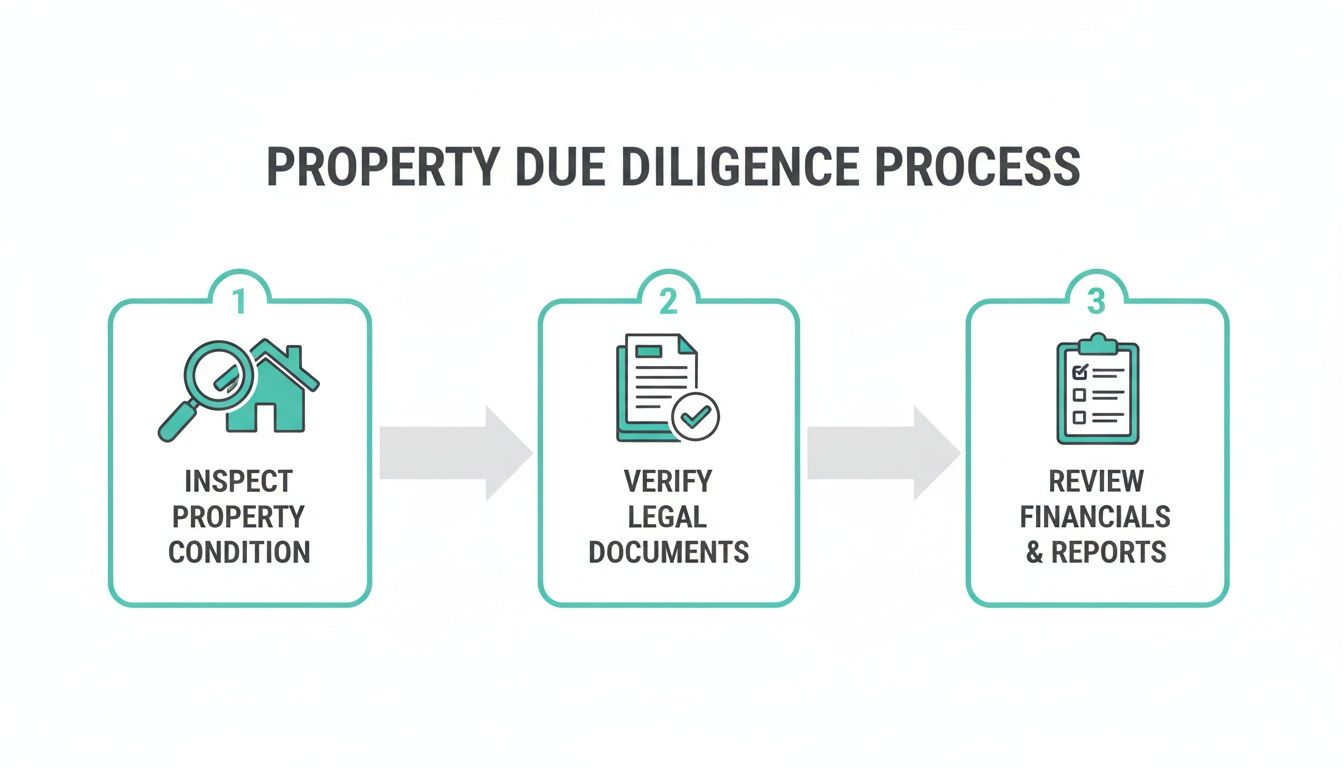
This systematic process—inspecting the property, verifying legal documents, and reviewing financials—is non-negotiable. It’s how you make sure your numbers line up with reality before you close.
A disciplined approach like this is critical in a competitive market. It's the investors with the most precise underwriting who win. The numbers, when you trust them, will always guide you to a smart, data-backed decision.
Answering a Few Common Property Analysis Questions
Even with the best spreadsheets and calculators, a few questions always come up when you're digging into a potential deal. Getting these sorted out will sharpen your process and help you analyze properties with more confidence.
What Is the 50 Percent Rule and Should I Actually Use It?
You’ve probably heard of the 50% Rule. It's a quick screening tool that suggests a property's operating expenses (everything except the mortgage) will be about 50% of its gross income. It’s handy for a back-of-the-napkin check to see if a deal is in the ballpark, but you should never use it to make a final decision.
Think of it as a first filter, not the final word. Real-world expenses can swing wildly depending on the property's age, location, and condition. Always ditch the rule of thumb and hunt down actual numbers for your real underwriting.
Where Does Market Analysis Fit into All This?
Market analysis is the context that gives your numbers meaning. A property might look fantastic on paper, but if it's in a city with a shrinking job market or declining population, that cash flow is at risk.
A great property in a terrible market is almost always a bad investment. You must pair your property-level analysis with a hard look at local job growth, population trends, and rental demand.
What Are the Biggest Mistakes Investors Make Here?
The most common mistakes are underestimating expenses (especially CapEx), being too optimistic about future rent growth, and skipping a thorough physical inspection.
Another major mistake is becoming emotional. Investors can get "deal fever," fall in love with a property, and start fudging their numbers to make it work. Discipline is everything. Trust your underwriting, stick to your buy box criteria, and be willing to walk away. Protecting your capital for the right opportunity is how you build long-term wealth.
A robust real estate investment property analysis is your most important skill. It protects your capital, identifies true opportunities, and provides the confidence to build a successful portfolio.
Create your free investor profile to get matched with deals that fit your criteria.