If you've ever tried to manage more than a couple of rental units using a clunky spreadsheet, you know the pain. It starts out fine, but pretty soon you're juggling sticky notes for maintenance requests, digging through texts for tenant conversations, and trying to remember who paid rent on the 1st versus the 5th. This is the operational drag that keeps many investors stuck in the weeds instead of focused on growing their portfolio.
This is where multifamily property management software comes in. It’s not just a digital upgrade; it's a fundamental shift in how you run your business, moving you from an overwhelmed landlord to a strategic investor who can actually scale. This guide breaks down what these platforms do, which features matter, and how to choose the right one for your real estate business.
Why Smart Investors Ditch the Spreadsheets

The leap from a duplex to a 20-unit building isn't just a numbers game—the complexity explodes. The manual hacks that got you through your first few doors will absolutely break as you grow, leading to costly mistakes, missed rent payments, and significant frustration. Every investor hits this wall eventually.
The real problem is that everything is scattered. Tenant info is in one file, rent rolls are in another, and maintenance requests are a chaotic mix of emails and voicemails. This administrative grind doesn't just waste your time; it actively pulls you away from high-value activities—finding new deals, securing financing, and building your network on platforms that connect you with partners.
The Strategic Shift to Automation
This is the exact moment when dedicated software stops being a "nice to have" and becomes a necessity. It pulls all those scattered, time-sucking tasks into one clean, organized dashboard. Think of it less as software and more as hiring a full-time, hyper-organized assistant who never sleeps or makes a typo.
Instead of hounding a tenant for late rent, the system sends an automatic reminder on the 6th of the month. Instead of playing phone tag with a plumber, you can assign a work order, track its progress, and pay the invoice all in one place. This is the kind of efficiency that makes scaling possible. We dive even deeper into these concepts in our ultimate guide to property management.
Investors who make the switch almost always point to these game-changing benefits:
- One Source of Truth: All your tenant data, leases, financial records, and maintenance history live in one secure spot. You get a real-time, objective look at how your entire portfolio is performing.
- Rock-Solid Cash Flow: Automated rent collection and expense tracking give you a crystal-clear picture of your finances. You know your Net Operating Income (NOI)—a key metric showing profitability before debt service—down to the dollar, which makes forecasting and planning a breeze.
- Happier Tenants, Less Turnover: Giving tenants an online portal to pay rent and submit maintenance requests isn't just convenient; it's what they expect. Happy tenants stay longer, which saves you a fortune in turnover costs.
For Beginners: This software is like having built-in guardrails, guiding you with best practices from day one. For Experienced Investors: It's the key to managing more doors with less overhead, freeing you up to chase bigger, better deals.
Ultimately, using the right software is about making the jump from an active landlord to a strategic asset manager. It allows you to spend your energy on increasing your portfolio's value, not getting lost in paperwork. In a competitive market, it’s not a luxury—it’s the cost of entry for long-term success.
What Are the Core Software Features You Actually Need?
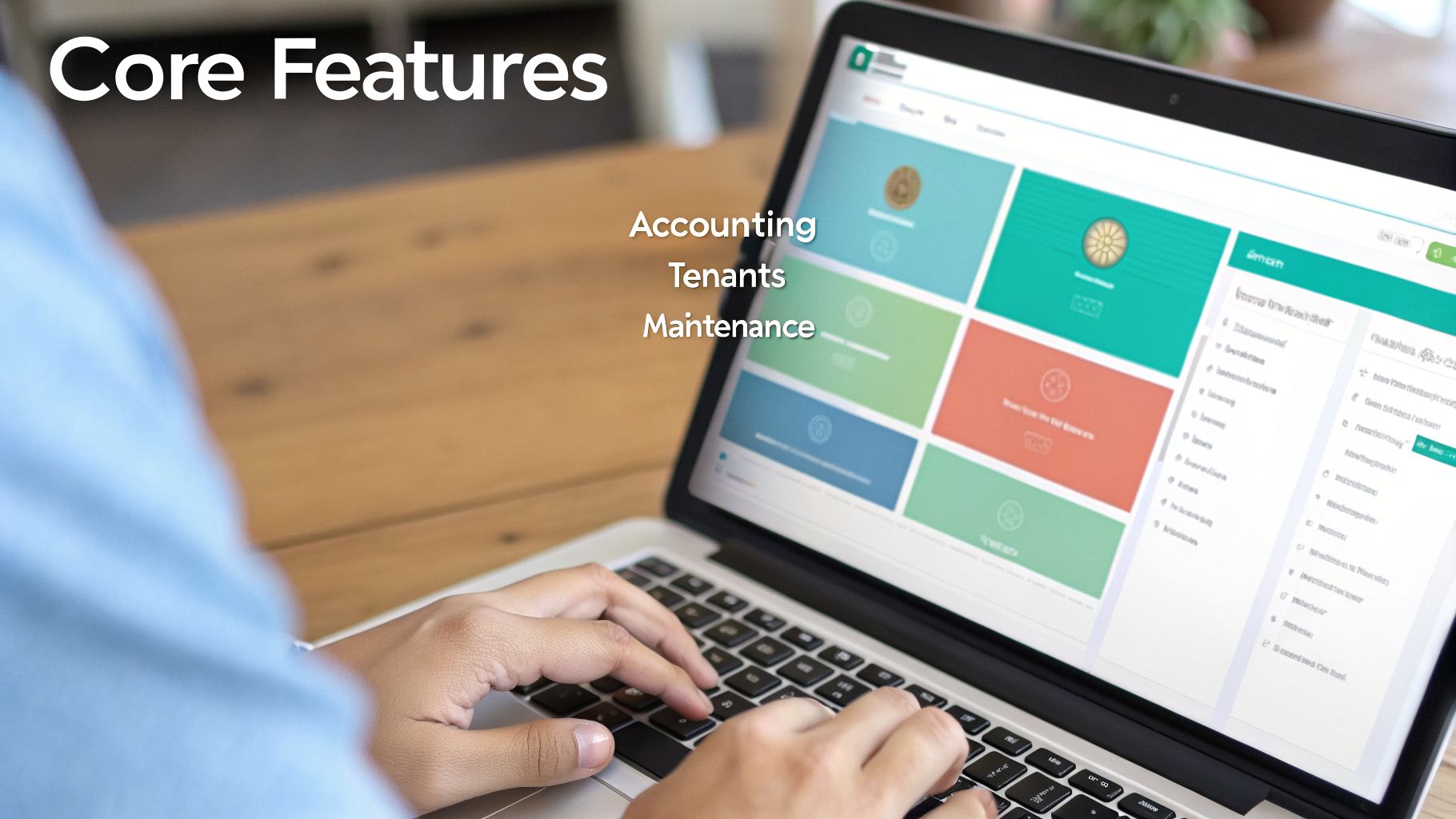
While it's easy to get distracted by flashy, advanced tools, any good property management software is built on a handful of non-negotiable features. Think of these as the engine of your entire operation. They handle the daily, repetitive tasks that make or break your profitability. Get them right, and you free yourself from endless administrative headaches and costly slip-ups.
These core functions are no longer chained to a desktop computer. The whole industry has moved to cloud-based systems, giving you the flexibility to manage your portfolio from anywhere. This isn't just a trend; it's a fundamental shift in how successful investors operate. The U.S. market, valued at $1,059.1 million in 2025, is expected to hit $1,622.1 million by 2033, driven almost entirely by this move to the cloud. You can explore more data on this market expansion to see where the industry is headed.
Let's break down the essential functions and what they mean for your bottom line. The table below outlines the core features and explains exactly why they matter to a multifamily investor.
Essential Software Features and Their Investor Impact
| Feature | What It Does | Key Benefit for Investors |
|---|---|---|
| Accounting & Financials | Automates rent collection, tracks every expense, and generates P&L statements. | Gives you a real-time, accurate picture of your cash flow and profitability. |
| Tenant & Lease Management | Acts as a central digital database for all tenant info, leases, and communications. | Eliminates messy paperwork and creates a clear, professional record of every interaction. |
| Maintenance & Work Orders | Turns tenant repair requests into a trackable, streamlined process from start to finish. | Prevents missed requests, boosts tenant satisfaction, and protects your asset's value. |
These three pillars work together to form the operational backbone of your portfolio. When they're automated and integrated, you spend less time putting out fires and more time focused on growth.
Accounting and Financial Reporting
For any investor, cash flow is everything. The accounting module is the financial heart of the software, and it automates the most critical—and often tedious—financial tasks. This is the difference between guessing how your properties are doing and knowing down to the penny.
Key functions you can't live without include:
- Automated Rent Collection: The system handles online rent payments, sends out automatic reminders for late payments, and applies fees based on your lease terms. This single feature drastically cuts down on late payments and awkward follow-up calls.
- Expense Tracking: You can log and categorize every single dollar that goes out, from utility bills to a contractor’s invoice. This creates a clean, auditable financial record that makes tax time a breeze and shows you exactly where your money is going.
- Financial Reporting: With just a few clicks, you can generate essential reports like your Profit & Loss (P&L), rent roll, and balance sheet. This data is crucial for analyzing asset performance and reporting back to your partners or lenders.
For Beginners: Get obsessed with the P&L statement. It’s your portfolio’s report card, telling you exactly how much money you’re making (or losing) each month. For Experienced Investors: Use the custom reporting to track specific Key Performance Indicators (KPIs) like your expense ratio per unit or the Net Operating Income (NOI) trends across your entire portfolio.
Tenant and Lease Management
A centralized database for all your tenant and lease information means no more digging through disorganized folders or frantically searching for a signed lease. This feature acts as your digital filing cabinet, keeping every critical detail organized and instantly accessible.
The module manages everything from applicant screening and lease creation to ongoing communication. It lets you handle digital applications, run background and credit checks, and get e-signatures on lease agreements. Better yet, when a tenant has a question or a complaint, every email and message is logged in one place. This creates a clear, undeniable record of every interaction—vital for maintaining professional relationships and heading off potential disputes.
Maintenance and Work Order Tracking
Nothing kills a tenant relationship faster than a maintenance request that goes into a black hole. A solid work order system transforms chaotic repair requests into a streamlined, completely transparent process.
When a tenant reports a leaky faucet through their online portal, the system instantly logs it and creates a work order. You can then assign that order to a vendor, track its status in real time, and even have the vendor upload photos or an invoice when the job is done. This simple workflow ensures no request ever falls through the cracks, gives you a complete maintenance history for every unit, and keeps tenants happy because they know they've been heard. It’s a win-win that boosts resident satisfaction while protecting the physical condition of your asset.
Advanced Features for Scaling Your Portfolio
Once your core operations are running smoothly, it's time to add the horsepower that really separates the pros from the amateurs. For serious operators, growing from a few properties to a real portfolio isn't about just doing more of the same. It's about moving past basic management and into strategic, high-level optimization.
That's exactly what the advanced features in today's multifamily property management software are for. They give you the data-driven insights you need to squeeze more revenue out of your assets, grow more efficiently, and make smarter acquisitions. These aren't just small tweaks; they're tools that let you manage more units with less overhead, turning a mountain of operational data into simple, actionable advice. This is how you stop just managing properties and start actively optimizing a high-performance portfolio.
AI-Powered Analytics and Revenue Management
The biggest game-changer in property management tech is, without a doubt, Artificial Intelligence (AI). AI-powered analytics tools dig through huge piles of data—your own past performance, current market comps, even local economic trends—to give you predictive insights that were pure science fiction just a few years ago.
These systems are completely changing how investors think about pricing and occupancy. The ground is shifting fast, and smart automation is becoming a major advantage. In fact, projections show that by 2026, 58% of successful property management companies will be using AI. This tech helps with everything from sorting through leads to forecasting occupancy, and it's been shown to cut down unit downtime by as much as 25%. You can see more on how AI is reshaping the multifamily world on Yardi.com.
Here's what these AI tools actually do:
- Dynamic Rent Pricing: Forget setting rents once a year and hoping for the best. AI algorithms can suggest daily or weekly rent adjustments based on real-time supply, demand, seasonality, and what your competitors are charging. This ensures you're not leaving money on the table.
- Vacancy Forecasting: By analyzing lease expiration dates, historical turnover rates, and market shifts, the software can predict when you'll have vacancies. This gives your marketing team a head start to minimize lost rent.
- Proactive Risk Management: AI is great at spotting unusual patterns in your financial data. For example, a sudden spike in utility costs for one building could be flagged by the system, alerting you to a potential water leak long before it becomes a five-figure problem.
Marketing and Leasing Automation
Filling empty units fast is the name of the game for maximizing NOI. Advanced marketing and leasing automation tools build a powerful, always-on leasing machine that works 24/7 to bring in and convert new prospects. This frees up your team from repetitive tasks so they can focus on what they do best: closing deals and taking care of residents.
For experienced investors, automation isn't about replacing people. It's about making them more effective. When an AI leasing agent can handle the first round of questions around the clock, your human agents can pour their energy into qualified prospects who are actually ready to sign a lease.
These automation tools usually include:
- Listing Syndication: With a single click, your vacant unit gets posted to dozens of top rental sites like Zillow, Apartments.com, and others, getting you maximum exposure instantly.
- AI Leasing Agents: Smart chatbots on your website can answer common questions, schedule tours, and even pre-qualify leads 24/7. You literally never miss an inquiry, even if it comes in at 2 a.m.
- Virtual and Self-Guided Tours: Giving prospects the freedom to tour units on their own time—either with a virtual walkthrough or in-person using smart lock technology—dramatically increases the number of tours you can do and speeds up the entire leasing cycle.
By putting these advanced features to work, you build a scalable system that not only makes your current portfolio more profitable but also prepares you to absorb new acquisitions without breaking a sweat. This is the tech foundation that lets sophisticated investors grow their holdings without proportionally growing their administrative headaches.
How to Choose the Right Software for Your Business
Picking a multifamily property management software feels like a huge decision, because it is. You’re choosing a long-term partner that will become the operational backbone of your entire portfolio.
With so many options, it’s easy to get lost in slick marketing and endless feature lists. The trick is to tune out the noise and figure out what you actually need. Don't get distracted by the flashiest website. Instead, think like an investor analyzing a deal—use a clear framework, be critical, and focus on what will deliver long-term returns.
Assess Your Portfolio's Needs First
Before you even watch a demo, you need to get honest about your own operational headaches and where you want to go. What works for a 100-unit syndicator is probably massive overkill for an investor with 15 units.
Start by asking yourself some practical questions:
- What are my biggest time-wasters right now? Is it chasing down rent checks, coordinating maintenance calls, or pulling together reports for your partners? Pinpoint the exact friction you want software to fix.
- What's my growth plan for the next 3-5 years? If you’re planning to jump from 20 units to 200, you need a platform that can scale with you without hitting you with punitive fees.
- Who is actually going to use this? Think about the tech-savviness of everyone involved—your property managers, bookkeepers, and maintenance crew. A powerful system that’s a pain to use will just gather digital dust.
For beginners: Your top priority should be the core functions: online rent collection, a simple way to communicate with tenants, and basic expense tracking. Don't overpay for advanced features you won’t touch for years. For experienced investors: You should be looking for robust reporting, the ability to connect with other tools (APIs), and deeper analytics. Your goal is optimizing the entire portfolio, not just managing one building.
Key Evaluation Criteria
Once you know what you need, you can start looking at vendors. The best way to do this is with a simple scorecard to compare your top picks. It keeps the process objective and makes sure you don't forget something critical.
Let’s break it down into four key areas.
Software Vendor Evaluation Checklist
Use this checklist as your starting point when you're sitting in on demos or doing your research. It forces you to compare each platform apples-to-apples, so you can see past the sales pitch and focus on what really matters for your business.
| Evaluation Criteria | Vendor A | Vendor B | Vendor C |
|---|---|---|---|
| Scalability & Pricing | |||
| User-Friendliness (UI/UX) | |||
| Core Features Match Needs | |||
| Advanced Features (If Needed) | |||
| Integration Capabilities (API) | |||
| Reporting & Analytics | |||
| Customer Support Quality | |||
| Onboarding & Training | |||
| Mobile App Functionality | |||
| User Reviews & Reputation | |||
| Total Cost of Ownership |
After you fill this out, a clear winner often emerges—and it's not always the one with the best marketing. The right choice is the one that best fits your specific operational DNA.
Scalability
Your software has to work for your business today and where it’s headed tomorrow. A system designed for small landlords will crumble under the weight of a growing portfolio with multiple properties. Make sure you check whether they use per-unit pricing or tiered plans so you understand exactly how your costs will change as you add more doors.
User-Friendliness
A platform loaded with features is completely useless if your team hates using it. During demos, pay close attention to the user interface (UI). Does it feel intuitive and clean? Can you find what you need in a couple of clicks, or is it buried under five layers of confusing menus? If it feels clunky to you, it will feel ten times worse to a busy property manager.
This decision tree shows how your feature needs evolve as you scale, moving from basic automation to more advanced AI analytics.
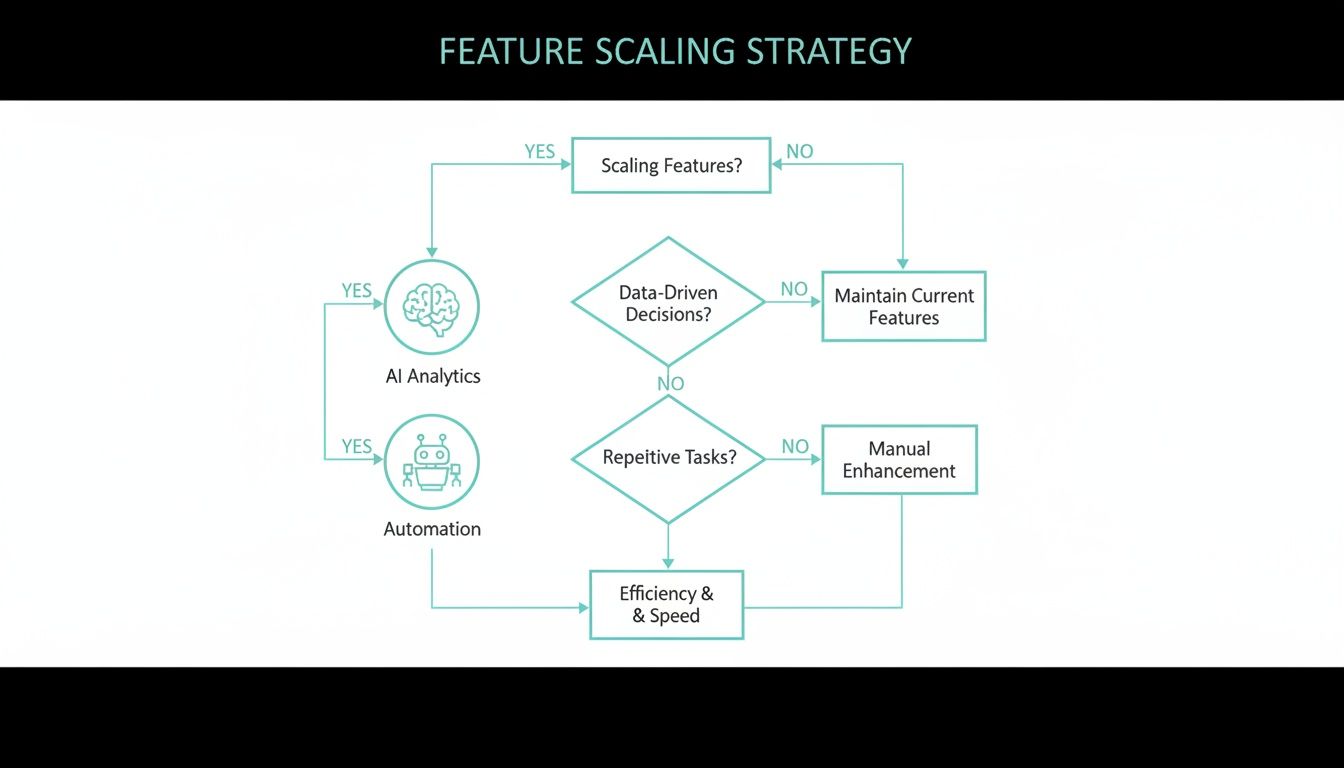
The key takeaway here is that while automation gets you initial efficiency, true scale comes from layering in AI-driven insights to make smarter, faster decisions.
Integration Capabilities
Your property management software doesn't live on an island. It needs to play nicely with the other tools you use, like your accounting software or investor portals on our marketplace. Look for vendors that have an open API (Application Programming Interface), which is a technical way of saying it can share data with other systems without a bunch of manual work.
Customer Support
When something inevitably breaks or you can’t figure something out, you need help—and you need it fast. Before you sign anything, dig into the vendor’s support options. Can you actually call a human, or are you stuck submitting a ticket and hoping for a reply sometime this week? Go read user reviews and see what people say specifically about their support experience. This is one of the most overlooked—and most critical—parts of the entire decision.
Integrating Software Data with Your Deal Pipeline
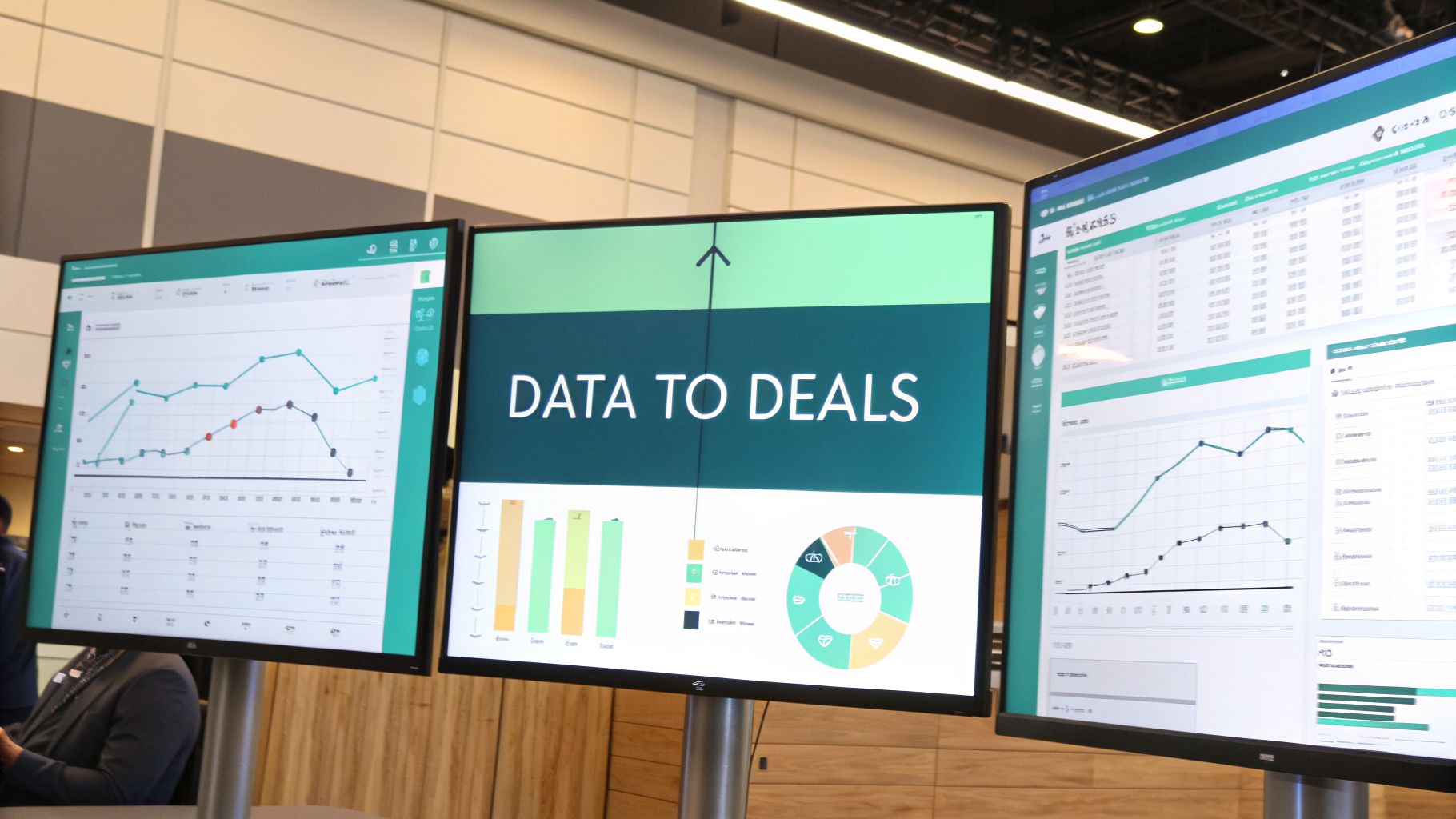
This is where the savviest investors really pull ahead. They don't see managing their current portfolio and hunting for new deals as two separate jobs. Instead, they build a powerful feedback loop where clean, accurate data from their multifamily property management software directly fuels their acquisition strategy.
Think of it this way: your software is busy optimizing the assets you already own, while a deal-finding platform like our marketplace is the engine for acquiring new ones. The real magic happens when you connect them. Suddenly, real-time numbers like Net Operating Income (NOI), expense ratios, and vacancy rates become your secret weapon for the next deal.
This data-driven approach pulls you out of the world of guesswork and into a cycle of proven success. You stop chasing random deals and start acquiring properties that fit a model you’ve already validated with your own portfolio.
From Data to Deals in Practice
Imagine your property management software spits out a report showing that your 2-bedroom, 1-bath units in a specific zip code are your golden geese. They consistently have the lowest vacancy rates and the best rent growth. This isn't a hunch; it's a hard fact pulled directly from your operational data.
Instead of letting that insight get buried in a PDF, you put it to work. You can then log into our investor marketplace and sharpen your buy-box to target those exact winning criteria.
- Property Type: Multifamily
- Unit Mix: At least 50% 2-bedroom units
- Location: The specific, high-performing zip codes
- Metrics: A target cap rate that mirrors your proven performers
Now, the platform cuts through all the noise. By setting up a profile with your criteria, you only see deals that match the DNA of your most successful assets. This networking and deal-sourcing advantage dramatically speeds up your path to a larger, more profitable portfolio.
The Advantage for Syndicators and Portfolio Builders
For investors looking to scale, especially those eyeing multifamily syndications on platforms like ours, this connection between operational data and deal sourcing is a complete game-changer. Integrated analytics can feed you real-time NOI, cap rates, and ROI projections, which perfectly complements the built-in calculators that help you filter thousands of listings by unit counts or development potential.
As North America continues to lead in adopting these tools, the global shift toward AI-enhanced systems promises even faster, smarter underwriting. You can learn more about this growing market on Reportprime.com.
By connecting the performance data from your software to your deal-sourcing criteria on a marketplace, you create a self-reinforcing system for growth. Your acquisitions get smarter, your underwriting gets faster, and your portfolio expands based on a repeatable, proven model.
This feedback loop helps you truly understand what makes an asset perform well for you. It gives you the confidence to act fast when a deal matching your proven formula hits the market. You can make more competitive offers, backed by your own hard numbers, giving you a huge leg up on investors who are still running their numbers from scratch.
Of course, a solid grasp of the underlying financial metrics is essential. That's exactly why we put together this guide on how to value a commercial property.
Calculating the ROI of Your Software Investment
Is that new multifamily property management software actually worth the monthly fee? For any sharp investor, every new expense has to pull its own weight and deliver a clear Return on Investment (ROI). The good news is, the ROI here isn’t some abstract concept—it’s about real, measurable financial gains you can track.
To see the full picture, you need to look at two different kinds of wins: the easy-to-count "hard savings" and the just-as-important "soft savings."
Tallying Up the Hard Savings
Hard savings are the direct, dollar-for-dollar wins you can circle on your P&L statement. These are the most straightforward numbers to track when you're making the case for the software.
Consider these practical examples:
- Reduced Administrative Hours: First, track the time your team (or you) spends on manual grunt work—chasing late rent, sifting through paper applications, and playing telephone to coordinate maintenance. Automating this can easily claw back 5-10 hours per week, which either slashes your labor costs or frees you up for work that actually grows the business.
- Lower Vacancy Rates: Every day a unit sits empty, you're losing money. Software that syndicates your listings and automates leasing can easily shorten your vacancy period by 10-15 days between tenants. For a unit renting at $1,500/month, that’s an extra $500-$750 that goes straight to your bottom line.
- Decreased Maintenance Costs: A good preventative maintenance scheduler is your best friend. It helps you fix a small leak before it becomes a catastrophic flood that costs you thousands. One common approach is to budget for preventative maintenance, which can cut overall repair costs by 12-18% a year.
On a small 20-unit building, saving just $25 per unit per month from these efficiencies adds up to a clean $6,000 a year. That alone often covers the software subscription several times over.
Accounting for the Soft Savings
Soft savings are a little harder to pin a number on, but they're just as critical to your long-term success. These are the benefits that improve relationships, slash your risk, and let you make smarter moves as an owner.
Don't underestimate these long-term game-changers:
- Improved Tenant Retention: It’s simple: happy tenants stay put. An online portal for paying rent and logging maintenance requests isn't a perk anymore; it's what people expect. If you can cut your turnover by just one unit a year, you save thousands in make-ready costs, marketing, and lost rent.
- Better Strategic Decisions: Clean, accurate data leads to smarter decisions. Period. With real-time reports on your NOI, expense ratios, and rent comps, you can instantly spot which assets are underperforming. This lets you make data-backed calls on rent bumps, capital projects, or even when it’s time to sell. That kind of clarity is priceless.
- Enhanced Investor Confidence: If you're a syndicator, this one is huge. Delivering professional, on-demand reports builds a massive amount of trust and credibility with your capital partners. That makes it way easier to raise money for the next deal and helps you scale your portfolio faster.
When you add up the hard and soft savings, the argument for investing in good property management software becomes a no-brainer. To run the numbers on your own portfolio, you can explore different financial models and check out the property investment calculators on our site. At the end of the day, the monthly fee is a small price to pay for the efficiency and strategic insight you gain.
Common Questions About Multifamily Property Management Software
Even with all the benefits laid out, it's smart to pause and ask a few final questions before you pull the trigger on a new system. Choosing a multifamily property management software is a big move that’ll shape your daily operations and long-term growth.
Let's clear up a few of the most common questions investors have before they commit.
How Much Does This Software Typically Cost?
There's no one-size-fits-all price tag. The cost really depends on the provider you choose and the size of your portfolio. That said, most pricing models fall into one of two camps.
Per-Unit, Per-Month Fee: This is the most common setup. You pay a set price for each door you manage, which often falls somewhere between $1.00 to $3.00 per unit. It’s a great model for new investors because it scales right alongside your portfolio—you only pay for what you're actually using.
Tiered Subscriptions: Other companies offer packages based on unit counts, like one tier for 1-50 units and another for 51-200 units. These plans come with a flat monthly or annual fee and usually unlock more powerful features as you move up the ladder. For larger portfolios, this can be the more cost-effective route.
When you're comparing prices, don't just look at the monthly fee. Always ask about one-time setup costs, data migration fees, and extra charges for premium support or add-on modules. The "Total Cost of Ownership" is the number that really matters.
How Difficult Is It to Switch from My Current System?
The thought of moving years of tenant data and financial records can feel daunting. But here's the good news: modern software providers have made this process way smoother than it used to be. Most reputable companies have a dedicated onboarding team whose whole job is to get you moved over and running smoothly.
The process usually looks something like this:
- Data Extraction: You’ll pull all your existing data out of your spreadsheets or old system. This includes tenant info, lease details, payment histories, and financial records.
- Data Mapping and Import: The onboarding team helps "map" your old data to the new system's fields before they handle the import. They'll run checks to make sure nothing got lost in translation.
- Team Training: Once the data is in, the provider will walk you and your team through the new platform. This ensures everyone is comfortable with daily tasks like collecting rent or logging maintenance requests from day one.
Yes, it takes some upfront effort, but a well-managed migration typically only takes a few weeks. The long-term efficiency you gain almost always makes the short-term hassle a distant memory.
Can I Manage Different Property Types in One Platform?
Absolutely. In fact, this is one of the biggest reasons investors with diverse portfolios make the switch. Most modern multifamily property management software is built for flexibility.
You can easily manage a whole mix of assets—a small apartment building, a handful of scattered duplexes, and even commercial or mixed-use properties—all from a single dashboard.
The software lets you segment your portfolio and apply unique settings for each property. This means you can run separate financial reports for your 10-unit building and your commercial storefront while still getting a consolidated, high-level view of how your entire portfolio is performing. For an investor who doesn’t stick to just one asset class, that kind of adaptability is non-negotiable.
Ready to stop drowning in spreadsheets and start scaling your portfolio with data-driven precision? Create your free investor profile to get matched with deals that fit your criteria.