What is a land development feasibility analysis? Think of it as the most critical investigation you will ever conduct before buying a piece of land. It's the disciplined process of determining if you can actually and profitably execute your project on a specific parcel—before you risk any serious capital. This guide provides a step-by-step framework that both new and seasoned investors can use to de-risk their next land deal.
Why a Feasibility Analysis Is Your Most Critical Tool
Before a single shovel hits the ground, the fate of a land development project is often decided during due diligence. This analysis isn't just a procedural box-checking exercise; it’s the strategic playbook that separates a profitable home run from a money pit. A proper study forces you to challenge assumptions with cold, hard data, building an evidence-backed case that gives you, your partners, and your lenders the confidence to move forward.
Core Components of the Analysis
The goal is to systematically de-risk the project by looking at it from every angle. This process boils down to four key questions:
- Market Viability: Will anyone actually buy or lease what I want to build here?
- Legal & Regulatory Hurdles: Will the municipality permit this project, and what are the requirements?
- Physical & Site Constraints: What are the ground conditions? Are utilities accessible? Will the topography create expensive problems?
- Financial Profitability: Can this project make money? A detailed pro forma is needed to project costs, revenue, and realistic returns.
This process is sequential; each stage logically builds on the one before it.
This flow is common sense. If there's no market for your product, zoning is irrelevant. If you can’t secure the proper zoning, running the financial numbers is a fantasy exercise.
To help break this down, here's a quick summary of the pillars that hold up any solid feasibility study.
Key Pillars of a Feasibility Analysis
| Analysis Pillar | What It Answers | Why It Matters for Investors |
|---|---|---|
| Market Analysis | "Is there real demand for my proposed project in this location?" | Confirms your end product has buyers or tenants, preventing you from building something nobody wants. |
| Zoning & Entitlements | "Can I legally build what I want, and how long will approvals take?" | Identifies deal-killing red tape early and helps estimate critical timeline risks. |
| Site & Infrastructure | "Is the land physically suitable, and are utilities accessible?" | Uncovers hidden costs related to topography, soil issues, or bringing utilities to the site. |
| Financial Modeling | "Will this project actually be profitable after all costs are paid?" | Quantifies potential return on investment (ROI), turning a concept into an investment case. |
Each pillar supports the next. If one is weak, the entire structure can collapse.
The Growing Importance of Diligence
Make no mistake, land development is a competitive sector. In the U.S. alone, the industry saw a compound annual growth rate (CAGR) of 6.2% between 2020 and 2025, growing to an estimated $22.9 billion market. That growth creates opportunity but also attracts fierce competition, which makes your upfront homework more critical than ever.
For beginners: Start with market and zoning. If the market doesn't want what you're selling or the city won't let you build it, none of the other details matter. Master those first.
For experienced investors: Use this framework to ruthlessly stress-test your assumptions. What happens to your Internal Rate of Return (IRR) if entitlements drag on for an extra six months? What if hard costs jump by 10%? The analysis is your tool for turning vague risks into hard numbers.
Getting this right is as foundational as knowing how to value a commercial property is for a buy-and-hold investor. It’s a non-negotiable skill.
Gauging Demand with Market and Site Assessment
Every successful land deal starts by answering two honest questions: Does anyone actually want what I’m planning to build? And is this particular piece of dirt the right place for it? Your feasibility study must tackle this head-on, starting with a 30,000-foot view of the market before putting boots on the ground. Get this part wrong, and you could end up with a great project in a terrible location.
Is the Market on Your Side?
First, you need to validate that tangible demand exists for your end product. Whether you're planning single-family homes, a small apartment building, or a strip mall, you must follow the data, not your gut. Smart investors constantly track these indicators:
- Population and Job Growth: Is the local population growing? Check census data and city economic reports. A strong job market is the engine of all real estate, so identify major employers. Are they hiring and expanding, or laying people off?
- Sales and Rental Comps: You have to dig into what similar properties are actually selling or leasing for. If building homes, what’s the price per square foot for new construction? If it’s a rental play, what are current market rents and vacancy rates? Our guide on how to calculate cap rate is a great place to start for income properties.
This isn't just about your local submarket. Globally, the land development market is projected to grow from USD 350 billion in 2025 to USD 585 billion by 2032, fueled by powerful urbanization trends.
Getting to Know Your Piece of Land
Once you’ve confirmed the market has an appetite for your project, it’s time to zoom in on the parcel itself. This is where hidden costs and nasty surprises often hide.
Investor Takeaway: Never fall in love with a piece of land from your car. You have to walk it, study it, and pay experts to tell you what’s happening above and below the surface. A gentle slope can easily turn into a six-figure drainage and grading problem.
Here’s a quick checklist of what to look for on-site:
- Topography and Grading: Does the land have a significant slope? Anything that isn't relatively flat will add serious costs for earthwork and foundations.
- Soil Conditions: A geotechnical report is non-negotiable. This report will tell you if the soil is stable enough to build on or if you’re about to hit rock that will obliterate your excavation budget.
- Utility Access: Where are the nearest tie-ins for water, sewer, power, and gas? Extending utilities just a few hundred feet can cost tens of thousands. You must call local utility providers to confirm location and capacity.
- Access and Frontage: How does the property connect to a public road? Is there enough road frontage for the necessary driveways? Legal access issues can sink a project before it starts.
On an investor marketplace, you can often filter land listings by these critical criteria, like utility availability or road frontage. This helps screen out non-starters and saves time before you drive out to a site.
Navigating Zoning Regulations and Entitlements
You can find a beautiful piece of land with incredible market demand, but if the local government won’t let you build what you want on it, it’s just expensive dirt. This is where many deals fall apart. The jump from market theory to the real-world headache of zoning, permits, and entitlements is where a land development feasibility analysis gets real, fast.
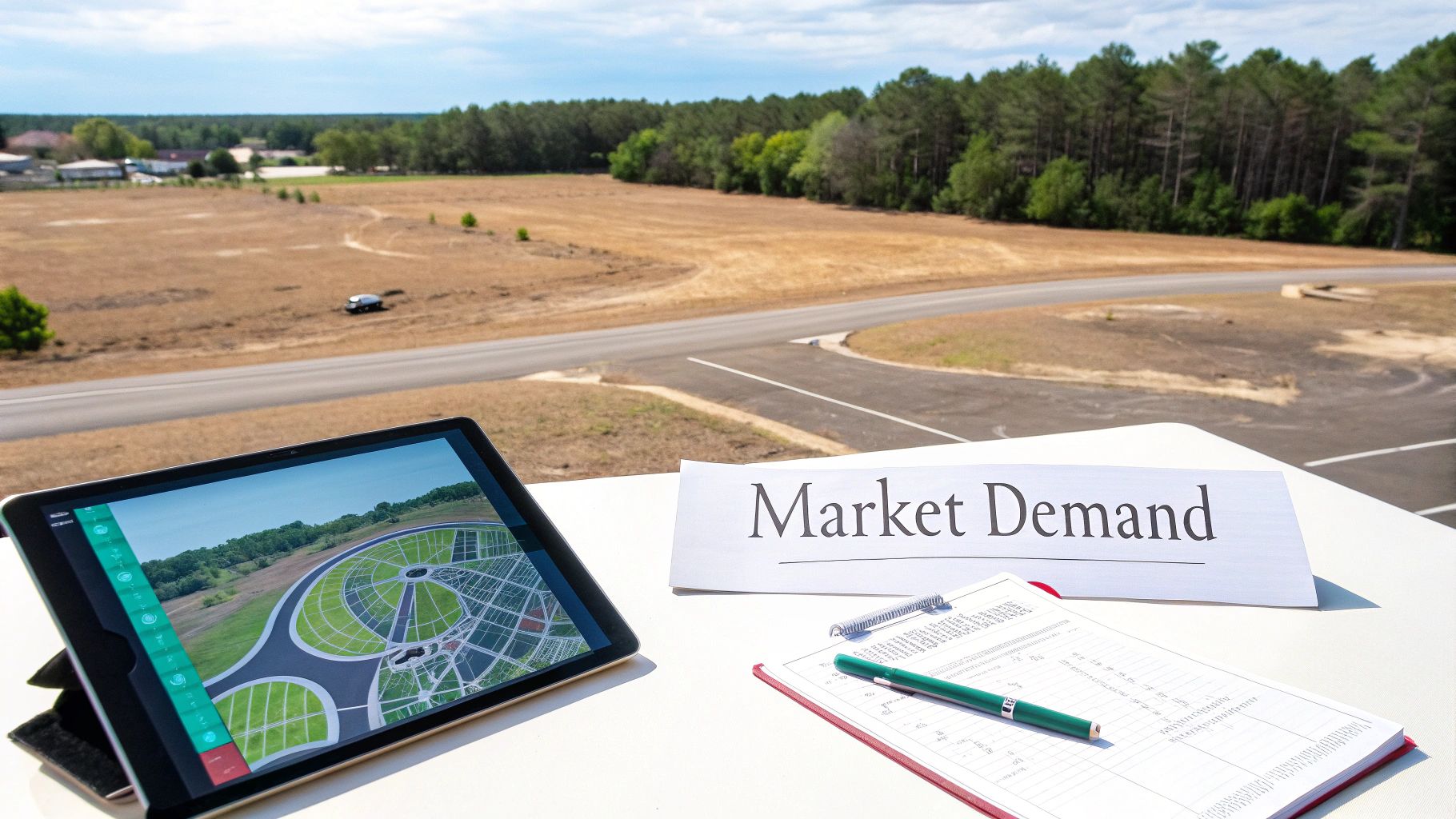
Getting through this maze is about a systematic process for figuring out what you can build, how much you can build, and how long it will take to get the green light. One wrong assumption here can wreck your project's timeline and budget.
Decoding the Zoning Ordinance
Your first stop is the local zoning code, the official rulebook for development. The goal is to find the property's specific zoning designation (e.g., R-2 for duplexes or C-1 for commercial) and understand what that allows. You need clear answers to a few non-negotiable questions:
- Permitted Uses: Is your project allowed "by-right"? A by-right use means your project fits the existing code and likely only needs administrative approval, avoiding a lengthy public hearing process.
- Setbacks: How far back from the front, side, and rear property lines must buildings be? This directly shrinks your buildable area.
- Density and Lot Coverage: What’s the maximum number of units per acre allowed? What percentage of the lot can be covered by buildings? These two numbers dictate the scale of your project.
- Height Restrictions: How high can you build? This is a make-or-break factor for multifamily or commercial development.
These are hard limits that will fundamentally shape your site plan and, by extension, your financial projections.
Understanding the Entitlement Process
It’s rare to find a property that’s already zoned perfectly. More often, you'll need some level of municipal approval. This is the entitlement process—the formal, often bureaucratic, journey of securing the legal right to develop a property for a specific use.
The timeline and complexity can vary wildly. A building permit for a by-right single-family home might take a few weeks. A request to rezone a large parcel for a mixed-use development could turn into a multi-year process involving public hearings and significant legal fees.
Investor Takeaway: Time is money, and nowhere is that more true than in entitlements. Delays are one of the biggest hidden killers in land development. Every month spent waiting on approval is another month of carrying costs—taxes, insurance, and loan interest—eroding your profit margin.
Streamlining Your Search on the Platform
This initial zoning check is a critical but time-consuming part of any land development feasibility analysis. Driving to the planning department for every property is a recipe for burnout. This is where a good investor marketplace gives you a massive edge. By setting up a "buy box" or saved search on the platform, you can filter for specific zoning codes like 'Multifamily' or keywords like 'development potential.' This lets you kill non-starters from your desk, saving countless hours and focusing your energy only on deals with a realistic path to approval.
Putting Pen to Paper: Building Your Financial Pro Forma
You’ve confirmed market demand and navigated local zoning. Now comes the moment of truth: building your financial pro forma. This is where the vision gets distilled into dollars and cents. A solid pro forma is the financial story of your project, forecasting every dollar in and every dollar out, proving to you, your partners, and lenders that the deal makes sense.
Totalling Up Your Project Costs
First, you need to account for every conceivable expense. A common mistake is focusing on the construction budget while underestimating all the other costs that quietly eat away at profits. Your costs generally fall into three buckets:
- Hard Costs: The physical components—lumber, concrete, wiring, plumbing, and all the labor needed to assemble them.
- Soft Costs: The intangible but necessary expenses, such as architectural and engineering fees, permits, legal bills, and marketing.
- Financing Costs: Unless you’re paying all cash, you’ll have financing expenses, including loan origination fees, interest carry during construction, and other capital-related costs. You can get a deeper dive by checking out our complete guide to real estate financing options.
Sourcing accurate numbers is everything. For hard costs, get preliminary bids from general contractors. For soft costs, call architects, civil engineers, and land-use attorneys.
Investor Takeaway: Don't guess. Underestimating your budget is the fastest way to kill a development deal. Your preliminary pro forma needs to be built on real conversations with professionals, not wishful thinking.
Projecting Revenue and Your Capital Stack
With costs tallied, turn to the revenue side. This is where you answer, "Where is the money coming from?" The answer depends entirely on your exit strategy.
- For-Sale Projects: If building single-family homes or condos to sell, your revenue is the total projected sales price, based on recent comparable sales (comps) for similar new construction.
- For-Rent Projects: If building an apartment or commercial space to hold, your revenue is the projected rental income, based on current market rents minus an allowance for vacancy.
This is also where you'll map out your capital stack—the different sources of money paying for the project, including your own equity and any debt financing.
Sample Land Development Pro Forma Inputs
| Category | Line Item Example | Where to Get This Number |
|---|---|---|
| Uses of Funds (Costs) | Land Acquisition Cost | Purchase Agreement or Broker Opinion of Value |
| Site Work & Infrastructure | Civil Engineer's Estimate, Contractor Bids | |
| Building Construction (Hard Costs) | General Contractor's Preliminary Budget | |
| Architectural & Engineering Fees | Proposals from A&E Firms | |
| Permits & Impact Fees | Local Municipal Fee Schedule | |
| Loan Fees & Interest Carry | Term Sheet from Lender | |
| Legal & Professional Fees | Quotes from Attorneys, Accountants | |
| Developer Fee | Your own fee structure (e.g., % of total cost) | |
| Contingency | Standard is 5-10% of Hard Costs | |
| Sources of Funds (Capital) | Developer Equity | Your own capital contribution |
| Senior Construction Loan | Lender Term Sheet | |
| Investor Equity / Mezzanine Debt | Investor Agreements | |
| Projected Gross Sales Revenue | Market Comps from a Real Estate Broker | |
| Projected Gross Rental Income | Rental Comps, Market Rate Surveys |
This table provides a solid framework for the data you need to start building an accurate financial model.
The New Reality of Escalating Costs
Building an accurate pro forma is harder than it used to be. Construction cost escalation is a massive factor. In the US, input prices are forecasted to climb another 5-7% in 2025 due to supply chain issues and rebuilding efforts. This follows a tough 2024, where material costs jumped 12% after major hurricanes, causing an estimated 28% of planned projects to be postponed. You can find more global real estate market insights from firms like Aberdeen Investments.
What does this mean for you? Your pro forma must include a healthy contingency fund—usually 5-10% of total hard costs—to absorb these impacts and keep your project on track.
Using Quick-Analysis Tools to Vet Deals Faster
Building a detailed pro forma in Excel is non-negotiable for final underwriting. But when screening deals, you need to move fast. On our marketplace, for example, many listings have built-in calculators for a quick analysis. You can plug in high-level cost and revenue estimates to get an instant snapshot of key metrics like potential ROI. It’s how you efficiently sift through dozens of opportunities to find the few worth a full-blown financial model.
Conducting Risk Analysis for a Confident Decision
You have a detailed pro forma. Great. But a spreadsheet loaded with best-case scenarios is a financial fantasy. Now, you must relentlessly stress-test every assumption to see where the deal breaks. This process isn't about scaring yourself out of a deal; it’s about building confidence. By identifying potential threats early, you can build in safeguards and make a final go/no-go decision with a clear view of all outcomes.
Stress-Testing With Sensitivity Analysis
The most powerful weapon in your risk analysis arsenal is sensitivity analysis. It's the simple practice of changing one key variable in your pro forma at a time to see how it impacts your bottom line. What happens to your profit if construction costs jump 10%? What if rising interest rates push your loan carry up by 1.5%? What if final lot prices come in 5% lower than your comps suggested?
Running these scenarios instantly pinpoints your project’s biggest vulnerabilities. This process turns vague worries into specific, quantifiable risks you can manage.
Identifying and Mitigating Common Land Development Risks
While every deal has its own quirks, most landmines fall into a few familiar categories. Your feasibility study must tackle each one with a clear plan.
- Entitlement and Political Risk: Often the most unpredictable risk. A contentious planning commission or organized opposition can stall a project for months or even years.
- How to Handle It: Meet with planning staff before you're under contract. Get a feel for the local political climate and build extra time into your project timeline.
- Market Risk: You might build the perfect project, but if the broader economy takes a nosedive, demand can evaporate.
- How to Handle It: Consider phasing your development. Instead of building all 100 lots at once, perhaps build and sell the first 25 to validate the market and reduce your upfront capital exposure.
- Construction and Cost Risk: Material prices and labor availability can be incredibly volatile.
- How to Handle It: Lock in prices for key materials with suppliers as early as possible. Build a healthy contingency fund—at least 10% of hard costs—into your pro forma.
- Environmental and Site Risk: This is where you encounter "unforeseen conditions" like contaminated soil or hitting solid rock during excavation.
- How to Handle It: Never skip your due diligence reports. A Phase I Environmental Site Assessment and a thorough geotechnical report are non-negotiable investments.
Investor Takeaway: Risk mitigation isn't about making risk disappear. It's about turning unknown risks into known, manageable risks that you have a specific plan and budget to address.
The Final Decision Metrics
After all the number-crunching, it boils down to a few key metrics that tell you whether to pull the trigger.
- Return on Investment (ROI): The simplest metric. It’s your net profit divided by your total project cost. If you're projected to clear $500,000 on a $2,000,000 project, your ROI is 25%.
- Internal Rate of Return (IRR): This is more advanced because it factors in the time value of money, telling you the annualized rate of return on invested capital over the project's life. A high IRR on a short project is often more attractive than a lower IRR on a deal that ties up capital for years.
These metrics are the final verdict of your land development feasibility analysis. They arm you with the objective data needed to confidently decide which deals are worth your time and which to walk away from. You are no longer operating on gut feeling but on a foundation of rigorous, data-driven analysis.
Common Questions About Feasibility Analysis

Even with a solid framework, questions arise when you're deep in a land deal. A thorough land development feasibility analysis is a complex process, but understanding common sticking points can prevent expensive mistakes. Let’s tackle a few of the most frequent questions.
How Long Should a Feasibility Analysis Take?
There's no single answer. The timeline depends on project complexity. For a simple infill lot, where you're confirming zoning and estimating high-level costs, a preliminary analysis might take a week or two.
However, a comprehensive study for a large subdivision or commercial project is a different beast. You could easily be looking at several months to commission detailed geotechnical surveys, environmental impact reports, and traffic studies.
For beginners: Always negotiate a 30-60 day due diligence period in your purchase contract. This provides a realistic window to do your homework without being rushed into a bad decision. Don't let a seller pressure you into a shorter timeline.
What Is the Biggest Mistake Investors Make?
The most common and painful mistake is underestimating soft costs and the entitlement timeline. New investors often get tunnel vision on hard construction costs like lumber and concrete, forgetting to budget for all the other real and expensive items. Soft costs can easily account for 20-30% of your total project budget. These include:
- Architectural and engineering fees
- Permit and impact fees from the municipality
- Legal costs for zoning and contracts
- Financing fees and interest carry during construction
Equally deadly is assuming a smooth approval process. Entitlement delays are the rule, not the exception. A project you thought would be approved in three months could get stuck in public hearings for a year or more, all while holding costs erode your profits.
Can I Do a Feasibility Analysis Myself?
This depends on your experience and the project's scale. For smaller, straightforward deals, an experienced investor can handle much of the initial legwork—pulling zoning maps, running quick numbers, and checking market comps.
But once a deal looks serious, especially for larger projects, you must bring in professionals. Trying to be an expert in everything is a recipe for disaster. Your go-to team should include:
- A Civil Engineer for site planning, grading, and utilities.
- A Land-Use Attorney to navigate the politics of entitlements.
- An Architect to draw up site plans that meet code.
- A Geotechnical Engineer to ensure the ground is stable.
A hybrid approach often works best. Do the high-level screening yourself to filter potential deals. Once a property passes your initial check, bring in your expert team to dig into the technical details. They will either confirm your assumptions or raise the red flags you need to see.
Ready to find your next development opportunity? On our marketplace, you can set up your buy-box to filter for land with specific zoning or development potential, ensuring you only see deals that fit your strategy. Create your free investor profile today and start sourcing your next project with confidence.