
Finding good real estate deals can feel like searching for a needle in a haystack. The old-school methods—like refreshing the MLS or waiting for a broker's email—are crowded and slow, leaving you to waste hours sifting through retail listings that were never meant for investors. This guide explains how to join a real estate investor marketplace online to find consistent, quality deal flow and build your portfolio more efficiently.
Specialized online marketplaces are changing the game by connecting you directly to off-market and pre-vetted deals that actually fit your investment criteria.
Why Online Investor Marketplaces Are the New Standard

The biggest headache for any investor, whether you’re just getting started or are a seasoned operator, is finding consistent, high-quality deal flow. Spending weeks combing through the Multiple Listing Service (MLS) or relying on a broker’s inconsistent "hot list" is a massive time sink. You burn valuable hours underwriting properties that will never hit your numbers.
Online investor marketplaces are built from the ground up to solve this problem. They aren't for retail homebuyers, so every feature is designed for speed, efficiency, and making decisions with real data. Instead of flowery descriptions about curb appeal, you get the hard numbers that actually matter.
Speed and Specificity: The Real Advantage
The biggest win here is the ability to cut through all the noise. Think about it: one investor can spend weeks digging through the MLS, while another finds three qualified deals in a single afternoon on a dedicated platform. That's the power of a marketplace.
On our platform, you can set up a "Buy Box" with your exact criteria. This is a game-changer. You can filter for:
- Property Type: Single-family rentals, 2-4 unit multifamily, or even land for development.
- Financial Metrics: Minimum cash-on-cash return, a target capitalization rate (cap rate), or a specific net operating income (NOI).
- Location: Hyper-specific cities, entire counties, or even down to the zip code.
This kind of targeting means only deals that actually fit your strategy ever hit your dashboard. You stop chasing bad leads and start analyzing real opportunities. The difference in efficiency is staggering.
Traditional vs Marketplace Deal Sourcing
The time savings alone can completely transform your business. Instead of spending weeks on manual tasks, you can reallocate that time to analyzing deals and making offers. Here's a look at how the effort compares.
| Activity | Traditional Method (Time/Effort) | Online Marketplace (Time/Effort) |
|---|---|---|
| Finding Deals | Weeks of manual MLS searches, networking, cold calls | Minutes with automated alerts from a detailed Buy Box |
| Initial Underwriting | Hours manually inputting data into spreadsheets | Seconds with built-in calculators and data feeds |
| Vetting Sellers | Days or weeks building trust and verifying information | Minutes reviewing a wholesaler's deal history and platform reputation |
| Building a Pipeline | Inconsistent; depends entirely on manual effort | Consistent; new deals that match your criteria are added automatically |
As you can see, the marketplace model takes activities that used to consume your entire week and condenses them into a few clicks. This allows you to focus on high-value tasks, not busywork.
A Curated and Credible Network
These platforms are more than just listings; they’re a professional network. Wholesalers can post their deals directly to an audience of serious, pre-qualified buyers. This kills the need for them to maintain huge, unreliable email lists and make endless cold calls.
For an investor, this means the deals you see are often brought to you by people who understand what you’re looking for. It creates a space where your reputation and deal history matter, which builds trust and helps everyone close deals faster.
The global real estate market continues to grow, with projections hitting over $4 trillion, and a huge part of that growth is being driven by investors who use technology to gain a competitive edge. You can learn more about the global real estate investment trends that are shaping the industry.
For both new and seasoned investors, this is a major shift. It levels the playing field, giving you access to deals and professional connections that used to take years to build.
Crafting an Investor Profile That Attracts Deals
On an investor marketplace, your profile isn't just a digital business card. It's your 24/7 deal-sourcing machine, working for you even when you're not online. A well-built profile is what makes sellers and wholesalers take you seriously, and it's the single best way to make sure the right opportunities actually land in your inbox.
This isn't just about filling out a few fields. It's about strategically telling the market exactly what you buy, so your profile filters out the noise for you.
Think about it from a wholesaler’s perspective. They want to connect with decisive buyers who can close, not tire-kickers who waste their time. A vague profile that says “looking for good deals” is an instant pass. But a specific one that says “seeking 2-4 unit multifamily properties in Travis County, TX, under $750k with at least an 8% cash-on-cash return”? That’s the kind of profile that gets direct messages with qualified listings.
Define Your Buy Box with Precision
The heart of your profile is your Buy Box. This is where you get hyper-specific about the deals you want to see. The more precise you are here, the better your results will be. It's the key to turning off the firehose of irrelevant listings and getting a curated flow of real opportunities.
Your Buy Box needs to clearly define your target:
- Property Type: Are you hunting for single-family rentals, small multifamily (2-4 units), fix-and-flips, or even vacant land? Name it.
- Target Market: Get granular. Name the exact counties, cities, or even the specific zip codes you're actively buying in.
- Price Range: What's your real minimum and maximum purchase price? This tells sellers instantly if their deal is even in your ballpark.
- Financial Metrics: This is where you really separate yourself from the amateurs. Define your required Cap Rate (a measure of a property's unleveraged return) and your target Cash-on-Cash Return (the first-year return on your actual cash invested). These numbers tell everyone you know how to underwrite a deal.
For Beginners: If you're new, it's often wise to start with a narrow, focused strategy. For example, you could concentrate only on 3-bedroom, 2-bath single-family rentals in just two specific zip codes. This focus makes it much easier to learn your market and analyze deals with confidence.
For Experienced Investors: If you're experienced, use your profile to highlight your track record. Mention the number of deals closed and specific wins (e.g., "Successfully completed 5 BRRRR (Buy, Rehab, Rent, Refinance, Repeat) deals in the last 24 months"). Get very specific about more complex criteria, like value-add potential or particular zoning requirements.
Tell Your Story and Build Instant Credibility
Beyond the hard numbers, your profile needs to tell a story. In a quick summary, explain your investment thesis. Are you a buy-and-hold investor focused on building long-term cash flow? Or are you a flipper looking for properties with a certain After Repair Value (ARV) potential?
This narrative is incredibly powerful. It helps others on the platform understand your game plan. A wholesaler who gets their hands on a killer cosmetic flip opportunity will know to bring it straight to you if your profile highlights that exact strategy. This simple step turns your profile from a passive resume into an active magnet for the right deals.
Finally, a complete profile signals you're a serious player. Upload a professional headshot and fill out every single section. If you operate under an LLC, include it. The goal is to build instant credibility, showing everyone you are ready, willing, and able to close.
Create your free investor profile to get matched with deals that fit your criteria.
Finding and Analyzing Deals on the Platform
Once your investor profile is live, it's time to engage with the marketplace and start building a real pipeline of opportunities. The work you put into defining your Buy Box is about to pay off.
Forget about sifting through hundreds of irrelevant listings. Your dashboard becomes a personalized feed of properties that already tick your most important boxes. The platform handles the initial, mind-numbing filtering, so you can spend your time underwriting deals that actually have a shot. This is the whole point—shifting from endless, manual searching to intelligent, automated matching.
This is how your investment thesis, criteria, and credibility come together to pull the right deals toward you.
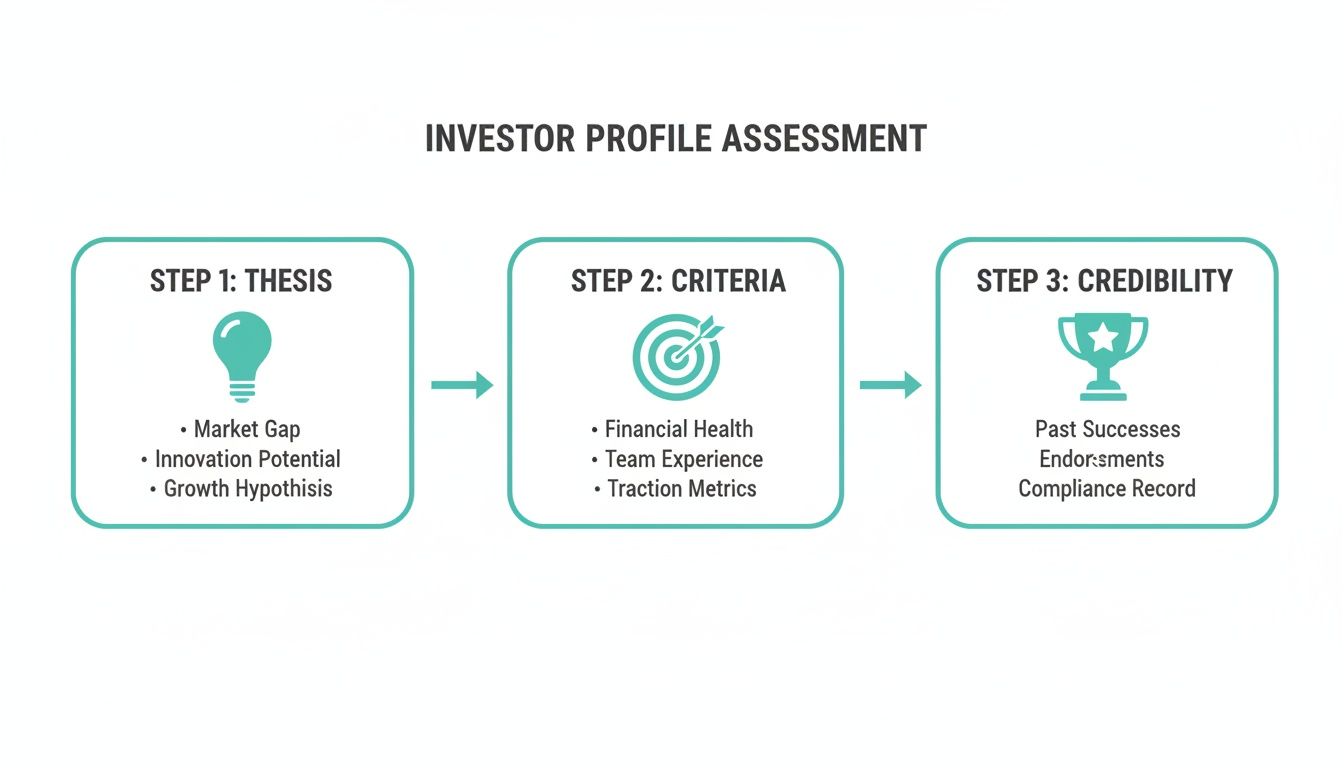
When these three pieces are clearly defined, you’re not just filtering properties. You’re sending a clear signal to sellers that you're a serious, qualified buyer who knows exactly what they’re looking for.
From Listing to Analysis in Seconds
Let’s play this out. A wholesaler posts a 4-plex that falls squarely within your target market and price range. It immediately pops up on your dashboard. Instead of the old routine—exporting numbers to a clunky, homemade spreadsheet—you can run the numbers right there on the spot.
With just a few clicks, you can instantly see the metrics that matter:
- Cap Rate: The platform takes the seller's Net Operating Income (NOI) and asking price to show the cap rate. It’s a quick look at the property's unleveraged return.
- Cash-on-Cash Return: This is where it gets personal. You can plug in your own financing numbers—your down payment, interest rate, and loan term—to see a projected first-year cash-on-cash return based on your capital stack.
- Potential Cash Flow: The calculator helps you quickly estimate your monthly and annual cash flow after you factor in your debt service. You’ll know right away if the deal has a chance of meeting your income goals.
This isn't about replacing your own deep-dive underwriting. It's about being able to vet deals in minutes, not hours, so you can quickly decide which properties are actually worth that deeper look.
Building Your Deal Pipeline
As you come across deals that look promising, you can save them to a "Deal Pipeline" inside the platform. This simple feature is a game-changer, replacing messy spreadsheets and forgotten browser bookmarks. Your pipeline lets you track every deal through its lifecycle, from "Initial Interest" to "Underwriting" and "Offer Made."
Getting this organized is critical. With significant capital flowing into the private real estate market, finding and tracking deals efficiently is a massive competitive advantage. Having a system helps you stay ahead.
A structured pipeline gives you a clean, high-level view of your activity. If you're an experienced investor, it helps you manage a higher volume of deals. If you're new, it provides a disciplined framework for learning how to move an opportunity from discovery to closing.
By using these tools, you stop being a passive browser and become an active manager of your own acquisition funnel. One of the key benefits of a marketplace platform is this ability to organize your deal flow and build repeatable systems.
Navigating Due Diligence and Making Contact

You've sifted through the noise and found a property in your pipeline that looks great on paper. The platform's calculators ran the initial numbers, and they line up with your goals. Now for the part that separates the pros from the amateurs: moving from digital analysis to real-world action.
It’s time to make contact, kick off due diligence, and find out if this deal is as solid as it seems. The great thing about a marketplace is that you can often bypass gatekeepers. The built-in messaging system puts you in a direct line to the wholesaler or seller.
Making First Contact the Right Way
A strong first impression shows you're a serious buyer who isn't here to waste time. This is not the place for a lowball offer out of the gate or your entire life story. Your only goal is to open the conversation and request the documents you need to start your real underwriting.
Pro Tip: Keep your initial message short and specific. Mention the property, confirm it fits your criteria, and ask for the due diligence package. For example: "Hi [Seller Name], your listing at 123 Main St. looks interesting and aligns with my buy box. Could you please share the rent roll and a recent P&L statement so I can begin my underwriting? Thanks."
This simple message tells the seller you’re organized and know exactly what you’re doing. It saves everyone a ton of back-and-forth.
Your Practical Due Diligence Checklist
Once you get a response and the documents start rolling in, the real work begins. Due diligence is all about "trust but verify." You have to independently confirm every single number and detail about the property.
While no two deals are identical, your checklist needs to cover these non-negotiables:
- Financial Verification: This is where the rubber meets the road. You need the actual rent roll to see who’s paying what, what the lease terms are, and if there are any delinquencies. You’ll also need the last 12-24 months of Profit and Loss (P&L) statements to verify income and—just as critically—all the operating expenses the seller might have "forgotten" to mention.
- Physical Inspections: Photos can lie. You absolutely need to get a qualified professional inspector on-site for a thorough property inspection. They'll uncover the deferred maintenance that never makes it into the listing pictures, from a leaky roof to foundation problems.
- Title and Legal Search: Have a reputable title company run a search immediately. This is how you uncover any hidden liens, unpaid taxes, or messy ownership disputes that can completely derail a deal at the eleventh hour.
As you dig in, use the marketplace itself to get another layer of confidence. Take a hard look at the seller's profile. Do they have a track record of closed deals? Are there reviews from other investors? A seller with a transparent history provides a bit more peace of mind as you move toward the finish line. This is one of the biggest advantages of knowing how to join a real estate investor marketplace online—it helps you close deals with much greater certainty.
Scaling Your Portfolio and Professional Network
Joining an investor marketplace isn't just about finding one deal. The real goal is to build a scalable business, and that means using the platform as a professional networking machine.
Think of it this way: your first few deals are just the warm-up. The long-term win comes from shifting your focus from chasing down individual properties to building relationships that bring a steady stream of opportunities directly to you.
Build Relationships, Not Just a Pipeline
The most successful investors don't get their deals by luck. They build a network of trusted partners. The moment you close a smooth transaction with a wholesaler on the platform, you've done more than just buy a property—you've made a powerful connection.
That wholesaler now knows exactly what you're looking for and, more importantly, that you can actually close.
The next time a deal lands on their desk that fits your criteria, who do you think they’ll call? You. That’s how you get a first look at deals before they ever hit the open market.
For experienced investors: This is the entire game. Building a small, trusted circle of five or six high-quality wholesalers who feed you consistent deal flow is far more valuable than sifting through hundreds of public listings. Your profile and deal history on the platform become your resume, making you a magnet for the best opportunities.
A Message for Wholesalers
If you're a wholesaler, this is where you stop wasting time. Instead of blasting deals to a cold email list full of tire-kickers, you can post your properties directly to an audience of pre-qualified, serious buyers on the marketplace.
Here’s how to make it work for you:
- Provide Complete Data: Upload high-quality photos and all the relevant docs—rent rolls, P&L statements, repair estimates—right from the start. Nothing kills a deal faster than missing information.
- Keep Your Numbers Realistic: Seasoned investors will see right through a fluff-filled After Repair Value (ARV) or a ridiculously low repair estimate. Presenting realistic numbers builds instant trust.
- Be Responsive: Serious buyers don't wait around. When they ask for information, be ready. Your responsiveness signals that you're a professional.
By treating the platform like your "virtual" buyers list, you can build relationships with proven closers and make your disposition process faster and more predictable with every single deal. The power of a strong real estate investor network can't be overstated.
FAQ for Joining a Real Estate Investor Marketplace
If you're thinking about joining an online investor marketplace, you likely have some questions. Here are answers to some of the most common ones we hear from both first-time investors and seasoned pros.
Is an Online Marketplace a Good Starting Point for a New Investor?
Yes, absolutely. While many experienced operators use platforms to find deals faster, a marketplace is an incredible place for beginners to build good habits from the very start.
For instance, the first thing you do is set up your "Buy Box." This forces you to define exactly what you’re looking for: target markets, property types, and required returns. That’s a fundamental exercise every successful investor has to master, and the platform walks you right through it.
Plus, the built-in calculators are a game-changer. You can instantly analyze deals using core metrics like Cap Rate and Cash-on-Cash Return without wrestling with a clunky spreadsheet. It's a practical way to learn underwriting by looking at real deals that fit your strategy.
How Is This Different from Just Browsing the MLS or Zillow?
The difference is focus and intent. Consumer sites like the MLS and Zillow are built for retail homebuyers. The listings are designed to sell a lifestyle, full of fluffy language about “dream kitchens” while burying the financial data you actually need.
An investor marketplace is built by investors, for investors. Every single listing is presented with the numbers that matter:
- Net Operating Income (NOI)
- Return on Investment (ROI)
- Cap Rate
- After Repair Value (ARV)
The entire experience is designed to get you from discovery to analysis to offer as efficiently as possible. It’s about eliminating the distraction of the retail market so you can focus on the deal itself.
What Kind of Deals Can I Actually Find on an Investor Marketplace?
Investor marketplaces are built to cater to a ton of different strategies, so the inventory is incredibly diverse. On our platform, you’ll find a mix of asset types for just about any goal.
One day you might see:
- Single-family rentals perfect for a classic buy-and-hold strategy.
- Distressed houses ideal for a fix-and-flip.
- Small and large multifamily buildings to scale your rental portfolio.
- Vacant land with the right zoning for a new development project.
- Niche commercial assets to diversify your holdings.
The real power isn’t just the variety; it’s the filtering. You can dial in your Buy Box to hunt for 2-4 unit multifamily properties in a specific county under $500k, or isolate your search to only show vacant land with commercial zoning. This kind of focus ensures that you only see opportunities that are a genuine fit for your goals.
Ready to see how a dedicated marketplace can accelerate your deal flow? At Investor Deal Exchange, you can create a free profile, set your Buy Box, and start discovering deals that match your exact criteria today. Learn more about Investor Deal Exchange.