Learning how to invest in rental properties isn't about jumping on the first deal that hits your inbox; it's about building a repeatable system to find and fund assets that generate predictable returns. The real work—the analysis that saves you from costly mistakes—happens long before you ever make an offer.
This guide provides a step-by-step framework for both new and seasoned investors. By mastering your goals, finances, and buying criteria, you'll learn to chase only the deals that align with your long-term strategy for building wealth through real estate.
Building Your Foundation for Rental Property Investing
Successful investors know that buying a rental isn't just a purchase; it's a calculated business decision. Without a clear plan, it’s easy to get sidetracked by a "shiny object"—a property that looks good on the surface but doesn't actually fit your financial reality or long-term vision.
Getting this foundation right is critical. The global real estate rental market is enormous, with significant growth projected in the coming years. That growth signals a massive opportunity, but it also means more competition. A disciplined, strategic approach is your edge.
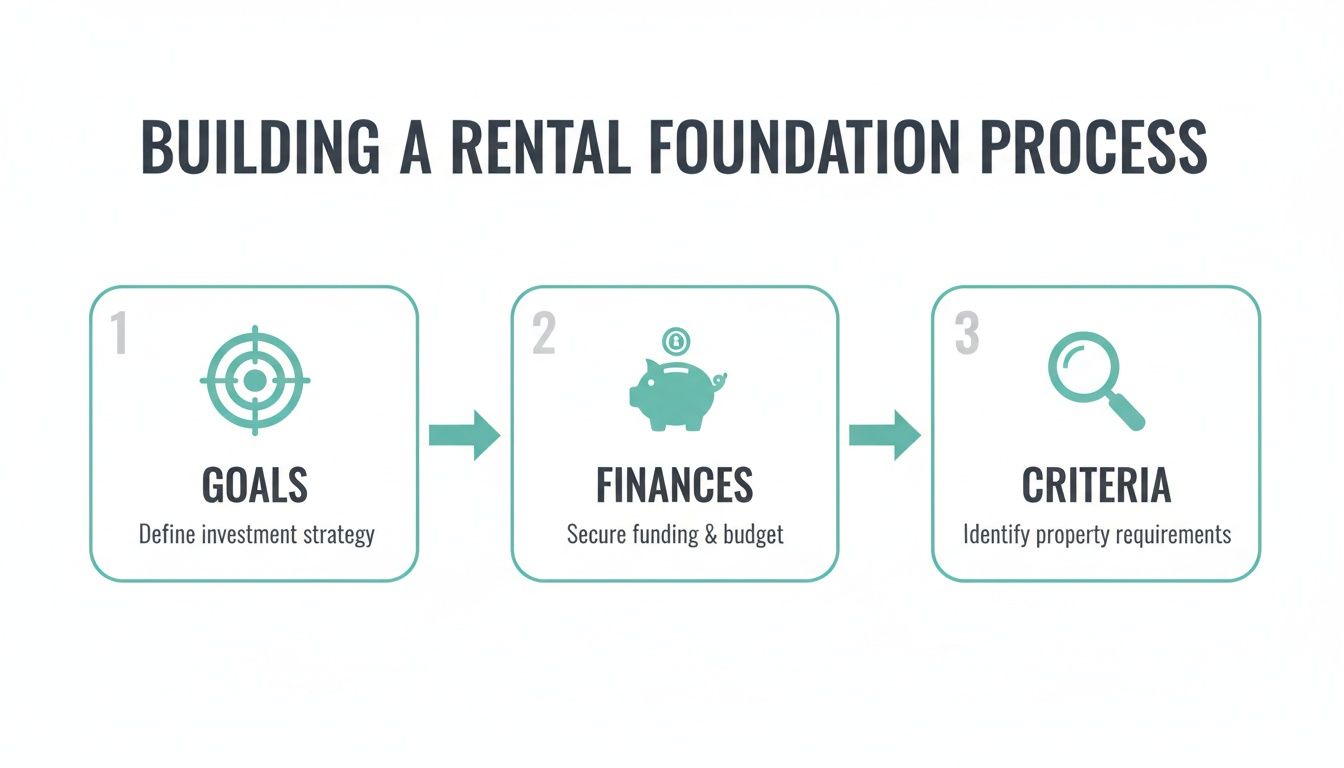
Nail Down Your Investment Goals
First things first: why are you investing in rental properties? The answer shapes every decision you make. Are you hunting for consistent monthly income to supplement your day job, or are you playing the long game, banking on appreciation to build massive equity over time?
- For Beginners: Your focus might be hitting a simple, measurable cash flow target, like "$500 in extra income per month." This provides a clear pass/fail metric when analyzing deals. A popular strategy for getting started is house hacking, which can eliminate your personal living expenses while you build a portfolio.
- For Experienced Investors: You’re likely thinking bigger picture. Your goal might be diversifying into a new asset class (like small multifamily), achieving a specific risk-adjusted return across your portfolio, or entering a new geographic market.
Get Real About Your Financial Readiness
Before making an offer, you need a crystal-clear picture of your financial situation. This goes beyond just having enough for a down payment. You need to assess your capital, credit, and capacity to absorb the unexpected costs that will pop up.
One of the most common mistakes is underestimating cash reserves. Many investors aim to have six months of PITI (Principal, Interest, Taxes, Insurance) plus maintenance funds set aside for each property. This buffer keeps a single vacancy or a busted water heater from derailing your investment.
You also need to be honest about your risk tolerance. Are you excited by the hands-on work of a major rehab project, or do you prefer a turnkey property that’s ready for a tenant on day one? Your answer directly impacts the types of deals you should seek and how much cash you'll need on hand.
Create Your Investor "Buy Box"
Your "buy box" is your non-negotiable checklist—a set of specific criteria a property must meet before you analyze it. Think of it as your personal filter for the market, ensuring you only spend time on relevant opportunities.
On a marketplace platform, setting up your buy box is the first thing you should do. It allows the system to automatically flag deals that are a match, saving you countless hours of sifting through irrelevant listings.
Your buy box needs to be specific. Get granular with things like:
- Property Type: Single-family home, duplex, small multifamily (2-4 units).
- Geographic Area: Pinpoint specific neighborhoods, cities, or counties.
- Price Range: Define your maximum purchase price.
- Minimum Return Metrics: Decide on a target cash-on-cash return or capitalization rate (cap rate).
To help you get started, here's a look at how you might define your investor profile.
Defining Your Investor Profile Key Considerations
| Component | Beginner Focus | Experienced Investor Focus |
|---|---|---|
| Primary Goal | Achieving a specific monthly cash flow target (e.g., $300-$500 per door). | Portfolio diversification, hitting a target IRR, or entering a new market or asset class. |
| Financial Strategy | Securing initial financing (FHA, conventional loan) and building PITI reserves for one property. | Leveraging existing equity, using portfolio loans or commercial financing, and managing reserves across all assets. |
| "Buy Box" Criteria | Tightly defined, often focusing on a single property type in a familiar local market (e.g., 3-bed/2-bath SFH under $250k). | Broader criteria that may span multiple markets or property types, focused on specific economic indicators. |
| Risk Tolerance | Lower, typically preferring turnkey or light value-add properties to minimize unexpected capital expenses. | Higher, potentially seeking out heavy rehabs, BRRRR projects (Buy, Rehab, Rent, Refinance, Repeat), or properties with operational challenges. |
Taking the time to define these components upfront is what separates disciplined investors from speculators. Once your foundation is set, you're ready to start the hunt—not with guesswork, but with a clear, confident strategy.
Finding and Analyzing Profitable Deals
With your investment foundation set, it’s time for the hunt. Finding great opportunities is the lifeblood of any successful investor—a skill that blends modern tech with old-fashioned networking and a sharp eye for numbers.
The good news is that technology has made deal sourcing more efficient than ever. Nearly every investor uses online platforms to find properties, but the trick is to use these tools strategically to cut through the noise and focus only on what fits your criteria.

Where to Source Your Next Rental Property
Profitable deals come from a variety of channels, and smart investors diversify their sourcing strategies to increase their odds of finding properties others overlook.
- Investor Marketplaces: On our platform, you can set your buy box criteria—like location, price, and minimum cash-on-cash return—and get matched with deals from wholesalers and other investors. This saves significant time compared to sifting through consumer-focused sites.
- Networking with Wholesalers and Agents: Build relationships with wholesalers who specialize in finding off-market deals and investor-friendly real estate agents. A good agent understands your numbers and will only bring you properties that make financial sense.
- Direct Mail and Driving for Dollars: This is a more hands-on, classic approach. Driving through target neighborhoods looking for distressed or vacant properties ("driving for dollars") can uncover opportunities before they hit the market.
Underwriting The Deal: A Numbers Game
Finding a potential property is just the starting line. The most critical phase is underwriting—analyzing a deal's financials to verify its profitability. This is where you must switch off emotion and focus on cold, hard data.
A classic mistake is trusting the seller's pro forma without question. Always build your own analysis using conservative estimates for vacancies, repairs, and capital expenditures. The seller’s numbers are a sales pitch; your numbers are your reality.
Three core metrics will tell you almost everything you need to know about a property's financial performance.
1. Net Operating Income (NOI) Your NOI is the property's total income minus all its operating expenses—before you factor in your mortgage payment. It is a pure measure of a property's ability to generate profit.
- Calculation: Gross Rental Income - Operating Expenses (property taxes, insurance, maintenance, property management, etc.) = NOI
2. Capitalization Rate (Cap Rate) The cap rate shows you the potential rate of return on an investment property, assuming you bought it with all cash. It’s an excellent way to compare the relative value of similar properties in the same market. For a deeper dive, check out our guide on how to calculate cap rate.
- Calculation: Net Operating Income (NOI) / Property Purchase Price = Cap Rate
3. Cash-on-Cash (CoC) Return This is arguably the most important metric for investors using financing. It measures the annual cash flow you receive relative to the actual cash you invested out-of-pocket (your down payment, closing costs, and initial rehab). It answers the simple question: "For every dollar I put in, how much am I getting back each year?"
- Calculation: Annual Pre-Tax Cash Flow / Total Cash Invested = Cash-on-Cash Return
Investor platforms often embed calculators directly into listings, letting you instantly analyze these metrics. Mastering these calculations is fundamental to learning how to invest in rental properties for long-term success.
Securing Financing and Conducting Due Diligence
You’ve found a property with numbers that make sense. Now the real work begins—navigating the two most critical phases of any deal: locking down the right financing and performing thorough due diligence. This is the stage where disciplined investors protect their capital and avoid costly surprises.
Choosing the right loan is a massive decision. Lenders recognize the stability of rental income, which means investors have access to more specialized financing options than ever before.

Investor-Focused Financing Options
As an investor, you need specialized financing tools. While traditional lenders focus on your personal debt-to-income ratio, investor-focused loans prioritize the property’s ability to generate cash flow.
- For Beginners: A conventional investment property loan, which usually requires a 20-25% down payment, is a common starting point. However, DSCR (Debt Service Coverage Ratio) loans are a powerful alternative. These are asset-based, meaning the lender qualifies the deal based on the property's income, not yours.
- For Experienced Investors: As you grow, you unlock more powerful options. Portfolio loans let you bundle multiple properties under a single loan, simplifying management. For value-add projects, the BRRRR method (Buy, Rehab, Rent, Refinance, Repeat) is a go-to strategy, typically using short-term financing for the purchase and rehab before refinancing into a long-term loan.
It pays to know your options. We break down even more in our complete guide to real estate financing options for investors.
The Due Diligence Checklist
Once you’re under contract, the clock starts ticking. This is your chance to verify every assumption you made while running your numbers. Do not cut corners here; what you find can save you tens of thousands of dollars.
The point of due diligence isn’t just to find problems—it’s to quantify them. A leaky roof isn't a deal-breaker if you can get a $15,000 credit from the seller to fix it. Your goal is to turn findings into leverage for negotiation.
Your inspection should be a three-pronged attack, covering the physical condition, financials, and legal standing of the property.
The Three Pillars of Due Diligence
| Category | Key Tasks | Common Red Flags |
|---|---|---|
| Physical | Hire a licensed inspector for a full report on the roof, foundation, HVAC, plumbing, and electrical. Consider specialized checks for pests or mold. | Foundation cracks, signs of old water damage, an aging HVAC system, or an outdated electrical panel. |
| Financial | Scrutinize all current leases, get tenant estoppel certificates, and review at least 12 months of the seller's actual utility and maintenance records. | High tenant turnover, rental rates that are significantly above market, or suspiciously high utility costs. |
| Legal | Order a title search to check for liens or other claims. Verify local zoning laws and pull any HOA documents to review the rules. | Unpaid tax liens, unresolved code violations, or restrictive rules that limit your ability to rent the property. |
This process is your final line of defense. If the financials are misrepresented or the inspection uncovers a major issue, you now have the power to either renegotiate the price or walk away with your earnest money intact.
Closing the Deal and Preparing for Tenants
Getting your deal through due diligence is a major milestone. Now, it's time to bring it home. The closing process is the final step in buying the property, but what you do the moment you get the keys sets the tone for your entire investment. This is where you officially shift from buyer to landlord.
The run-up to closing day can feel like a dash of paperwork and coordination. Staying organized and proactive is the only way to keep things on track. Stay in regular contact with your lender, title company, and agent to keep everything moving forward.
Your Pre-Closing Checklist
A few days before closing, you'll do a final walkthrough of the property. This isn't another inspection; its purpose is to confirm the property is in the same condition as when you agreed to buy it and that any negotiated repairs have been completed.
Bring your inspection report and purchase agreement to double-check everything. The day before closing, review the final closing disclosure (CD) line by line to avoid any expensive surprises at the signing table.
Your final steps before the keys are yours:
- Final Walkthrough: Verify the property’s condition and check that all agreed-upon repairs are done.
- Review Closing Documents: Scrutinize the closing disclosure for accuracy.
- Wire Funds: Arrange the wire transfer for your down payment and closing costs. Always call the title company directly to verify their wiring instructions to avoid fraud.
- Sign and Fund: Attend the closing, sign the documents, and officially become the owner.
Self-Management vs. Hiring a Professional
With keys in hand, you face your first big operational decision: will you manage this property yourself or hire a professional property management (PM) company? There is no single right answer; it depends on the property's location, your experience, and your investment goals.
Self-management gives you total control and saves you the 8-12% of gross monthly rent that most PMs charge. The trade-off? You are the one handling late-night emergency calls, screening tenants, and collecting rent. It's a real job.
Hiring a property manager creates a more passive experience, freeing you up to find the next deal. A great PM handles all day-to-day operations, from marketing vacancies to coordinating repairs.
For Beginners: If this is your first rental and it's local, self-managing can be an invaluable learning experience that forces you to understand every part of the business.
For Experienced Investors: If you're buying out-of-state or scaling your portfolio, a solid property manager is non-negotiable. They are your "boots on the ground," and their local expertise is critical for managing assets from a distance.
Setting Up Your Management Systems
If you decide to self-manage, setting up solid systems from day one is the only way to avoid chaos. You need clear, repeatable processes for the core functions of being a landlord.
First, lock in your tenant screening criteria, ensuring they comply with all fair housing laws. Next, choose a platform for online rent collection to automate payments. Finally, build your go-to list of local contractors—a reliable plumber, electrician, and handyman—so you know who to call when something breaks.
On a networking platform, you can often find recommendations for vetted property managers and contractors from other investors in your market. This lets you tap into the community's experience to build your team faster.
Effectively Managing and Scaling Your Portfolio
Getting the keys to your first rental is a huge milestone, but it's just the starting line. Real wealth in real estate comes from building a scalable portfolio that generates consistent, predictable income. This means shifting your mindset from buying a house to managing a long-term business asset.
It’s all about efficiency, tenant retention, and having a clear plan for strategic growth.

Mastering Tenant Relations and Retention
Vacancy is the single biggest profit killer in the rental business. It is always cheaper to keep a good tenant than to find a new one. The secret to minimizing vacancy loss is focusing on retaining the great tenants you already have.
It all starts with being a responsive, professional landlord. Address maintenance requests quickly, communicate clearly, and treat your tenants like valued customers. Small gestures, like offering an online payment portal, go a long way in building goodwill.
- For Beginners: Your main job is to build a reputation for reliability. Return calls and emails within 24 hours and get repairs handled promptly. This builds trust and encourages lease renewals.
- For Experienced Investors: Look for ways to add value that justify rent increases and make tenants want to stay. This could range from upgrading kitchen appliances to installing smart home gadgets.
From Reactive Repairs to Proactive Maintenance
Waiting for something to break is one of the most expensive ways to manage a property. A proactive maintenance plan protects your asset's value and prevents small issues from becoming budget-destroying emergencies.
Create a simple seasonal checklist for routine tasks like servicing the HVAC system, cleaning gutters, and inspecting for leaks. This approach not only saves money on crisis repairs but also shows tenants you care about the property.
A well-maintained property attracts and retains higher-quality tenants who are often willing to pay more for a home that is clean, safe, and functional. Proactive maintenance is an investment in your cash flow.
Building Systems to Prepare for Scale
You can't grow from one property to ten if you're the one handling every task. To scale your portfolio, you need repeatable systems for every part of your operation, from screening applicants to scheduling repairs.
Start by documenting your processes. Create a turnover checklist for when a tenant moves out. Write down your standard screening criteria. As you add more properties, these documented systems allow you to hand off tasks to a virtual assistant or property manager without a drop in quality.
On an investor marketplace, you can keep your buy box updated so you're constantly seeing new deals that fit your growth strategy, even while managing your current properties. With a solid team and systematized operations, you will be well-positioned to capitalize on market trends. You can read more about global real estate market trends to see how they might impact your strategy.
Advanced Growth Tactic: The 1031 Exchange
Once you have a few properties and are looking to accelerate growth, the 1031 exchange is one of the most powerful tools available. Named after Section 1031 of the U.S. Internal Revenue Code, it lets you defer paying capital gains taxes when you sell an investment property, as long as you reinvest the full proceeds into a new "like-kind" property.
This strategy allows you to roll your entire equity from one investment directly into the next, enabling you to buy larger or more profitable assets without a significant tax hit. It’s a way to compound your returns and scale your portfolio much faster. This is an advanced strategy with strict rules and timelines, so you must work with a qualified intermediary and a tax professional.
Your Top Questions, Answered
As you put theory into practice, questions will arise. Whether you're looking at your first deal or your fifteenth, core concerns about capital, returns, and common mistakes always come up. Let's tackle some of the most frequent ones.
How Much Money Do I Actually Need to Start?
The honest answer is: it completely depends on your market and strategy. While there's a myth that you need a briefcase full of cash, that's rarely the case.
For a standard investment property loan, plan on a down payment of 20-25% of the purchase price. On a $200,000 property, that's $40,000 to $50,000. However, you also need to account for closing costs (another 2-5%) and cash reserves.
Many seasoned investors won't touch a deal unless they have at least six months of PITI (Principal, Interest, Taxes, and Insurance) stashed away for vacancies or unexpected repairs.
Key Takeaway: The down payment is just the entry ticket. A safer, all-in number to have in the bank is closer to 30% of the purchase price once you account for closing costs and a healthy emergency fund.
Strategies like house hacking with an FHA loan can lower the entry barrier to as little as 3.5% down. For experienced investors, creative financing like seller financing or partnerships can also reduce your initial cash outlay.
What's a Good Cash-on-Cash Return for a Rental?
A "good" Cash-on-Cash (CoC) Return is subjective and depends on your goals and risk tolerance. That said, a general target in the investor community is a CoC return between 8% and 12%.
- Below 8%: This may be acceptable in a high-appreciation market where long-term equity growth is the primary goal, not immediate cash flow.
- 8% to 12%: This is a solid sweet spot, indicating healthy cash flow and a respectable return on your invested capital.
- Above 12%: This is a fantastic return, but be sure to verify the numbers. High returns can sometimes signal higher risk, such as a property in a challenging neighborhood or one needing significant repairs.
When sifting through deals on an investor marketplace, use the built-in calculators to instantly assess the CoC return, allowing you to quickly vet properties against your personal benchmark.
Should I Form an LLC for My First Rental?
Setting up a Limited Liability Company (LLC) is a smart move for asset protection. It creates a legal separation between your business and personal assets. If a tenant sues, they are suing the LLC, not you personally, which helps protect your home, car, and personal savings.
However, whether you need one for your first property is a common debate.
- For Beginners: Many investors buy their first rental in their personal name because it can be easier to secure favorable conventional financing. They then protect themselves with robust landlord and umbrella insurance policies.
- For Experienced Investors: Once you begin scaling, an LLC becomes almost non-negotiable for organizing your portfolio and protecting your growing assets.
This is a legal and financial decision. Before you act, consult with a real estate attorney and a CPA to understand the costs and benefits for your specific situation.
What Are the Biggest Mistakes I Can Make on My First Deal?
Your success as a new investor is often defined more by the mistakes you avoid than the brilliant moves you make. A few pitfalls are especially common for newcomers.
- Underestimating Expenses: This is the classic rookie mistake. It's easy to calculate the mortgage but forget about vacancy (budget 5-10% of annual rent), capital expenditures (like a future roof replacement), ongoing repairs, and property management fees.
- Skipping a Thorough Inspection: Never waive the inspection to make your offer more competitive. A $500 inspection can easily save you from a $20,000 foundation or plumbing nightmare.
- Getting Emotional: It’s easy to fall in love with a property's cosmetic features. But this is a business transaction. If the numbers don't work, you must be disciplined enough to walk away.
Avoiding these traps comes down to discipline and data-driven decisions. Using a platform that puts the hard numbers—like ROI and cap rate—front and center helps you build the right habits from the start.
Ready to put this knowledge into action? An investor marketplace can help you cut through the noise and find deals that fit your criteria.
Create your free investor profile to get matched with deals that fit your criteria.