If you’ve ever tried to finance a rental property, you know the headache. Traditional lenders bury you in paperwork, demanding W-2s, tax returns, and a deep dive into your personal finances. For self-employed investors or those scaling a portfolio, it’s a massive roadblock.
But what if the property could qualify for a loan on its own merit? That’s exactly what a DSCR loan does, and a DSCR loan calculator is the tool that lets you see if a deal has what it takes. This guide will show you how to use this tool to vet deals in minutes, not drown in paperwork for weeks, and make smarter investment decisions.
Why a DSCR Loan Calculator Is an Essential Tool for Investors

For real estate investors serious about growing their portfolios, traditional mortgages can feel designed to slow you down. The endless income verification is a major hurdle, especially if your tax returns are complex or you don't have a standard W-2 job.
DSCR loans, which stands for Debt Service Coverage Ratio, offer a practical workaround. These are a type of non-QM (non-qualified mortgage) loan built specifically for investors. Instead of digging through your personal bank statements, lenders ask a much simpler question: does the property itself generate enough income to pay its own bills?
A Shift Toward Property-Based Underwriting
The DSCR loan market has exploded, now making up a significant portion of non-agency mortgage volume. This isn't just a niche product anymore; it's a fundamental shift in how lenders underwrite rental property deals.
As the Single Family Rental (SFR) world has become more institutionalized, both big firms and individual investors have piled in. This has made cash-flow-based lending a durable, long-term model. You can explore more data on this trend and what it means for you.
This evolution is fantastic news for serious investors. It means you can get capital even if your personal debt-to-income ratio is high or you have a non-traditional job. Your DSCR loan calculator becomes the first and most important tool in your belt.
Quick Guide to DSCR Loan Concepts
Here’s a quick summary of the essential terms you'll encounter when using a DSCR loan calculator and evaluating deals.
| Term | What It Means for Investors | Common Benchmark |
|---|---|---|
| DSCR | The ratio of a property's income to its debt payments. This is the single most important metric for this loan type. | 1.20x or higher is the standard for most lenders. |
| Gross Rental Income | The total potential rent you could collect before any expenses or vacancy. | Market-rate rents for comparable properties. |
| PITI | Principal, Interest, Taxes, and Insurance. Your total monthly housing debt. | The core expense used in every DSCR calculation. |
| Vacancy Rate | A percentage of gross income set aside to account for times the property is empty. | Lenders typically assume 5% - 10%. |
| Operating Expenses | Costs like property management, maintenance, repairs, and HOA fees. | Often estimated as a percentage of gross rent. |
Getting a handle on these terms makes the whole process less intimidating and puts you in a much stronger position when analyzing a potential investment.
Benefits of Using a DSCR Loan Calculator
Running the numbers with a DSCR loan calculator helps you immediately see if a property even has a chance of qualifying for this type of financing. The advantages are clear:
- Speed and Efficiency: Instantly analyze a deal's financial strength without waiting days for a lender. This lets you vet multiple properties in the time it used to take to review one loan application.
- Data-Driven Decisions: Move past "gut feelings." A calculator gives you a hard number that tells you if a property's cash flow is strong, weak, or right on the line.
- Pre-Qualification Power: Approaching a lender knowing your property has a solid DSCR starts the conversation from a position of strength. You've already confirmed the deal meets their number one underwriting metric.
Ultimately, this tool is indispensable for both new and seasoned investors. On a platform like our Investor Deal Exchange marketplace, you can find deals and use our built-in calculators to make this entire analysis process seamless, helping you quickly identify opportunities that match your criteria.
Deconstructing the DSCR Formula for Manual Calculation

Before you plug numbers into a DSCR loan calculator, it’s helpful to know what’s happening behind the scenes. It all comes down to one simple formula that tells a lender if a property makes enough money to pay its own bills.
The DSCR Formula: Debt Service Coverage Ratio = Net Operating Income (NOI) / Annual Debt Service
This ratio is the lender's single most important metric. It shows them how many times the property’s income can cover the mortgage payments each year.
A DSCR of 1.25 means your property generates 25% more income than it needs to cover the debt—a healthy cushion. A DSCR of 1.0 means you're just breaking even, and anything below that means the property is losing money every month. Let's pull apart both sides of this equation.
Calculating Net Operating Income (NOI)
Net Operating Income (NOI) is your property's total annual income after you subtract the costs of running it. It’s the pure profit the property generates before you factor in the mortgage.
For Beginners: If you're just starting, you can get a quick estimate by focusing on the big, non-negotiable expenses.
- Start with Gross Potential Rent: This is the total rent you'd collect if the property was 100% occupied for the entire year.
- Subtract Operating Expenses: These are the must-pay bills.
- Property Taxes
- Property Insurance
- HOA Fees (if applicable)
- Maintenance & Repairs (a good rule of thumb is to budget 1% of the property’s value each year)
For Experienced Investors: To get your deal funded, you need to think like a lender. They dig deeper than basic expenses to get a realistic picture of a property's performance.
Here’s what a lender’s underwriting really looks at for NOI:
- Vacancy Rate: No property stays full 100% of the time. Lenders will always apply a vacancy factor—usually 5% to 10% of gross rent—to account for tenant turnover.
- Property Management Fees: Even if you plan to manage the property yourself, a lender will almost always include a property management fee of 8-10% of gross rent. They want to know the deal still works if you have to hire a pro.
- Capital Expenditures (CapEx): These are the big-ticket items that eventually fail—the roof, HVAC, water heater. Lenders may add a CapEx reserve (often 3-5% of gross rent) to ensure a single major repair doesn’t sink the investment.
Calculating Annual Debt Service
The other half of the formula, Annual Debt Service, is your total mortgage payments for the year. This isn't just principal and interest; for a DSCR loan, it almost always includes taxes and insurance, too.
This is your total monthly PITI payment:
- Principal
- Interest
- Taxes
- Insurance
To get your annual debt service, you simply calculate your monthly PITI and multiply it by 12. Any mortgage calculator can give you the principal and interest, but don't forget to add your monthly property tax and insurance costs to get the full PITI number lenders will use.
Once you know how to calculate NOI and Annual Debt Service, you’ve mastered the foundation a DSCR loan calculator is built on.
Meeting Lender Requirements and DSCR Thresholds
Nailing your DSCR calculation is a great start, but it’s only part of the story. A fantastic ratio on paper means nothing if it doesn't match what a specific lender is willing to fund. To get a deal across the finish line, you have to know the underwriting rules lenders use to size up their risk.
This is the key to working smarter. When you analyze a property through a lender’s eyes, you can spot the winners and toss the duds long before you waste time on a loan application.
The Gold Standard: The 1.25 DSCR
Talk to enough lenders, and you'll hear one number over and over: 1.25. This is the industry-wide benchmark for a solid DSCR loan. It tells a lender the property pulls in 25% more income than it needs to cover its mortgage and related debts.
To a lender, a 1.25 DSCR is a critical safety net. It proves the investment can absorb a few punches—like an unexpected vacancy or a surprise repair—without immediately risking default.
While 1.25 is the goal, some lenders might dip lower for borrowers with strong "compensating factors." For instance, an investor with a high credit score, significant cash reserves, or a larger down payment might get approved with a DSCR closer to 1.15. Still, you should always aim for 1.25 or higher to lock in the best rates and terms.
Key Underwriting Criteria Beyond DSCR
A strong DSCR gets your foot in the door, but it’s part of a bigger picture. Lenders are piecing together a full risk profile on both the property and you, the investor. Knowing what they’re looking for is crucial when you’re plugging numbers into a DSCR loan calculator.
Most lenders look for a combination of these fundamentals:
- Minimum FICO Score: Most lenders have a floor, usually around 660-680. A score of 740+ will likely qualify you for better interest rates and more flexible terms.
- Maximum Loan-to-Value (LTV) Ratio: This is the loan amount compared to the property's appraised value. Lenders typically cap this at 75-80%, which is why you'll need to bring a down payment of at least 20-25%.
- Cash Reserves: Lenders need to see you have enough cash on hand to cover a few months of payments (PITI) after you close. The standard ask is for 3-6 months of reserves.
These criteria all work together, painting a complete picture for the underwriter. Understanding how DSCR, credit, LTV, and reserves fit together lets you use a DSCR loan calculator with real confidence—not just to see if a deal makes money, but to see if it actually meets the bar for getting funded. You can learn in our guide to real estate financing options how these standards help investors build stable portfolios.
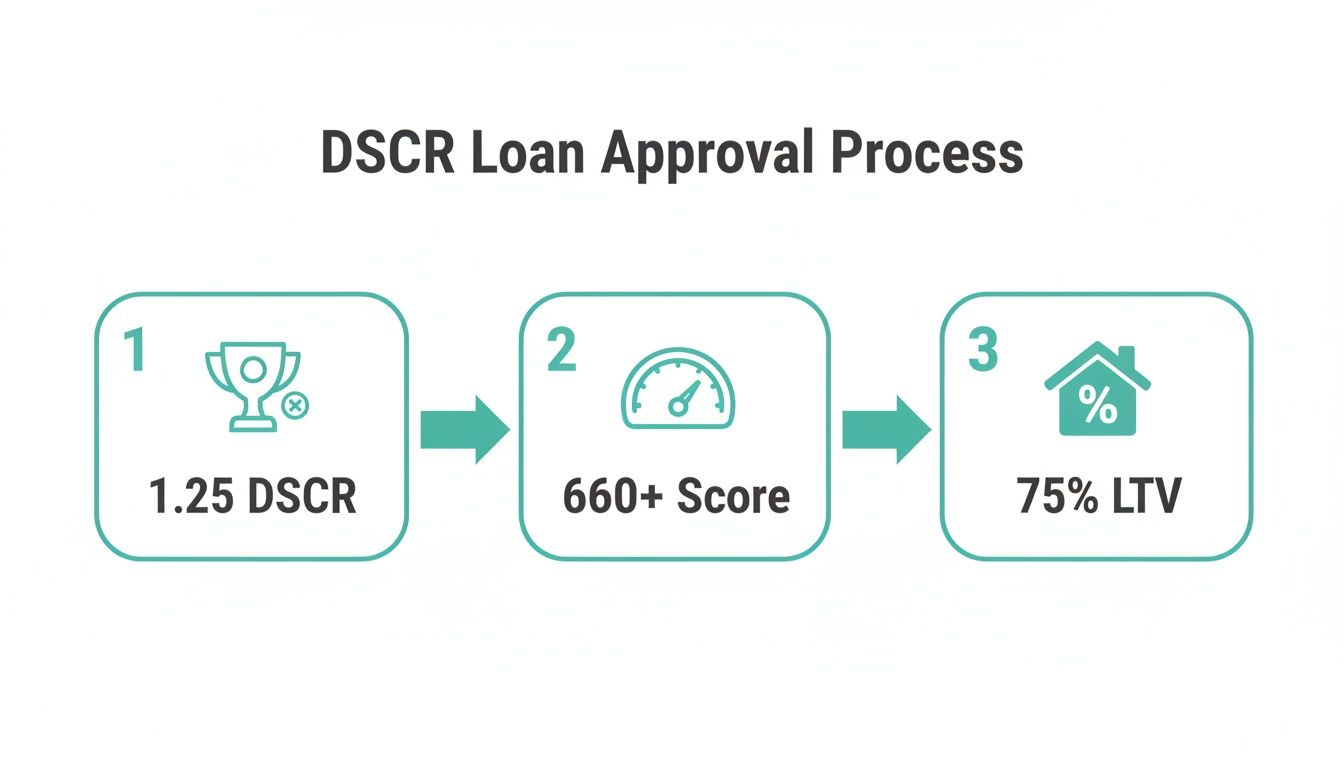
As you can see, lenders are generally looking for a DSCR of 1.25 or higher, a credit score over 660, and a loan-to-value (LTV) around 75%. Nail these three, and you're in a great position.
The Core Inputs: Getting the Basics Right
These are the foundational numbers for your entire analysis. Get these right, and the rest falls into place.
- Purchase Price: This one's easy. It’s the asking price or what you plan to offer.
- Down Payment: For most DSCR loans, you'll need at least 20-25%. The calculator uses this to figure out your loan amount and LTV. A bigger down payment means a smaller loan, which almost always improves your DSCR.
- Interest Rate: This is a huge variable. Check current rates for investor loans, but always run a second calculation with a higher rate. This "stress test" shows you if the deal still works when things get more expensive.
- Gross Monthly Rent: This is the most important income number. If the property is occupied, use the current lease amount. If it's vacant, find what similar properties in the area are renting for. Be realistic—don't use a "best-case" number.
The Expense Inputs: Where Deals Fall Apart
The number one mistake investors make is underestimating expenses. A good DSCR loan calculator is your best defense against this, forcing you to account for every cost that eats into your cash flow.
If you’re just starting out, you can use standard percentages for a quick "back of the napkin" analysis.
- Property Taxes & Insurance: You can usually find tax records online. For insurance, a good rule of thumb is to budget 0.5% of the purchase price annually. Just divide that by 12 for your monthly cost.
- Maintenance & Repairs: Things break. Set aside 5-8% of the gross monthly rent for this. For older properties, you might want to bump that percentage up.
- Vacancy Rate: Lenders will almost always factor in vacancy. They typically assume 5-10% of gross rent will be lost to turnover. You must include this.
- Property Management Fees: Even if you plan to manage the property yourself, lenders underwrite the deal as if you’re hiring a pro. Budget 8-10% of gross monthly rent for this fee.
- HOA Fees: If the property is in a homeowners association, don't forget this. It’s a fixed monthly cost that can absolutely tank your DSCR if you ignore it.
Once you’ve plugged in these numbers, the calculator does the heavy lifting, instantly giving you the monthly PITI, your Net Operating Income (NOI), and the final DSCR ratio. With the right inputs, you can confidently vet a deal in less than five minutes.
By systematically working through these inputs, you transform a simple property listing into a clear financial snapshot. This disciplined process ensures you never overlook a critical expense and helps you decide—with confidence—whether a deal is truly worth chasing. You can find powerful tools to help with this, including our own free and easy-to-use investment property calculators built for investors.
Using a DSCR Calculator to Make Smarter Investment Decisions
A DSCR loan calculator is more than a simple qualifying tool. For savvy investors, it’s a strategic weapon for making smarter, more resilient investment choices. It’s how you perform sensitivity analysis—a way to stress-test a deal to see how it holds up when things don’t go according to plan.
By running a few different scenarios, you can uncover a property's financial breaking points and build a crucial margin of safety into your analysis. This process moves you beyond a simple "yes" or "no" on a loan and helps you answer the critical "what if" questions that separate amateur investors from professional operators.
Running Scenarios to Stress-Test Your Deal
Think of sensitivity analysis as a financial fire drill for your potential investment. Instead of just plugging in today's numbers to get a single DSCR, you intentionally tweak your assumptions to see where the deal might crack under pressure. A good DSCR loan calculator makes this incredibly easy.
Here are a few essential scenarios every investor should run:
- Interest Rate Hikes: What happens if the interest rate you get is 0.5% or even 1.0% higher than you projected? Does the deal still cash flow and meet the lender's minimum DSCR?
- Higher Vacancy: Your initial numbers might assume a 5% vacancy rate, but what if the market softens and it jumps to 10% or 15%? A single extra month of vacancy can crush your Net Operating Income and DSCR.
- Unexpected Expense Jumps: What if property taxes get reassessed and increase by 20%? Or what if a major repair blows up your maintenance budget for the year?
Running these hypotheticals helps you pinpoint the exact threshold where a good deal turns sour. This gives you confidence that your investment can withstand the inevitable bumps in the road.
Understanding Rate Variations and Their Impact
When you’re using a DSCR loan calculator, it's vital to use realistic interest rates. DSCR loan rates are highly sensitive to the specifics of your deal.
For instance, pushing your LTV to 80% could easily bump your rate higher. On the flip side, a stronger DSCR can help you lock in pricing on the lower end of the spectrum. As you can discover more about these rate dynamics, understanding how lenders price risk is key to running accurate numbers.
A strong DSCR isn't just for getting approved—it's a powerful negotiating tool. If your property shows a DSCR of 1.50 or higher, you're in a prime position to ask for a lower interest rate or better loan terms because you represent a lower risk to the lender.
Connecting Analysis to Action on Our Platform
This level of detailed analysis is where an investor marketplace and networking platform really shines. Instead of just finding deals, you can instantly vet them against your personal risk tolerance and financial criteria.
On our platform, you can set up a "buy-box" with your minimum acceptable DSCR. This automatically filters out properties that don’t meet your core financial standards from the start. When a promising deal does pop up, you can use the built-in calculators to run sensitivity analyses in seconds and save your findings to your deal pipeline. This is a much smarter approach than manually slogging through every single listing.
It's about finding deals with strong fundamentals and then quickly confirming their resilience, all without ever leaving the platform. This is a key step before you dive deeper into other metrics, and you can learn how to calculate cap rate in our related guide to round out your analysis.
Got Questions About DSCR Calculators? We've Got Answers.
Even after you get the hang of DSCR, practical questions always pop up when it's time to analyze a real deal. Let’s clear up some of the most common points of confusion so you can use a DSCR loan calculator with confidence and start thinking like a lender.
We’ve rounded up the questions we hear most from investors. Getting these right will make sure you're prepared to underwrite your next rental property like a pro.
Can I Get a DSCR Loan with No Real Estate Experience?
Yes, it's possible. While some lenders prefer a proven track record, many are willing to fund a first-time investor—if the deal itself is a home run. This is where your property analysis becomes your single best asset.
Lenders will look for "compensating factors" to make up for the risk of inexperience. Think of these as extra points in your favor:
- A high personal credit score (think 720+).
- Significant cash reserves sitting in the bank (well beyond the standard 3-6 months).
- A property with a very strong DSCR (for example, 1.35 or higher).
For a beginner, presenting a deal backed by a thorough, well-researched analysis from a DSCR loan calculator is your best move. It proves you’ve done your homework and understand the numbers.
What Is a Good DSCR Ratio for a Rental Property?
In the current market, a "good" DSCR is generally considered to be 1.25 or higher. This ratio tells a lender the property brings in 25% more income than it needs to cover the full mortgage payment, which gives both you and the bank a healthy cushion.
A "great" DSCR is anything 1.50 or higher. Hitting this level will often get you access to the best interest rates and loan terms. While you might find a lender willing to approve a loan with a DSCR as low as 1.0 (breakeven), that’s rare and usually requires other strong compensating factors.
How Do Lenders Verify Rental Income for a DSCR Loan?
Lenders need a reliable, third-party source to confirm what a property can actually earn. They verify rental income almost exclusively through the formal property appraisal.
The appraiser completes a specific form for this, like a Small Residential Income Property Appraisal Report (Form 1025) or a Comparable Rent Schedule (Form 1007). Their job is to pull data on recent rental rates for similar, nearby properties to establish a fair market rent.
Here's a key detail: if the property is already rented out, lenders will also look at the existing lease. To play it safe, they will almost always use the lower of the two figures—the appraised market rent or the actual rent from the lease—for their final DSCR calculation.
What Are the Most Common Mistakes When Using a DSCR Calculator?
A calculator is only as good as the numbers you put into it. The most common mistakes come from overly optimistic assumptions or simply forgetting key costs.
Here are the top errors to watch out for:
- Underestimating Expenses: This is the #1 mistake. Forgetting to budget for vacancy, property management fees, or long-term capital expenditures (CapEx) will give you an inaccurate picture of your cash flow.
- Using Unrealistic Rent Estimates: Plugging in "best-case scenario" rents instead of what comparable properties are actually getting is a recipe for an inflated DSCR that won't survive the appraisal.
- Ignoring the Full PITI: Many new investors only think about principal and interest (P&I). Lenders underwrite using the full PITI—Principal, Interest, Taxes, and Insurance. It's a bigger number and the only one that matters.
- Not Knowing Lender Requirements: A 1.20 DSCR is great, but it's useless if your lender has a hard minimum of 1.25. Always know their specific rules before you apply.
Conservative estimates and diligent research are the best defense against these common errors.
A DSCR loan calculator is a fundamental tool for any serious real estate investor. By mastering this calculation, you can analyze deals faster, make more data-driven decisions, and build a stronger, more profitable portfolio. Create your free investor profile to get matched with deals that fit your criteria and start putting these principles into practice today.