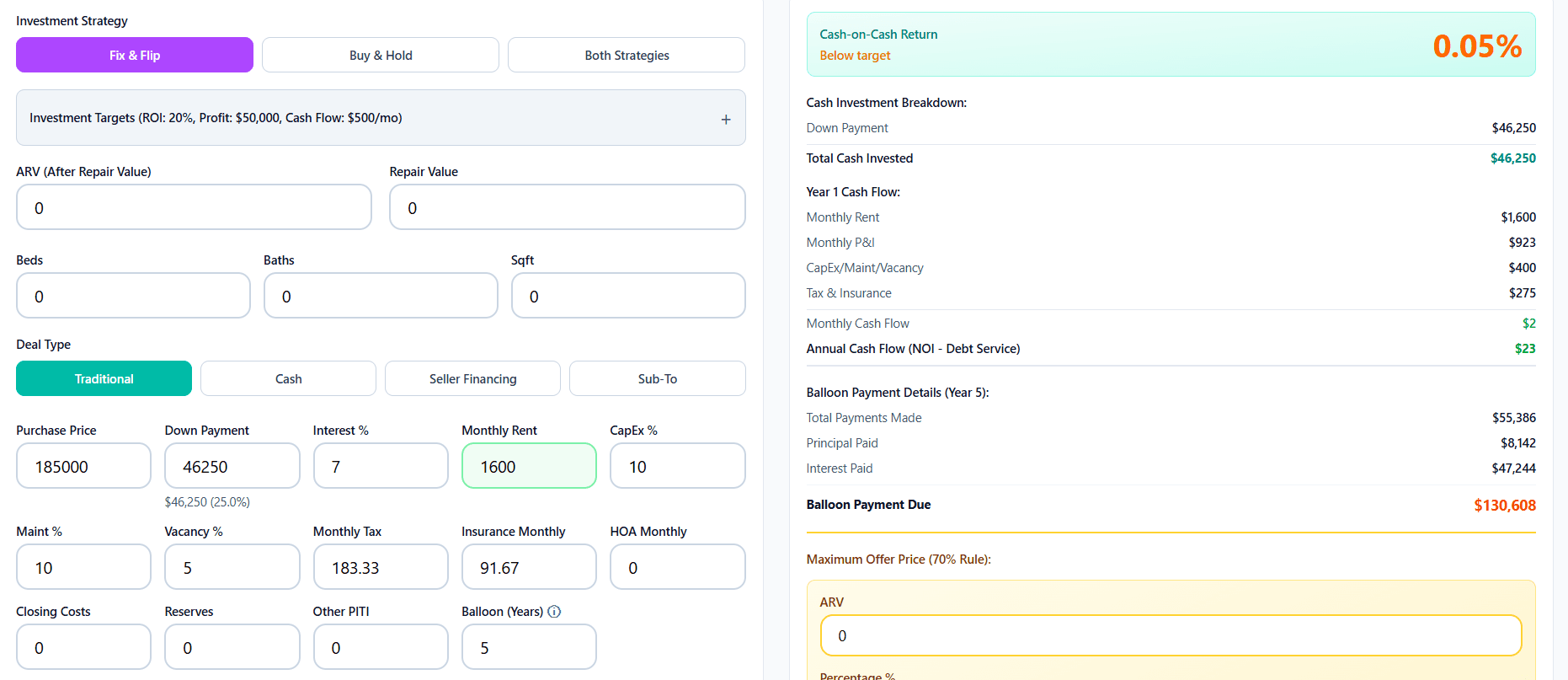
Real estate success often comes down to one thing: knowing the numbers before you commit to a deal. A strong real estate investment calculator helps investors and wholesalers quickly determine whether a property is profitable, what offer makes sense, and how much room exists for financing, repairs, and resale.
The Investor Deal Exchange calculator suite
is built to make those decisions faster. Instead of relying on rough estimates, scattered spreadsheets, or mental math, users can evaluate core deal metrics—including projected profit, return potential, and cash-on-cash return—in one place.
Why calculators matter in real estate
A property can look attractive on the surface—a low purchase price, a desirable neighborhood, or a high expected resale value—but still be a poor investment once the full costs are included.
A practical calculator turns a potential deal into a clear financial picture. It helps users account for:
Purchase price and down payment
Repair or renovation budget
Closing, holding, financing, and transaction costs
Expected rent or resale value
Cash flow and return expectations
Profit margins and investment risk
For an investor, these figures determine whether to pursue, renegotiate, or walk away from a property. For a wholesaler, they determine whether a contract can be assigned to a cash buyer while still leaving enough profit for everyone involved.
The biggest benefit is speed: the faster you can analyze a property accurately, the faster you can make a confident offer.
What makes a real estate calculator useful
Not every calculator is equally valuable. The best ones are designed for decisions—not just arithmetic.
A useful real estate calculator should be:
Feature Why it matters
Easy to update Deals change quickly. Investors need to adjust purchase price, repairs, rent, or resale assumptions without rebuilding a spreadsheet
Focused on key metrics The calculator should surface profitability, cash invested, cash flow, return, and margins—not bury users in unnecessary complexity
Flexible for different strategies A wholesaler, fix-and-flip investor, landlord, and BRRRR investor all evaluate deals differently
Clear enough for sharing Investors often need to discuss numbers with partners, lenders, sellers, contractors, and buyers
Fast to use on active deals A calculator is most useful when it can be used while analyzing leads, speaking with sellers, or submitting offers
Investor Deal Exchange’s calculator experience is designed around editable inputs and quick deal adjustments. Users can revise fields as new numbers become available and see the financial impact without starting over. The calculator also highlights cash-on-cash return, a key metric for evaluating how effectively invested cash may perform.
Benefits for real estate investors
Make smarter offers
Investors should not offer based solely on an asking price or a seller’s claimed value. A calculator helps work backward from the property’s expected outcome.
For a flip, an investor might begin with the expected after-repair value, subtract repairs, selling expenses, financing costs, holding costs, and the desired profit. The result is a more disciplined maximum allowable offer.
For a rental, the investor can estimate whether projected income covers operating expenses, debt service, reserves, and the return required for the cash invested.
This creates a repeatable acquisition process instead of relying on gut feeling.
Protect your profit margin
Small missed expenses can have a major impact on a deal. A property may appear to offer a $30,000 profit until carrying costs, lender fees, insurance, taxes, utilities, commissions, and renovation overruns are included.
A calculator helps investors test the downside before it happens. For example:
What happens if repairs rise by $15,000?
What if the property takes three extra months to sell?
What if the resale price comes in below expectations?
What if the rent is lower than projected?
What if the buyer requires a larger discount?
Running these scenarios before closing helps an investor avoid deals that only work under perfect conditions.
Compare more opportunities
Active investors often review many properties before finding one worth pursuing. A consistent calculator makes it easier to compare opportunities using the same standards.
Rather than saying, “This one feels like a good deal,” an investor can compare:
Expected net profit
Total cash required
Cash-on-cash return
Estimated monthly cash flow
Purchase price as a percentage of after-repair value
Risk if repairs, time, or selling price change
That consistency makes it easier to prioritize the best deals and avoid spending time on marginal ones.
Improve communication with partners and lenders
Clear numbers build trust. Whether an investor is presenting a deal to a private lender, business partner, hard-money lender, or potential buyer, a clean calculation makes the opportunity easier to understand.
Instead of sending a vague message such as, “It should make money,” an investor can explain:
“The projected resale value is $325,000, the purchase and renovation budget is $240,000, and the estimated total cost after financing and selling expenses is $278,000. That leaves an estimated $47,000 profit before any contingency adjustments.”
This level of clarity helps others evaluate the deal faster and shows that the investor has thought through the details.
Benefits for wholesalers
Wholesalers need to move quickly, but speed without accurate analysis can create problems. If a wholesaler contracts a property too high, there may not be enough room for an end buyer to profit after repairs and resale costs.
A real estate calculator helps wholesalers identify a price that works for both the assignment strategy and the buyer’s investment strategy.
Find a realistic maximum allowable offer
Most cash buyers are not purchasing based on the seller’s asking price. They are buying based on the property’s after-repair value, renovation needs, timeline, risk, and desired profit.
A wholesaler can use a calculator to estimate the buyer’s likely maximum purchase price, then determine whether there is room for an assignment fee.
For example:
Deal component Example amount
Estimated after-repair value $350,000
Renovation budget $55,000
Buyer’s desired profit $45,000
Estimated closing, financing, holding, and resale costs $35,000
Approximate maximum buyer purchase price $215,000
Seller contract price $195,000
Potential assignment-fee room $20,000
The exact formula varies by market, property condition, financing method, and buyer strategy. But the principle is straightforward: the wholesaler needs to leave enough margin for the end buyer while still being compensated for finding and securing the opportunity.
Market deals more credibly
Wholesalers who provide organized deal numbers stand out. A buyer is more likely to review a deal when the basic economics are already presented clearly.
Rather than sending only an address and asking for offers, wholesalers can share a concise deal overview:
Contract or asking price
Estimated after-repair value
Repair estimate
Estimated assignment fee
Projected investor margin
Recommended exit strategy
Key assumptions and disclosures
A calculator makes this information easier to prepare and helps wholesalers build a reputation for bringing serious, underwritten opportunities to their buyer network.
Negotiate with more confidence
When a seller asks why the offer is lower than expected, a wholesaler who understands the deal math can explain the reasoning professionally.
The conversation does not need to become an argument over what the seller wants. It can focus on the financial reality of the property: condition, repairs, resale value, transaction costs, and buyer requirements.
That approach can lead to more productive negotiations and fewer contracts that fall apart later.
Key numbers to track
Whether you are investing, flipping, wholesaling, or building a rental portfolio, these numbers deserve attention:
After-repair value (ARV): The estimated market value after renovations are completed.
Purchase price: The amount paid to acquire the property.
Repair costs: The expected budget to bring the property to its intended condition.
Holding costs: Expenses incurred while owning the property, such as insurance, utilities, taxes, interest, and maintenance.
Closing and selling costs: Title, escrow, lender fees, commissions, transfer taxes, and other transaction expenses.
Cash invested: The amount of personal or partner capital required for the deal.
Projected profit: Expected sale proceeds or operating income minus all project costs.
Cash-on-cash return: A measure of the return generated relative to the actual cash invested. Investor Deal Exchange surfaces cash-on-cash return as a core metric for evaluating deal performance.
No calculator can guarantee a deal’s outcome. Market values, repair costs, financing terms, rental demand, and timelines can all change. But reviewing these numbers in advance gives you a far stronger starting point.
Use calculators as a decision system
The real advantage of a calculator is not simply that it adds and subtracts. Its value is in helping you create a consistent investment process.
Before submitting an offer, investors and wholesalers should be able to answer:
What is the realistic exit value or rental income?
What will it cost to acquire, repair, finance, hold, and sell the property?
How much cash is required?
What happens if the project costs more or takes longer?
Is there enough margin for the level of risk?
Would a buyer, lender, or partner understand the deal from the numbers alone?
If the deal still makes sense after answering those questions, it may be worth pursuing. If it only works when every assumption is optimistic, it is usually better to renegotiate or move on.
Analyze your next deal
The best real estate opportunities are not always the properties with the lowest price—they are the properties with the strongest numbers after every relevant cost is considered.
Use the
Investor Deal Exchange real estate calculators
to evaluate investment potential, test different deal assumptions, and make better-informed decisions before you submit an offer, assign a contract, or commit capital. The calculator interface allows key fields to be adjusted and emphasizes return analysis, including cash-on-cash return, to support faster deal evaluation.