
Tired of sifting through endless, irrelevant listings to find your next investment? The right digital marketplace can transform your deal flow from a time-consuming chore into an efficient, repeatable system. Finding the best platforms for real estate investor marketplaces is critical for scaling your business, whether you're a wholesaler hunting for buyers, a flipper seeking your next project, or a buy-and-hold investor building a rental portfolio. These online hubs connect you with deals, data, and partners to help you close more effectively.
This guide provides a detailed breakdown of the top platforms available to investors today. We cut through the marketing copy to give you a practical assessment of what each marketplace does best, who it's for, and its trade-offs. We will explore specific features that help you find, analyze, and secure assets that fit your exact criteria.
You will learn which platforms excel for specific strategies, from single-family rentals and small multifamily buildings to commercial properties and raw land. Each option in our list includes screenshots and direct links to help you evaluate them firsthand. Our goal is to equip you with the insights needed to choose the platform that aligns with your investment strategy and accelerates your path to closing your next deal. We'll compare key features, outline ideal user profiles, and present the critical pros and cons, helping you make a confident, informed decision.
1. Investor Deal Exchange
Investor Deal Exchange is a premier choice among the best platforms for real estate investor marketplaces, designed by investors to shorten the time between discovery and closing. The platform's core strength is delivering curated, high-signal deal flow directly to investors, eliminating the noise common on larger portals. It achieves this with a powerful feature called Smart Buy Boxes, making it an exceptionally efficient tool for serious investors across various asset classes.
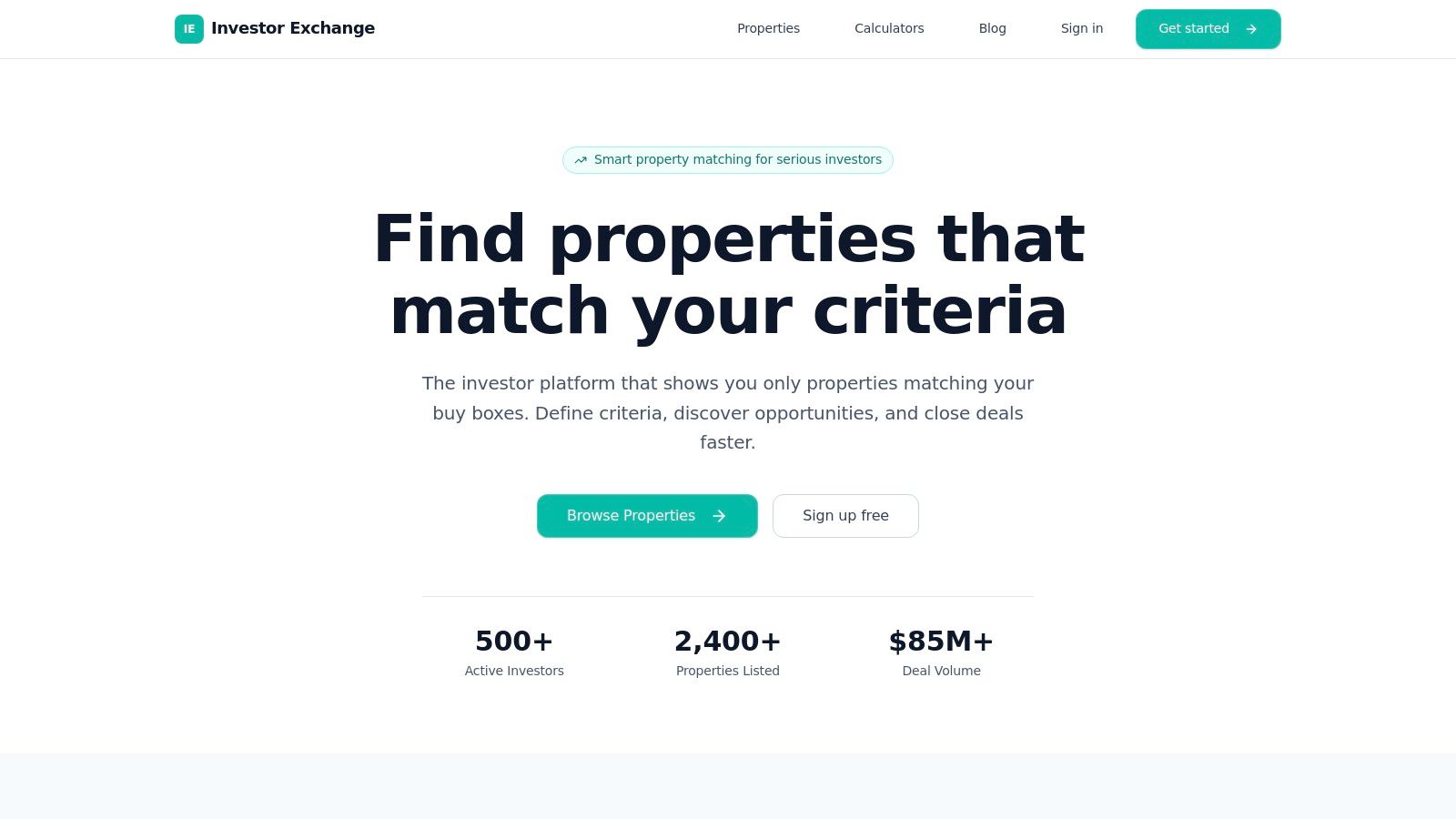
This focus on precision makes it an ideal environment for single-family rental buyers, multifamily syndicators, land developers, and fix-and-flip investors who value their time and require data-driven insights to act quickly. On the platform, wholesalers can also post deals to reach pre-qualified investors who are actively looking for that specific property type, instead of relying on cold outreach.
Key Features and Workflow
Investor Deal Exchange is more than a listing site; it's an integrated workflow tool built to support the entire deal acquisition process.
- Smart Buy Boxes: This is the platform's defining feature. Instead of manually searching, you define your exact investment criteria—property type (Single Family, Multifamily, Land), financial metrics (price, cap rate), and physical attributes. The marketplace then acts as a filter, only showing you properties that match your buy box. This reverses the traditional search model and puts your strategy first.
- Built-in Underwriting Calculators: Every listing includes integrated calculators for key metrics like ROI, Cap Rate, and Cash-on-Cash Return. This allows for immediate, on-the-fly analysis without needing to export data to an external spreadsheet, helping you decide whether to pursue a deal or move on.
- Integrated Deal Pipeline: When you find a promising opportunity, you can save it directly to your personal Deal Pipeline. This feature functions like a CRM for your acquisitions, allowing you to track properties from initial interest through due diligence and closing. You can message owners directly within the platform, keeping all communications organized.
Use Case: For the Focused Investor
Imagine you are a multifamily investor looking for a 5-10 unit building in a specific submarket, with a target capitalization rate (cap rate)—a measure of a property's return—of 6% or higher. On traditional sites, this requires hours of filtering. With Investor Deal Exchange, you create a Smart Buy Box with these exact parameters. The platform then notifies you only when a matching property is listed, allowing you to be one of the first to analyze and engage.
Key Benefit: The platform's structure prioritizes investor efficiency. By showing you only what you asked for, it dramatically reduces wasted time and helps you focus your capital and energy on opportunities with a genuine chance of closing.
Pros and Cons
Pros:
- Laser-Focused Deal Matching: Smart Buy Boxes are highly effective at filtering out irrelevant listings.
- Instant Underwriting: Built-in calculators enable fast, data-driven decision-making directly on the listing page.
- Unified Workflow: The Deal Pipeline and direct messaging keep your acquisition process organized in one central location.
- Proven Traction: With over 500 active investors and $85M+ in deal volume, it’s a living marketplace, not a ghost town.
- Multi-Asset Support: Accommodates diverse strategies across single-family, multifamily, land, and commercial assets.
Cons:
- Variable Market Coverage: As a growing platform, inventory may be lower in some secondary or tertiary markets compared to national MLS portals.
- Pricing Transparency: The platform offers a free account, but details on advanced tiers may require direct inquiry.
Pricing and Onboarding
You can create a free account on Investor Deal Exchange in minutes to set up your profile and Smart Buy Box. This no-cost access allows you to test the platform's core functionality and see the quality of its deal flow before committing to any premium plans.
Website: https://www.investordealexchange.com
2. Roofstock
Roofstock is a specialized marketplace designed for investors acquiring single-family rentals (SFRs) and small multifamily properties. Its primary value proposition is offering rent-ready or already-leased properties, allowing investors to purchase assets that generate cash flow from day one. This focus on turnkey rentals makes it a standout choice for both new and experienced buy-and-hold investors, especially those investing outside their local area.
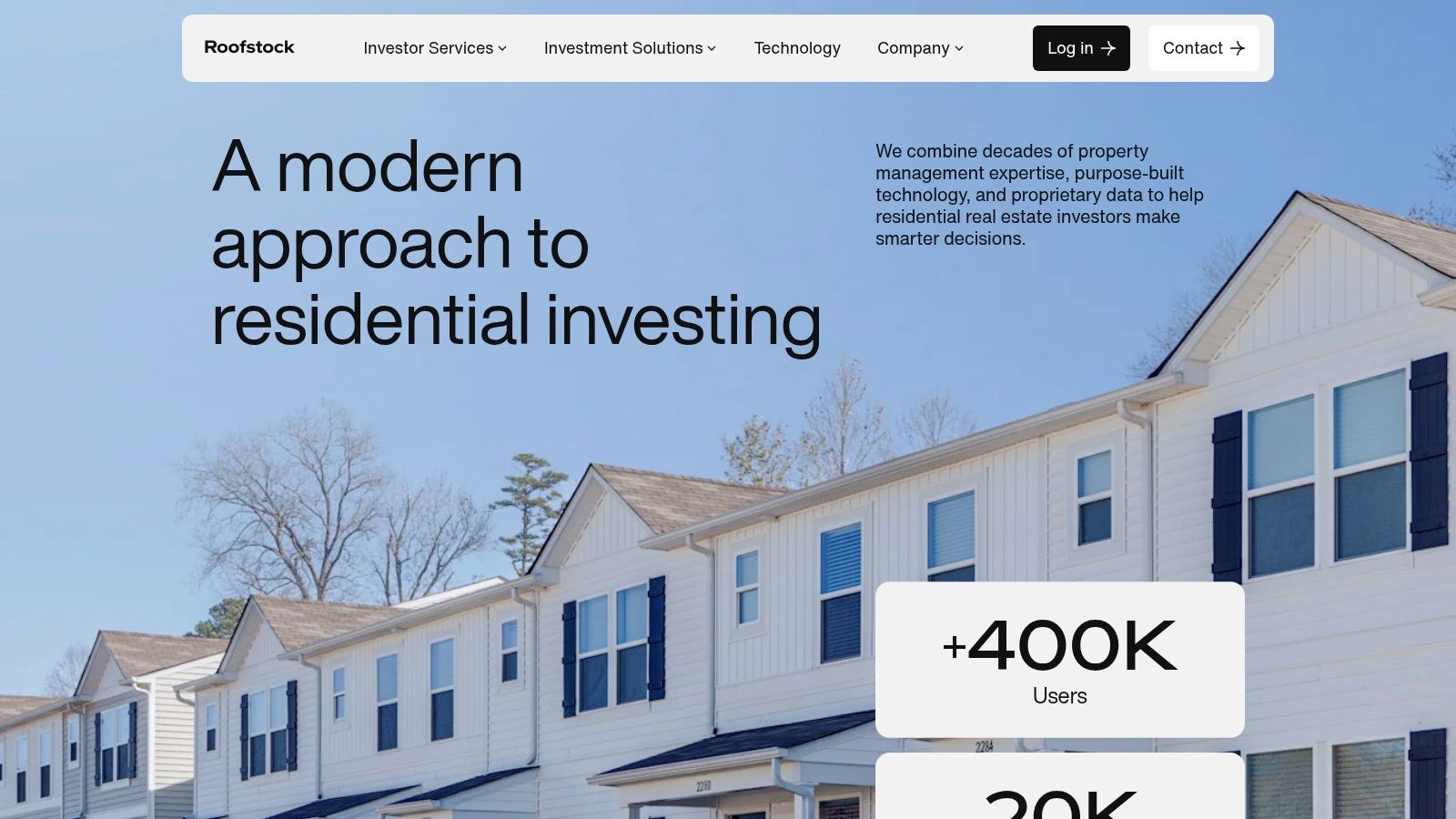
Unlike general real estate portals, Roofstock curates its inventory, providing detailed property inspection reports, tenant lease information, and financial pro formas. This upfront data helps investors underwrite deals remotely. Beyond just listings, Roofstock also connects buyers with vetted property management companies, a critical service for out-of-state investing. While their property valuation tools are strong for SFRs, investors looking at larger or more complex assets may want to review additional resources on how to value a commercial property for a broader perspective.
Key Features & Use Cases
- Best For: Buy-and-hold investors, particularly those investing long-distance or seeking immediate cash flow from single-family rentals.
- Core Offerings: Curated SFR listings with existing tenants, detailed underwriting data, access to property managers, and fractional ownership options.
- Pricing: Buyers pay a marketplace fee of 0.5% of the contract price or $500, whichever is greater. Sellers pay a 3% fee or $2,500, whichever is greater.
Pros & Cons
Pros:
- Day-One Income: Many properties come with tenants in place, eliminating initial vacancy costs.
- Transparency: Fees are clearly disclosed, and extensive due diligence materials are provided upfront.
- Investor Support: Offers educational resources through Roofstock Academy and connections to essential third-party services.
Cons:
- Niche Focus: Limited inventory for investors interested in large multifamily, commercial, or heavy value-add projects.
- Variable Market Depth: Property availability and quality can vary significantly between metropolitan areas.
- Pro Forma Validation: Buyers are still responsible for verifying all financial projections and third-party cost estimates.
Website: https://www.roofstock.com
3. LoopNet (by CoStar)
LoopNet stands as the dominant digital marketplace for commercial real estate (CRE) in the United States, making it an essential starting point for almost any commercial property search. Operated by the data giant CoStar, it offers an expansive inventory that covers every major asset class, including office, retail, industrial, multifamily, hospitality, and land. Its sheer scale means that brokers nationwide use it to list properties for sale and lease, giving investors a broad view of available assets.
This platform is primarily a discovery engine, providing robust search filters that allow users to narrow down properties by location, type, size, and price. Unlike niche investor-focused sites, LoopNet's strength is its breadth of listings and its connection to the CoStar ecosystem, which provides deep market analytics and comparable sales data, though full access often requires a paid subscription. For investors beginning their search for a commercial deal, LoopNet is one of the best platforms for real estate investor marketplaces because it offers the widest possible net for deal sourcing.
Key Features & Use Cases
- Best For: Commercial real estate investors, brokers, and developers looking for a wide selection of on-market properties across all major asset classes.
- Core Offerings: Nationwide CRE search for for-sale and for-lease properties, detailed listing information, and broker contact information.
- Pricing: Free to search and view basic listing details. Premium features for enhanced listing exposure and access to CoStar’s advanced research tools require a paid subscription, which can be costly.
Pros & Cons
Pros:
- Unmatched Volume: The largest selection of CRE listings in the U.S., offering unparalleled market reach.
- Broad Asset Coverage: Includes everything from small office buildings to large industrial warehouses and apartment complexes.
- Data-Rich Environment: Integration with CoStar provides a strong foundation for market context and property comparables.
Cons:
- Variable Listing Quality: The detail and accuracy of listings are dependent on the listing broker.
- Subscription for Deep Data: The most valuable research tools and analytics are locked behind a CoStar subscription paywall.
- Lacks Investor Analytics: The platform is not built with default tools for calculating investor-specific metrics like cap rate or IRR.
Website: https://www.loopnet.com
4. Crexi
Crexi has quickly emerged as a major commercial real estate (CRE) marketplace, offering a powerful combination of listing services, auction capabilities, and market intelligence. Investors use Crexi to find and analyze active CRE listings ranging from multifamily and office to retail and industrial properties. Its modern interface and broker-centric tools help ensure that the inventory is fresher and more detailed than what is often found on legacy platforms, making it a critical tool for sourcing active deals.
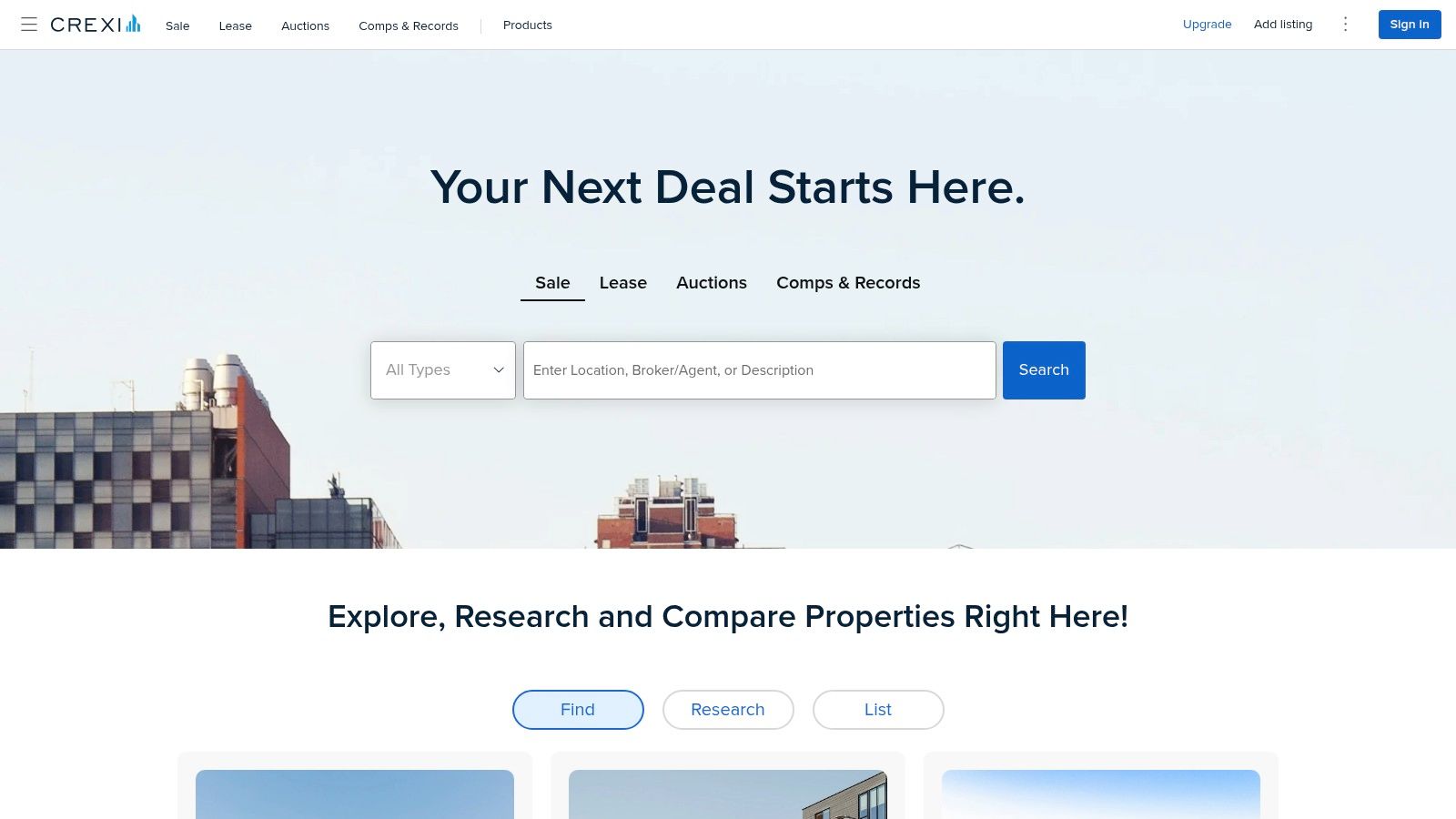
The platform distinguishes itself by integrating a free-to-browse marketplace with an optional paid intelligence suite called Crexi PRO. While anyone can search listings and connect with brokers, PRO subscribers gain access to a deeper layer of data, including sales comparables and market analytics. This tiered model makes Crexi one of the more accessible platforms for real estate investor marketplaces, allowing new investors to start sourcing deals for free while providing experienced operators the data they need for serious underwriting.
Key Features & Use Cases
- Best For: Commercial real estate investors, brokers, and syndicators seeking active listings, auction properties, and market data across all major CRE asset classes.
- Core Offerings: Free marketplace for active listings, online auctions, lead generation tools for brokers, and a paid data subscription (Crexi PRO) for sales comps and analytics.
- Pricing: Browsing listings is free. Crexi PRO pricing for buyers and brokers is customized based on market and access level, often requiring a direct sales quote.
Pros & Cons
Pros:
- Active Deal Flow: A large volume of listings is driven by broker tools that encourage frequent updates.
- Lower Barrier to Entry: The free tier offers significant value for sourcing deals without the high cost of traditional CRE data services.
- Integrated Auctions: Provides an additional channel for acquiring properties, sometimes at a discount.
Cons:
- Intelligence is Paywalled: Access to sales comps and deep market analytics requires a paid PRO subscription.
- Variable Listing Quality: Data completeness can differ depending on the broker and the specific market.
- Negotiated PRO Pricing: The cost for the PRO plan varies and is not transparently listed, requiring negotiation.
Website: https://www.crexi.com
5. Ten-X
Ten-X is a major online auction platform for commercial real estate, facilitating a high volume of transactions for assets ranging from office buildings and retail centers to multifamily properties. It serves as a vital marketplace for investors, brokers, and sellers who prioritize speed and certainty of execution. The platform’s core strength is its structured, time-bound auction process, which compresses the typical sales cycle and provides transparent price discovery through live bidding.
Unlike traditional listing sites, Ten-X standardizes the disposition workflow. Sellers prepare comprehensive due diligence materials in a secure data room before the auction begins, allowing prospective buyers to conduct their analysis upfront. The platform’s auction formats cater to different seller needs, especially for time-sensitive or unique assets. For investors comfortable with the fast-paced, limited-contingency nature of auctions, Ten-X offers access to a broad inventory of commercial properties and is a top contender among the best platforms for real estate investor marketplaces.
Key Features & Use Cases
- Best For: Commercial real estate investors, portfolio managers, and brokers seeking efficient, time-sensitive acquisitions or dispositions.
- Core Offerings: Timed online auctions, managed bid events, secure due diligence data rooms, and a standardized process for transacting commercial property.
- Pricing: A buyer's premium (transaction fee) is typically added to the winning bid, the amount of which is disclosed in the asset's due diligence documents.
Pros & Cons
Pros:
- Efficiency and Speed: The auction format significantly shortens the time from listing to closing compared to traditional sales.
- Transparency: Bidding history is often visible, providing clear price discovery during the event.
- Broad Reach: Markets assets to a national pool of investors, potentially surfacing more buyers for unique properties.
Cons:
- Auction Terms: Transactions typically come with buyer's premiums and have limited or no contingencies, requiring significant upfront diligence.
- Variable Asset Quality: The quality of due diligence materials and the seller’s reserve price strategy can vary widely.
- High-Stakes Environment: The fast-paced auction format can be challenging for newer investors or those requiring more time for analysis.
Website: https://www.ten-x.com
6. Auction.com
Auction.com is one of the largest U.S. distressed real estate marketplaces, focusing heavily on residential foreclosures, bank-owned properties (REOs), and some commercial assets. It serves as a primary source for investors targeting fix-and-flip, rental, and note strategies who are seeking discounted, as-is inventory. The platform’s main function is to facilitate online bidding for these properties, making it a critical tool for investors comfortable with the risks inherent in distressed assets.
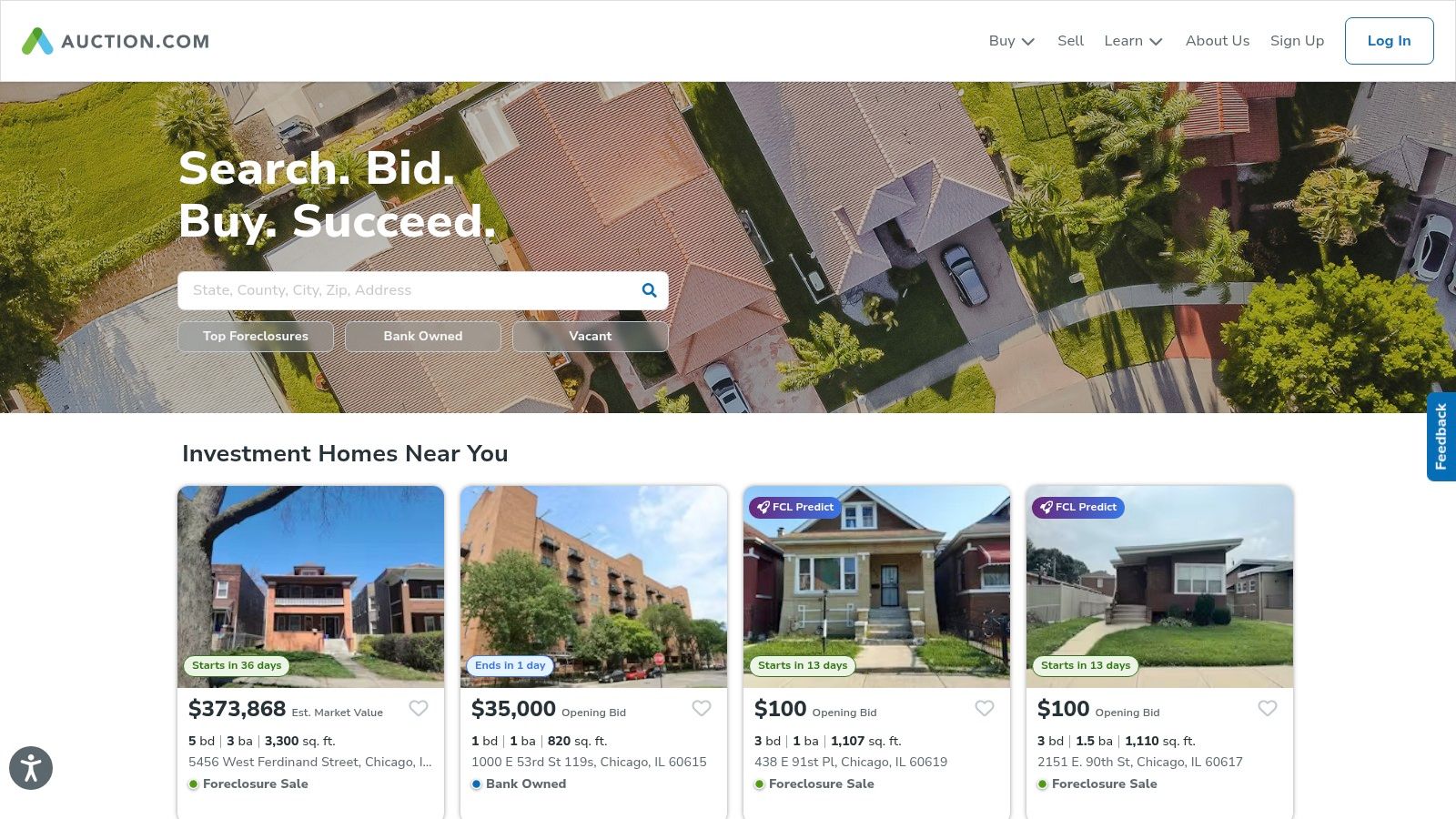
Unlike retail-focused sites, Auction.com provides a direct pipeline to properties before they hit the open market, often at a lower cost basis. It standardizes the auction process with a digital bidding interface, property detail pages, and data rooms containing available due diligence documents. This structure brings efficiency to a traditionally fragmented part of the industry. The platform's constant flow of auction events across numerous states makes it one of the more dependable platforms for real estate investor marketplaces if your strategy revolves around acquiring distressed properties.
Key Features & Use Cases
- Best For: Experienced fix-and-flippers and buy-and-hold investors comfortable with "as-is" purchases and conducting thorough off-site due diligence.
- Core Offerings: Large inventory of foreclosure and REO properties, frequent online auction events, and a standardized bidding platform.
- Pricing: A buyer's premium (often 5% of the winning bid or a minimum amount) is typically added to the purchase price. Bidders must also submit a refundable deposit to participate.
Pros & Cons
Pros:
- Consistent Deal Flow: Offers a steady pipeline of distressed opportunities directly from banks and servicers.
- Standardized Process: Online bidding workflows and data presentation are consistent across most listings.
- Potential for Discounts: Properties can often be acquired below market value, ideal for value-add strategies.
Cons:
- High Risk: Properties are sold as-is with limited inspection rights and potential title or occupancy issues.
- Ancillary Costs: Buyer premiums and required deposits can significantly impact the total capital needed for a deal.
- Requires Expertise: Successfully navigating title risks and underwriting unknowns demands significant investor experience.
Website: https://www.auction.com
7. CrowdStreet
CrowdStreet provides a gateway for accredited investors to participate in institutional-quality commercial real estate (CRE) deals that were once hard to access. The platform specializes in single-asset syndications and multi-asset funds, connecting individuals with experienced sponsors. Its key distinction is its focus on high-caliber commercial offerings, such as large multifamily complexes and industrial parks, with typical investment minimums around $25,000.

The platform’s value lies in its rigorous sponsor vetting and deal screening process, which helps filter opportunities before they are presented to investors. Each offering includes a detailed deal room with documents, financial models, and live webinars where investors can question sponsors directly. This model allows passive investors to diversify their portfolios with commercial assets without the burden of direct management. As these deals involve complex capital stacks, investors can benefit from understanding the fundamentals covered in this complete guide to real estate financing options.
Key Features & Use Cases
- Best For: Accredited investors seeking passive exposure to institutional-grade commercial real estate syndications and funds.
- Core Offerings: Vetted CRE projects and funds, direct access to sponsor-led deals, and advisory options for managed portfolios.
- Pricing: Investors do not pay fees to CrowdStreet to join or invest; sponsors pay platform fees to list their offerings.
Pros & Cons
Pros:
- Access to Quality Deals: Provides opportunities to invest alongside established sponsors in institutional-caliber projects.
- Asset Diversity: Offerings span a wide range of commercial asset classes, including multifamily, industrial, and medical office.
- Transparency: Deal rooms are thorough, and frequent sponsor Q&A webinars provide direct lines of communication.
Cons:
- Accredited Investors Only: Participation is limited to individuals who meet specific income or net worth requirements.
- Illiquid Investments: These are private placements with long hold periods and no easy exit option.
- Sponsor Risk: Despite vetting, investment performance is tied to sponsor execution, and diligence is crucial.
Website: https://www.crowdstreet.com
8. RealtyMogul
RealtyMogul bridges the gap between passive and active real estate investing, offering opportunities for both accredited and non-accredited investors. The platform provides access to professionally managed commercial real estate (CRE) deals, ranging from large-scale multifamily and office buildings to retail centers. Its main appeal lies in its hybrid model, featuring public, non-traded REITs with low investment minimums alongside private placements for those who qualify and seek direct positions in specific assets. This dual approach makes it one of the more accessible real estate investor marketplaces for building a diversified CRE portfolio.
Unlike platforms focused on wholesaling or flipping, RealtyMogul curates institutional-quality investments sponsored by vetted real estate companies. For each deal, it provides centralized access to diligence materials and sponsor information. Post-investment, the platform offers a clean investor dashboard for tracking performance and accessing tax documents. This removes many administrative burdens, though it's important to remember that sponsors are ultimately responsible for execution; for a deeper dive into operations, review this ultimate guide to property management to understand what's involved.
Key Features & Use Cases
- Best For: Investors seeking passive exposure to commercial real estate, including non-accredited individuals wanting a REIT-based option.
- Core Offerings: Two public, non-traded REITs, private placements in individual properties for accredited investors, and a centralized dashboard for portfolio management.
- Pricing: No platform fees for investors to join and browse. Fees are deal-specific, typically ranging from 1-2% for asset management and other sponsor-level charges, which are disclosed in the offering documents.
Pros & Cons
Pros:
- Accessible to All Investors: Non-accredited investors can participate through their two REIT offerings.
- Asset Diversity: Provides access to various CRE asset classes like multifamily, office, and retail.
- Transparency: Offers clear disclosures on fees, sponsor track records, and ongoing investment reporting.
Cons:
- Limited Direct Control: Investors rely on the sponsor's expertise and management for deal performance.
- Illiquidity: Investments in both REITs and private placements are long-term and lack easy liquidation options.
- Fees Can Impact Returns: Multiple layers of fees (platform, sponsor, asset management) are standard and must be factored into net return calculations.
Website: https://www.realtymogul.com
9. New Western
New Western is a national investment property marketplace with a sharp focus on providing wholesale and off-market residential deals to fix-and-flip and BRRRR investors. BRRRR stands for Buy, Rehab, Rent, Refinance, Repeat—a popular strategy for building a rental portfolio. It operates by having local acquisition teams who source discounted properties not typically found on the MLS. This model provides a consistent pipeline of opportunities for investors looking for their next renovation project, making it a key destination among the best platforms for real estate investor marketplaces.
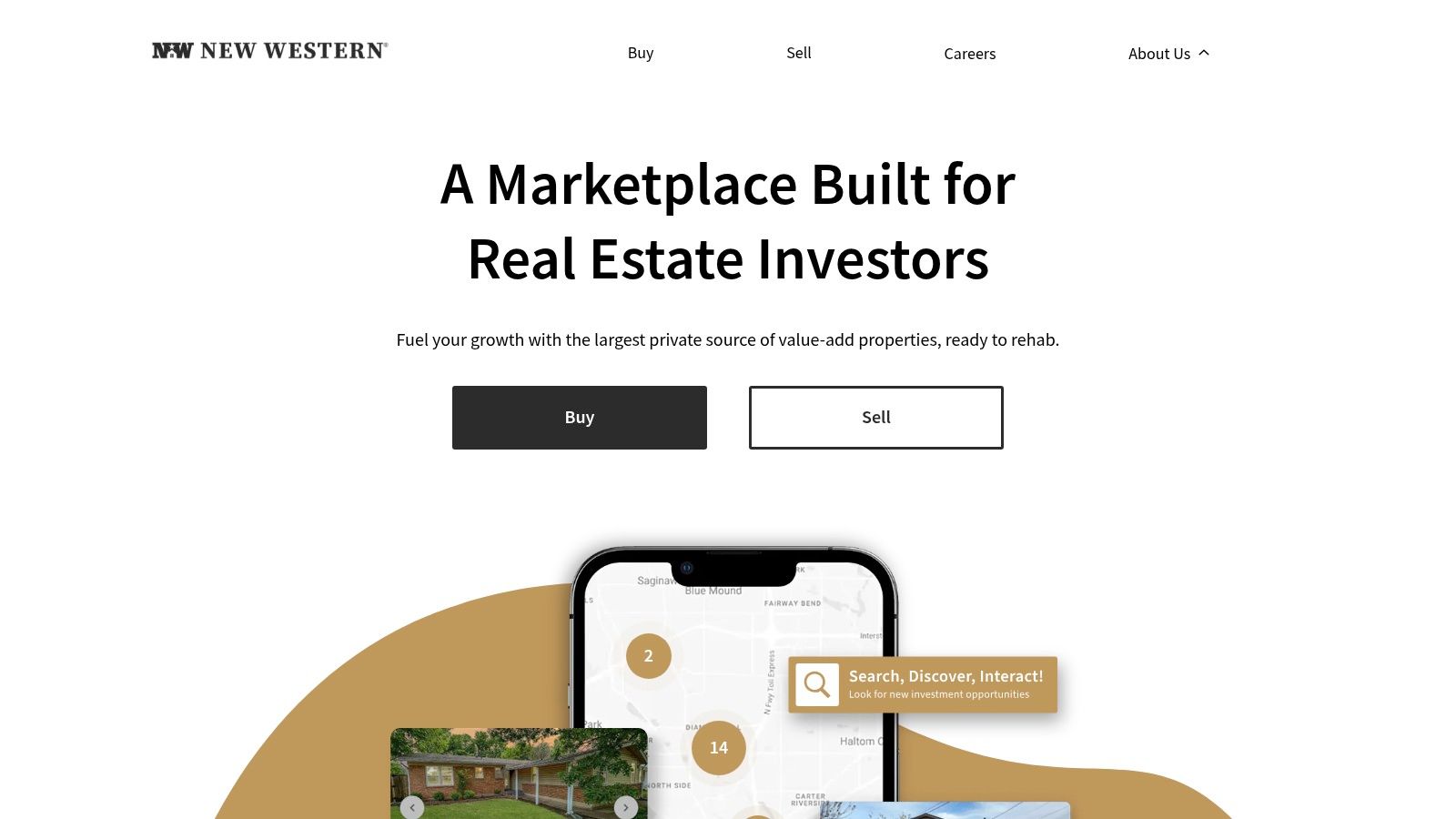
The platform’s distinct advantage is its human-in-the-loop approach. Investors are connected with a local New Western agent who understands the area and can help evaluate comparable sales and potential rehab scope. This ground-level support is especially useful for those investing in new markets. The process is built for speed, with streamlined offer and assignment workflows that allow investors to secure properties much faster than through traditional channels.
Key Features & Use Cases
- Best For: Fix-and-flip and BRRRR investors who need a reliable source of off-market, value-add properties.
- Core Offerings: Curated inventory of distressed and wholesale properties, local agent support for comping and rehab analysis, and a simplified transaction process.
- Pricing: New Western’s compensation comes from an assignment fee or a double closing, which is built into the final purchase price. These fees are not itemized separately for the buyer but affect the overall deal spread.
Pros & Cons
Pros:
- Consistent Deal Flow: Provides a steady stream of rehab-friendly properties sourced directly from sellers.
- Local Market Expertise: Agents offer valuable on-the-ground support and comping assistance.
- Faster Timelines: Transactions are structured to close quickly, bypassing many typical MLS delays.
Cons:
- Built-in Transaction Fees: The assignment fee model reduces the investor’s net profit margin.
- Significant Rehab Needs: Many properties require substantial work, introducing uncertainty in budget and scope.
- Variable Inventory: Deal availability and quality can fluctuate significantly by market.
Website: https://www.newwestern.com
10. Brevitas
Brevitas operates as a private commercial real estate (CRE) marketplace, connecting brokers, sponsors, and qualified investors. It distinguishes itself by focusing heavily on controlled access, offering both on-market and off-market listings with robust confidentiality tools. This makes it an ideal environment for syndicators and brokers looking to discreetly market deals or build an investor list without broadcasting sensitive information to the public. The platform is designed for professionals who need more than just a public listing service.
Unlike mainstream CRE portals, Brevitas provides a suite of marketing and lead management tools. Brokers and deal sponsors can create private deal rooms, track interested parties, and manage the entire outreach process within the platform. This workflow-oriented approach is valuable for managing a compliant and organized capital raise or disposition. For investors, Brevitas provides access to exclusive deal flow that often isn't available on larger, public-facing sites, making it one of the better platforms for real estate investor marketplaces focused on private CRE.
Key Features & Use Cases
- Best For: CRE brokers, syndicators, and private capital investors looking for exclusive off-market opportunities.
- Core Offerings: Private and public CRE listings, secure deal rooms, lead management dashboards, and marketing analytics for deal sponsors.
- Pricing: Basic access for investors is free. Brokers and sponsors pay for membership tiers (Pro, Teams, Enterprise) to unlock advanced marketing, exposure, and analytics features.
Pros & Cons
Pros:
- Off-Market Focus: Excellent for accessing deals with controlled confidentiality and for brokers needing to execute a private marketing process.
- Sponsor Marketing Tools: Provides brokers and syndicators with analytics and lead tracking beyond what simple listing sites offer.
- Professional Network: Fosters connections between serious, vetted CRE professionals and investors.
Cons:
- Smaller Inventory Scale: The number of listings is significantly smaller than that of giants like LoopNet or Crexi.
- Membership for Full Functionality: Key features for brokers and sponsors are locked behind paid membership plans.
- Listing Quality is Sponsor-Dependent: The depth and accuracy of deal information rely heavily on the broker or sponsor providing it.
Website: https://brevitas.com
11. Land.com Network (LandWatch, Land And Farm, Lands of America)
The Land.com Network is an essential resource for investors specializing in land acquisition, consolidating three of the largest land marketplaces: LandWatch, Land And Farm, and Lands of America. This network serves as a primary discovery engine for rural, recreational, farm, ranch, and development parcels across the United States. Its strength lies in aggregating massive buyer and seller traffic into one ecosystem, making it one of the best platforms for real estate investor marketplaces focused purely on acreage.

Unlike platforms geared toward buildings, the Land.com Network’s inventory is all about the dirt itself. It offers powerful filters for acreage, location, price, and specific land uses like hunting, timber, or waterfront. For land developers, it's a critical tool for sourcing large tracts and researching comparables at the county level. While the platform excels at discovery, investors must conduct their own thorough diligence, as the quality of information regarding utilities, access, and zoning can vary significantly between individual listings.
Key Features & Use Cases
- Best For: Land developers, subdividers, and buy-and-hold investors focused on raw land, ranches, farms, or recreational acreage.
- Core Offerings: Aggregated listings from three major land sites, robust search filters for land-specific attributes, and direct contact with brokers and owners.
- Pricing: Free for buyers to search and contact sellers. Sellers and brokers pay for listing packages, with pricing based on exposure and features.
Pros & Cons
Pros:
- Unmatched Reach: Offers the largest combined audience and inventory for U.S. land sales.
- Strong Comparables: A valuable tool for establishing land comps and pricing trends at a local level.
- Active Marketplace: Listings are frequently updated, with high participation from brokers and landowners.
Cons:
- Inconsistent Data: Listing details on utilities, financing, and surveys can be incomplete or missing.
- Variable Disclosure: The quality of information and seller transparency differs greatly from one listing to another.
- Limited Due Diligence Tools: Buyers are responsible for sourcing their own surveys, zoning reports, and feasibility studies.
Website: https://network.land.com
12. Sundae
Sundae operates a two-sided marketplace designed to connect sellers of distressed or dated properties with a network of qualified real estate investors. It carves out a specific niche by focusing on homes sold as-is, often requiring significant repairs. This provides a direct channel for fix-and-flip investors and wholesalers to find off-market deals without the intense competition of the MLS, making it one of the more focused platforms for real estate investor marketplaces.
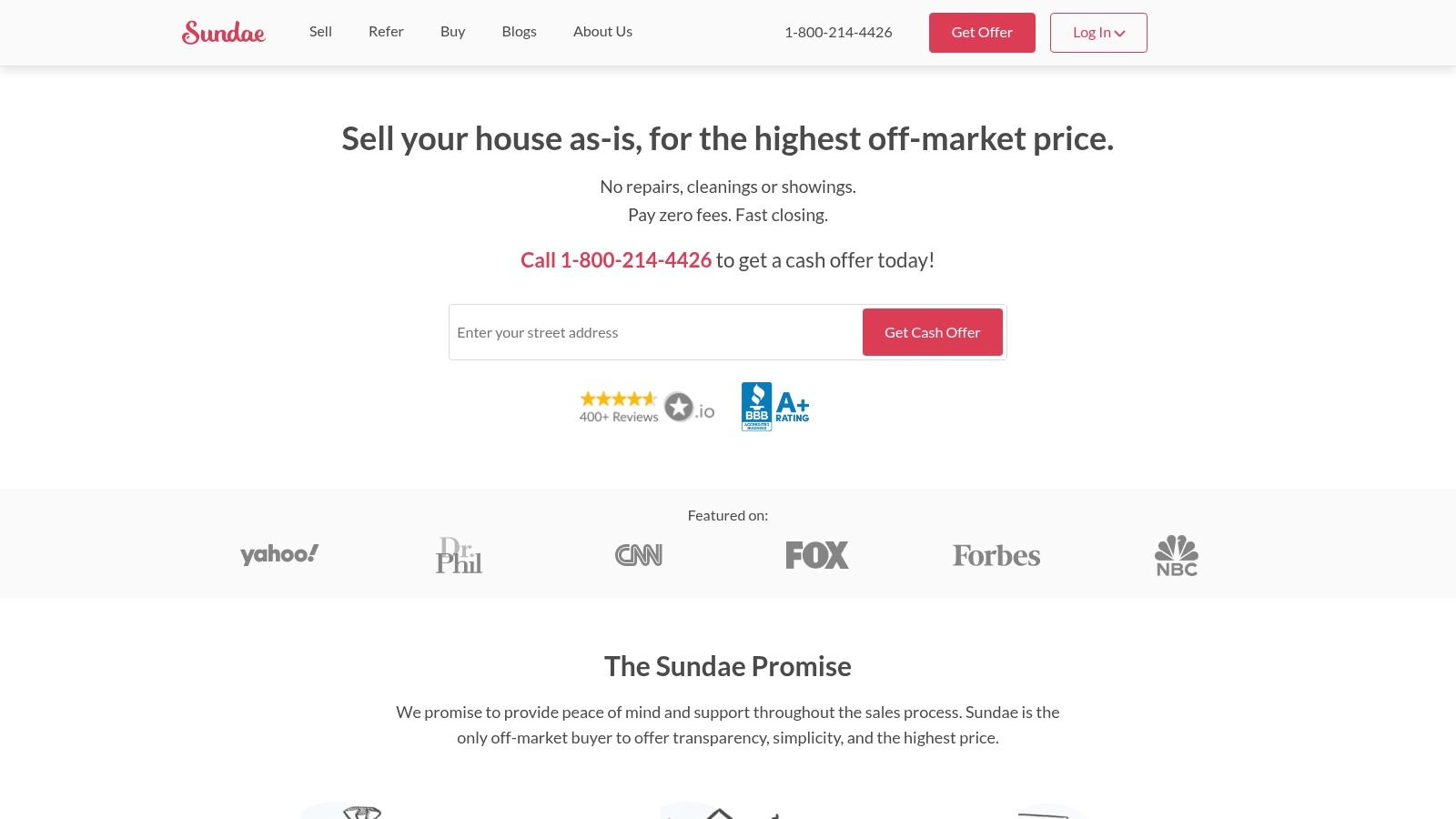
The platform’s core function is to streamline the acquisition process for rehab-suitable properties. Sellers are offered a simple way to list their home, and Sundae prepares a property profile that often includes photos, 3D tours, and sometimes even inspection reports. Investors in their network then participate in a managed bidding process, creating an auction-like environment. This structured approach provides a more standardized workflow compared to sourcing deals directly from wholesalers, giving investors a centralized place to find their next project.
Key Features & Use Cases
- Best For: Fix-and-flip investors, BRRRR strategists, and wholesalers looking for a consistent source of off-MLS, value-add residential properties.
- Core Offerings: A managed marketplace for as-is homes, investor bidding system, verified property information, and a network of local investors.
- Pricing: Investors pay a buyer's premium on winning bids, which is added to the final purchase price. Specific premium amounts are disclosed on each property listing.
Pros & Cons
Pros:
- Direct Off-MLS Access: Provides a flow of distressed properties that are not publicly listed, reducing competition.
- Standardized Information: Deal packages are more consistent than typical wholesale deals, saving initial due diligence time.
- Faster Timelines: The managed process can accelerate the timeline from discovery to closing for flippers on a schedule.
Cons:
- Added Costs: The buyer's premium and other administrative fees cut into potential profit margins.
- Geographic Limitations: Service is only available in select metropolitan areas, limiting its reach for many investors.
- Investor Competition: While off-MLS, you are still bidding against other vetted investors on the platform.
Website: https://sundae.com
Top 12 Real Estate Investor Marketplaces Comparison
| Platform | Core Focus & Asset Types | Key Features / USP | UX & Analytics | Target Audience | Pricing / Value |
|---|---|---|---|---|---|
| Investor Deal Exchange 🏆 | Deal-first marketplace: SFR, MF, Land, Other ✨ | Smart Buy Boxes; built-in ROI/Cap/CoC calculators; Deal Pipeline ✨ | ★★★★★; 500+ investors, 2.4k listings, $85M+ volume | 👥 SFR buyers, MF syndicators, land devs, wholesalers, flippers | 💰 Free sign-up; advanced tiers via contact |
| Roofstock | Single-family rentals & small MF (turnkey/occupied) | Turnkey / rent-ready listings; property mgmt access; fractional SFR | ★★★★☆; strong underwriting tools | 👥 Buy-and-hold SFR investors | 💰 Transparent buyer/seller fees |
| LoopNet (CoStar) | Broad commercial CRE: office, retail, industrial, MF, land | Nationwide CRE exposure; CoStar comparables & data integration | ★★★★★; unmatched reach; some features behind CoStar | 👥 Brokers, institutional & CRE investors | 💰 Free browsing; paid CoStar/featured options |
| Crexi | Commercial marketplace + broker toolkit | Listings, auctions, buyer analytics; Crexi PRO intelligence ✨ | ★★★★☆; alerts & comps with PRO | 👥 Active investors, brokers, acquirers | 💰 Free tier; PRO paid (ZIP-based) |
| Ten-X | Online auctions for commercial dispositions | Timed auctions; diligence data rooms; transparent bid history | ★★★★☆; fast price discovery for time-sensitive sales | 👥 Opportunistic buyers, asset managers, brokers | 💰 Auction buyer premiums; variable terms |
| Auction.com | Distressed residential (foreclosure/REO) | Large foreclosure/REO inventory; online bidding workflows | ★★★☆☆; steady pipeline; as-is risk | 👥 Flippers, rehab investors, discount buyers | 💰 Deposits required; buyer premiums |
| CrowdStreet | Institutional-style CRE syndications (accredited) | Sponsor vetting; deal rooms; $25k+ typical minimums | ★★★★☆; institutional deals, sponsor Q&A | 👥 Accredited investors seeking syndications | 💰 Min ~$25k; sponsor & platform fees |
| RealtyMogul | REITs + private placements (equity & debt) | Public non-traded REITs (non-accredited) + private deals; reporting | ★★★★☆; dashboards & tax reporting (K-1/1099) | 👥 Accredited & non-accredited investors | 💰 REIT fees; private deal fees; min varies |
| New Western | Off-market wholesale residential (rehab/BRRRR) | Curated off-market inventory; local acquisition teams | ★★★☆☆; fast timelines; assignment workflows | 👥 Flippers, BRRRR investors, wholesalers | 💰 Assignment/transaction fees apply |
| Brevitas | Private/off-market CRE listings & marketing | Confidential listings; membership for featured exposure ✨ | ★★★☆☆; niche, broker-driven inventory | 👥 Brokers, syndicators, investors seeking private deals | 💰 Membership tiers for marketing/features |
| Land.com Network | Land-focused (LandWatch, Land And Farm, Lands of America) | Aggregated land listings; filters by acreage/use; wide reach | ★★★★☆; best reach for rural/recreational farmland | 👥 Land buyers, developers, ranch/farm buyers | 💰 Listing promotion fees; browsing free |
| Sundae | As‑is homes marketplace & investor bidding | Seller-prepped as-is listings; managed bidding; inspections | ★★★☆☆; standardized as‑is workflow; metro-dependent | 👥 Flippers, rehab investors, local buyers | 💰 Buyer premiums & admin fees |
Upgrade Your Deal Flow Today
The era of sifting through scattered, unreliable listings to find your next investment is over. The platforms we've explored prove that technology has created a more direct, data-rich path to acquiring property. The central lesson is clear: relying on a dedicated investor marketplace is no longer a luxury, but a fundamental component of a modern, scalable real estate business. These tools offer more than just listings; they provide a system for deal flow management, data-backed analysis, and crucial network connections.
Making the move from fragmented, manual sourcing methods to a centralized platform is a significant operational upgrade. It allows you to define your investment thesis with precision, using a "buy box" to filter out the noise and focus only on properties that meet your specific criteria. This is the core advantage offered by the best platforms for real estate investor marketplaces. Instead of spending 80% of your time searching and 20% analyzing, you can flip that ratio, dedicating your energy to underwriting quality opportunities.
Choosing Your Platform: A Strategic Decision
As our review has shown, there is no single "best" platform for every investor. The right choice depends entirely on your strategy, experience level, and the types of assets you target.
- For the New Investor or Wholesaler: Your primary need is access and speed. Platforms like New Western or our own Investor Deal Exchange are built to connect you directly with motivated sellers or pre-vetted buyers. On our marketplace, you can post your wholesale deal to reach investors actively looking for this property type.
- For the Small Multifamily and BRRRR Investor: You need a mix of on-market and off-market deals with solid data. Roofstock excels with its turnkey rental data, while other marketplaces can surface value-add opportunities that fit the Buy, Rehab, Rent, Refinance, Repeat model. Look for tools with strong neighborhood analytics and rent comparables.
- For the Commercial and Syndication Specialist: Your world revolves around detailed financials, tenant rolls, and market demographics. Crexi, LoopNet, and Brevitas are your go-to resources. Your focus should be on the depth of the due diligence documents provided and the quality of the broker relationships facilitated.
- For the Niche Specialist (Land, Distressed Assets): If you focus on a unique asset class, a specialized platform is non-negotiable. The Land.com Network is indispensable for land investors, while Sundae and Auction.com provide direct access to the distressed properties that others overlook.
Regardless of your focus, commit to mastering the platform. Set up your investor profile or buy box with meticulous detail. The more specific you are, the better the algorithm can work for you, serving up deals that match your goals. Engage with the community features, message other investors, and build your presence. The most successful investors use these platforms not just as a search engine, but as a networking and reputation-building tool.
Ultimately, integrating one of these top real estate investor marketplaces into your operations is about gaining a competitive edge. It’s about making smarter, faster decisions backed by real-time data and connecting with the right people to close deals. The opportunities are there, and with the right digital toolkit, you are better equipped than ever to find and fund them.
Ready to stop searching and start closing? Investor Deal Exchange was built to directly connect wholesalers, flippers, and buy-and-hold investors in a transparent marketplace. Create your free investor profile on Investor Deal Exchange today to get matched with deals that fit your criteria.